OriginsAnswer
Why is it so hard to test ideas about what happened before the hot Big Bang?
An earlier history needs a calculable path to a measurement that separates it from competing explanations.
THE QUESTION LIBRARY ORIGINS
Several serious ideas in physics allow other universes, so here is what each one says, how scientists have tried to test them, and how a scientific braneworld differs from the multiverse in the movies.
Nobody knows yet. Several serious ideas in physics allow other universes: regions of space far beyond what we can see, bubble universes from cosmic inflation, the many worlds of one reading of quantum physics, and sheet-like universes in extra dimensions. None has been observed. A 2011 search of the Big Bang’s afterglow for scars from other bubble universes found no evidence for them. Scientists still argue about whether most multiverse ideas can ever be tested.
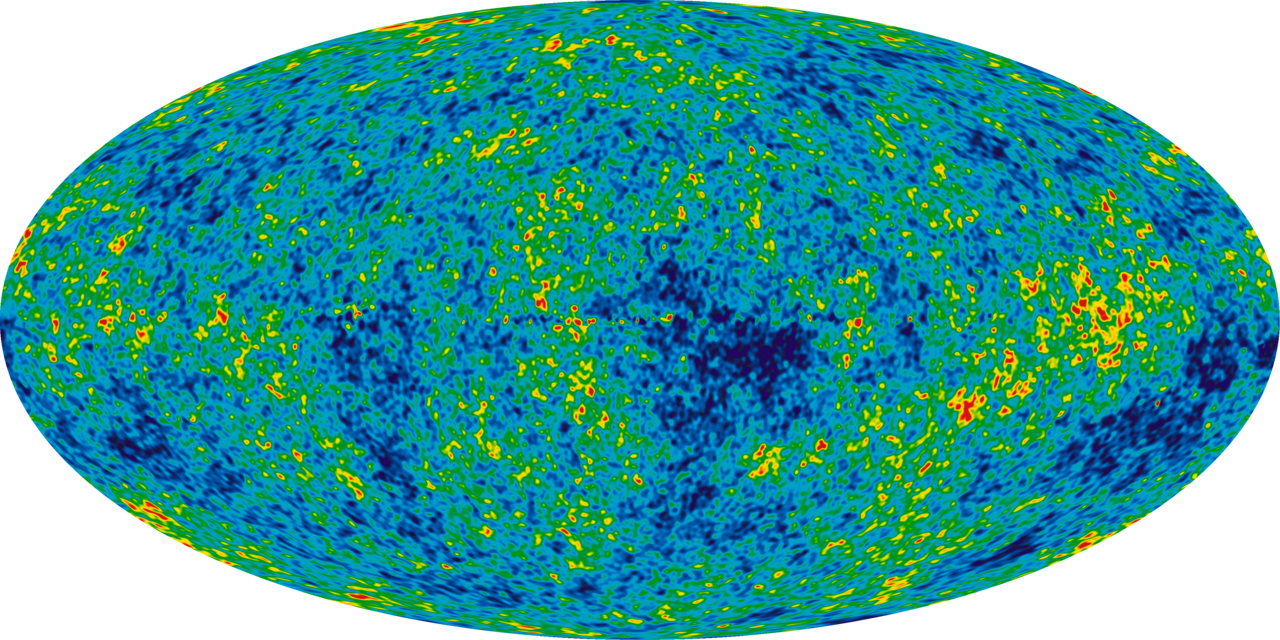
The whole sky in microwaves, from nine years of NASA WMAP data. The colors show tiny temperature differences in the Big Bang’s afterglow. A 2011 study searched earlier WMAP data for round scars from other bubble universes and found no evidence for them.
WHERE THE EVIDENCE STANDS
WHAT WE DON’T KNOW YET
Nobody knows whether any other universe exists, or whether space goes on forever. Nobody knows how to count probabilities across an infinite multiverse, which some physicists see as the key barrier to testing it. Whether the many worlds of quantum physics are real is still debated.
WHAT WOULD CHANGE THIS ANSWER
A clear, repeatable mark in the Big Bang’s afterglow that only a collision with another bubble universe could explain would change this answer. So would collider evidence for extra dimensions. Evidence for a physical process that collapses quantum possibilities into one outcome would count against many worlds.
Nobody knows yet. Other universes have never been observed. But this is not only a movie idea. Several serious theories in physics allow other universes, and some scientists think one or more of them may be real. Others doubt the idea can ever be tested.
People ask for many reasons. Movies and TV shows have made the multiverse familiar. Some readers want to know if there is another version of them somewhere. Others have heard that many universes could explain why our universe seems fine-tuned for life. And some simply wonder whether everything we see is all there is.
It helps to know that “other universes” means different things to different scientists. Max Tegmark sorts the ideas into four levels.
Far-off space. If space goes on far enough, there are regions so distant that their light has not had time to reach us. Some call these other universes, though they share our laws.
Bubble universes. In one version of cosmic inflation, a burst of very fast expansion at the start, the expansion never stops everywhere. It keeps making new “pocket” universes, which might have different constants of nature.
Many worlds. In one reading of quantum physics, every possible outcome of a quantum event happens, each in its own world.
Other mathematics. Tegmark’s boldest level imagines universes with entirely different laws of physics.
There is also the braneworld, a model in which our universe is like a thin sheet floating in a larger space with extra dimensions. It is a mathematical idea with possible tests, not a portal to a copy of Earth.
So the plain picture is this. Other universes are allowed by some serious theories. No evidence yet shows that any exist. And scientists still argue about whether most of these ideas can be tested.
Free long answer 1 of 3 this month.
In a 2003 survey, Max Tegmark laid out the four levels described above. He argued that the key question is not whether parallel universes exist but how many levels there are. In his view, the first level, distant regions of our own space, is uncontroversial in the standard picture of cosmology. He also argued that the higher levels face a severe “measure problem” before they can make testable predictions. Others are more cautious, including the authors of the Stanford Encyclopedia’s cosmology entry, discussed next.
Level one depends on how big space is. The part we can see is limited, because light has had only so much time to travel. Whether space beyond it goes on forever is unknown. Our answer Is the universe infinite? explains why. Tegmark argues that if space is infinite in this way, there would even be an identical copy of you, unimaginably far away.
Cosmic inflation proposes a brief burst of very fast expansion in the universe’s first instant. The Stanford Encyclopedia’s fine-tuning entry notes that its strongest support is widely believed to come from its apparently correct predictions for the pattern in the Big Bang’s afterglow. For more on that instant, see What Happened in the First Second After the Big Bang?
The Stanford Encyclopedia’s cosmology entry, by Christopher Smeenk and George Ellis, explains that many cosmologists argue for a version called eternal inflation. In some regions inflation stops, forming “pocket” universes. In others it goes on. Supporters argue that we should accept the multiverse the way we accept many things we cannot see directly: as an unavoidable consequence of an established physical theory.
The same entry lists strong doubts. Not every inflation model leads to eternal inflation, arguably including the models the afterglow data favor, and the accounts of how it happens rely on speculative physics. The idea that each pocket gets different constants is an assumption, not yet backed by a well-tested theory. And Alan Guth, as the entry quotes him, said that in eternal inflation “anything that can happen will happen.” If everything happens somewhere, the entry warns, then any observation fits the theory.
Scientists have tried. One idea is that a neighboring bubble might once have bumped into ours, leaving a round scar in the cosmic microwave background, the faint afterglow of the Big Bang. In 2011, Stephen Feeney and three colleagues searched seven years of data from NASA’s WMAP satellite. They found that the data did not call for bubble collisions. They set a limit, at a 68% confidence level: fewer than 1.6 detectable collisions on the whole sky, on average. They added that data from the Planck satellite could test the idea more fully.
A missing scar does not rule out the multiverse. The Stanford Encyclopedia notes that the theory does not always predict scars; a collision that happened too early would be erased.
The second approach is to predict the constants of nature. In 1987, Steven Weinberg reasoned about which values of the energy of empty space would still let galaxies form, in a multiverse where that value varies. According to the Stanford Encyclopedia, it is the most widely cited evidence for a multiverse, and some advocates see its success as the most compelling evidence. Others point to rival explanations for the same value.
The strongest objection. The Stanford Encyclopedia notes the unease many feel about multiverse ideas, and the “measure problem”: nobody agrees how to count probabilities across the ensemble. In 2014, George Ellis and Joe Silk argued in Nature that attempts to exempt speculative theories of the universe from experimental verification undermine science. Supporters reply, as the Stanford Encyclopedia puts their case, that we accept many things we cannot see directly when they follow from an established theory. The debate continues.
The many-worlds interpretation, going back to Everett in 1957, says that every possible outcome of a quantum measurement really happens, each in a different world. We see only one.
Supporters like it mainly because it avoids the sudden “collapse” to one outcome that other readings need. On this view, there are many versions of you in different worlds. In the Stanford Encyclopedia’s words, it allows nature to avoid “playing dice.” (For Einstein’s famous doubt about dice, see Did Einstein lose his argument that God does not play dice?)
Can it be tested? The entry says a decisive test would need interference between states of a large, everyday-sized object, which is far beyond today’s technology. Some rival theories that make the wave collapse have been tested, and some versions were ruled out, but not all. Realistic experiments, the entry adds, cannot tell many worlds apart from Bohmian mechanics, a reading with a single world. The entry’s author, Lev Vaidman, argues that the burden of proof lies with opponents, since collapse would be new physics beyond the well-tested equations of quantum theory.
In films, other universes usually hold other versions of people you can visit. A scientific braneworld is a different kind of idea. In a 1999 paper, Lisa Randall and Raman Sundrum studied a single three-dimensional brane, or sheet, inside a space with five dimensions. They showed that ordinary gravity could still come out right.
Other physicists went further. The ekpyrotic model of Justin Khoury and colleagues proposed that the hot Big Bang came from a brane colliding with another boundary in the larger space. They pointed to a way to tell it apart from inflation, using its pattern of gravitational waves, ripples in space itself.
CERN explains how experiments at the Large Hadron Collider look for signs of extra dimensions: heavier copies of known particles, energy that goes missing, or tiny black holes. So the difference is this. A scientific braneworld comes with equations and tests about gravity, particles and ripples in space. None of these papers is about traveling to another world.
“Scientists have found other universes.” They have not. No observation so far has shown one.
“The multiverse is pure science fiction.” Several versions grow out of serious theories, and some have been put to real tests with real data.
“A multiverse settles the God question.” Many see it as the main rival to design as an answer to fine-tuning. But as our page Is the universe fine-tuned for life? explains, critics such as Ian Hacking argue that inferring other universes from our lucky one is a mistake. For the design side, see What are the main arguments for God’s existence?
“Other universes would have different physics.” Not always. Tegmark’s first level shares our laws. For the hope of one theory behind all laws, see What is a theory of everything?
The answer stays the same after all this detail. Other universes are allowed by several serious theories, none has been observed, and whether most of them can be tested is still debated.
THREE THINGS TO REMEMBER
WHERE THE AUTHOR’S RESEARCH TOUCHES THIS
Author’s hypothesis. Ricardo Maldonado, author of GOD PLAYS DICE, uses a braneworld-style picture as a possible stage for his idea. His HD-Blast idea asks whether the hot, dense start of our universe was the local aftermath of a short burst of energy in a larger space with more dimensions than we can see. No one has observed such an event, and the idea does not yet say what caused it. In Chapter 8, the book notes that in some braneworld pictures our universe is one brane among others. It sketches a brane collision as one of three broad kinds of possible event, and says none of the three is a completed model yet.
The book is careful about limits. It says extra dimensions and branes are serious mathematical research programs, but none has been shown to exist by experiment. HD-Blast does not claim that a higher-dimensional blast happened. To make the idea testable, the book fixes one clue: its benchmark curve says the slow hum of gravitational waves should bend, like a knee, at about one cycle per year. Its public status, as of 29 September 2026, is a frozen benchmark waiting for later independent pulsar-timing data. No test of the frozen curve against later, independent pulsar-timing data has been published. See What is the HD-Blast hypothesis?, the research notebook page and the test ledger.
Is the universe fine-tuned for life?
Many physicists say yes, in a limited sense: life as we know it seems to depend on some numbers of nature falling in narrow ranges.
God Plays Dice answers big questions in plain words, with sources and one of six honest labels.
See a mistake? Report a problem. Corrections are made openly.
CONTINUE THE THREAD
OriginsAnswer
An earlier history needs a calculable path to a measurement that separates it from competing explanations.
OriginsAnswer
Many physicists say life depends on a few numbers of nature falling in narrow ranges, so here is what that means, why 137 is famous, and how design, many universes and luck each try to explain it.
OriginsAnswer
Cosmic expansion means distances between faraway galaxies grow; it does not require a wall, an edge, or a room beyond space.
The Architect AI companion · All Access
Labels describe the evidence for a claim, not the people who hold it.
Match my phone uses your device’s light or dark setting.