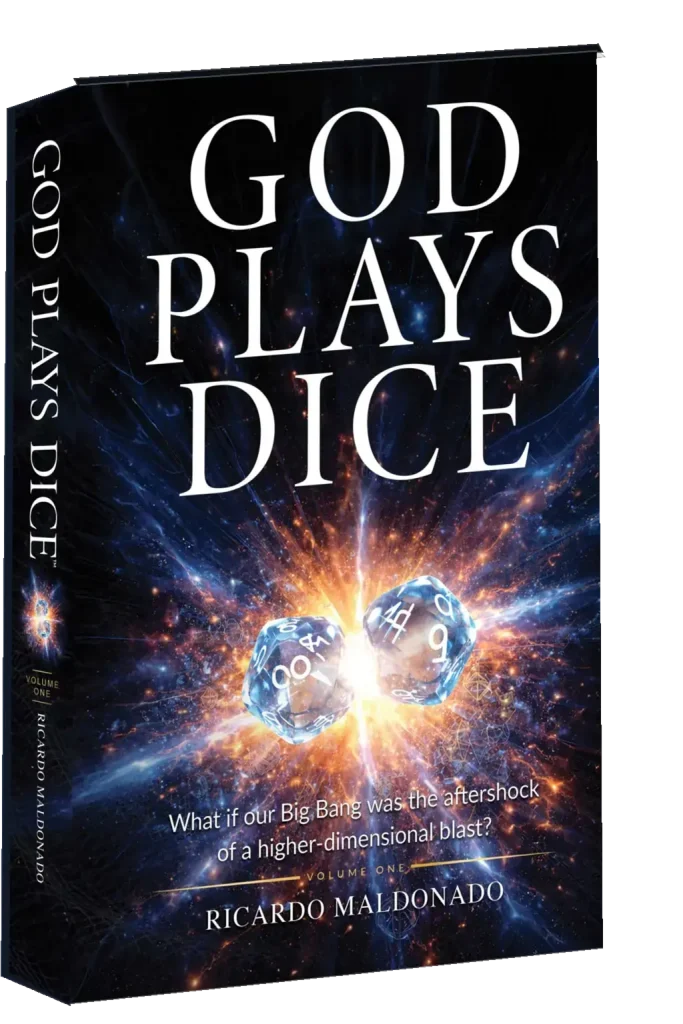
Hardcover mockup of GOD PLAYS DICE™ Volume One by Ricardo Maldonado

Drag horizontally, use the arrow keys, or choose a view below. This is a visual mockup; final manufacturing details may differ.

Front cover view.

GOD PLAYS DICE™ • VOLUME ONE • IN PRODUCTION

What if the Big Bang wasn’t the beginning?

What if our Big Bang was the aftershock of a higher-dimensional blast? A bold, testable cosmological hypothesis explained for readers without a science background.

No equations required. Written for readers with no science background — if you can wonder, you can read it.

The first edition is in production. Verified retailer links will appear here when available.

FROM THE UPDATED BACK COVER

What if the Big Bang wasn’t the beginning?

For a century, Einstein’s unease with randomness has haunted modern physics. But what if the first throw of the cosmic dice happened outside our universe—and our Big Bang was only the aftermath?

GOD PLAYS DICE™ begins where wonder must face evidence.

Listening to the universe

By listening rather than looking, Maldonado explores a bold but falsifiable possibility: our early universe may have been the local aftermath of a brief higher-dimensional blast. He puts a specific target on the table—a bend in the faint gravitational-wave hum probed by pulsar timing arrays. This is a hypothesis, not a discovery claim.

No equations required

For anyone who has ever lost sleep staring at the night sky and refused to accept “that’s just how it is,” this is the story of an impossible-sounding question, the evidence that could support it, and the tests that could rule this version out.

If the idea survives as better data arrive, our origin story may change. If it fails, the test will still have taught us something real. Either way, the dice are already rolling.

1926 → 2026 • A COINCIDENCE ACROSS A CENTURY

A century after Einstein’s dice remark.

On December 4, 1926, Albert Einstein wrote to physicist Max Born about the new quantum mechanics and added the remark later popularized as “God does not play dice.” God Plays Dice arrives in 2026, the centennial year of that letter.

Einstein was discussing quantum indeterminacy—not cosmology, the Big Bang, or higher dimensions. This book deliberately carries his metaphor into a different, falsifiable question about cosmic origins: one the universe can grade.

Read the dated Einstein–Born letter and authoritative English translation ↗

ABOUT THE BOOK

A personal journey. An evidence scorecard. A proposal allowed to fail.

What if our Big Bang was not the beginning? In God Plays Dice, writer and independent researcher Ricardo Maldonado explores a bold but falsifiable possibility: our hot, dense early universe may have been the local aftermath of a brief higher-dimensional blast. To make the idea testable, he puts a specific target on the table: a bend in the faint gravitational-wave hum probed by pulsar timing arrays.

Maldonado is not a physicist. He follows a question that refused to leave him alone—and refuses to protect the idea from failure.

This is a hypothesis, not a discovery claim. The book distinguishes its testable benchmark from a still-unfinished physical mechanism, explains what its exploratory screens can and cannot establish, and identifies the observations that could rule out the version tested here. From pulsars and gravitational waves to extra dimensions, the early universe, and ringing black holes, it translates the science for curious readers without a scientific background—no equations required.

For anyone who has ever lost sleep staring at the night sky and refused to accept “that’s just how it is,” God Plays Dice is part personal journey and part evidence scorecard. If the idea survives as better data arrive, our origin story may change. If it fails, the test will still have taught us something real. Either way, the dice are already rolling.

INSIDE VOLUME ONE

The journey, chapter by chapter.

Twelve chapters carry one restless question from personal origin to a public scorecard—without confusing a testable proposal with proof.

  1. 01

    When the Night Wouldn’t Let Me Sleep

    From childhood cosmic questions to the sleepless night when a physical picture formed, this chapter traces the personal path behind the hypothesis while keeping biography separate from evidence.

  2. 02

    The Question That Wouldn’t Shut Off

    The Big Bang model’s triumphs meet the deeper question of initial conditions, and the higher-dimensional “d-blast” becomes a picture with a possible gravitational-wave target—not proof.

  3. 03

    How to Listen to the Universe

    A plain-language tour of gravitational waves, LIGO, LISA, pulsars, and the galaxy-sized detector built from cosmic clocks explains what a persistent bend could—and could not—tell us.

  4. 04

    The Knee in the Noise

    The idea becomes a frozen five-parameter benchmark in the pulsar-timing band, with a clearly defined knee and guardrails that make the proposal testable.

  5. 05

    The Line I Will Not Cross

    The book separates its central claim from unfinished particle-physics directions and sets a hard condition: late-time gravity must still pass the tests of four-dimensional general relativity.

  6. 06

    When Black Holes Ring Like Bells

    Black-hole ringdown becomes a demanding check, illustrated by a pipeline whose real observational conclusions remain reserved for real-event posteriors and full systematic analysis.

  7. 07

    How We’ll Know

    A four-rung evidence ladder distinguishes model definition, exploratory screening, conditional consistency, and the real-data trials that remain open.

  8. 08

    Where the Blast Lives

    Branes, the bulk, and possible higher-dimensional events enter the picture—along with the warning that a viable model must derive its source, coupling, spectrum, energy budget, and cosmic evolution.

  9. 09

    How to Watch the Dice Roll

    A practical guide to future headlines separates a common signal, a persistent feature, a favored source family, and a fully derived mechanism while asking whether analyses are truly independent.

  10. 10

    Meaning in a Dice-Playing Universe

    The story turns from measurement to meaning without letting philosophy replace evidence: the benchmark may be alive, but it is not proved.

  11. 11

    How Science Kills and Crowns Ideas

    Corrections, version history, stronger data, rival explanations, and independent attempts to break an idea become the standards by which it earns—or loses—seriousness.

  12. 12

    If the Dice Really Fell This Way

    The final chapter asks what would change if every gate were passed—and why derivation, alternatives, replication, peer review, and repeated observation would still matter.

PLANNED EDITIONS

Choose the way you want to enter the question.

6×9 casebound hardcover

A keepsake edition built around the full cosmic cover design.

6×9 paperback

A reader-first edition for underlining, questioning, and returning.

Ebook

Planned for major digital-book retailers when publication links are verified.

Formats and retailer availability will be displayed only when confirmed.

Ricardo Maldonado smiling in a dark blue jacket in front of softly blurred bookshelves

RICARDO MALDONADO

The person behind the question.

Ricardo Maldonado is a writer and independent researcher born in Guadalajara, Mexico, and raised in Las Vegas. His path—from a deeply religious childhood to an evidence-driven search for cosmic answers—led to the hypothesis at the heart of this book.

Read Ricardo’s story