Did Einstein lose his argument that God does not play dice?
A century after his famous letter to Max Born, experiments have ruled on part of Einstein’s hope, while the question of dice itself is still argued.
God Plays Dice Editorial · independently fact-checked · corrections welcomeChecked Sep 30, 20269 min read
THE SHORT ANSWER
Mostly, but not completely. Einstein hoped quantum physics was incomplete, and that hidden details, never faster than light, decided each result. Experiments from 1972 to the loophole-free tests of 2015, honored by the 2022 Nobel Prize, went against that local version of his hope. But he was right that entanglement is deeply strange, and the question he raised about what the theory leaves out is still unsettled. Whether nature truly “plays dice” is still debated, because some readings of quantum theory keep it fully determined.
On December 4, 1926, Einstein wrote to Max Born that he was convinced “He is not playing at dice,” using “the Old One” as a figure of speech for nature’s laws.
In 1935, Einstein, Podolsky and Rosen argued that quantum theory could not be a complete description of reality.
In 1964, John Bell showed that any theory with local hidden variables must obey a limit that quantum theory predicts can be broken.
Tests from 1972 onward, including loophole-free tests in 2015, broke that limit, and Aspect, Clauser and Zeilinger shared the 2022 Nobel Prize in Physics.
Readings such as Bohmian mechanics and many-worlds have no fundamental dice, so the question of chance itself is still debated.
On this pageAbout this picture
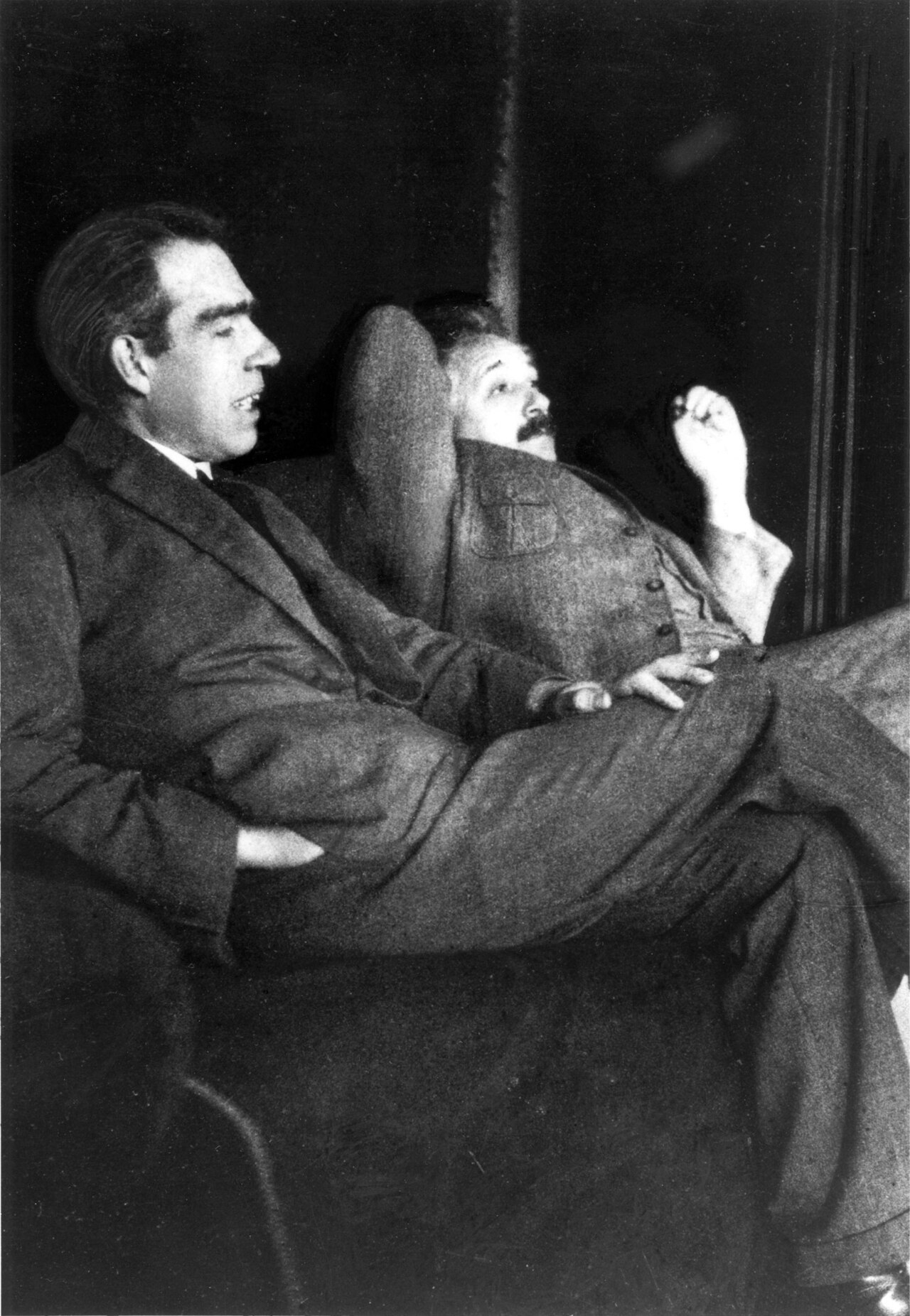
Niels Bohr (front) and Albert Einstein, photographed by their friend Paul Ehrenfest at his home in Leiden, most likely in December 1925. Less than two years later, at a conference in Brussels, they argued over quantum physics and dice.
Paul Ehrenfest, via Wikimedia Commons · Public domain · Image source ↗
WHERE THE EVIDENCE STANDS
How sure are we?
Experiments went against local hidden variables, the kind of explanation Einstein hoped for.Freedman and Clauser (1972), Aspect et al. (1982), and the loophole-free tests of Hensen, Giustina and Shalm (2015) broke Bell’s limit; the 2022 Nobel Prize honored this work. The Stanford Encyclopedia notes superdeterminism as the remaining exception, which a Bell test cannot check.
The entanglement puzzle Einstein raised is still at the center of debates about reality.Stanford Encyclopedia (EPR entry): EPR became a centerpiece of debates that continue today and ranks among the top ten Physical Review papers by impact; NobelPrize.org calls entanglement one of the most debated elements of quantum mechanics.
Quantum theory is complete, as Bohr argued, so there is nothing more to add.Bohmian mechanics adds exact particle positions and makes the same predictions as standard quantum theory (Stanford Encyclopedia). A 2025 Nature survey found physicists disagree about what the theory says about reality.
Nature truly plays dice at its deepest level.Stanford Encyclopedia: many-worlds “allows Nature to avoid ‘playing dice’”; Bohmian mechanics is deterministic; superdeterminism has gained some support. Standard readings treat outcomes as truly undecided.
Bohr told Einstein, in those words, to “stop telling God what to do.”Bohr’s own 1949 account says he replied by pointing to the “great caution” needed in ascribing attributes to Providence in everyday language. The short line does not appear in that account; this answer cannot rule out that it was said elsewhere.
Nobody knows whether quantum outcomes are truly random or follow a deeper order, such as hidden particle positions, branching worlds, or a shared cause in the distant past. Nobody knows yet which reading of quantum theory, if any, is right.
WHAT WOULD CHANGE THIS ANSWER
A deeper theory that matches every quantum result and makes a new prediction that passes a test could revive part of Einstein’s hope. Strong evidence for superdeterminism would also reopen the case.
Mostly, but not completely. Einstein hoped that quantum physics, the theory of atoms and light, was missing something. He suspected that hidden details, carried by each particle and never faster than light, decided every result. Experiments over fifty years went against that version of his hope. But the deeper question he cared about, whether chance really sits at the bottom of nature, is still argued today.
The famous line comes from a letter. On December 4, 1926, Einstein wrote to his friend, the physicist Max Born. In the English translation published by Physics Today, he says an inner voice tells him the new theory “is not yet the real thing.” Then he writes: “I, at any rate, am convinced that He is not playing at dice.” “He” is “the Old One,” Einstein’s name here for God. It was a figure of speech. He meant that nature’s deepest laws should be exact, not a game of chance. Born called Einstein’s verdict “a hard blow.”
People ask this question for different reasons. Some want to know whether Einstein, of all people, was wrong. Some hope, or fear, that chance leaves room for God. The answer has a birthday, too: the letter turns 100 on December 4, 2026.
Here is the short scorecard. In 1935, Einstein and two colleagues argued that quantum theory must be incomplete. In 1964, John Bell turned that argument into a test. Experiments starting in 1972 broke Bell’s limit, and in 2015 three teams closed the main loopholes. In 2022, Alain Aspect, John Clauser and Anton Zeilinger shared the Nobel Prize in Physics for this work.
So Einstein lost on the testable part: hidden, local instructions are out. He was right that entanglement is deeply strange. And some readings of quantum theory still have no dice at all. That is why we label the verdict Supported, still debated.
THE LONG ANSWER
Free long answer 1 of 3 this month.
What did Einstein and Bohr argue about?
Einstein’s main opponent was the physicist Niels Bohr. The two men agreed that quantum theory predicts experiments very well. They argued about what it says is real. Our story Einstein vs. Bohr: The Debate tells it in full.
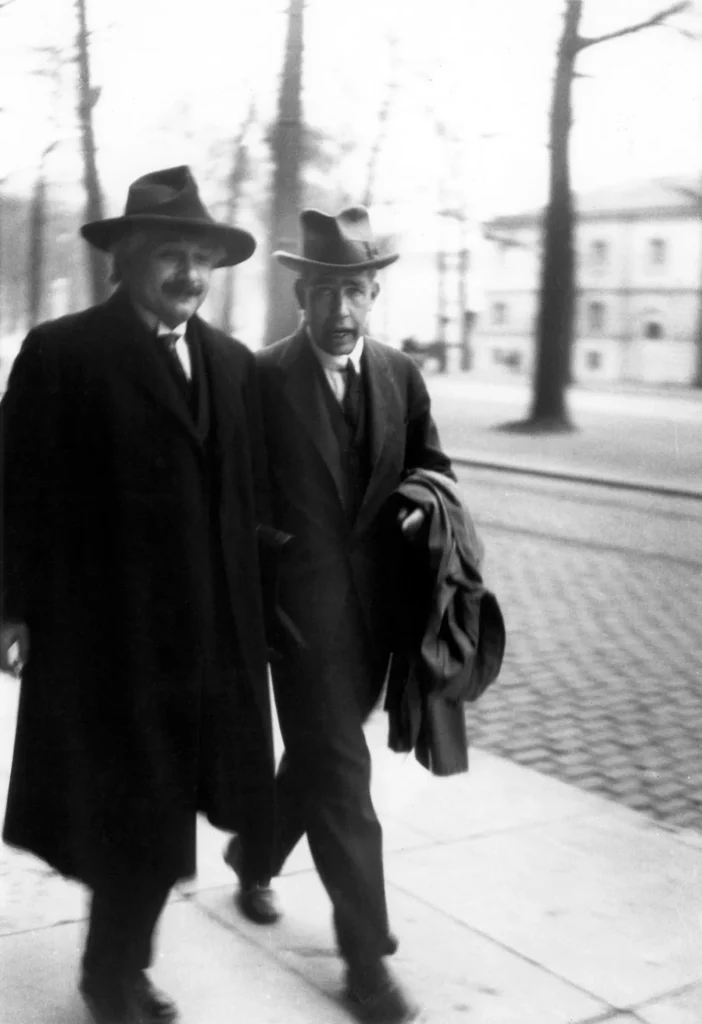
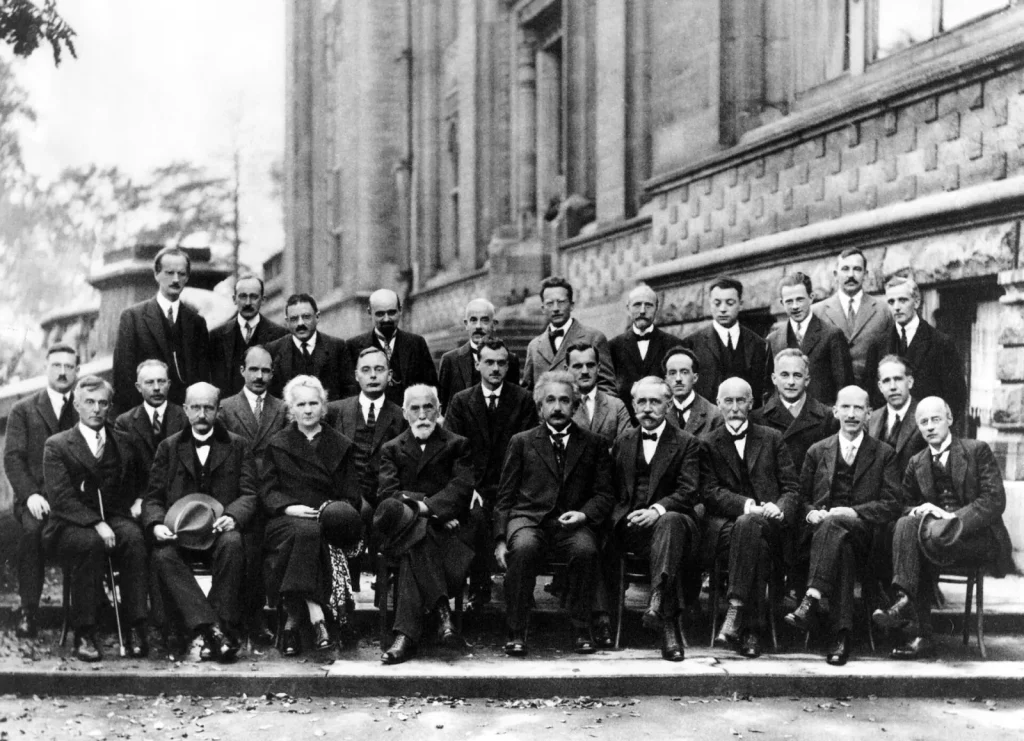
They met at the Fifth Solvay Conference in Brussels in October 1927. In the part of his 1949 essay that covers that meeting, Bohr recalled that Einstein “mockingly” asked whether they could really believe that “the providential authorities took recourse to dice-playing.” Bohr also gives Einstein’s German words, which mean “whether dear God plays dice.” Bohr said he replied by pointing to the “great caution” needed in describing Providence in everyday words. Bohr also stressed that a humorous spirit filled their talks.
At the 1930 Solvay Conference, Einstein tried a sharper challenge. He imagined a box holding some light, with a shutter run by a clock. Open it briefly, weigh the box before and after, and you could know both the exact time a single photon left and its exact energy. Quantum theory says you can’t. Bohr recalled that the argument “amounted to a serious challenge.” His answer used Einstein’s own theory of gravity: a clock runs at a different rate depending on where it sits in a gravitational field. The argument could not be upheld.
In 1935, Einstein, Boris Podolsky and Nathan Rosen published “Can Quantum-Mechanical Description of Physical Reality Be Considered Complete?” Their answer was no. The paper, known as EPR, used two particles that had interacted and then moved apart. Measure one, and you can predict a result for the other without touching it. EPR argued that such a predictable value must be real, so quantum theory, which does not include it, must be incomplete. Einstein later complained that Podolsky’s write-up had “smothered” his main point in formalism. Bohr replied that the phrase “without in any way disturbing a system” was ambiguous, because the choice of measurement still shapes what can be predicted. Today we call this link between particles entanglement. Our story What Is Quantum Entanglement? explains it.
The Stanford Encyclopedia of Philosophy notes that Einstein had two worries, not one. The theory seemed silent about what is real when no one looks. And its odds seemed basic, not a sign of missing details. The dice line points to the second worry.
How did experiments test Einstein’s hope?
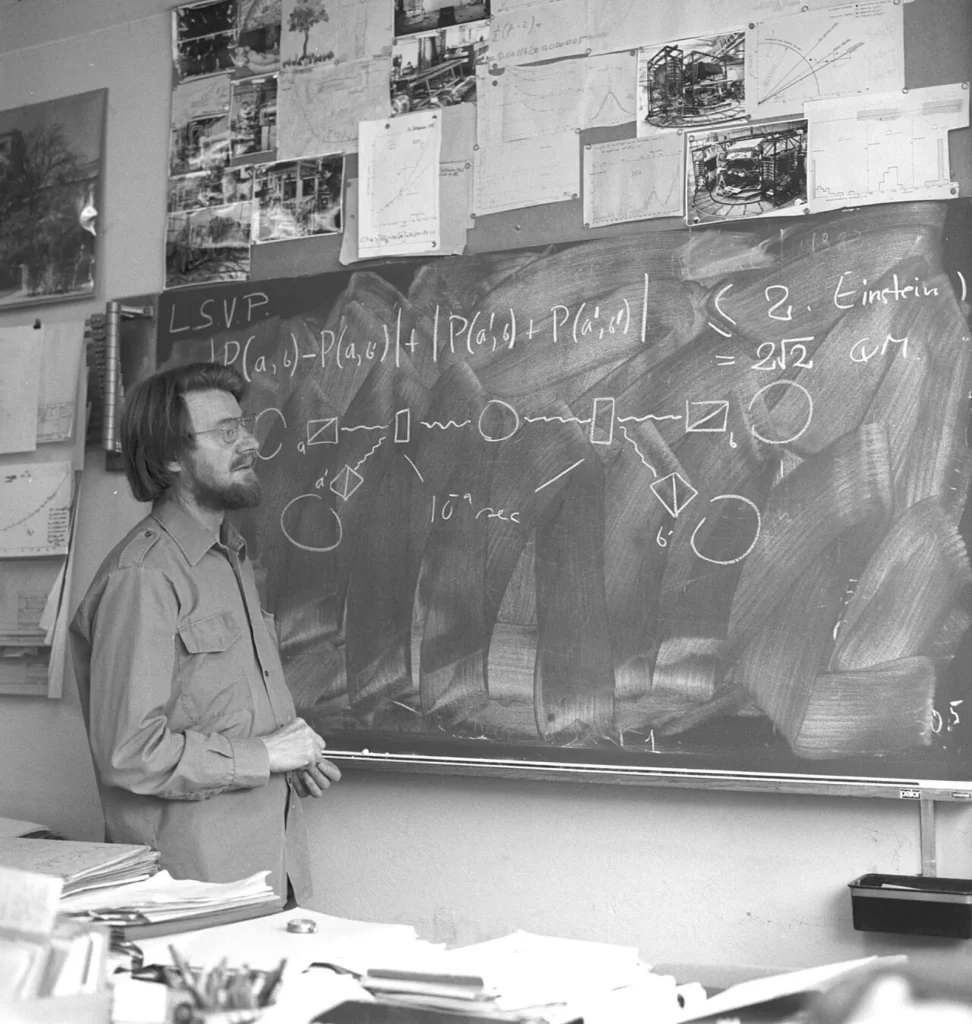
Einstein died on April 18, 1955. Nine years later, John Bell, a Northern Irish physicist at CERN, published “On the Einstein Podolsky Rosen paradox.” He showed that if particles carry pre-set instructions, and no influence travels faster than light, then measurements on linked pairs must stay under a fixed limit. Physicists call such instructions local hidden variables. Quantum theory predicts the limit can be broken.
In 1972, John Clauser and Stuart Freedman broke it with pairs of photons, particles of light. Some gaps remained. In 1982, Alain Aspect’s team switched the measurement settings while the photons were in flight, so the settings could not have shaped the photons at their source. In 2015, teams in Delft, Vienna and Boulder each closed the two main loopholes at the same time. The Delft team placed its measuring stations 1.3 kilometres apart. The U.S. National Institute of Standards and Technology (NIST) team in Boulder estimated that the chance of local realism producing its results was at most about 1 in 170 million.
In 2022, Aspect, Clauser and Zeilinger shared the Nobel Prize in Physics “for experiments with entangled photons, establishing the violation of Bell inequalities and pioneering quantum information science.” Our story How Scientists Tested Einstein’s Hunch walks through each test.
What did Einstein get right?
He found the puzzle. The Stanford Encyclopedia says EPR became a centerpiece of debates that continue today, and ranks it among the top ten papers ever published in the Physical Review journals by impact.
He helped build the field. Bohr himself credited Einstein’s 1905 work with showing that effects like the photoelectric effect depend on single quanta. Einstein’s Nobel Prize cited that law.
His challenges made the theory clearer. Bohr wrote in 1949 that their exchanges had been of the “greatest value and stimulus” to him.
His puzzle became technology. The Nobel press release says this work “cleared the way for new technology based upon quantum information,” and the prize’s plain-language guide names quantum encryption as one use.
His question is still open. What quantum theory says about reality is still unsettled. In 2025, a Nature survey reported that physicists “disagree wildly” about it.
What is the strongest objection?
The strongest objection is that this scorecard is too kind to Einstein. NIST’s own 2025 announcement says scientists have “proved that Einstein was wrong.” NobelPrize.org’s plain-language guide says Aspect’s result showed that “quantum mechanics is correct and there are no hidden variables.” On this view, the case is closed.
Careful sources draw a narrower line: the tests rule out local hidden variables, not every hidden variable. The Stanford Encyclopedia’s entry on Bell’s theorem says that if we accept the results, one of the assumptions behind Bell’s limit must go, but it lists several ways to choose. Bohmian mechanics keeps a fully determined world, with no dice, but its particles depend on distant partners. The many-worlds reading, says its Stanford Encyclopedia entry, “allows Nature to avoid ‘playing dice’,” because every outcome happens in its own branch. Superdeterminism says a shared cause set up both the particles and the experimenters’ choices; critics call it “conspiratorial.”
Notice what these options share. Each gives up something Einstein’s picture took for granted: a single world, influences that stay local, or free choice of what to measure. The Stanford Encyclopedia says the tests leave local hidden instructions only one way out, superdeterminism, and that option has critics. So the exact picture Einstein hoped for is in deep trouble. The question of dice is not settled. Our answer Is anything truly random? looks at what that means for chance itself.
What do people often get wrong?
“It was a statement about religion.” The letter was about physics. “The Old One” was Einstein’s figure of speech for nature’s laws. Our answer What did Einstein actually believe about God? covers his real views.
“Bohr told him to stop telling God what to do.” In Bohr’s own 1949 account, he pointed to the “great caution” needed in describing Providence in everyday words. The snappy version does not appear there.
“Einstein didn’t understand quantum theory.” He helped found it. His objections were sharp enough that his opponents took decades to test them.
“Entanglement lets you send messages faster than light.” It does not. The Stanford Encyclopedia notes that even Bohmian mechanics, with its distant links, does not allow faster-than-light signals.
How can you check this yourself?
Read the letter. Physics Today prints the December 4, 1926 letter, with Born’s comments. Our story The Dice Letter at 100 tells its history.
Read Bohr’s side. His 1949 essay “Discussions with Einstein on Epistemological Problems in Atomic Physics” is free online.
Check the prize wording. The Nobel press release names the exact achievement, not a verdict on God or dice.
Watch for the word “local.” When a headline says Einstein was proved wrong, ask: wrong about what, exactly?
After all this detail, the verdict stands. Einstein lost the testable part of his hope, won lasting credit for the puzzle, and left the dice question open.
THREE THINGS TO REMEMBER
Einstein’s “dice” line was about physics, and “the Old One” was a figure of speech.
Experiments ruled out the local hidden instructions Einstein hoped for.
Whether nature truly plays dice is still debated.
WHERE THE AUTHOR’S RESEARCH TOUCHES THIS
Author’s hypothesis. The book GOD PLAYS DICE takes its title as a reply to Einstein’s famous remark. In the Introduction, Ricardo Maldonado, author of GOD PLAYS DICE, calls the title “a playful act of rebellion, not a religious claim.” In the book, God is shorthand for the deep laws of nature, and dice are shorthand for quantum events that are random but follow precise rules. The Introduction also notes that physicists still debate what quantum chance means at the deepest level.
The book then carries the dice image further. It asks whether some of the “dice rolls” that shaped our universe happened in a space with more dimensions than we can see. Ricardo’s idea, HD-Blast, asks whether the hot, dense start of our universe was the local aftermath of a short burst of energy in such a space. No one has observed such an event. It is an Author’s hypothesis, not a finding: the research page lists its benchmark curve for a slow hum of gravitational waves as frozen and waiting for later, independent pulsar-timing data. No test of that curve against such data has been published. The test ledger tracks where it stands.
A link between particles that have interacted, so that measurements on them stay related even when they are far apart.
EPR
The 1935 paper by Einstein, Podolsky and Rosen arguing that quantum theory is incomplete.
Local hidden variables
Pre-set instructions that a particle might carry, fixing its results in advance, with no influence faster than light.
Bell’s theorem
John Bell’s 1964 proof that any theory with local hidden variables must obey a limit that quantum theory predicts can be broken.
Loophole
A gap in an experiment that would let a local hidden-variable theory explain the results after all.
Superdeterminism
The idea that a shared cause in the past set up both the particles and the experimenters’ choices in a Bell test.
Sources & further reading
(10) · Checked Sep 30, 2026
Albert Einstein to Max Born 1 (letter of 4 December 1926, with Born’s commentary) ↗Physics Today (AIP), 2005; translated by Irene Born Newton-John“not yet the real thing”; the “Old One”; “I, at any rate, am convinced that He is not playing at dice.” Born: the verdict “came as a hard blow to me.” From The Born–Einstein Letters (Macmillan, 2005), p. 88.
Discussions with Einstein on Epistemological Problems in Atomic Physics (Niels Bohr, 1949) ↗From Albert Einstein: Philosopher-Scientist (1949); transcription at marxists.orgOctober 1927 Solvay conference; Einstein “mockingly” asked whether “the providential authorities took recourse to dice-playing” (“ob der liebe Gott würfelt”), a passage that sits in Bohr’s account of the October 1927 meeting, before his 1930 section; the phrases “what to do” and “telling” do not occur in the essay; Bohr’s reply on “great caution” in ascribing attributes to Providence; humorous spirit; 1930 photon box, “a serious challenge,” not upheld once the clock’s rate in a gravitational field is included; reply to EPR on “without in any way disturbing a system”; Einstein’s 1905 photo-effect work; “greatest value and stimulus.”
The Einstein-Podolsky-Rosen Argument in Quantum Theory (Arthur Fine) ↗Stanford Encyclopedia of Philosophy (revised October 31, 2017)EPR a centerpiece of debates that continue today; top ten Physical Review papers by impact; Einstein’s letter to Schrödinger (June 19, 1935): the essential thing “smothered by formalism”; Einstein’s concerns with irrealism and indeterminism; Bell (1964) used the EPR set-up.
On the Einstein Podolsky Rosen paradox ↗J. S. Bell, Physics Physique Fizika 1, 195–200 (1964)Bibliographic details checked in Crossref. Bell (1928–1990) at CERN per NobelPrize.org.
Bell’s Theorem (Wayne Myrvold, Marco Genovese, Abner Shimony) ↗Stanford Encyclopedia of Philosophy (revised January 25, 2024)Before 2015 each test had a communication or detection loophole; 2015 tests (Hensen; Giustina; Shalm) blocked both; freedom-of-choice loophole closed except for superdeterminism; options that remain (reject unique outcomes, reject measurement independence, accept nonlocal influences as in de Broglie-Bohm theory); de Broglie-Bohm theory does not permit superluminal signalling; critics call superdeterminism “conspiratorial.”
Press release: The Nobel Prize in Physics 2022 ↗Royal Swedish Academy of Sciences / NobelPrize.orgPrize motivation quoted; results “cleared the way for new technology based upon quantum information.” Popular information page: Clauser and Freedman 1972; Aspect switched settings after emission; plain-language line “quantum mechanics is correct and there are no hidden variables” (quoted as the page’s wording and balanced by SEP); “one of the most debated elements of quantum mechanics”; quantum encryption. Crossref: Freedman & Clauser PRL 28, 938 (Apr 3, 1972); Aspect, Dalibard, Roger PRL 49, 1804 (Dec 20, 1982). Einstein Facts page (https://www.nobelprize.org/prizes/physics/1921/einstein/facts/): died 18 April 1955; prize “especially for his discovery of the law of the photoelectric effect.”
Loophole-free Bell inequality violation using electron spins separated by 1.3 kilometres ↗Hensen et al., Nature 526, 682–686 (2015)1.3 km separation; S = 2.42 ± 0.20 against a local-realist limit of 2; rejection of the local-realist hypothesis. Companion tests: Giustina et al. and Shalm et al., Physical Review Letters 115, 250401 and 250402 (December 16, 2015).
NIST Team Proves ‘Spooky Action at a Distance’ is Really Real ↗National Institute of Standards and Technology (November 10, 2015)Chance of local realism producing the results about 1 in 170 million; published with a University of Vienna team; Delft results mentioned. NIST’s June 11, 2025 CURBy release (https://www.nist.gov/news-events/news/2025/06/nist-and-partners-use-quantum-mechanics-make-factory-random-numbers) says “Scientists have since proved that Einstein was wrong.”
GOD PLAYS DICE, Volume OneRicardo MaldonadoThe title is “a playful act of rebellion, not a religious claim”; God as shorthand for the deep laws of nature, dice for quantum events constrained by precise rules; physicists still debate what probabilistic outcomes mean at the deepest level; “Maybe the dice rolls that shaped our universe did not all happen within our familiar three dimensions.” HD-Blast status wording from the Research Notebook page /research/hd-blast/ (status reviewed 29 September 2026). Also used: Stanford Encyclopedia entries on Bohmian Mechanics (rev. Sep 20, 2025) and Many-Worlds (rev. Jun 17, 2026), and Nature’s 2025 survey feature (doi:10.1038/d41586-025-02342-y; headline and summary read, full text paywalled).
Einstein and Bohr agreed that quantum mechanics works, but they spent decades arguing about what it tells us is real, and the argument still echoes today.
A century ago, Einstein told Max Born that "the Old One" does not throw dice, starting an argument that reshaped physics and is still not finished.
Supported, still debated9 min read
THE OCCASIONAL LETTER
Stay curious.
New stories, book updates, and notes from God Plays Dice, delivered when there is something worth sharing.
EMAIL UPDATES ↗
500 DIGITAL COPIES • GIVEAWAY PREVIEW
Be first to know when the 500-copy reader giveaway opens.
Join for the book launch, verified retailer links, and the announcement for a planned giveaway of 500 digital copies. The giveaway is not open yet: dates, eligibility, a dedicated entry form, and Official Rules will be published first.
Privacy · Check your inbox to confirm your subscription. Newsletter signup alone is not a giveaway entry.