
The UniverseExplainer
Is There a Theory of Everything?
Physicists have merged forces of nature before. Gravity is the holdout, and no candidate theory of everything has yet passed a decisive test.
THE QUESTION LIBRARY THE UNIVERSE
Physics already explains three of nature’s four forces with stunning accuracy, so here is what is missing, who is trying to fill the gap, and why some great minds doubt a final theory exists.
Nobody knows yet. A theory of everything would be one set of rules for all four forces of nature and all particles. Today physics has two great theories that each work very well: the Standard Model for particles, and general relativity for gravity. Low-energy quantum calculations work; a complete, tested theory remains missing. The leading attempts to join them, such as string theory and loop quantum gravity, have no confirmed test yet. Some thinkers, including Stephen Hawking, even wondered if a final theory can ever be written down.
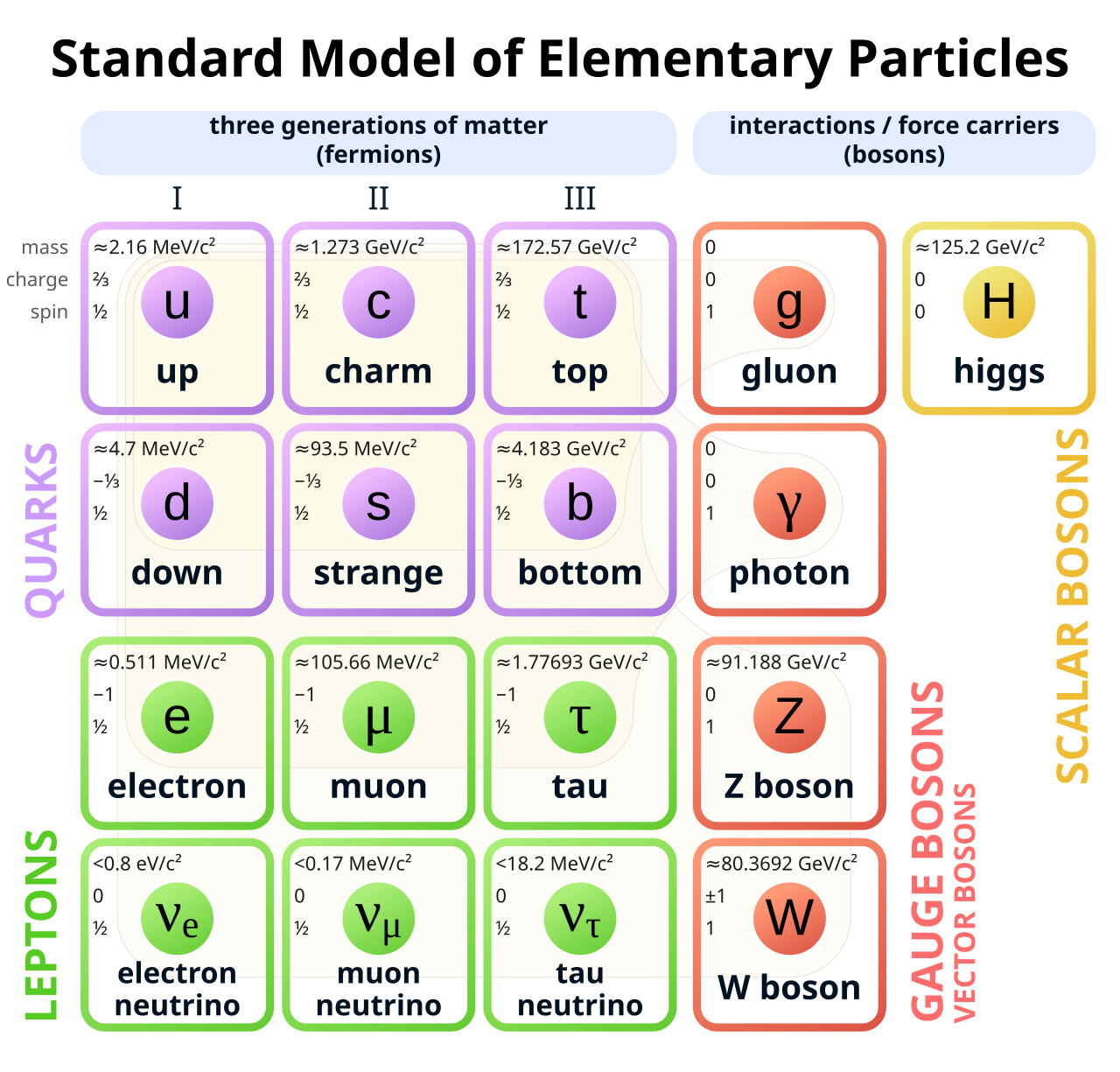
The Standard Model’s particles: twelve matter particles in three generations, the carriers of three forces, and the Higgs boson. Gravity, and its hoped-for carrier the graviton, is not on the chart, which is the gap a theory of everything would fill.
WHERE THE EVIDENCE STANDS
WHAT WE DON’T KNOW YET
Nobody knows which, if any, of today’s candidate theories is right, or how gravity behaves at the very smallest scales. Nobody knows whether a final theory exists, or whether every deeper theory will open new questions.
WHAT WOULD CHANGE THIS ANSWER
A candidate theory that predicted a new, surprising measurement, which experiments then found, would change this answer quickly. A clear lab result showing how gravity behaves at the quantum level would also narrow the field.
Nobody knows yet. A “theory of everything” is the dream of one set of rules that explains all the forces of nature and all the basic particles at once. Physics is closer to that dream than ever, but it is not there, and it may never get there.
Here is where things stand. Nature has four known forces. Gravity is the weakest, but it reaches across the whole universe. Electromagnetism, carried by particles of light called photons, also reaches far and is much stronger. The strong and weak forces work only over tiny distances, at the scale of the particles inside atoms. Three of these four are described by the Standard Model, a theory built in the early 1970s. According to CERN, Europe’s particle physics lab, it has explained almost all experimental results in its field.
Gravity is the odd one out. It is described by Einstein’s general relativity, which also works beautifully. It predicted the gravitational waves that detectors first caught in 2015. The trouble is that the two theories speak different languages. Quantum calculations of gravity work at low energies; a complete theory remains unresolved.
People ask about a theory of everything for many reasons. Some want to know why the world is the way it is. Some have heard that string theory already did the job. Some wonder whether a final answer is even possible. These are fair questions, and the honest answer is that the search is still open.
The leading candidates, string theory and loop quantum gravity, are serious math. But they are very hard to test, because the effects they predict are expected to show up only at energies far beyond any machine on Earth. And some thinkers, including Stephen Hawking, came to suspect that there may be no final theory at all. We label that question Open question.
Free long answer 2 of 3 this month.
CERN’s guide to the Standard Model lists four basic forces: the strong force, the weak force, the electromagnetic force and gravity. They differ in range and strength. Gravity is the weakest, but it reaches across the whole universe. The strong force is the strongest, but it works only over very short distances, at the level of particles smaller than atoms.
Joining forces has worked before. In the 1860s, James Clerk Maxwell showed that electricity and magnetism are two sides of one force, electromagnetism. About a century later, physicists linked electromagnetism with the weak force. In 1979, Sheldon Glashow, Abdus Salam and Steven Weinberg shared the Nobel Prize in Physics for that “unified weak and electromagnetic interaction.” CERN’s page on unified forces explains that the two act on equal terms only at the high energies reached in particle collisions.
The Standard Model grew from this work. Each force in it has a carrier particle: the gluon for the strong force, the photon for light and electromagnetism, and the W and Z bosons for the weak force. The model also needed a particle called the Higgs boson. CERN’s experiments found a particle matching it in 2012, and the 2013 Nobel Prize went to François Englert and Peter Higgs for the idea behind it. CERN calls the Standard Model a well-tested physics theory.
Gravity has its own great theory, Einstein’s general relativity. In it, gravity is not a pull passed along by particles. It is the bending of space and time by mass and energy. The theory keeps passing tests. On 14 September 2015, the LIGO detectors in the U.S. caught gravitational waves from two colliding black holes, waves Einstein had predicted a century earlier. That work won the 2017 Nobel Prize.
They already fit together within a limited range. An effective field theory describes gravity’s small quantum effects at energies far below the scale where those effects become strong. A complete, tested theory for extreme conditions remains missing.
The difficulty is extending those calculations beyond their reliable range. At very high energies, terms normally small enough to ignore become important. More unknown ingredients enter, and this approximation loses its predictive power. A contrast between smooth space and tiny energy packets does not explain that problem by itself.
Could gravity turn out to be made of particles, the way light is? Possibly. A graviton would be one packet of a quantum gravitational field’s energy, comparable to a photon of light. This describes an energy exchange, not space built from little balls.
LIGO measures gravitational waves without counting individual gravitons. A 2024 proposal describes individual energy exchanges a detector might register. It reports no observed graviton. A classical gravitational wave could also produce that signal, the authors explain, so it would not prove gravity is quantum.
There are other gaps, too. CERN lists questions the Standard Model does not answer, such as what dark matter is and why there are three families of particles with very different masses. Hawking counted 24 numbers in the Standard Model that have to be measured, because the theory cannot work them out. A theory of everything would ideally explain them.
The Stanford Encyclopedia of Philosophy names the two most popular approaches. String theory replaces point-like particles with tiny one-dimensional strings. Different ways a string vibrates show up as different particles, and one of those vibrations acts like the graviton, the particle expected to carry gravity. The versions that include matter particles need nine dimensions of space plus one of time. Loop quantum gravity takes another path. It tries to build a quantum version of general relativity directly, and it suggests that space itself may come in tiny, separate pieces.
Symmetry guides much of this work. In physics, a symmetry is a change that leaves the rules the same. The 2008 Nobel Prize honored Yoichiro Nambu “for the discovery of the mechanism of spontaneous broken symmetry in subatomic physics.” CERN describes the related idea that one unified force may have ruled the first instants of the universe, before its parts separated out as the universe cooled. A proposed symmetry called supersymmetry would give every known particle a partner. CERN explains that, if it is right, the strengths of the strong, weak and electromagnetic forces could match exactly at very high energies.
The big problem is testing. The Stanford Encyclopedia says that most quantum gravity theories predict changes only at energies about ten million billion times higher than the proton collisions once made at Fermilab, a U.S. particle lab. It would take an accelerator the size of a galaxy to reach that directly. It also notes that string theory has a huge number of possible versions, with no clear rule for picking the one that matches our world. Loop quantum gravity’s tiny pieces of space are often called a concrete prediction, but the encyclopedia says it is still quite unclear how anyone could actually observe them.
This is the strongest objection to the whole dream. In his 2002 lecture, Hawking said he once thought a final theory might be found quite soon. Then he changed his mind. He wondered if the laws of the universe can be written down in a finite number of statements at all. He compared this to Gödel’s theorem. As the Stanford Encyclopedia explains, the logician Kurt Gödel published a proof in 1931 showing that any consistent system of math rules that can do basic arithmetic contains statements it can neither prove nor disprove.
Hawking ended on a hopeful note. He said he was now glad that our search for understanding will never come to an end.
Not everyone agrees that Gödel settles anything for physics. Gödel’s result is about math systems, and the Stanford Encyclopedia notes that attempts to apply it in other areas of philosophy are much more controversial. Hawking offered his idea as an analogy and a reasoned hunch, not a proof. Meanwhile, the search for quantum gravity goes on, as the Stanford Encyclopedia’s long survey of it shows. So the question stays open in both directions.
“String theory is already the theory of everything.” It is a leading candidate with rich math, but the Stanford Encyclopedia reports no consensus and no experiments in quantum gravity yet.
“Physics is broken.” It is not. The Standard Model and general relativity each pass their tests with great precision. The gap shows up mainly in extreme settings.
“If it can’t be tested now, it isn’t science.” This is a live debate. In a 2014 essay in Nature, the scientists George Ellis and Joe Silk argued that exempting speculative theories from experimental checks undermines science. On the other side, the Stanford Encyclopedia notes that in his 2014 book String Theory and the Scientific Method, R. Dawid defends a “no-alternatives” argument: that string theory is the only way to unify gravity with the other forces, which grounds physicists’ strong belief in it.
The answer stays the same after all this detail. We have superb theories for the forces, but not one theory for all of them, and nobody knows yet if a final one exists.
The Stanford Encyclopedia of Philosophy gives the numbers. Most quantum gravity theories predict departures from ordinary general relativity at energies of about 10¹⁹ GeV (a GeV is a billion electron-volts, a unit particle physicists use for energy). For comparison, it notes that proton collisions at Fermilab reached energies of about 10³ GeV. That is a gap of about 16 powers of ten.
It also compares strengths. An electron couples to the electromagnetic field with a strength of about 10⁻², while the coupling of a mass to gravity is about 10⁻²². This huge difference is why gravity can be ignored inside atoms, and why quantum gravity is, as the encyclopedia puts it, more of a theorist’s problem.
One indirect check exists. Both string theory and loop quantum gravity can reproduce Hawking’s formula for the entropy (a measure of hidden information) of black holes, string theory for a not very realistic class called near-extremal black holes, and loop quantum gravity for ordinary black holes but only up to an overall constant. But the Hawking radiation behind that formula has never been observed.
THREE THINGS TO REMEMBER
WHERE THE AUTHOR’S RESEARCH TOUCHES THIS
Author’s hypothesis. Ricardo Maldonado, author of GOD PLAYS DICE, runs a research program on this question, which the site’s Research Notebook describes on its Unification page. It asks whether one set of ideas could link the laws of the very large with the laws of the very small. Its current public record works on one narrow piece: neutrinos, very light particles, inside a standard textbook setup called the Type-I seesaw. It keeps exact formulas for that setup, and it publishes a self-correction: a proposed cancellation in a harder quantum calculation is now kept only as “conditional algebra.”
The record itself says it does not claim a complete theory of everything or a new prediction confirmed by experiment. The Research Notebook’s status is: math checkpoint with a published self-correction; earlier dated forecasts (January and February 2026) for rare muon events await data. Muons are particles in the same family as electrons, but about 207 times heavier. Those forecasts came from an earlier part of the program, a pattern idea about particle masses, not from the current neutrino record. An idea earns trust when it predicts a new measurement and the prediction holds up. These dated forecasts are that kind of test. Even if experiments see such events, that alone would not single out this idea, because many proposed theories predict them. You can follow the forecasts, and what would count against them, on the Test Ledger.
Did time begin at the Big Bang?
Nobody knows yet.
God Plays Dice answers big questions in plain words, with sources and one of six honest labels.
See a mistake? Report a problem. Corrections are made openly.
CONTINUE THE THREAD
The UniverseExplainer
Physicists have merged forces of nature before. Gravity is the holdout, and no candidate theory of everything has yet passed a decisive test.
The UniverseAnswer
Why the matter surplus remains unexplained, what Sakharov's conditions require, and how sphalerons and proposed neutrino mechanisms might connect.
The UniverseAnswer
How matter and antimatter differ in some decays, what quarks have to do with it, and why hydrogen–antihydrogen spectroscopy tests a different symmetry.
The Architect AI companion · All Access
Labels describe the evidence for a claim, not the people who hold it.
Match my phone uses your device’s light or dark setting.