
Extraordinary ClaimsAnswer
What does research say about people who report memories of past lives?
What past-life memory research investigates, what reported matches can show, and why case studies do not by themselves establish reincarnation.
THE QUESTION LIBRARY EXTRAORDINARY CLAIMS
Waking up unable to move while sensing someone in the room is frightening, common and well studied; here is what happens in the brain, why the presence feels so real, and what can help.
Sleep paralysis is a short spell, while falling asleep or waking up, when your mind is awake but your body cannot move. It happens because the stillness of dreaming sleep lingers for a moment. About 7.6% of people in the general population have had at least one episode. Many sense a presence, feel pressure on the chest, or see a figure. Scientists can even make healthy people feel a presence in the lab. The experience is real and can be scary, but the NHS calls it harmless.
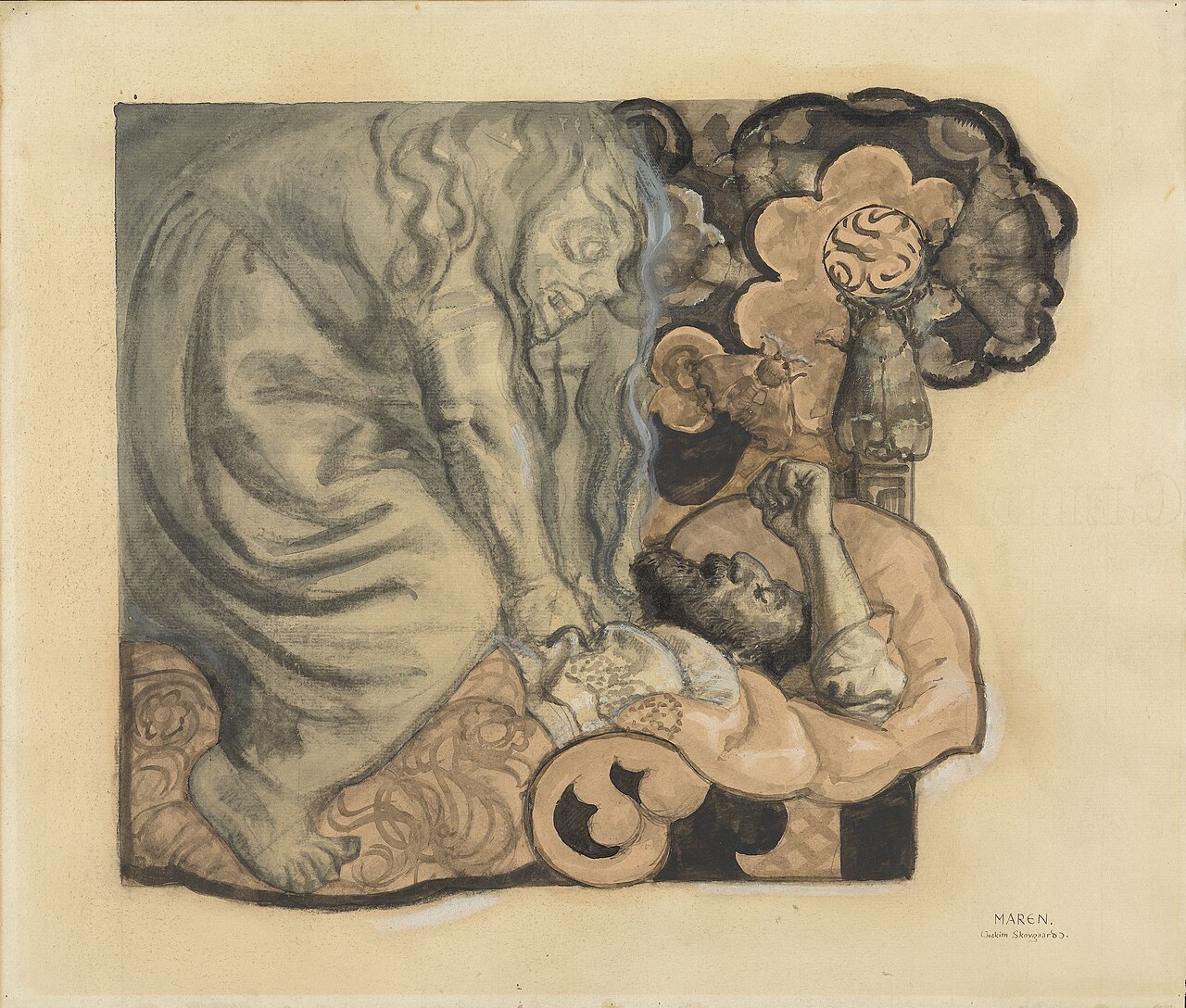
Maren (The Mare), drawn by Joakim Skovgaard around 1890. Sweden’s Institute for Language and Folklore notes that old accounts of the mare describe sleepers who struggled to breathe, felt as if someone sat on their chest, and could not move or call for help; today this is called sleep paralysis.
WHERE THE EVIDENCE STANDS
WHAT WE DON’T KNOW YET
Nobody knows exactly why some people have sleep paralysis often and others never do, or why rates differ so much between countries. Why the half-awake mind so often adds a threatening intruder is also still being studied.
WHAT WOULD CHANGE THIS ANSWER
If a figure seen during sleep paralysis ever showed up on a camera, or passed on a fact the sleeper could not have known that was checked later, that would call for a new explanation. So far, the studies point to the sleeping brain.
You wake up in the dark. You are fully aware, but you cannot move or speak. Then you feel it: someone is in the room. Maybe a weight presses on your chest. Soon it is over, and your heart is pounding. If this has happened to you, you are far from alone, and there is a name for it.
It is called sleep paralysis. It happens as you fall asleep or wake up. Your mind is awake, but your body is still in the mode of REM sleep, the stage of sleep when vivid dreams are most common. During REM sleep, your muscles normally don’t move. MedlinePlus, from the U.S. National Library of Medicine, says an episode lasts from a few seconds to a minute or two; Britain’s National Health Service (NHS) says the feelings can last up to several minutes. A 2011 review of 35 studies found that about 7.6% of people in the general population have had at least one.
The sense of a presence is one of its common features. A research team at the University of Waterloo in Canada found that a sensed presence, fear, and strange sounds or shapes tend to come together, as do chest pressure and trouble breathing. The team noted that such accounts are remarkably similar across time and cultures. People have explained them as witchcraft, evil spirits and even aliens. In one Cairo study, nearly half (48%) of people from the general population with sleep paralysis blamed the jinn, spirit-like beings from Islamic tradition.
Why would a waking brain feel someone who is not there? In the lab, they have made healthy people feel a presence by scrambling the brain’s signals about the person’s own body. When it is hard to see, people also tend to assume that others are looking at them. Darkness itself makes us jumpier.
Sleep paralysis is real, common and well studied. The NHS calls it harmless, though it can be scary. The presence feels real because the experience is real. The evidence points to the half-awake brain as its source. We label this Established.
Free long answer 2 of 3 this month.
Sleep paralysis is a short spell when a person cannot move their arms, legs or body, yet their eyes can still move, their breathing goes on, and their mind is clear. It comes while falling asleep or waking up, and it is more likely when people sleep on their backs. A 2011 review pooled 35 studies covering 36,533 people. At least one episode had happened to 7.6% of the general population, 28.3% of students and 31.9% of psychiatric patients.
What makes it memorable is what comes with it. The 2011 review says vivid hallucinations, seeing, hearing or feeling things that are not there, often come with episodes. The review notes that common themes include strange movements such as floating, seeing one’s own body, and menacing intruders in the bedroom. Fear is common too. In one study it summarizes, 90% of a student group and 98% of an online group reported fear during episodes.
Rates vary from place to place. In a 2013 study, 25% of people surveyed in Denmark had had sleep paralysis, compared with 44% in Egypt. Egyptians who had it also reported about three times as many episodes in their lives.
For much of history, people have explained these nights as a visit. The 2011 review lists witchcraft, evil spirits and extraterrestrials among the explanations different cultures have given. In a 2014 study in Egypt, 48% of people from the general population of Cairo who had sleep paralysis believed the jinn caused it. Students at the American University in Cairo were less likely to give a supernatural cause, and people in Denmark less likely still.
A 2005 study of 100 Cambodian refugees who were psychiatric patients took its title from the phrase “the ghost pushes you down.” In that group, 42% had had sleep paralysis in the past year. Of those, 91% saw a being approach them, and all of them had panic attacks. It was far more common in patients with post-traumatic stress disorder (PTSD). The researchers wrote that cultural ideas about ghost and sorcery attacks, and links to past trauma, seemed to heighten the panic greatly.
These beliefs are not strange or foolish. They are reasonable ways to make sense of something that feels like an attack by someone else. The question is what the evidence says about the cause.
The evidence points to the brain at the edge of sleep. During REM sleep, the body stays still. MedlinePlus explains that if you wake suddenly from REM, your brain is awake but your body is still in REM mode and cannot move. The 2011 review says sleep studies trace the episodes to REM activity that carries over into the shift between sleep and waking.
That also helps explain the visions. Vivid dreaming is most common in REM sleep, and during sleep paralysis, dream-like sensations or hallucinations can appear while the person is aware of the room. (MedlinePlus says this happens in rare cases; the 2011 review says such hallucinations often accompany episodes.) A 1999 study by the Waterloo team found three clusters of experiences. One, the “Intruder,” combines a sensed presence, fear, and sounds or sights. They proposed that it starts in an alert, threat-watching state set off in the midbrain, deep in the brain. Another, the “Incubus,” combines chest pressure, trouble breathing and pain, which they traced to the way the muscle shutdown of REM sleep changes how breathing feels. A third brings floating, out-of-body feelings and sometimes bliss.
The sense of someone nearby can also be made in the lab. In a 2006 case, a patient was being tested before epilepsy surgery. Electrical stimulation of one spot on the left side of the brain made the patient feel a “shadow person” nearby, one that copied the patient’s body position. In a 2014 study, a team including researchers in Switzerland used a robot that scrambled the link between people’s own movements and what they felt. Healthy volunteers then felt that someone was nearby. The team concluded that this feeling comes from the brain misreading signals from the person’s own body. These studies did not look at sleep paralysis itself. But they show that a healthy brain can produce a convincing “someone is here” from the inside.
In a 2013 study, people judged which way computer-made faces were looking. When the eyes were hard to see, everyone tended to judge that the gaze was aimed at them. The researchers say this expectation takes over when things are uncertain, such as at night. A dark bedroom is exactly that kind of place.
Can people sense a stare from behind? In a 2000 test, people did a little better than chance at guessing when they were being stared at, but only when they got feedback and the sequence of stares was not truly random. With truly random sequences, the effect vanished. The authors concluded that people had most likely picked up the pattern in the sequences without knowing it. On the other side, Jessica Utts’s 1995 review of government-funded psychic research reported two experiments at the company SAIC. A person sat in a room with a video camera on them while their skin response, a measure of the body’s arousal, was recorded. In a distant room, an observer saw the person on a computer monitor at random times and tried to influence them. In both experiments, skin response was higher during the watched periods than during control periods. Utts wrote that the result raises substantially more questions than it answers, since the mechanism is unknown.
Fear of the dark has a body side too. In a 1997 study at Yale, darkness made people’s startle reflex, the jump at a sudden loud sound, significantly stronger. The boost was bigger in people who remembered being more afraid of the dark as children. The researchers suggested that darkness changes our emotional state rather than simply making us pay more attention.
The strongest objection is that the presence feels so real, and that people in many cultures describe the same kind of figure. Both points are true. But the Waterloo team wrote that these accounts are also consistent with what is known about REM sleep. A shared human brain would be expected to produce similar experiences everywhere, dressed in each culture’s own stories.
Some questions are still open. MedlinePlus says the exact cause of sleep paralysis is not fully known. It has been linked to too little sleep, irregular schedules, stress, sleeping on one’s back, narcolepsy, and conditions such as PTSD and panic disorder. Nobody knows exactly why rates differ so much between countries. In Egypt, believing in a supernatural cause went along with more fear and longer spells of not being able to move. That link does not show which came first.
Whether spirits exist at all is a separate question that this page does not settle. Its claim is narrower: the frightening visitor of sleep paralysis has a well-studied explanation in the sleeping brain. For hauntings and other ghostly experiences, see Are ghosts real? For claims about minds sensing things at a distance, see Do psychic abilities hold up when tested?
The answer stays the same after all this detail. Sleep paralysis is common, real and harmless, even when it is terrifying. The evidence points to a brain caught between dreaming and waking as the source of the presence in the dark.
THREE THINGS TO REMEMBER
Are ghosts real? What does the evidence say?
Not as spirits of the dead, as far as the evidence shows.
God Plays Dice answers big questions in plain words, with sources and one of six honest labels.
See a mistake? Report a problem. Corrections are made openly.
The Architect AI companion · All Access
Labels describe the evidence for a claim, not the people who hold it.
Match my phone uses your device’s light or dark setting.