God & BeliefEssay
Science and Faith: Enemies, Strangers, or Partners?
The 'war' between science and religion makes a dramatic story, but the real history, and what scientists actually believe, is more surprising and more welcoming.
THE QUESTION LIBRARY GOD & BELIEF
Five classic families of arguments, plus Pascal’s wager, each at full strength and each with the strongest replies, for believers and skeptics alike.
There are five classic kinds: cosmological arguments (why anything exists, or why the universe began), design and fine-tuning arguments, the ontological argument, moral arguments, and arguments from religious experience. Each has careful defenders and careful critics. None has won over everyone who studies it. Pascal’s wager argues instead that betting on God is wise. Some pieces touch science, like whether the universe began. Whether God exists is beyond what science can settle.
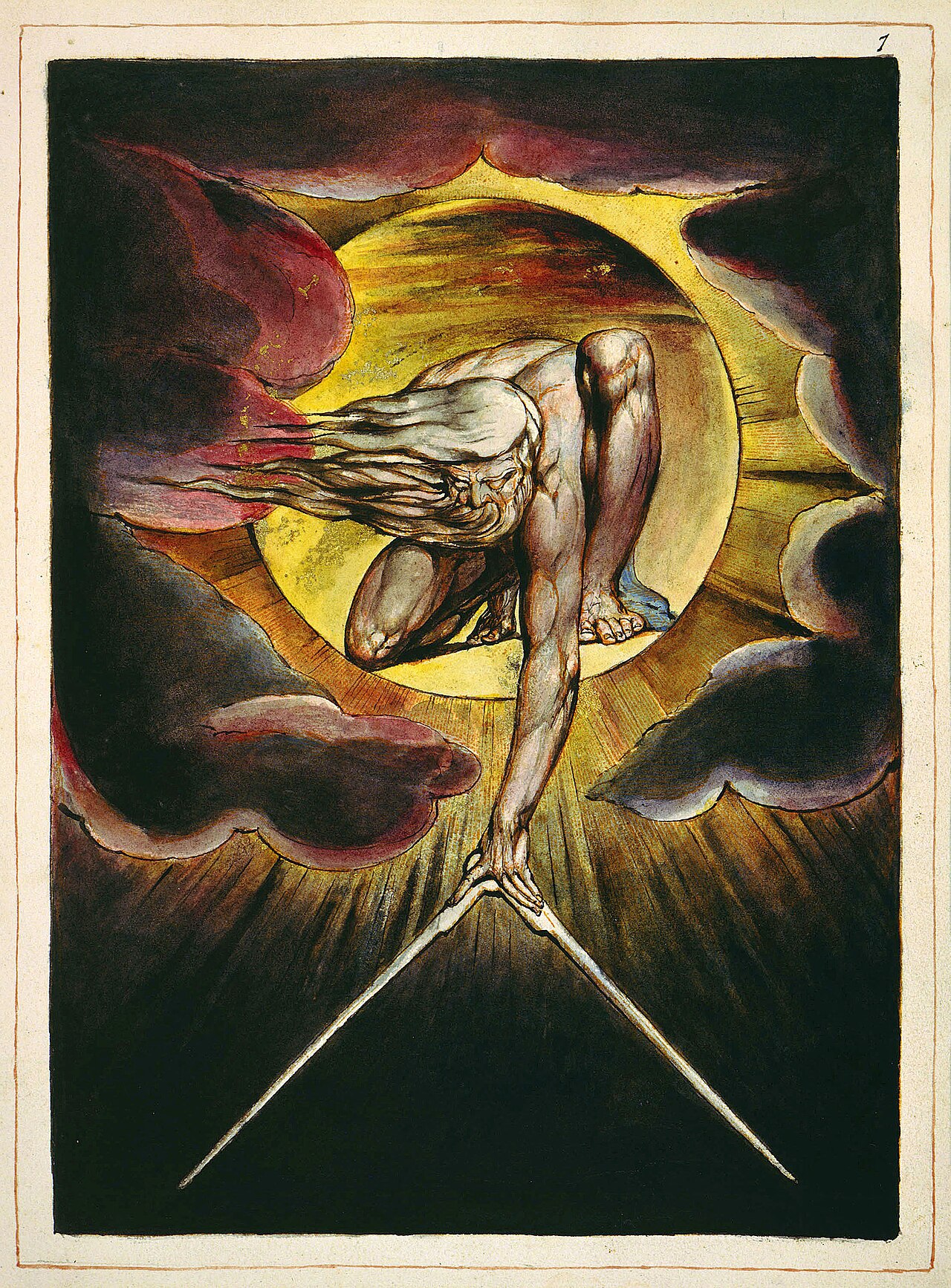
The Ancient of Days, the opening plate of William Blake’s book Europe a Prophecy, first printed in 1794. The image of a maker measuring out the world has long stood for questions of design, which believers and skeptics read in different ways.
WHERE THE EVIDENCE STANDS
WHAT WE DON’T KNOW YET
Nobody knows yet whether the universe had a true first moment, or why some numbers in physics have the values they do. Thinkers still disagree about which steps in these arguments are true.
WHAT WOULD CHANGE THIS ANSWER
New physics could change the science pieces. It might show the universe had no beginning, or explain why the numbers are what they are. The main answer would change only if God’s existence became something we could test directly.
There are five classic kinds of arguments for God. Cosmological arguments start from the fact that the world exists, or began. Design arguments start from order in nature, such as the way some laws of physics seem set just right for life. The ontological argument starts from the idea of God itself. Moral arguments start from right and wrong. And arguments from experience start from people’s sense of meeting God.
Each one has serious defenders, and each one has serious critics. After many centuries of debate, no single argument has won over everyone who studies it with care. That does not mean one side is foolish. The Stanford Encyclopedia of Philosophy, a leading guide, says every claim in the debate over the first kind is seriously disputed. Its entry on moral arguments says no version counts as a proof, since each rests on steps that many thoughtful people reject. It adds that most defenders today do not claim to offer proofs in that strict sense.
People ask about these arguments for many reasons. A believer may want to know whether faith has good reasons behind it. Someone who grew up religious may wonder whether the arguments they heard hold up. A skeptic may want to know the best case, not the weakest one. All of these are fair reasons to ask, and all of them deserve the strongest version of each side.
So this page lays out each argument at full strength, then the best replies, then how defenders answer back. It also covers Pascal’s wager. That is not an argument that God exists. It says it is wise to bet that God does.
Some pieces touch science, such as whether the universe had a beginning, or whether some numbers in physics are finely set for life. We label those pieces on their own. But the main question, whether God exists, is one science cannot settle. We label it Beyond science. You are welcome here, whatever you believe.
Free long answer 3 of 3 this month.
The idea is old. The Stanford Encyclopedia of Philosophy traces it to Plato and Aristotle. Islamic philosophers such as Ibn Sina developed the argument from contingency, later taken up by Thomas Aquinas. Something is contingent if it could have failed to exist. If everything in the universe is like that, the argument asks, what explains why anything exists at all? Its answer is a necessary being, one that could not fail to exist, which defenders identify with God.
A second version, the kalam argument, came from Muslim theologians such as al-Ghazali (1058–1111). In widely discussed writings, the philosopher William Lane Craig defends it with evidence from several fields. Its core runs in three steps: whatever begins to exist has a cause; the universe began to exist; so the universe has a cause. Defenders such as Craig then argue that the cause must be personal. Before the first physical event, there is nothing for the laws of physics to act on, so a scientific explanation runs out. The explanation, they say, must be the free choice of an agent. The critic Wes Morriston questions whether that step works.
The strongest replies. Against the contingency argument, Bertrand Russell answered that the universe needs no explanation. It is “just there, and that’s all.” The philosopher Robert Koons replies that we do not need to see every kind of thing to know that things like it need a cause. Against the kalam argument, other critics doubt the first step. We learn about causes from things inside the universe, they say, so it is not clear the rule applies to the universe as a whole, and quantum physics may loosen the link between cause and effect. Craig replies that even quantum events happen under some prior conditions, while at the absolute beginning there would be nothing at all. The second step leans on cosmology. The Encyclopedia notes that this makes it only probably true, and that the scientific picture keeps changing. Finally, even if the argument works, it reaches a first cause. Showing that this cause is the God of a particular religion is a further, hard step. Some philosophers argue that a necessary first cause would have godlike features, and critics such as Graham Oppy dispute those arguments.
Design arguments start from a common feeling that order, beauty and purpose in nature could not come from blind accident. In 1802 William Paley compared nature to a watch found on the ground. Its parts fit together for a purpose, so we infer a watchmaker.
David Hume had already raised sharp objections in his Dialogues Concerning Natural Religion, published in 1779. The Encyclopedia’s entry on design arguments summarizes them: nature is not much like a machine; a designer inferred from a flawed world might be limited, or even a committee; and a designer would itself need explaining. Not everyone agreed that Hume had defeated the argument; Paley’s watch came more than twenty years later. Later, Darwin’s theory of natural selection offered a way for living things to become well fitted to their surroundings without a plan.
Modern design arguments often turn to physics. According to many physicists, a universe able to support life depends delicately on the values of some constants of nature. One example comes from a 2000 study in the journal Science by Heinz Oberhummer and two colleagues. It found that if the strong nuclear force, which holds atomic nuclei together, changed by more than about 0.5%, stars would make 30 to 1,000 times less carbon or oxygen. Life as we know it needs both. Some people see a designer behind such settings.
The strongest replies. Some say fine-tuning needs no special explanation: we could only ever find ourselves in a universe that allows observers. The philosopher Elliott Sober compares this to a fishing net whose holes let small fish escape, so the catch tells you about the net, not the lake. Others doubt that probabilities even make sense for constants that could, in principle, take any value. Defenders reply that the math can be set up more carefully, so that almost all possible values would still rule out life. Others propose a multiverse, a vast collection of universes with different settings. That reply has critics too. The Encyclopedia’s fine-tuning entry describes the charge, identified by the philosopher Ian Hacking in 1987, that inferring many universes from one lucky one is a fallacy. Design defenders add that hoping future science will explain it is a promise, not an explanation.
In the eleventh century, Anselm of Canterbury defined God as “that than which no greater can be conceived.” A being that exists in reality is greater than one that exists only as an idea, he reasoned, so the greatest conceivable being must exist. Descartes and later Alvin Plantinga offered their own versions. Plantinga’s version says that if it is even possible that a maximally great being exists, then such a being exists.
Gaunilo, who lived at the same time as Anselm, replied with a parody: the same logic could prove a perfect island exists. Immanuel Kant argued that the argument wrongly treats existence as a real property of a thing, like its size or its goodness. Critics of Plantinga’s version point out that one can run it backward: if it is possible that God does not exist, the same logic says God is impossible. Defenders answer that there may be good reasons to prefer the first starting point over the second. The Encyclopedia notes Russell’s remark that it is easier to feel these arguments fail than to say exactly why. Plantinga himself said his version may not prove its conclusion, but can show that belief is rational.
The moral argument runs roughly like this: there are objective moral facts, such as that cruelty for fun is wrong; God is the best explanation of those facts; so God probably exists. C. S. Lewis opened Mere Christianity (1952) with a version of it.
Critics push on both steps. Some deny that morality is objective. Others, such as the philosopher Erik Wielenberg, argue that moral truths can be basic facts that need no God. An old puzzle from Plato, the Euthyphro dilemma, asks whether God commands what is right because it is right, or whether it is right because God commands it. Defenders such as Robert Adams reply that God’s commands flow from God’s good nature, so they are neither arbitrary nor dependent on an outside standard. The Encyclopedia concludes that no version is a proof, but each can show what it would “cost” to reject God.
Many people report experiences that seem to them to be of God or a sacred reality. Richard Swinburne’s Principle of Credulity says that if something seems present to you, you are justified in believing it is, unless there is a specific reason for doubt. We trust our senses this way, so why not these experiences? William Alston and Plantinga defend related views.
The Encyclopedia names two main replies. First, reports from different religions disagree, like witnesses who contradict each other. Second, psychology or brain science might explain the experiences. Defenders answer that every experience, including ordinary seeing, has a matching brain state, so finding one does not show an experience is false. There is also William James’s point: an experience may give good reason to the person who has it, but not to someone who only hears about it.
Blaise Pascal thought reason alone could not decide whether God exists. But he argued we must still choose. As the Encyclopedia explains, his wager weighs the outcomes: if you bet on God and are right, you gain an infinitely happy life; if you are wrong, Pascal says, you lose nothing. So, he argued, the wise bet is on God.
Critics raised the “many gods” problem early. In 1746 Denis Diderot noted that an imam could reason in exactly the same way, so the wager cannot pick which God to bet on. Others say no one can simply decide to believe. Pascal saw that objection coming. He advised acting as believers do, taking holy water and having masses said, so belief could grow. Still others raise moral worries. W. K. Clifford argued in 1877 that believing on too little evidence harms society. Voltaire found the whole gambling frame unfit for so serious a subject. Defenders such as the philosopher James Franklin reply that this misses Pascal’s key point: we cannot avoid the choice, so we should make it with care.
“The arguments were refuted long ago.” Each has living defenders and critics among professional philosophers, and the Encyclopedia’s entries are still being revised.
“If an argument fails, God does not exist.” A weak argument for a conclusion does not show the conclusion is false. That works in both directions.
“The Big Bang proves a creator.” The Big Bang is strong science about an expanding, cooling universe. Whether it marks an absolute beginning is still open, and what caused it, if anything, is beyond what current evidence shows. The answer Did time begin at the Big Bang? looks at this in more detail.
There is common ground. Both sides can agree the questions are real ones. The Encyclopedia quotes the philosopher Graham Oppy’s view that a reasonable Christian and a reasonable person who rejects the supernatural can each hold beliefs that the other reasonably rejects. On his view, a good argument is one that ought to lead reasonable people who do not yet accept its conclusion to rethink. The story Science and Faith: Enemies, Strangers, or Partners? explores more of this common ground.
The answer stays the same after all this detail. The arguments are serious, the replies are serious, and whether God exists remains beyond what science can settle.
THREE THINGS TO REMEMBER
Why is there something rather than nothing?
Nobody knows, and science alone may never be able to say.
See this path: Can faith and science share a table?
God Plays Dice answers big questions in plain words, with sources and one of six honest labels.
See a mistake? Report a problem. Corrections are made openly.
CONTINUE THE THREAD
God & BeliefEssay
The 'war' between science and religion makes a dramatic story, but the real history, and what scientists actually believe, is more surprising and more welcoming.
God & BeliefAnswer
There is no single religious creation account. Here are three selected texts: Genesis, the Quran and a Rigveda hymn. These examples do not speak for every religion or…
God & BeliefAnswer
Big beliefs touch identity, family and what feels sacred, so here is what research says helps a hard conversation, a step-by-step way to try it, and why you are allowed to stop.
The Architect AI companion · All Access
Labels describe the evidence for a claim, not the people who hold it.
Match my phone uses your device’s light or dark setting.