OriginsExplainer
How Big Is the Universe, and Does It Have an Edge?
The part we can see is about 93 billion light-years wide, but whether the whole universe ends, loops back or goes on forever is still unknown.
THE QUESTION LIBRARY ORIGINS
Cosmic expansion means distances between faraway galaxies grow; it does not require a wall, an edge, or a room beyond space.
It need not be expanding into anything. In the standard cosmological picture, the distance between faraway galaxies grows because space itself changes with time. That does not require an outer wall or a pre-existing room. We do not know whether all of space is infinite or finite, and this answer does not settle whether any larger reality exists outside the part our physics describes.
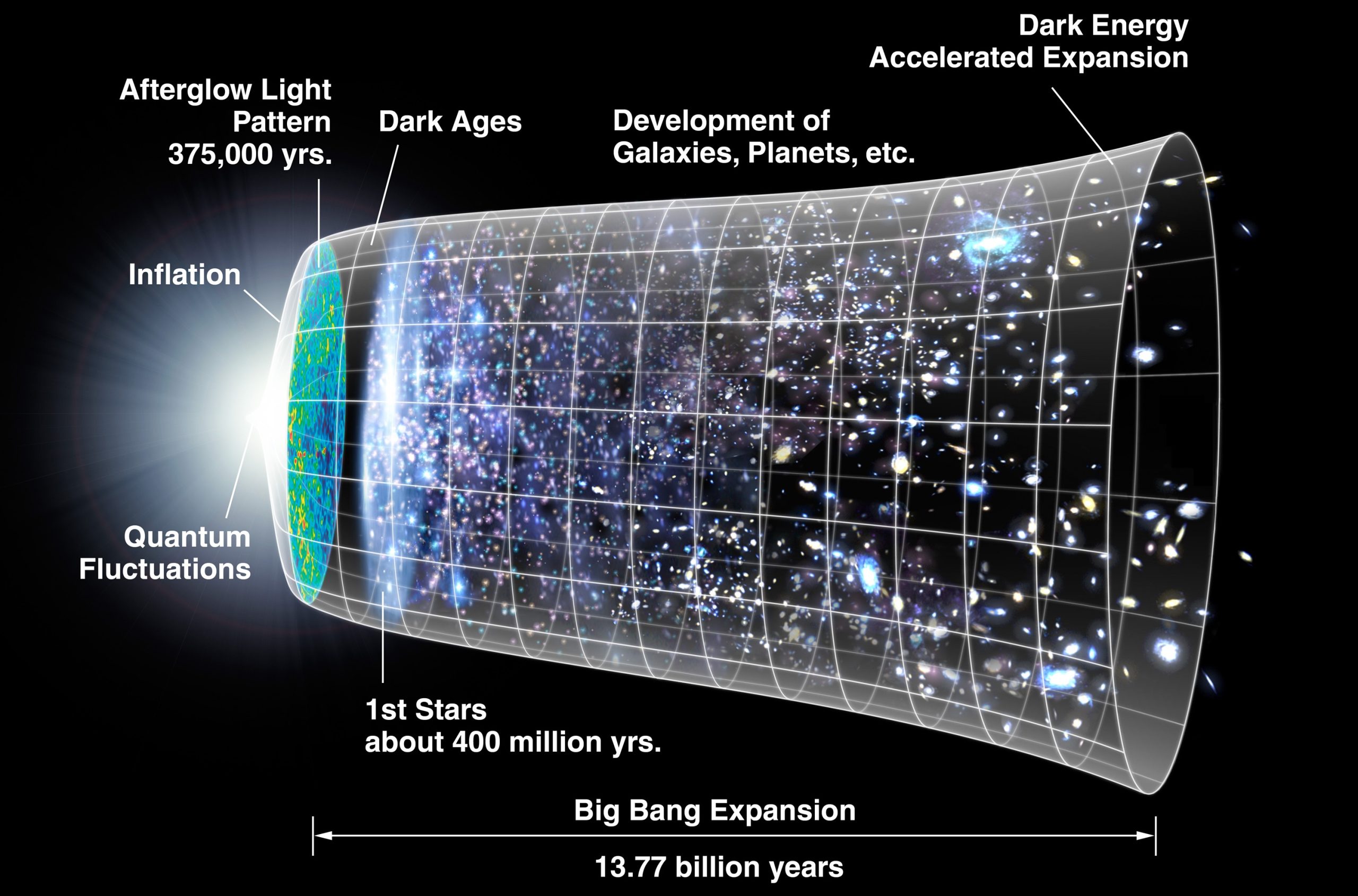
A timeline of cosmic history. The widening shape shows distances growing over time; it is not a picture of an edge or of anything outside the universe.
WHERE THE EVIDENCE STANDS
WHAT WE DON’T KNOW YET
We do not know the full size or global shape of space. We also do not know whether a wider physical setting exists beyond the universe described by current cosmology.
WHAT WOULD CHANGE THIS ANSWER
A repeatable observation that specifically reveals an edge, a center, or an external dimension would change this picture. A claim about a larger setting needs a test that distinguishes it from ordinary expansion.
Picture dots on a stretchy sheet. As the sheet stretches, the dots move farther apart without crawling across it. That is a useful analogy for distant galaxies: the distances between them can grow because the space between them changes. The analogy has a limit. The sheet sits in a room, but the cosmic model does not require a room outside the universe.
How do we know anything is expanding? Light from distant galaxies is stretched toward longer, redder wavelengths. Galaxies farther away generally show more of this redshift. Together with measured distances, that pattern reveals a universe whose large-scale distances change with time. It is a result we can test, even though we cannot watch a cosmic edge move outward.
The name “Big Bang” can mislead us. An ordinary explosion begins somewhere, sends debris into surrounding space, and has a center you can point to. The hot early universe was not that kind of event. Every region we see was once much denser and hotter. John Mather, a Nobel laureate and the Webb telescope’s senior project scientist, says the Big Bang “happened everywhere at once,” not at one special address. If observers lived in another distant galaxy, they would also see the broad pattern of faraway galaxies receding.
“No outside needed” is a statement about the model, not a declaration that every philosophical question is solved. We can see only a finite part of the universe, because light has had a finite time to reach us. Whether space as a whole continues forever, loops around, or has some larger context remains unsettled. The honest answer is that expansion tells us how distances within space change. It does not show us a container around everything.
Free long answer 1 of 3 this month.
On very large scales, the distance between galaxies that are not held together by gravity increases over time. Astronomers describe this with a “scale factor”: a way to compare the distance between such places at one cosmic time with the distance at another. It is a property of the geometry of space, not a wind pushing galaxies through an otherwise fixed emptiness. Redshift gives a visible clue. As light crosses expanding space, its wavelength grows. Measure that stretch and compare it with an independently estimated distance, and a pattern appears: more distant galaxies generally show more expansion.
This does not mean everything stretches. NASA’s raisin-bread analogy gets this part right: the dough grows between the raisins, but the raisins stay the same size. In NASA’s words, the matter is not expanding; the space around it is. Atoms, people and planets do not grow with the universe. The analogy also gets something wrong. The loaf rises into a kitchen. The cosmic calculation has no kitchen in it.
An explosion has a center because debris flies away from a particular place. But if distances grow throughout space, each observer sees distant, unbound galaxies getting farther away. From another galaxy the broad pattern looks similar. Earth is not privileged; it is simply where our telescope sits. John Mather’s NASA explanation says that the Big Bang happened everywhere at once. The microwave glow left by the hot early universe surrounds us in every direction, another clue that the early event was not a blast from a location we could travel to.
The surface of an inflating balloon can help here. Draw dots on the rubber. As it expands, every dot sees the others recede. No dot on the surface is the center of that two-dimensional surface. But the balloon analogy can trick us: its center and surrounding air are parts of our three-dimensional room. There is no evidence that our three-dimensional universe must be the skin of a four-dimensional balloon. The picture illustrates changing distances, not a proven extra dimension.
It has a horizon: there are places too far away for their light to have reached us since the hot early period. A horizon is a limit to what we can currently observe. It is not a wall where space ends. Imagine standing in fog. You see only so far, but the fog does not mark the edge of the road. The analogy is imperfect because cosmic horizons depend on the history of expansion, not just blocked visibility, yet it helps separate a limit of sight from a physical boundary.
Whether all of space is infinite is a different question, explored in Is the universe infinite? A universe could be finite without having an edge, just as the surface of Earth has a finite area but no rim. That is again an analogy, not a claim that space has Earth’s shape. Measurements tell us about the portion we can observe. They have not supplied a complete map of all space beyond the horizon.
The objection is simple: in daily life, “expanding” always means taking up more of something around you. A balloon, a crowd, or a cloud needs a surrounding space. So how can the universe be different? Because the everyday examples are objects in space. In general relativity, Einstein’s theory of gravity, distances are themselves part of the physical description and can change. The model asks whether light, galaxies, and measured separations fit that changing geometry. They do. It does not first require a second space outside the first.
Could there still be a larger setting? Possibly. Some physicists have proposed ideas of this kind, such as the other-universe proposals in Could there be other universes beyond ours? None has been observed, and the expansion we see does not establish one. To move such a proposal beyond possibility, its advocates must identify a distinctive observation and show that ordinary cosmology would not produce the same result. A drawing of a balloon does not meet that standard.
Read NASA’s account of Hubble’s law and its raisin-bread analogy. Ask which parts represent measured facts and which parts are teaching aids. Then read NASA’s Webb Q&A with John Mather. Notice the explicit claim that the Big Bang was not a firecracker at a time and place. Finally, compare the two questions that often get mixed: “Are distances within space growing?” and “What, if anything, lies outside all space?” Astronomy has strong evidence for the first. The second is not answered by the redshift of galaxies.
That distinction protects curiosity. Saying “the model needs no outside” is a precise scientific statement. Saying “there cannot possibly be any outside” would go farther than the evidence. We can keep asking the larger question while being clear about what observations have actually shown.
There is another everyday trap in the word “bigger.” If you make a map twice as wide, you may imagine that its border moved into blank paper. In cosmology the map's coordinates are a tool, and the physical claim concerns measured distances between places. A new amount of distance can appear between faraway galaxies without any telescope finding an outer border. That is why the best evidence comes from light and galaxies inside the universe, not from a picture of the universe as a ball seen from outside. The picture is a way to teach the mathematics, not a camera view.
The distinction also explains why the Big Bang does not identify a place in the sky. We can look in every direction and see ancient light from the hot early universe. Each direction takes us back toward the time when the light was released. None points toward a unique center of the whole expansion. If an observer in another galaxy made the same kind of sky map, that observer would also find the early glow all around. The universe can have a history without having a central launch pad.
When someone says the universe is “expanding into itself,” treat that as shorthand for growing distances within space. It does not mean space is a substance flowing into a hidden cavity. And when someone asks whether there might be a wider reality, keep the question open. The current evidence establishes expansion; it does not make the wider question meaningless. It simply cannot answer that question without a clear, testable clue.
THREE THINGS TO REMEMBER
Next on the path “Where did everything come from?” · step 4 of 7
Is gravity a force, or a bend in space and time?
Both: gravity acts as a force in Newton’s model and as curved space and time in Einstein’s.
See this path: Where did everything come from?
God Plays Dice answers big questions in plain words, with sources and one of six honest labels.
See a mistake? Report a problem. Corrections are made openly.
CONTINUE THE THREAD
OriginsExplainer
The part we can see is about 93 billion light-years wide, but whether the whole universe ends, loops back or goes on forever is still unknown.
OriginsExplainer
From the first atomic nuclei back to a possible burst of inflation, here is what scientists have tested about the first second, and where knowledge runs out.
OriginsAnswer
An earlier history needs a calculable path to a measurement that separates it from competing explanations.
The Architect AI companion · All Access
Labels describe the evidence for a claim, not the people who hold it.
Match my phone uses your device’s light or dark setting.