OriginsAnswer
Why is it so hard to test ideas about what happened before the hot Big Bang?
An earlier history needs a calculable path to a measurement that separates it from competing explanations.
THE QUESTION LIBRARY ORIGINS
Many physicists say life depends on a few numbers of nature falling in narrow ranges, so here is what that means, why 137 is famous, and how design, many universes and luck each try to explain it.
Many physicists say yes, in a limited sense: life as we know it seems to depend on some numbers of nature falling in narrow ranges. In one 2000 study, changing the strong nuclear force by more than about 0.5% cut the carbon or oxygen made in stars by 30 to 1,000 times. Why the numbers are what they are is still open. A designer, many universes and plain luck are all serious answers, and none has been shown to be right.
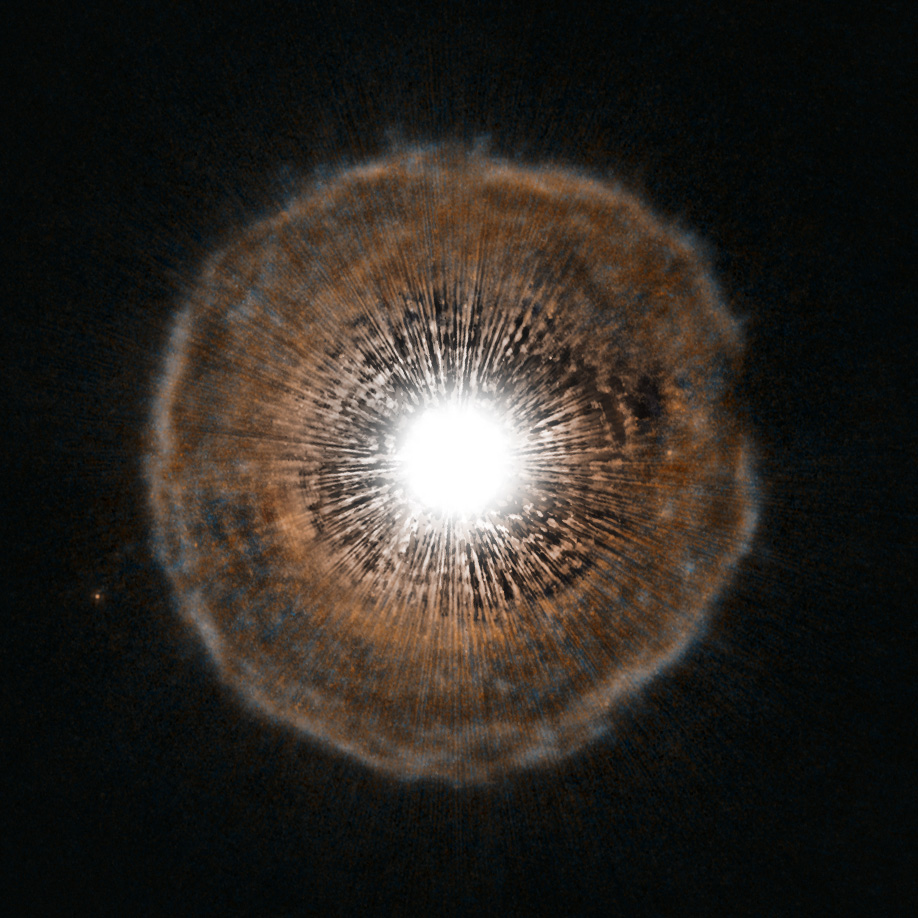
The carbon star U Camelopardalis, seen by the Hubble Space Telescope, inside a shell of gas it blew off as helium around its core began to fuse. Its atmosphere holds more carbon than oxygen.
WHERE THE EVIDENCE STANDS
WHAT WE DON’T KNOW YET
Nobody knows yet why the constants have the values they do, or whether a deeper theory will fix them. Nobody knows how to count the odds for numbers that could, in principle, take any value. And nobody knows whether other universes exist.
WHAT WOULD CHANGE THIS ANSWER
A deeper theory that forces the constants to their measured values would weaken the idea that they were tuned. Strong, independent evidence for other universes with different constants would change how we read the tuning. So would firm proof that a constant differs in another part of space.
Many physicists say yes, in a limited sense. Life as we know it seems to depend on a handful of numbers in nature falling inside narrow ranges. That is the scientific part. Why the numbers fall where they do is a different question, and nobody knows the answer yet.
Here is one example. Most of the carbon in our universe is made inside stars. In 2000, three researchers publishing in the journal Science ran the numbers for how stars make carbon. They found that if the strong nuclear force, which holds atomic nuclei together, changed by more than about 0.5%, stars would make 30 to 1,000 times less carbon or oxygen. Life as we know it needs both.
Physicists call results like this fine-tuning. The word does not mean someone did the tuning. The Stanford Encyclopedia of Philosophy compares it to a phone: it only works if its parts are just right. The phone had a designer. For the universe, that is the question people disagree about.
People ask about fine-tuning for many reasons. A believer may see a Creator’s fingerprints. A skeptic may suspect we are fooled by the fact that we are here to look. Someone else just wonders why nature has these numbers and not others. All of these are fair questions.
There are four main answers. Some see a designer. Some think there are many universes with different numbers, and we live in one that happens to allow life. Some say it is luck, and that we could only ever find ourselves in a universe that allows observers. And some expect a deeper theory to explain the numbers one day. Each answer has careful defenders and a strong objection. This page walks through them fairly.
Free long answer 1 of 3 this month.
The Stanford Encyclopedia’s fine-tuning entry lists several cases that physicists have studied. Here are a few, in plain words.
Some numbers in nature are also wildly different in size. The same entry notes that, between an electron and a proton, electromagnetism is stronger than gravity by roughly a 1 followed by 40 zeros. CERN puts it simply: a small fridge magnet out-pulls the gravity of the whole Earth. CERN’s page on extra dimensions opens with that very puzzle, why gravity is so much weaker than the other forces, and explores one possible answer.
The fine-structure constant, written with the Greek letter alpha, measures how strongly light and electric charges interact. It was introduced by Sommerfeld in 1916, according to NIST, the U.S. national measurement lab. It has no units. It is a pure number, very nearly 1/137, so its value is the same whether you use meters or miles.
That is why it fascinates physicists. Quanta Magazine reports that Richard Feynman called it “a magic number that comes to us with no understanding,” and that Paul Dirac called its origin “the most fundamental unsolved problem of physics.” Quanta adds that physicists have more or less given up trying to explain where the value comes from. Many now accept that the constants could be random, set by chance as the universe began. They still measure alpha as precisely as they can, because precise values test the Standard Model, the main theory of particles.
One detail surprises many readers. NIST explains that alpha grows at high energies, to about 1/128. So NIST calls the famous number 1/137 “not unique or especially fundamental.” It is the low-energy value.
Physicists have tested this idea seriously. A review by Jean-Philippe Uzan lists many checks: atomic clocks, light from distant quasars, the timing of pulsars, the afterglow of the Big Bang, and the making of the first elements.
In 2020, a team led by Michael Wilczynska studied light from a quasar so far away that the light left it when the universe was only 0.8 billion years old. They found no evidence that alpha has changed over time. When they combined these with older data, the data slightly preferred a model in which alpha varies across space. The team called this preference marginal, and it is not established. The Stanford Encyclopedia says ideas of constants that vary across space seem disfavored by the evidence.
What about the speed of light? In 1998, Andreas Albrecht and João Magueijo explored what would follow if light traveled faster in the early universe. They argued this could solve some cosmic puzzles, such as why space is so flat. Their paper is a theoretical proposal; it does not report any observation of faster light. M. J. Duff argues that asking whether the speed of light alone changed has no clear meaning, since its number depends on our choice of units. Changes in pure numbers such as alpha, he says, are a fair subject for testing. Not everyone agrees: Duff’s paper includes appendices answering criticisms from other physicists and remarks by Magueijo. Since 1983, the speed of light has been fixed by definition in our units, at 299,792,458 meters per second.
The Stanford Encyclopedia says many regard fine-tuning as the strongest form of the design argument that modern science offers. Defenders such as Swinburne and Collins argue that a life-friendly universe is more likely if God exists than if not. Leslie offers a famous story, as an analogy: a prisoner faces a firing squad, all the marksmen fire, and he is still alive. He wonders whether they meant to miss. Leslie and others argue it would be very implausible for him not to suspect it. (The analogy breaks in one place: we know firing squads have people who plan them, which is the very thing in question for the universe.)
Strongest reply: Elliott Sober and Jan Narveson argue we are in no position to predict what a bodiless cosmic designer would want or do. As Sober puts it, our judgments about design rest on what we know of human designers. Defenders such as Rota answer that the argument still has force, because a life-friendly universe without a designer would be so utterly unexpected. The debate continues.
If there are countless universes with different constants, some will allow life, and we must live in one of those. Physicists such as Susskind, Greene and Tegmark regard this step to a multiverse as a rational response to fine-tuning. Our page Could there be other universes beyond ours? looks at it closely. Whether our own space goes on forever is a separate puzzle, covered in Is the universe infinite?
Strongest reply: Ian Hacking identified the “inverse gambler’s fallacy” in 1987. If you walk into a casino and see a lucky roll, you should not conclude that many rolls probably came before. Critics say inferring other universes from our lucky one makes the same mistake. Many philosophers reject that charge. McGrath, for example, argues that the casino story misleads, because we could not have found ourselves in a universe unfit for life. The Stanford Encyclopedia adds that concrete multiverse ideas are extremely difficult to test.
Carter’s weak anthropic principle points out that we could only ever observe conditions that allow observers. The Stanford Encyclopedia adds a simple point, a view shared by writers such as Gould: any exact run in a long series of coin tosses is very unlikely, yet it needs no special explanation. Perhaps fine-tuning is like that.
Strongest reply: Leslie agrees that unlikely events do not always need explaining. But he argues that when good candidate explanations are on the table, we should not dismiss fine-tuning as how things happen to be.
Einstein hoped a final theory would fix every constant, leaving nothing to tune. Cosmic inflation, a brief burst of very fast expansion in the first instant, is the model case. If it is right, it explains why space is so flat, which older accounts treated as fine-tuned. Not everyone accepts its successes. See What is a theory of everything? for where that search stands.
Strongest reply: The Stanford Encyclopedia notes that string theory, a leading candidate, seems to allow an enormous number of possible sets of laws, not one. And unlike flatness, most other constants show no clear pattern that a theory might explain.
“Fine-tuned means someone tuned it.” In physics, the word only describes sensitivity. Whether anyone did the tuning is the open question.
“Every constant sits on a knife’s edge.” The ranges differ a lot. Fred Adams argues that life-friendly ranges are quite considerable, and that a universe could even have been more friendly to life than ours. Luke Barnes disagrees when many constants change at once.
“It is about humans.” The arguments concern life of any kind. The worry is that different numbers would give a universe with far less structure, such as no stars or no atoms beyond hydrogen.
For the design argument alongside other arguments for God, see What are the main arguments for God’s existence?.
The answer stays the same after all this detail. Many physicists find that life depends on some constants in narrow ranges, and why nature has these values remains an open question.
THREE THINGS TO REMEMBER
Next on the path “Can faith and science share a table?” · step 7 of 8
Why do bad things happen to good people?
Nobody has a final answer, but part of the question can be answered.
See this path: Can faith and science share a table?
God Plays Dice answers big questions in plain words, with sources and one of six honest labels.
See a mistake? Report a problem. Corrections are made openly.
CONTINUE THE THREAD
OriginsAnswer
An earlier history needs a calculable path to a measurement that separates it from competing explanations.
OriginsAnswer
Several serious ideas in physics allow other universes, so here is what each one says, how scientists have tried to test them, and how a scientific braneworld differs from the multiverse in the movies.
OriginsAnswer
Cosmic expansion means distances between faraway galaxies grow; it does not require a wall, an edge, or a room beyond space.
The Architect AI companion · All Access
Labels describe the evidence for a claim, not the people who hold it.
Match my phone uses your device’s light or dark setting.