Life in the UniverseEssay · personal view
The Questions I Would Ask an Alien
If I ever met a visitor from another world, I would skip the small talk. I would ask what its civilization knows about beginnings—and how it knows.
ORIGINS ESSAY · PERSONAL VIEW
The Big Bang explains an early hot, dense universe. It may not be the first page of reality. Here is my best current hypothesis—and the evidence that would have to judge it.
What came before the Big Bang?
The most honest scientific answer is: we do not know.
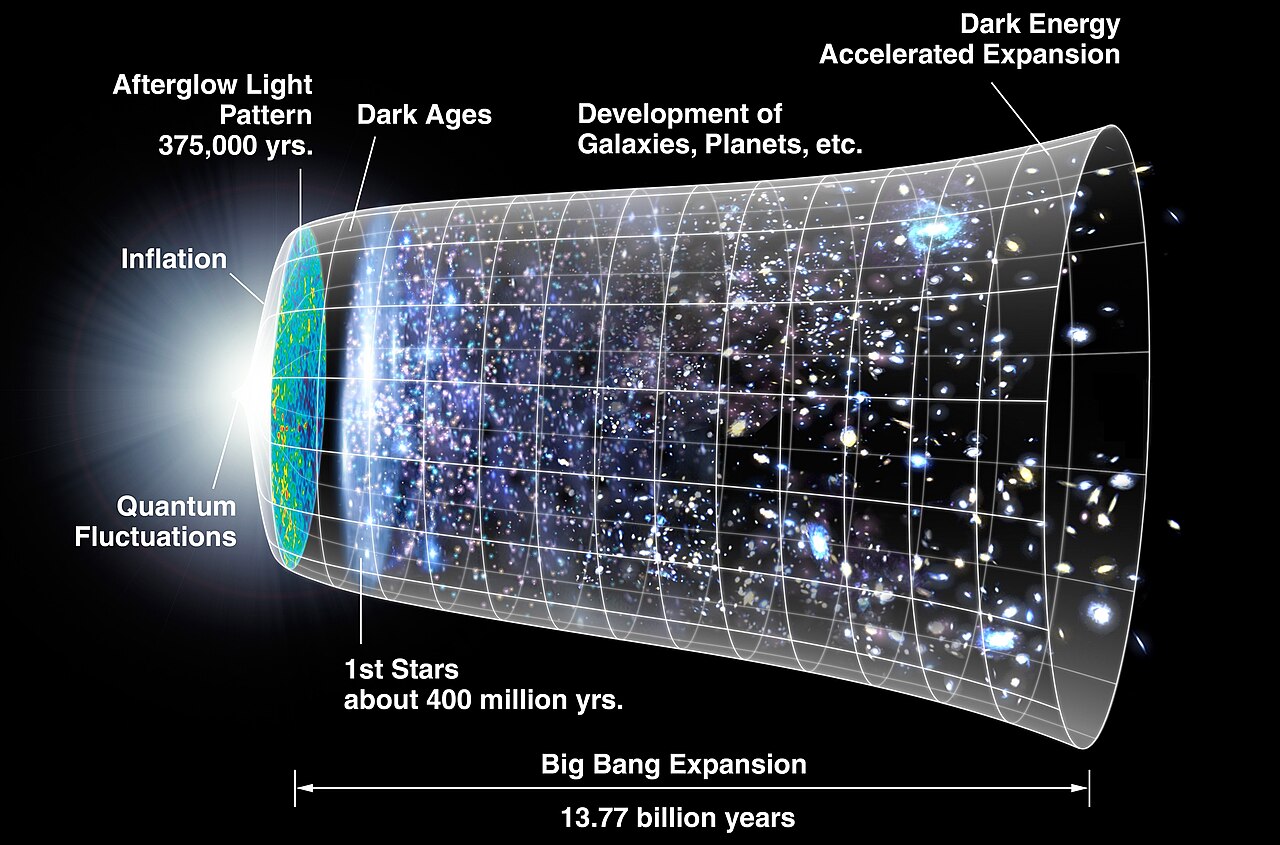
We know the observable universe was once much hotter and denser than it is today. We know space expanded, matter cooled, atoms formed, stars ignited, galaxies grew, and eventually life appeared on at least one planet.
The Big Bang model explains that history extraordinarily well.
But when people ask, “What actually banged?” they are asking about the boundary of the model. Was the hot, dense beginning the beginning of everything? Did time itself start there? Was it a transition from an earlier state? Did something happen in a reality larger than the universe we observe?
Science does not yet have a confirmed answer.
I have a hypothesis.
Our Big Bang may have been the inside view of a short, violent event in a larger-dimensional arena, leaving behind a gravitational-wave background with a measurable bend—a knee—that pulsar timing arrays can test.
That is the disciplined version of an idea that first came to me while I was awake in bed on February 18, 2019.
A physical picture formed in my mind: perhaps our Big Bang was not the absolute beginning, but the local aftermath of something like a collapse, rupture, or blast outside the dimensions we ordinarily experience.
The picture was not evidence.
It was a question shaped like a mechanism.
Imagine living on the surface of a pond without knowing the pond has depth.
Something violent happens beneath or above the surface. You cannot observe the cause directly. You experience only a wave racing across your world.
In this analogy, our universe is the surface. A larger-dimensional environment is the unseen depth. The Big Bang is the local impact.
The analogy is not literal physics. It does not explain the mechanism by itself. Its purpose is to make the question visible:
Could an event outside our familiar dimensions produce the hot, expanding universe we see from inside?
A story about an invisible higher dimension can explain anything if it is allowed to change whenever evidence disagrees.
That would not be science.
The idea becomes scientific only when it risks failure.
A short, energetic event should leave fingerprints. In the version I study, one possible fingerprint is a stochastic gravitational-wave background—a broad hum of overlapping ripples in spacetime—with a smooth change in slope.
That change is the knee.
Pulsar timing arrays, which use rapidly spinning neutron stars as cosmic clocks, are sensitive to extremely slow gravitational waves with periods measured in years. If a cosmological knee exists in that band, future data may sharpen it.
If the spectrum settles into a simple straight power law instead, the blast interpretation weakens.
That is the point.
Here is the boundary I want readers to keep clear.
Established: The universe passed through a hot, dense early phase. Gravitational waves exist. Pulsar timing collaborations have found evidence for a common low-frequency gravitational-wave signal. Supermassive black-hole binaries are a leading explanation for much of that background.
Proposed: A short higher-dimensional event may contribute a knee-shaped cosmological component.
Screening result: In the public-data approximation used in the snapshot behind God Plays Dice, a knee-like curve fits the selected free-spectrum points better than simple straight-line alternatives.
Not established: That the knee is real, that it is cosmological, or that a higher-dimensional blast caused our Big Bang.
A full test requires stronger likelihood information, proper treatment of correlations, independent reproduction, and future data.
The hypothesis loses if better PTA data remove the bend.
It loses if different timing arrays place the knee in incompatible locations.
It loses if the gravitational-wave energy required by the model violates early-universe limits.
It loses if the same spectrum predicts signals in other frequency bands that observations rule out.
It may also lose if the analysis contains an error or if a simpler model explains the evidence better.
I do not list these possibilities reluctantly.
A hypothesis that cannot die is not an explanation. It is a refuge.
Not by itself.
Earlier versions of my thinking tried to connect the blast picture quickly to dark matter, dark energy, particle patterns, the accelerated expansion of the universe, and larger chains of universes.
Those are interesting possibilities, but they are not established consequences of the core hypothesis. Adding every mystery to one story can make the story feel powerful while making it impossible to test.
So I now separate the claims.
The central question of the blast-only hypothesis is narrower:
Can a short higher-dimensional event produce a gravitational-wave fingerprint that survives real observational constraints?
Questions about dark matter, dark energy, particle physics, God, purpose, and a multiverse remain open.
If the knee persisted under better data and stronger analysis, and if a physical higher-dimensional mechanism could produce it without breaking everything else we know, then the Big Bang might stop looking like an absolute wall.
It could become the beginning of our observable chapter rather than the beginning of all reality.
That would not prove God.
It would not disprove God.
It would move one part of the origin question from theology and philosophy toward measurable physics.
And if the hypothesis fails, the question remains valuable. We will have learned more about the gravitational-wave background, the limits of public-data screening, and how easily a compelling shape can disappear under better evidence.
As citizens of this universe, we have every right to ask how we got here.
We also have a responsibility to separate what we imagine from what nature has shown us.
My best guess is that the Big Bang may have had a physical backstory in a larger arena.
My stronger commitment is not to the guess.
It is to the test.
The universe does not owe my idea survival.
It only owes us the answer its evidence allows.
Did time begin at the Big Bang?Open question
Nobody knows yet. About 13.8 billion years ago the universe was extremely hot and dense, and it has been expanding and cooling ever since; that part is well…
Why is there something rather than nothing?Beyond science
Nobody knows, and science alone may never be able to say. Physics traces our universe back to a hot, dense start about 13.8 billion years ago, and it has ideas…
Author’s hypothesisCosmic origins
Could our hot beginning be the aftermath of something larger?

Ricardo Maldonado, founder and editor of God Plays Dice.
More essays by Ricardo
Why is it so hard to test ideas about what happened before the hot Big Bang?
We infer earlier history from later traces.
God Plays Dice answers big questions in plain words, with sources and one of six honest labels.
CONTINUE THE THREAD
Life in the UniverseEssay · personal view
If I ever met a visitor from another world, I would skip the small talk. I would ask what its civilization knows about beginnings—and how it knows.
Meaning & LifeEssay · personal view
Becoming a father did not answer my questions about life. It changed which answers mattered most.
OriginsEssay · personal view
To another intelligence, we might not be “humans” at all, but one highly social species of living organism—technologically remarkable, biologically related to the rest of life, and still learning what consciousness means.
The Architect AI companion · All Access
Labels describe the evidence for a claim, not the people who hold it.
Match my phone uses your device’s light or dark setting.