
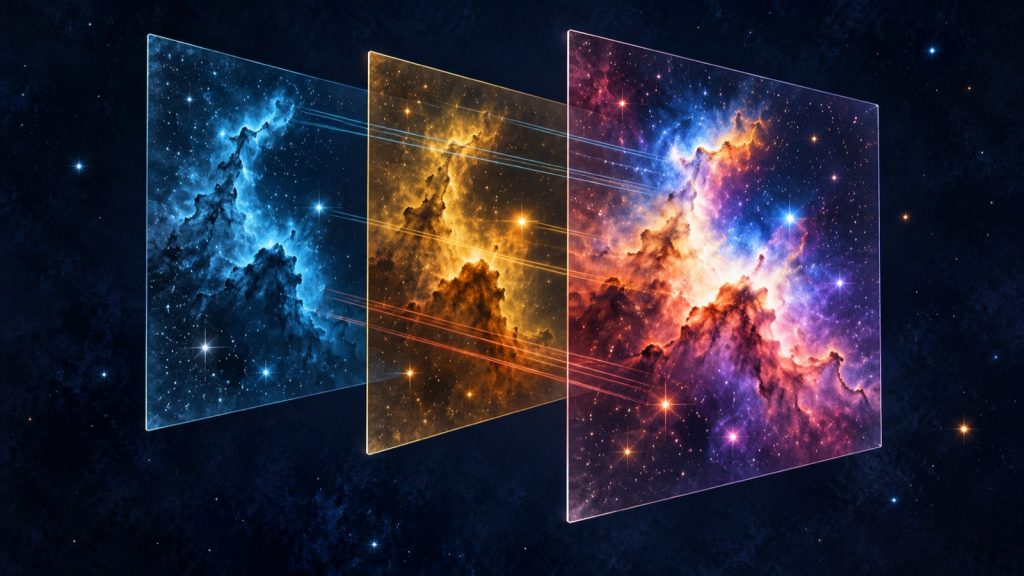
How We KnowAnswer
Are the colors in space photos real?
A space image can be faithful to measured light without matching human eyesight. Here is how to read the translation.
THE QUESTION LIBRARY HOW WE KNOW
How scientists check and correct mistakes, what failed replications can reveal, and why anomalies need evidence before they become discoveries.
Science catches mistakes when people challenge claims, inspect the work and try the tests again. Better evidence can lead to a revised explanation or a corrected research record. That makes correction possible; it does not guarantee that every error is found quickly, or that scientists always respond well.
WHAT WE DON’T KNOW YET
These sources do not establish how many errors remain undiscovered across all scientific fields or how quickly any particular claim will be corrected. Failed replication alone does not distinguish fraud, error or differing conditions.
WHAT WOULD CHANGE THIS ANSWER
For a particular claim: new independent tests, a demonstrated analysis error or a substantiated investigation finding could change the assessment. No universal timetable or automatic correction guarantee.
Calling science self-correcting describes work people must do: expose a claim to checks, investigate what went wrong, and revise the public record when the evidence calls for it. The route matters more than the slogan.
Free long answer 1 of 3 this month.
It means a published claim can be checked and changed. Publication is a starting point for scrutiny, not protection from it. The National Academies’ 2019 review distinguishes two useful checks: rerunning calculations with the original data and code, and collecting new data to test the same question. The first checks the analysis; the second checks whether the finding holds again.
A wrong answer is not automatically dishonest. In the 2000 U.S. federal research misconduct policy, making up results, misrepresenting research and taking others’ work without credit are distinguished from honest error or disagreement. That distinction matters: a failed test is not proof that someone cheated.
The policy describes inquiries, investigations and decisions about corrective action. It also includes correcting the research record among possible responses. These are concrete routes for investigating a concern, rather than asking readers to trust a promise that science will eventually fix itself. An accusation still needs evidence and a fair investigation.
The phrase describes concern about published findings that later tests did not confirm. A prominent 2015 psychology project repeated 100 studies from three journals. Thirty-six percent of the repeat studies produced statistically significant results. That means their results crossed a statistical threshold; it is not a count of findings proved true or false.
The researchers used several measures of replication success and warned that no single measure was enough. Their results showed substantially weaker support for many original findings. They did not show that 64 percent of all science is false, or that every unsuccessful replication exposes fraud.
The National Academies’ review recommends clearer methods, uncertainty estimates and appropriate statistical practice. A failure to repeat can reflect an error, bias or an important difference between conditions. Finding out which requires further work. The lesson is to make claims easier to challenge, not to treat a single paper as the last word.
Yes, but an unexplained result is only the beginning. NASA describes how Neptune was found: Uranus did not move exactly as expected, and Urbain Le Verrier calculated where another planet might explain the difference. Johann Galle then found Neptune in 1846.
The important step was a prediction followed by observation. The puzzle did not establish the planet by itself. This example is a reason to investigate anomalies carefully, not a reason to assume every surprising measurement announces a revolution.
A useful response asks what the new evidence changes. Does it undermine the result, narrow the conditions where it holds, or point to a different explanation? “We were wrong” and “this works only under these conditions” are different corrections. As a reader, ask to see the comparison: what was expected, what happened, and which claim was revised?
Confidence: strong that these checking and correction routes exist; no guarantee that they work promptly in every case. Unknowns: the sources here do not tell us how many errors remain undiscovered across all fields. What would change an assessment: for a particular claim, new independent tests, a demonstrated analysis error or an investigation finding can justify revising it. Ask which evidence bears on that claim.
Read alongside whether science proves things for certain and how to judge a scientific study.
Are the colors in space photos real?
Space photos often show real measurements, but their colors may represent light our eyes cannot see.
God Plays Dice answers big questions in plain words, with sources and one of six honest labels.
See a mistake? Report a problem. Corrections are made openly.
CONTINUE THE THREAD
How We KnowAnswer
A space image can be faithful to measured light without matching human eyesight. Here is how to read the translation.
How We KnowAnswer
Why anecdotes feel convincing, what individual cases can show, and how to assess a confident judgment.
How We KnowAnswer
How scientists distinguish real signals from lucky fits: look-elsewhere effects, independent predictions, black-hole searches and data-window artefacts.
The Architect AI companion · All Access
Labels describe the evidence for a claim, not the people who hold it.
Match my phone uses your device’s light or dark setting.