
How We KnowAnswer
Why do personal stories and gut feelings feel more convincing than data?
Why anecdotes feel convincing, what individual cases can show, and how to assess a confident judgment.
THE QUESTION LIBRARY HOW WE KNOW
A space image can be faithful to measured light without matching human eyesight. Here is how to read the translation.
Space photos often show real measurements, but their colors may represent light our eyes cannot see. Hubble combines filtered exposures; James Webb mainly observes infrared light and translates it into visible colors. Those choices can reveal useful differences without showing an astronaut’s exact view. Check the original caption, instrument and color key before deciding what a blue or red region means.
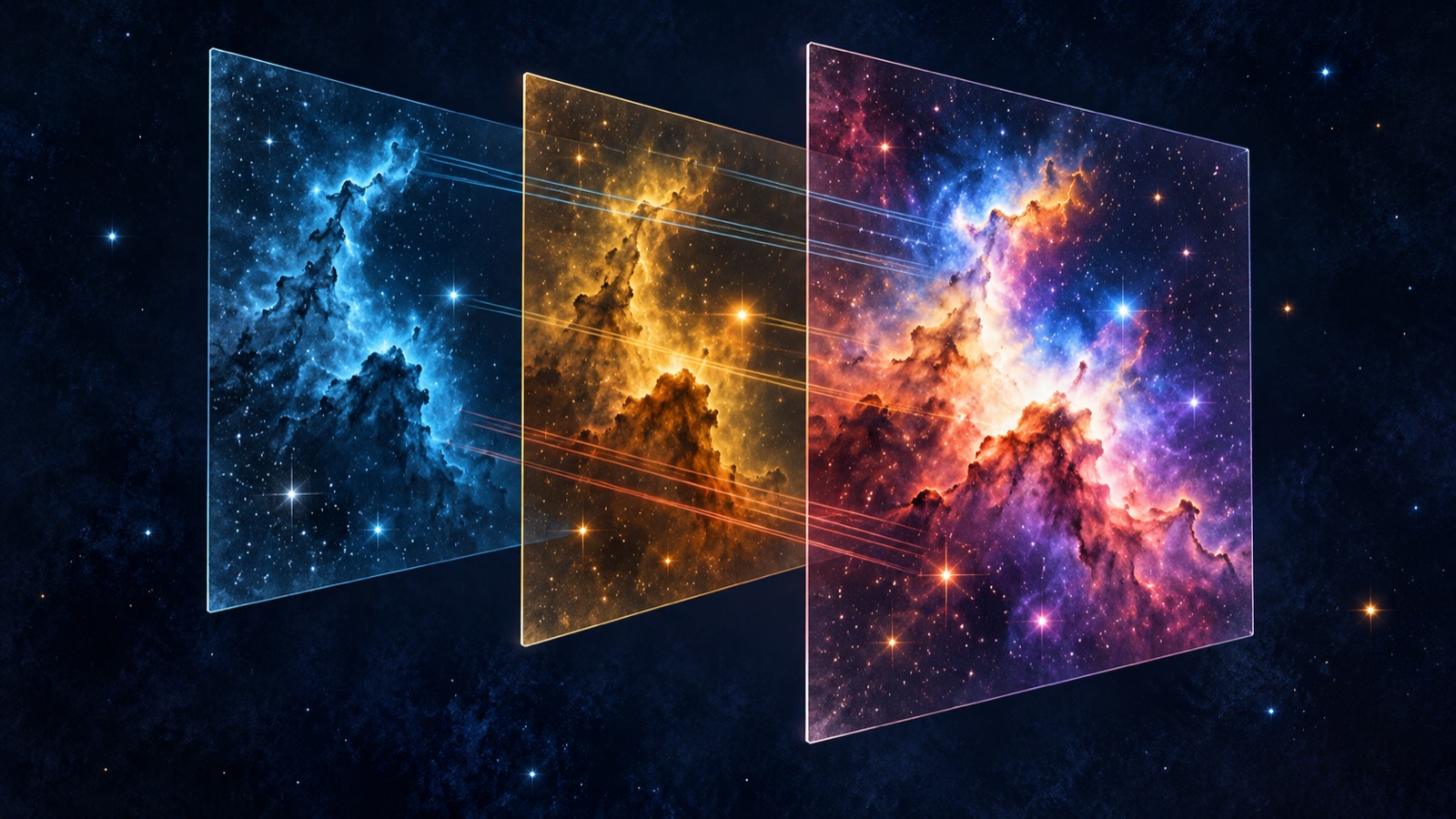
Original AI-generated conceptual illustration for God Plays Dice, October 2026. This is not telescope data or a photograph of a real nebula.
WHERE THE EVIDENCE STANDS
WHAT WE DON’T KNOW YET
A repost without its original caption may not reveal its filters, color assignments or edits. Its colors alone cannot establish composition, temperature, motion or authenticity.
WHAT WOULD CHANGE THIS ANSWER
A corrected release, revised filter key or documented processing error could change the interpretation of a particular image. This answer concerns published image-making methods, not a claim that every circulating space picture is authentic.
A gold cloud in one image, a blue cloud in another: which picture should you trust? Start by asking what each picture measures. The color key matters as much as the picture.
Free long answer 2 of 3 this month.
A telescope detector measures incoming light. An individual exposure can be displayed as shades of gray, with brighter pixels representing a stronger signal. A filter selects a range of wavelengths, meaning a particular part of the light spectrum. Separate filtered exposures can then become separate color channels in a combined image.
NASA explains that Hubble records grayscale images. Some color combinations approximate visible light; others highlight particular elements or wavelengths outside human vision. There is no single rule that every Hubble image uses natural-looking colors.
Usually, no. Webb observes mainly infrared light, beyond human vision. Its pictures need a translation into visible colors. ESA/Webb describes this as representative color: separate measurements receive display colors and are combined.
Think of a rainfall map. Blue and orange can mark different amounts of rain without claiming that rain itself has those colors. The analogy has a limit: a telescope image maps measured light in different wavelength bands, rather than rainfall totals.
In a common ordering, the shorter infrared wavelengths receive blue and the longer ones red. Both may still be infrared. A blue patch therefore does not automatically mean blue light, a hotter object, or something moving toward us. Read that image's key before making a physical claim.
Different instruments and filters collect different parts of the signal. A comparison may reveal a change in what was measured or how it was displayed, without showing a change in the object itself.
NASA's 2023 Webb view of the Crab Nebula gives a concrete example. Its key assigns blue to the F162M filter and red to F2100W, with four additional colors between them. NASA identifies sulfur as red-orange, iron as blue, dust as yellow-white and green, and synchrotron emission as white in that particular presentation. These meanings belong to this image; do not transfer them automatically to another nebula.
Comparing the same object's Hubble and Webb images can be useful precisely because their views differ. Before interpreting a color difference, compare the instruments, filters and color assignments.
Processing alone is not evidence of fabrication. In a NASA interview with image specialists, Joe DePasquale explains how ordered color assignments preserve relationships in the observations. Color can carry information rather than imitate eyesight.
Still, a processed observation and an artist's concept answer different questions. An observation begins with detected signals. An artist's concept illustrates an interpretation or imagined viewpoint. A computer simulation represents a model. The caption should identify which kind of image you are seeing.
NASA's walkthrough of Webb image production describes brightness adjustments, artifact removal, composition choices and scientific review. Some presentation decisions involve judgment. That is a reason to inspect the method and caption, rather than assume either untouched photography or arbitrary invention.
Try this with the Crab Nebula release above: find F162M and F2100W in the caption, then match them to their assigned colors. You have checked a specific part of the translation yourself.
For the wider story of what light tells us, read what we are seeing when we look at stars. For checking a repost's origin, explore how to check a viral video.
The wonder can survive the explanation. Knowing how a picture was made gives you more to see in it.
About this page's artwork: the featured image is an original AI-generated conceptual illustration of color channels. It is not telescope data or a photograph of a real nebula.
THREE THINGS TO REMEMBER
When we look at the stars, what are we really seeing?
Yes: when we look at stars, we see light that left them in the past.
God Plays Dice answers big questions in plain words, with sources and one of six honest labels.
See a mistake? Report a problem. Corrections are made openly.
The Architect AI companion · All Access
Labels describe the evidence for a claim, not the people who hold it.
Match my phone uses your device’s light or dark setting.