
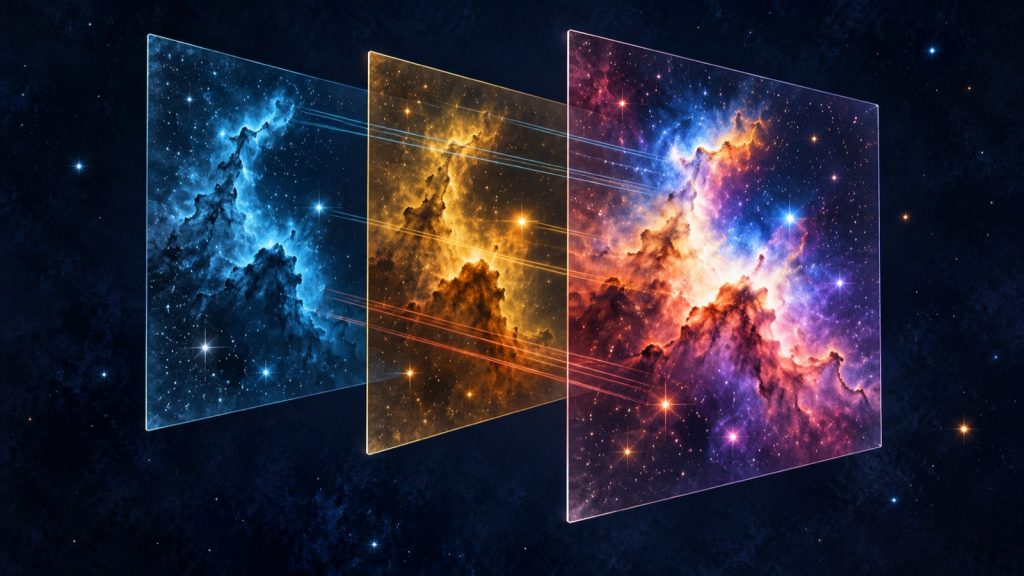
How We KnowAnswer
Are the colors in space photos real?
A space image can be faithful to measured light without matching human eyesight. Here is how to read the translation.
THE QUESTION LIBRARY HOW WE KNOW
Random outcomes can form real streaks. Learn how independent events, chance models, and face pareidolia help explain luck and perceived patterns.
Luck is a useful everyday name for favorable or unfavorable outcomes we did not control. It is not, by itself, evidence for a force that changes the odds. Random sequences can contain real streaks, and our perception can also add patterns that are not evidence of a cause. To distinguish these possibilities, define the outcome and test the pattern against an appropriate chance model.
WHAT WE DON’T KNOW YET
A particular streak may involve dependence, bias, skill, or changing conditions rather than independent chance. This evidence does not establish or exclude every metaphysical interpretation of luck.
WHAT WOULD CHANGE THIS ANSWER
A predefined, repeatable pattern predicting new results beyond an appropriate chance model.
Luck is a useful everyday name for favorable or unfavorable outcomes we did not control. It is not, by itself, evidence for a force that changes the odds. Random sequences can contain real streaks, and our perception can also add patterns that are not evidence of a cause. To distinguish these possibilities, define the outcome and test the pattern against an appropriate chance model.
Free long answer 1 of 3 this month.
A streak can really happen. If a fair coin's tosses are independent, four heads in a row has probability one in sixteen for a specified four-toss block: one-half multiplied four times. After those heads, the next toss still has a one-half chance of heads. NIST defines independence as one event not changing the probability of another. Tails is not owed to you, and heads is not newly favored. This calculation assumes a fair coin and independent tosses. NIST: independent events.
Those assumptions are part of the answer. A biased coin, a changing process, or connected events require another model. Calling a run lucky does not establish which model is right. Nor does finding a streak prove that the process generating it has changed. We must separate a description of past results from a prediction about the next one.
Heads, tails, heads, tails can look fairer than a cluster of heads. But randomness does not require that tidy rhythm. NIST's runs test examines groups of repeated outcomes across a sequence and compares the observed pattern with what a specified random process would predict. Both unusual clustering and unusual regularity can raise questions. The comparison concerns the whole sequence, not just its most striking patch. NIST: testing runs.
Try a thought experiment: before tossing, predict one specific block of four heads. Then compare that task with looking through a long record afterward and choosing any interesting streak. The second task gives you many places to find a match. They are different probability questions. A dramatic example selected afterward should not be assigned the odds of a single prediction made beforehand.
Seeing a face in something that is not a face is called face pareidolia. A 2020 study used brain measurements to compare human faces, objects that looked face-like, and matched ordinary objects. The results supported rapid processing of illusory faces involving face-sensitive brain regions. This helps explain why a face-like arrangement can jump out before you deliberately decide what it is. It does not show that the object is a person or carries a message. Original face-pareidolia research.
There may be a real arrangement of marks and a mistaken interpretation of it at the same time. Likewise, a real streak can invite an unsupported explanation. Confidence is high in the independent-coin calculation and in the existence of face pareidolia. Explaining a particular real-world streak requires its data and assumptions. A repeatable pattern that predicts new observations better than chance could change the conclusion. Read meaningful coincidences and how evidence supports a claim.
THREE THINGS TO REMEMBER
Are the colors in space photos real?
Space photos often show real measurements, but their colors may represent light our eyes cannot see.
God Plays Dice answers big questions in plain words, with sources and one of six honest labels.
See a mistake? Report a problem. Corrections are made openly.
CONTINUE THE THREAD
How We KnowAnswer
A space image can be faithful to measured light without matching human eyesight. Here is how to read the translation.
How We KnowAnswer
Why anecdotes feel convincing, what individual cases can show, and how to assess a confident judgment.
How We KnowAnswer
How scientists distinguish real signals from lucky fits: look-elsewhere effects, independent predictions, black-hole searches and data-window artefacts.
The Architect AI companion · All Access
Labels describe the evidence for a claim, not the people who hold it.
Match my phone uses your device’s light or dark setting.