
How We KnowAnswer
Are the colors in space photos real?
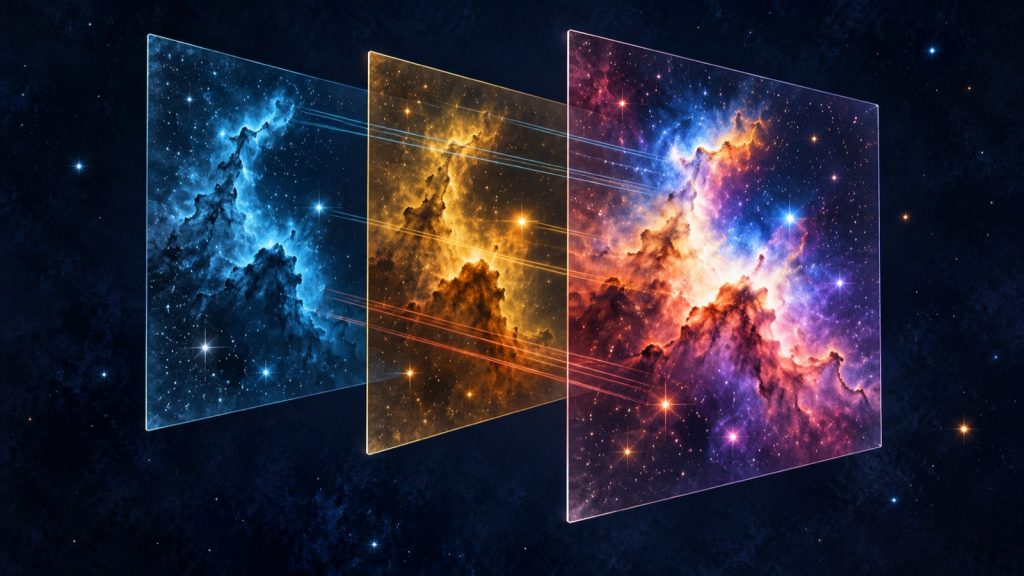
A space image can be faithful to measured light without matching human eyesight. Here is how to read the translation.
THE QUESTION LIBRARY HOW WE KNOW
Proof belongs to mathematics and logic, while science builds strong, testable confidence from evidence, and that difference is a strength, not a weakness.
No, not in the strict sense. Proof belongs to mathematics and logic, where a conclusion follows from starting rules. Science works with evidence. It tests ideas against the world, checks how often chance alone would give such a result, and asks others to repeat the work. The best-tested ideas, like atoms or the Earth orbiting the Sun, are extremely reliable. But even strong theories stay open to refinement if new evidence calls for it.
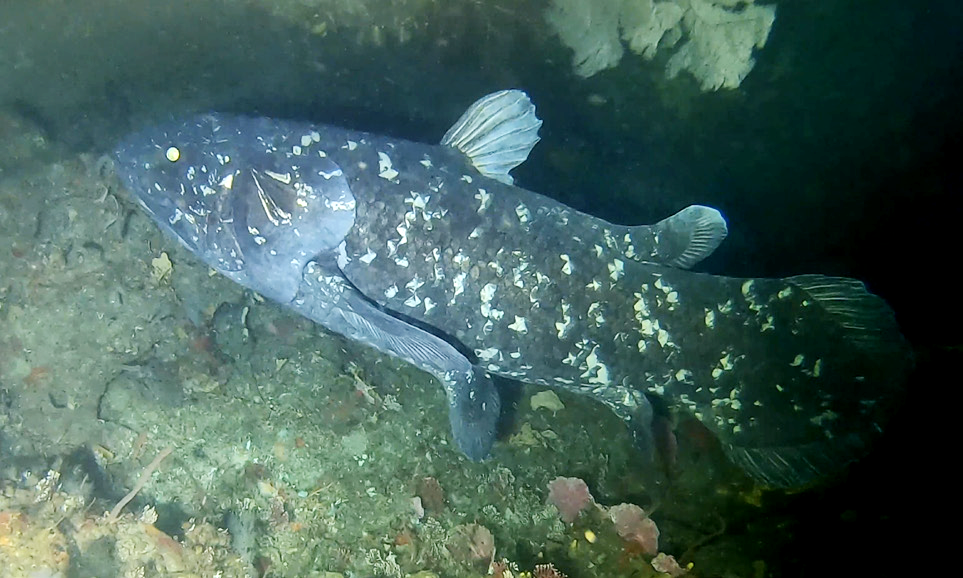
A living coelacanth, photographed 69 metres down off Pumula on South Africa’s KwaZulu-Natal South Coast on 22 November 2019. Until 1938, scientists accepted that these fish had died out about 80 million years ago.
WHERE THE EVIDENCE STANDS
WHAT WE DON’T KNOW YET
Philosophers still disagree about the general rule that separates science from non-science, even when they agree on many specific cases. Nobody can say in advance which of today’s theories will need refining next, or by how much.
WHAT WOULD CHANGE THIS ANSWER
The basic answer would change only if someone found a way to rule out every future surprise in nature, and no such method exists. Smaller parts could change as philosophers and statisticians refine how they describe good evidence.
No, not in the strict sense of the word. Proof belongs to mathematics and logic. Science works with evidence. That can sound like a weakness, but it is a big part of why science keeps getting better.
People ask this for good reasons. A headline says scientists have proved something, and later another headline seems to say the opposite. A relative calls evolution “just a theory.” A video argues that since science can’t prove everything, any idea is as good as any other. These are fair things to wonder about.
Here is the core picture. In mathematics, a proof starts from agreed rules and uses logic to show that a statement must follow. In 1995, the mathematician Andrew Wiles published a proof of Fermat’s Last Theorem, a claim about whole numbers first stated in the 1600s. His proof covers every case at once, which no amount of checking examples could ever do.
Science is different, because its claims are about the real world. As a matter of logic, no pile of observations can show that a general law holds everywhere and always. In principle, one solid counterexample can show that it fails, though in practice scientists first check whether something else went wrong. So scientists talk about evidence and confidence. The U.S. National Academies put it this way: science aims for refined degrees of confidence, rather than complete certainty.
That does not make science a guess. Some ideas are backed by so much evidence that no new finding is likely to overturn them: the Earth goes around the Sun, living things are made of cells, and matter is made of atoms. Engineers use well-tested science to design airplanes, and the airplanes fly. Even these ideas stay open to refinement. That openness is part of why they can be trusted.
Free long answer 2 of 3 this month.
A mathematical proof is a chain of logic. It starts from agreed rules and shows, step by step, that a statement must follow from them. Take Fermat’s Last Theorem. It says that no positive whole numbers x, y and z can make x cubed plus y cubed equal z cubed, and the same goes for every higher power. Pierre de Fermat stated it in the 1600s. Andrew Wiles finished the job in a paper published in 1995, with help from Richard Taylor. The Norwegian Academy of Science and Letters gave him the 2016 Abel Prize for what it called his “stunning proof.”
Science cannot work this way, because its claims are about nature, not about rules we chose. The Stanford Encyclopedia of Philosophy sums up a point the philosopher Karl Popper built on: experience can never logically verify a universal law, but one genuine counterexample can refute it. One example it gives is the law of conservation of energy, which amounts to saying that no perpetual-motion machine can exist. Every machine that fails fits the law. One that truly worked would break it.
So science deals in evidence and degrees of confidence. Understanding Science, a project of the University of California Museum of Paleontology, says real, absolute proof “is not particularly scientific.” Science accepts or rejects ideas based on the evidence, and any idea could be overturned if the evidence called for it. Our editorial standards put it this way: “Proof belongs to mathematics and logic. Science works with evidence, tests and probabilities, and even strong theories can be refined.”
In everyday talk, “theory” often means a hunch. In science it means something much stronger. The National Academies describe a scientific theory as a comprehensive explanation of some part of nature, supported by a vast body of evidence. The idea that the Earth goes around the Sun, cell theory, the idea that matter is made of atoms, and plate tectonics are all theories in this sense.
A hypothesis is a tentative explanation that can be tested, and the Academies add that it must be stated so that it could be rejected. A scientific law is usually a compact description of a pattern in data, a statement of what we expect to happen. Understanding Science gives the ideal gas law as an example. It links the pressure, volume and temperature of a gas, yet real gases do not follow it exactly. Laws can have exceptions too.
Hypotheses do not grow up into theories, and theories do not graduate into laws. Understanding Science compares them to apples, oranges and kumquats: they differ in how much they cover, not in how well they are supported. So calling evolution “just a theory” misreads the word. The National Academies call evolution both a theory and a fact, and note that many religious groups see no conflict between evolution and faith.
Popper argued that a scientific idea must be able to clash with possible observations. He prized “risky” predictions, ones that could conceivably have turned out false. One example that impressed him was Einstein’s theory of gravity, which predicted that light passing a massive body would bend. Arthur Eddington’s observations in 1919 bore it out. Popper contrasted this with theories that could explain any outcome at all, which in his view made them untestable.
Philosophers later found its limits. In the 1800s, the planet Uranus did not move quite as Newton’s physics predicted. Assuming Newton was right, Adams and Le Verrier, working separately, proposed an unseen planet and calculated where it should be. Galle, at the Berlin observatory, found Neptune right there. Popper’s former student Imre Lakatos later asked: what if Galle had found nothing? Scientists would not have abandoned Newton. They could have blamed something else, such as the Earth’s air blurring the telescope’s view. Big theories come wrapped in extra assumptions, and a failed prediction can land on those instead. The Stanford Encyclopedia reports that Popper himself finally accepted that falsifiability alone cannot separate science from non-science.
To tell a real signal from random noise, physicists use sigma (σ), a way of saying how unlikely a result would be if only noise were at work. The Particle Data Group’s statistics review notes that in particle physics an effect often qualifies as a discovery at five sigma. That matches a probability of 2.87 in 10 million, or about 1 in 3.5 million, that noise alone would give a result at least that strong.
On July 4, 2012, the ATLAS and CMS experiments at CERN each reported a new particle at about that level. CERN still called the results preliminary and described a particle “consistent with” the long-sought Higgs boson. ATLAS’s later published paper reported 5.9 sigma, about a 1.7-in-a-billion chance that background noise alone would fluctuate that high.
Sigma is not the whole story. The same review says belief in a new effect also depends on how plausible it is and on trust in the model behind the numbers. The National Academies give an example. Under the assumptions in the report, suppose a hypothesis starts with only a 1 percent chance of being right, and a study reports a result at the p ≤ 0.01 level. Then only about one in eight such conclusions would be correct. With a 25 percent starting chance, more than four in five would be. This is one reason extraordinary claims need extraordinary evidence.
The National Academies separate two checks. Reproducibility means getting consistent results from the same data and code. Replicability means a new study, with its own data, reaching consistent results. In 1989 two electrochemists, Martin Fleischmann and Stanley Pons, claimed room-temperature “cold fusion.” Dozens of laboratories tried to replicate it over the next several months, and a consensus soon formed that they had erred.
In 2015 the Open Science Collaboration repeated 100 studies from three psychology journals. Of the originals, 97% had statistically significant results. Of the repeats, 36% did, and the effects were about half as large. The Academies note that not every failure to replicate is a mistake; some are a normal part of studying complex systems.
The strongest objection goes like this: if science never proves anything, why trust it more than any opinion? The answer is that “not proved” is not the same as “not known.”
Understanding Science points out that accepted ideas are reliable because many lines of evidence support them and their predictions keep coming true. Openness to change keeps that reliability honest. Until 1938, paleontologists accepted that coelacanths, an ancient kind of fish, had died out about 80 million years ago. Then a live one turned up off the coast of South Africa, and the idea was revised.
The theory of gravity shows the same pattern. The National Academies note that it has been backed by many observations on Earth, and that general relativity expanded it in the early 1900s. The Academies write that new knowledge that displaces or reframes older knowledge “should not be interpreted as a weakness in science.” A method that can admit mistakes can also fix them.
Science does not deal in proof. It deals in evidence, and the best of that evidence is very strong.
THREE THINGS TO REMEMBER
WHERE THE AUTHOR’S RESEARCH TOUCHES THIS
Author’s hypothesis. Ricardo Maldonado, author of GOD PLAYS DICE, applies these rules to his own idea. His HD-Blast proposal asks whether our hot beginning could be the aftermath of a burst of energy in a space with more dimensions. The book’s glossary calls a falsifiable idea one that specific evidence could show to be wrong, and says that in science this is the entrance requirement. It keeps a written list of results that would rule the idea out, and Chapter 11 states the rule plainly: “If an idea cannot be wrong, it cannot be science.”
The book also applies the sigma lesson to itself. Its glossary says five sigma is a conventional discovery bar in some fields, and that the book’s own exploratory statistical screens are not sigma-level results. On the Research Notebook, the idea’s benchmark curve for a slow hum of gravitational waves is listed as frozen and waiting for later, independent pulsar-timing data. No test of that curve against such data has been published. The test ledger lists its dated public predictions and the results that would weaken it.
How can you tell good science from bad science?
Good science makes a clear, testable claim; shows how evidence was gathered and analyzed; reports uncertainty; and lets others check the work.
God Plays Dice answers big questions in plain words, with sources and one of six honest labels.
See a mistake? Report a problem. Corrections are made openly.
CONTINUE THE THREAD
How We KnowAnswer
A space image can be faithful to measured light without matching human eyesight. Here is how to read the translation.
How We KnowAnswer
Why anecdotes feel convincing, what individual cases can show, and how to assess a confident judgment.
How We KnowAnswer
How scientists distinguish real signals from lucky fits: look-elsewhere effects, independent predictions, black-hole searches and data-window artefacts.
The Architect AI companion · All Access
Labels describe the evidence for a claim, not the people who hold it.
Match my phone uses your device’s light or dark setting.