
OriginsExplainer
How Big Is the Universe, and Does It Have an Edge?
The part we can see is about 93 billion light-years wide, but whether the whole universe ends, loops back or goes on forever is still unknown.
THE QUESTION LIBRARY THE UNIVERSE
The night sky brings us old light, carrying clues about distant places and earlier times.
Yes: when we look at stars, we see light that left them in the past. Even sunlight takes about eight minutes to reach Earth. A light-year measures distance, not time: it is how far light travels in a year. Telescopes collect old light and split it into patterns that reveal the matter it met. Very distant views also depend on cosmic expansion. They show earlier events, rather than a live view of every object today.
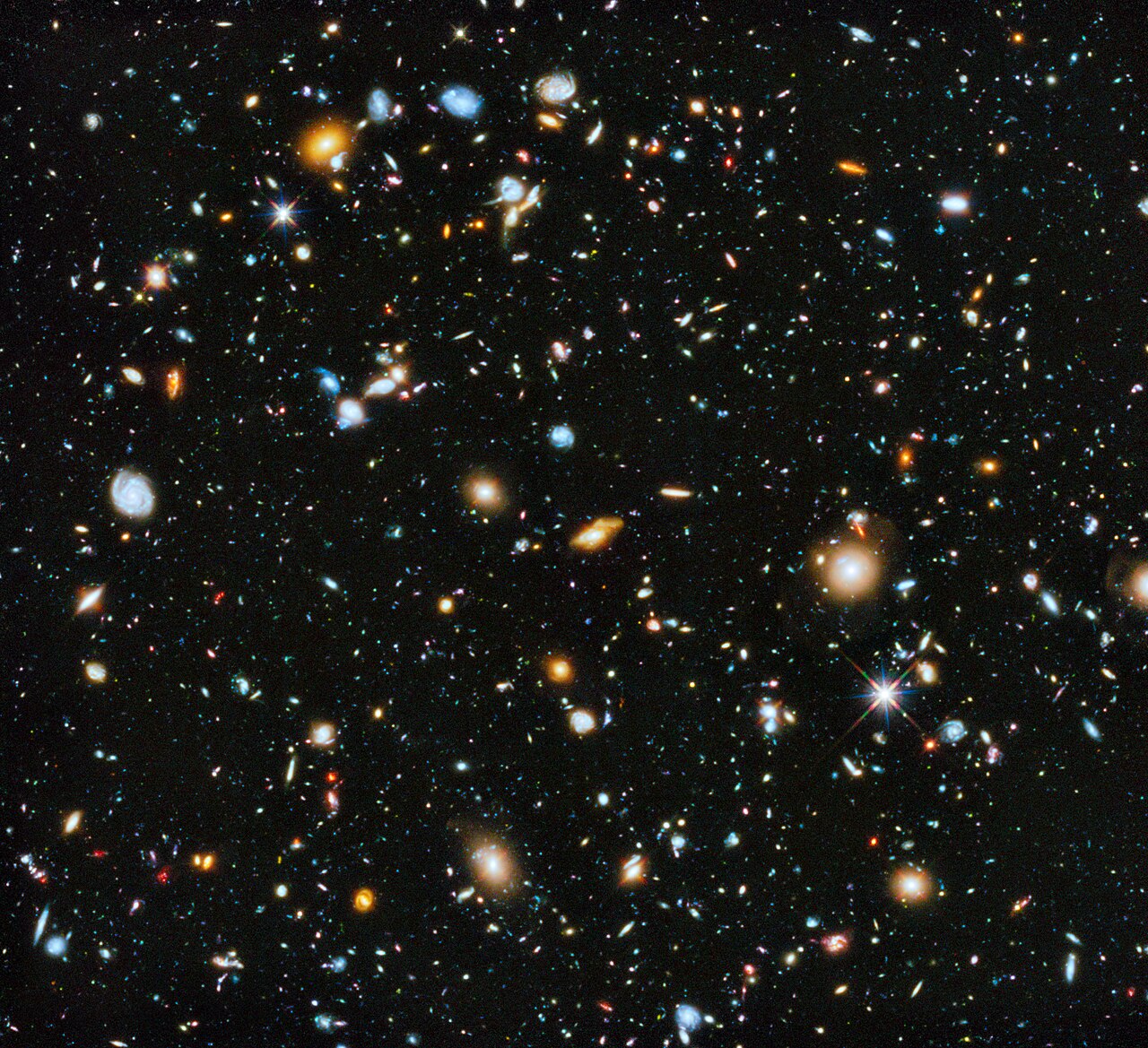
The Hubble Ultra Deep Field combines light from galaxies at different distances. Each galaxy appears as it was when the light we receive left it.
WHERE THE EVIDENCE STANDS
WHAT WE DON’T KNOW YET
We cannot directly see what a distant star is doing now before its newer light arrives. How the earliest stars and galaxies formed remains an active question.
WHAT WOULD CHANGE THIS ANSWER
New observations can change a particular star’s distance, age or makeup. A repeatable failure of light-travel or spectral predictions would require changes to the relevant physical model.
Yes, looking at the stars means receiving light from the past. The delay is real. Light travels fast, but space is wide. The Sun we see is the Sun of about eight minutes ago. A distant star reaches us through light that has been traveling for years.
This can feel strange because the sky looks like a single scene. It is better understood as many arrivals happening together. Light from nearby and distant sources reaches your eyes on the same night, although it began its journey at different times. The scene is present to you; the events it shows are earlier.
A light-year helps express those distances. It means the distance light travels in one year. The word year can make it sound like a clock, but the whole term names a length. For nearby stars, the distance in light-years also gives a useful estimate of how many years their light took to reach us.
Old light can tell us more than where a bright dot appears. Spread it into a spectrum, a pattern ordered by wavelength, and you can find marks made by atoms. An element absorbs and emits particular kinds of light. Comparing those patterns with laboratory measurements helps us learn what distant stars contain.
Our eyes receive only a small part of the range of light. Telescopes also detect radio waves, infrared light and X-rays. Each view adds information. Colors assigned to those invisible signals help us read a picture; they need not be colors an unaided eye would see.
The view has limits. Cosmic expansion complicates very large distances, and earlier cosmic matter blocked light from traveling freely. A telescope is a way to study earlier events. It does not let us step into them, alter them or see every distant object as it is today.
Free long answer 2 of 3 this month.
The event you observe and the moment you receive its light are different. A telescope gathers light arriving now. That light carries information about a source at an earlier time. NASA’s account of observing cosmic history follows this idea from sunlight to distant galaxies. The delay grows as the journey becomes longer.
Consider an analogy: a letter arriving today may describe what someone did years ago. Its arrival is new; its news is old. The analogy breaks because light is a physical signal with a measurable speed, rather than a message that someone chooses when to mail. Still, it helps separate receiving information from the event described.
Seeing earlier light does not mean that most stars in your sky have vanished. It means that this view alone cannot establish their present condition. A claim that a particular star no longer exists needs more information about its nature and history. The delay is established; the star’s later fate is a separate question.
The sky therefore mixes many times. Two points close together in your view may lie at very different distances. Their apparent closeness on the sky cannot tell you that they are neighbors, or that their light left at the same moment. This is one reason a photograph needs context.
A light-year is a distance: how far light travels in a year. NASA Space Place explains both the unit and the delayed view. Suppose, as a simple example, a star is ten light-years away and its distance changes little during the journey. Its light takes about ten years to reach us. The example illustrates the unit; it does not identify a particular star.
Astronomers use this unit because stellar distances make ordinary travel units awkward. It also connects distance with the time that information needs to cross it. Do not read ten light-years as the star’s age. A distance estimate cannot by itself tell you when that star formed.
Across the expanding universe, there are several useful distance measures. Light-travel time, the separation when light was emitted and a calculated separation today are different quantities. David Hogg’s guide to cosmological distances sets out these distinctions. Applying the nearby-star shortcut to every cosmic distance can lead to a mistaken picture.
Cosmic expansion also stretches light toward longer wavelengths. This is called cosmological redshift. ESA’s cosmic-eras explanation shows how astronomers use spectral features and an expansion model to estimate a distant galaxy’s light-travel time. A redshift is a measurement; converting it into an age or distance requires a model.
A spectrum sorts light by wavelength, the distance between successive wave peaks. Within it, atoms leave patterns of missing or added light. These are absorption and emission features. NASA’s Webb spectroscopy explainer connects those patterns with the allowed changes in an atom’s energy.
Here is an analogy: the pattern acts like an identifying fingerprint. The analogy breaks if it makes the process sound like reading a perfect label from a single line. Real spectra can contain overlapping features, weak signals and light altered along its path. Astronomers compare patterns and test how well competing explanations fit.
The strongest objection is reasonable: a star is far away, and nobody has brought a sample back. The reply is a testable connection between laboratory physics and astronomical light. The same element has characteristic spectral patterns in both settings. This supports an inference about composition, with limits set by the quality of the data.
A spectrum does not weigh every atom inside a star. It mainly records the material that emitted or altered the received light. NASA’s Hubble spectroscopy page describes how spectra can also reveal conditions and intervening gas. Asking which material produced a feature helps keep the conclusion within the observation’s reach.
It would reveal more than the familiar stars, but there is no single ordinary color view of all wavelengths. Radio waves, microwaves, infrared light, visible light, ultraviolet light, X-rays and gamma rays are parts of the electromagnetic spectrum. They differ in wavelength. Our eyes respond to a limited band.
Astronomers turn invisible signals into readable images by assigning display colors. NASA’s guide to visualizing light shows a galaxy viewed in infrared, visible light and X-rays. Dust, stars and high-energy regions contribute differently. Comparing the views gives a fuller picture than treating one band as the whole object.
Assigned color does not make the measurement fictional. It is a way to display data. The important questions are what was detected, which color represents it and whether the image combines several bands. A bright blue patch may stand for X-ray emission rather than blue light that your eye could see.
The answer depends on what you mean by thing. An individual star, a galaxy and a widespread background signal belong to different categories. This page does not name a current record holder. To assess a record claim, you need its date, a confirmed distance estimate and a clear category.
For light from an early cosmic epoch, the cosmic microwave background matters more than a leaderboard. NASA’s LAMBDA archive describes it as a snapshot of the universe when it was roughly 380,000 years old. It is widespread radiation, rather than a photograph of a single distant star.
Before that transparent phase, light scattered repeatedly in hot cosmic matter. NASA’s Webb early-universe account explains why ordinary telescopes cannot simply look through that earlier opacity. Better sensitivity helps us study faint sources. It cannot remove a physical limit on what freely traveling light records.
Start with NASA’s light-year definition. Write distance beside the term, then read the Sun example. Keep distance, light-travel time and the source’s age separate. For a galaxy headline, look for redshift and the assumptions used to turn it into a distance.
Next, compare an absorption pattern in the Webb explainer with a spectrum on the Hubble page. You need not solve the atomic equations to notice that several matching features give a stronger case than a photograph’s color alone. Look for what the data show and what the model adds.
Finally, read the caption of a telescope image before deciding what its colors mean. Ask which wavelengths it combines and which earlier events it shows. These small checks preserve the wonder while giving you a firmer grasp of what the picture can tell you.
THREE THINGS TO REMEMBER
How old is the universe, and how do we know?
About 13.8 billion years.
God Plays Dice answers big questions in plain words, with sources and one of six honest labels.
See a mistake? Report a problem. Corrections are made openly.
CONTINUE THE THREAD
OriginsExplainer
The part we can see is about 93 billion light-years wide, but whether the whole universe ends, loops back or goes on forever is still unknown.
The UniverseAnswer
Why the matter surplus remains unexplained, what Sakharov's conditions require, and how sphalerons and proposed neutrino mechanisms might connect.
The UniverseAnswer
How matter and antimatter differ in some decays, what quarks have to do with it, and why hydrogen–antihydrogen spectroscopy tests a different symmetry.
The Architect AI companion · All Access
Labels describe the evidence for a claim, not the people who hold it.
Match my phone uses your device’s light or dark setting.