
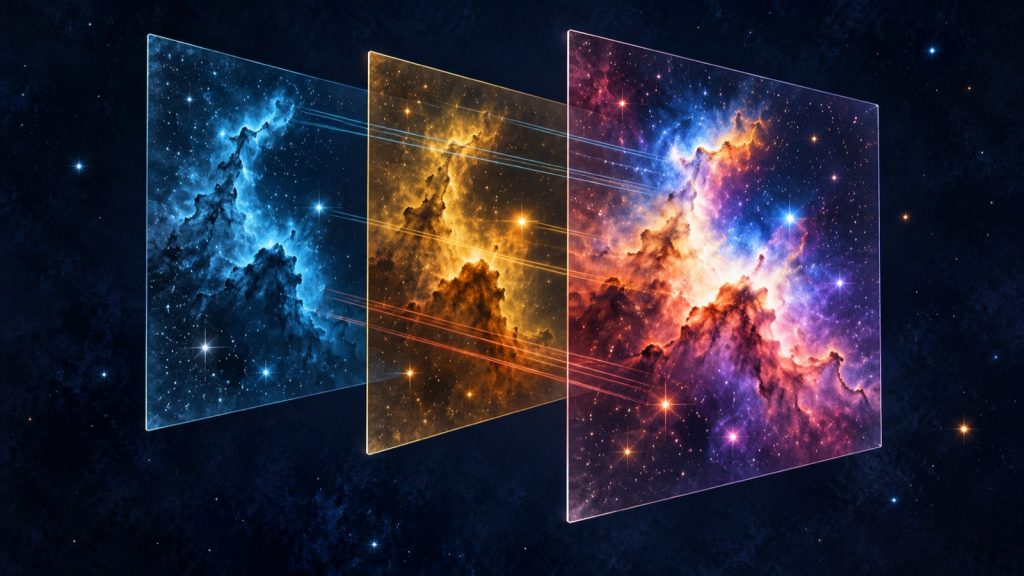
How We KnowAnswer
Are the colors in space photos real?
A space image can be faithful to measured light without matching human eyesight. Here is how to read the translation.
THE QUESTION LIBRARY HOW WE KNOW
Science can test explanations and inform decisions, but evidence alone cannot choose our values. Learn the difference between unknown and unknowable.
No. Science answers questions by comparing explanations with observations. It can inform choices about values and meaning, but measurements alone do not decide what we ought to value. Some scientific questions remain open because the evidence is incomplete. Saying we do not know yet is different from proving that nobody could ever know. A useful answer separates those kinds of limits.
WHAT WE DON’T KNOW YET
We cannot provide a complete forecast of everything humans might eventually discover. Dark matter constituents remain unconfirmed in the checked NASA explanation.
WHAT WOULD CHANGE THIS ANSWER
New observations, sharper definitions, or a test distinguishing previously indistinguishable explanations.
No. Science answers questions by comparing explanations with observations. It can inform choices about values and meaning, but measurements alone do not decide what we ought to value. Some scientific questions remain open because the evidence is incomplete. Saying we do not know yet is different from proving that nobody could ever know. A useful answer separates those kinds of limits.
Free long answer 2 of 3 this month.
Compare how a rainbow forms with whether a painting of one is beautiful. Science can investigate light and visual perception. Beauty also involves a judgment. Similarly, evidence about the consequences of a decision can inform ethics without selecting everyone's moral priorities. UC Berkeley's Understanding Science explains these limits. They do not make questions about meaning unimportant; they make the kind of answer we seek important. Science and value judgments.
Here is an editorial example. Suppose a community must divide a budget between two worthwhile projects. Research might estimate their costs and consequences. But choosing how much to prioritize fairness, immediate benefit, or future benefit requires reasons about values. Gathering another measurement can improve the estimates while leaving that choice unresolved. The practical task is to state both the evidence and the priorities openly.
Because a question can have a supported part and an unanswered part. NASA describes dark matter through gravitational effects and observations such as gravitational lensing, while noting that proposed constituents have not been confirmed. Evidence for a phenomenon is not automatically an explanation of everything about it. Naming an unknown can help researchers design tests instead of filling the gap with a confident story. NASA: Dark Matter.
This distinction also tells you what to ask next. Does the unknown concern whether something occurs, how it occurs, or what it is made of? Those are separate claims. An answer to one does not necessarily answer the others. Conversely, an unanswered detail does not erase every observation already established. Ask the speaker to identify the exact unresolved point.
There are limits to particular methods and measurements. NIST's measurement guidance explains that a measured value is generally an estimate and that reporting uncertainty is part of a complete result. Knowing a range can be useful knowledge, even when an exact value is unavailable. More precise instruments may improve an estimate; they do not justify pretending the current uncertainty is zero. NIST: measurement uncertainty.
For a claim that permits no observational distinction between competing explanations, science has no test to choose between them. That is a boundary of the method, not a certificate that the claim is true. Nor can we give a complete list of everything humans will never discover. Confidence is high about the need for testable evidence; predictions about all future knowledge deserve caution. A new test or observation could turn an open question into an answer. Continue with scientific proof and questions about meaning.
THREE THINGS TO REMEMBER
Are the colors in space photos real?
Space photos often show real measurements, but their colors may represent light our eyes cannot see.
God Plays Dice answers big questions in plain words, with sources and one of six honest labels.
See a mistake? Report a problem. Corrections are made openly.
CONTINUE THE THREAD
How We KnowAnswer
A space image can be faithful to measured light without matching human eyesight. Here is how to read the translation.
How We KnowAnswer
Why anecdotes feel convincing, what individual cases can show, and how to assess a confident judgment.
How We KnowAnswer
How scientists distinguish real signals from lucky fits: look-elsewhere effects, independent predictions, black-hole searches and data-window artefacts.
The Architect AI companion · All Access
Labels describe the evidence for a claim, not the people who hold it.
Match my phone uses your device’s light or dark setting.