
The UniverseExplainer
Why Is There More Matter Than Antimatter?
The Big Bang should have left an almost empty universe. A tiny surplus of matter built everything we know, and nobody yet knows why.
THE QUESTION LIBRARY THE UNIVERSE
Antimatter is measured in nature and laboratories, while its cosmic imbalance remains unexplained.
Yes, antimatter is real. We find it in nature, make it in labs, and study it. A positron is the electron’s partner. It has the same mass but a positive charge. Antimatter is not dark matter. The phrase “moving backward in time” comes from a way to do the math. It does not show time travel. Why the cosmos has so much more matter is still unknown. Making antimatter stores energy supplied elsewhere; annihilation alone does not establish a practical engine.
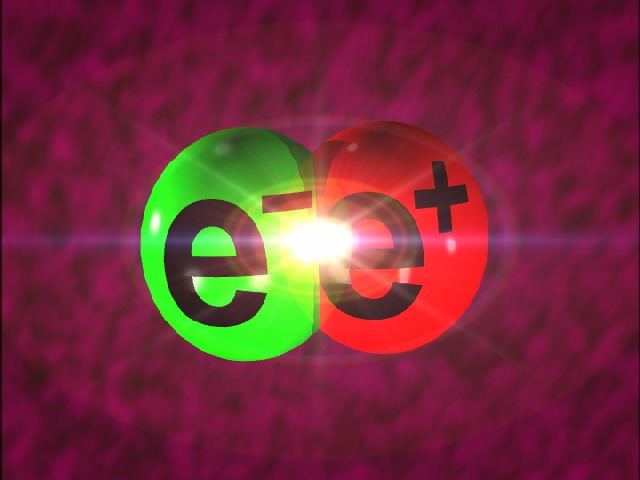
NASA illustration of an electron and positron meeting; the colors are visual labels, not the actual appearance of antimatter.
WHERE THE EVIDENCE STANDS
WHAT WE DON’T KNOW YET
We do not know why the cosmos has so much more matter than antimatter. Some traits of these particles still need finer tests.
WHAT WOULD CHANGE THIS ANSWER
Repeatable tests that disagreed with measured masses, charges or gravitational behavior would change our account of antimatter’s properties. The evidence that antiparticles exist is already strong; their cosmic imbalance remains a separate open question.
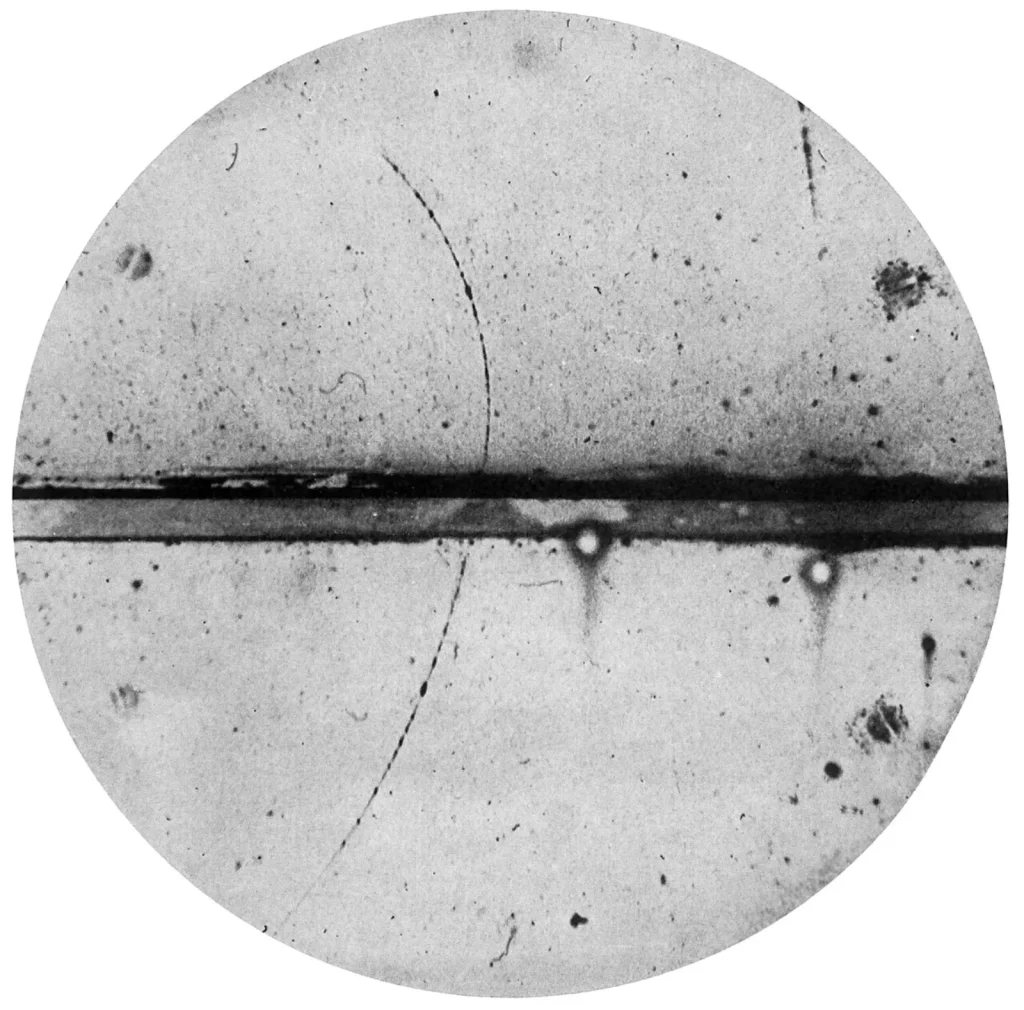
Antimatter has a name that sounds like it belongs in a spaceship engine. Yet the basic evidence comes from tracks in detectors, not from fiction. The simplest example is the positron. Dirac’s equation, combining quantum physics with relativity, suggested an electron partner; Anderson’s 1932 cloud-chamber track then supplied evidence for that positively charged particle. An electron carries negative electric charge. A positron carries positive charge and has the same mass. The word “anti” marks this relationship; it does not mean the particle is unreal or has negative mass.
A positron can meet an electron and take part in a process called annihilation. The original particles are replaced by other particles, such as photons, the particles of light. Energy is conserved. Nothing has vanished from the physical account. Some natural radioactive processes and collisions involving cosmic rays also produce antiparticles. They are not found only inside huge research machines.
Scientists have gone further and assembled anti-atoms. Antihydrogen contains an antiproton and a positron, in place of hydrogen’s proton and electron. Studying it lets researchers ask a sharp question: do matter and antimatter obey the same rules to the precision we can measure?
Two common pictures need care. Antimatter is not an invisible substance called dark matter. It has familiar interactions with light. And an antimatter apple would not be a black silhouette or a fruit that ages into yesterday. Such an apple is hypothetical, but ordinary-looking light and chemistry would be expected if it could exist away from normal matter. Nobody has made one.
The major mystery is not whether antimatter exists. It is why so little of it remains across the visible universe compared with matter. Keeping those questions apart matters. We can have strong evidence for an object and still lack a full account of its history. That is the situation here.
Free long answer 1 of 3 this month.
Before anyone found a positron, Paul Dirac had built an equation that joined quantum physics with special relativity. Quantum physics describes particles at small scales. Special relativity describes space and time, including motion close to light’s speed. Bringing them together exposed possibilities that were missing from earlier accounts of the electron.
The story is sometimes told as if an equation alone created an object. It did not. Mathematics suggested what to look for. Nature still had to decide whether such a particle existed. That distinction is central to the strength of this example.
In 1932, Carl Anderson found evidence of a positively charged particle with the electron’s mass. A cloud chamber made a charged particle’s path visible as a track. A magnetic field bent that path. Reading the track required care about the direction of travel, as well as its curve. The result supported a new particle, now called the positron.
A detector track is not a close-up portrait of a tiny ball. It records an effect the particle leaves while passing through matter. The interpretation must match charge, motion, and other measured features. Later experiments provided many more ways to test the same particle.
So the evidence does not rest on one dramatic photograph or one brilliant guess. Prediction and measurement came from different routes and met. That makes the story useful when judging a new proposed particle: ask what it predicts, how it would be detected, and whether other measurements agree.
An electron and a positron can annihilate. Their energy can emerge as photons. With other particles and energies, the products can differ. “Annihilate” sounds like removal from existence, but the physical claim is a conversion governed by conservation laws. The incoming energy remains accounted for in what comes out.
Antiparticles are not made by giving an ordinary object a minus sign in every property. An antiproton has the proton’s mass and opposite electric charge. An antineutron is electrically neutral, as a neutron is, while other internal properties distinguish the pair. Electric charge alone is therefore not a full definition of antimatter.
Anti-atoms also need careful handling. Charged antiparticles can be held by electric and magnetic fields. Neutral antihydrogen needs a different trap that uses its magnetic properties. Researchers keep normal matter out of the trap because contact can destroy the anti-atoms they want to study. A glass jar would be a poor container.
This is where fiction often stretches a real process into a technology we do not have. A release of energy does not show that large supplies of antimatter are easy to make or store. Producing it costs energy, and existing amounts are extremely small by everyday standards.
The sensible distinction is between a demonstrated physical process and a practical fuel system. The first is real. Claims about routine engines or large stockpiles would need separate evidence. The word “antimatter” cannot supply that evidence on its own.
Imagine an apple made entirely of antiparticles, placed in an environment also made of antimatter. This is a thought experiment, not an object anyone has grown. Known physics gives reason to expect familiar chemistry and an ordinary-looking apple. Light is not divided into everyday light and a special visible “anti-light.”
The illustration on this page uses colored spheres to mark an electron and a positron. Those colors are labels chosen by an artist. They do not tell us that antimatter glows red, green, or purple. Pictures can help us follow a process while adding features that the process itself does not have.
The apple’s appearance and its safety are different questions. Put the imagined fruit in ordinary air, and matter would contact antimatter at its surface. That interaction would spoil the quiet picture. Looking normal would not make it behave like an ordinary apple in our surroundings.
Gravity presents another possible confusion. Opposite electric charge does not imply opposite gravitational behavior. In 2023, CERN’s ALPHA experiment reported a direct study of how antihydrogen moves under Earth’s gravity. The anti-atoms fell downward, with results consistent with ordinary gravitational attraction within the experiment’s precision.
That result did not test an apple, every kind of anti-atom, or every possible tiny difference. It did test the claim that antihydrogen simply falls upward. Separate the measured result from the wider expectation: downward motion was observed; finer comparisons remain part of the research.
Physicists can represent a positron in calculations as an electron going backward along the time direction. This is a way of arranging the mathematics of particle interactions. University of Toronto teaching material describes equivalent ways to interpret the same calculation. The strange wording deserves an explanation, rather than a literal leap.
In the laboratory, a positron can be produced, move through an apparatus, and leave detector signals in an ordinary sequence of events. The backward-time representation does not show a particle arriving yesterday to change a recorded event. It is not a method for sending a person, message, or apple into the past.
A good test for a striking phrase is to ask what extra observation it requires. Two equivalent descriptions may predict the same measurements. An additional claim about controllable time travel would need additional evidence. A diagram with a reversed arrow is not that evidence.
Dark matter is a separate issue. Astronomers infer unseen matter from gravitational effects. The dark matter particle, if it is a particle, has not been identified. Familiar antimatter interacts with light and can produce detectable signals when it meets matter. Renaming it does not give it the properties needed for the dark matter evidence.
The similarity of the names can hide this difference. “Anti” describes a particle’s relationship to a partner. “Dark” describes a puzzle in observations of the cosmos. Read more in how we know dark matter exists. Neither label should become a container for every unknown thing in space.
In principle, annihilation could supply energy for propulsion. Laboratory-produced antimatter would carry energy supplied during production, rather than provide free energy. An engine would still need a way to turn released energy into useful thrust, the push that changes a spacecraft’s motion. In 2018, NASA described an early feasibility study using positrons from radioactive decay to help initiate fusion, in which light atomic nuclei combine. That was a concept proposal, not a demonstrated antimatter-powered spaceship.
The movie version borrows a real interaction but assumes a large stored supply. CERN’s discussion of Angels & Demons explains that making antimatter consumes more energy than annihilation returns. A hypothetical large release could be destructive; that possibility does not establish a workable device. Producing enough material and keeping it isolated from ordinary matter are separate obstacles. Laboratory quantities are tiny compared with the movie’s stockpile.
An antimatter twin is a thought experiment. Ordinary air would already interact with its surface, before a handshake. If we imagined contact in an otherwise isolated setting, annihilation would occur where matter meets antimatter. That does not establish that both complete bodies instantly vanish. The contact conditions and subsequent interactions of the released particles would determine what followed.
Making antiprotons is not the same as capturing them. Energetic collisions produce particles moving in many directions; only a fraction enters the decelerator, which slows them for experiments. Storage then has two jobs: reduce nearby gas with a very high vacuum, and keep antiparticles away from the container’s walls. The vacuum itself does not hold them in place. Electric and magnetic fields confine charged particles; putting more of the same charge together increases repulsion. Once antiprotons and positrons form neutral antihydrogen, that charged-particle trap no longer works. A different trap uses the anti-atom’s small magnetic properties in a specially shaped field.
The strongest challenge is the distance between a measured antiparticle and an untested larger claim. CERN describes production and storage limits. DOE describes antimatter regions as a possibility, while saying that scientists have not seen such regions. Evidence for positrons therefore does not establish a supply of antimatter fuel, a whole anti-apple, or a way to travel into the past.
For the existence claim, a serious objection must address the detector results and the later anti-atom measurements together. For the cosmic imbalance, a proposed answer must explain why matter survived. These questions ask for different evidence. A successful particle measurement cannot stand in for a missing cosmic mechanism.
Start with CERN’s antimatter overview. Look for a measured particle or anti-atom, a method of detection, and a stated comparison. Then read Fermilab’s account of Anderson’s cloud-chamber evidence. Notice the difference between a photograph of a track and a drawing of a particle. Both can be useful, but they carry different information.
For gravity, open the ALPHA report linked below. Identify the material actually tested: antihydrogen. Look for uncertainty as well as the direction of motion. A headline that says antimatter falls down captures the broad result. The experimental limits tell you how far that result extends.
For the apple, mark the change in evidence. Researchers have made and studied anti-atoms. A whole apple is an extrapolation from known physics. The expected appearance is not a photograph, and the thought experiment is not a production plan. Keeping that boundary visible lets the example teach without pretending it was observed.
For backward time, ask whether the source discusses an interpretation of equations or an experiment that sends information into the past. Those are distinct claims. For dark matter, ask whether the proposed explanation fits both gravity and interactions with light.
Finally, separate existence from cosmic history. The universe’s matter excess remains unresolved even though antiparticles are measured. Why there is any matter explores that puzzle further. A gap in one explanation does not undo the measurements on the other question. It tells researchers where the next tests are needed.
THREE THINGS TO REMEMBER
Why do physicists still call the matter-antimatter imbalance unsolved?
Known physics supplies important ingredients, but no confirmed mechanism accounts for the observed matter surplus.
God Plays Dice answers big questions in plain words, with sources and one of six honest labels.
See a mistake? Report a problem. Corrections are made openly.
CONTINUE THE THREAD
The UniverseExplainer
The Big Bang should have left an almost empty universe. A tiny surplus of matter built everything we know, and nobody yet knows why.
The UniverseAnswer
Why the matter surplus remains unexplained, what Sakharov's conditions require, and how sphalerons and proposed neutrino mechanisms might connect.
The UniverseAnswer
How matter and antimatter differ in some decays, what quarks have to do with it, and why hydrogen–antihydrogen spectroscopy tests a different symmetry.
The Architect AI companion · All Access
Labels describe the evidence for a claim, not the people who hold it.
Match my phone uses your device’s light or dark setting.