If I ever stood face to face with a being from another world, I doubt my first question would be, “What planet are you from?”
On this pageAbout this picture
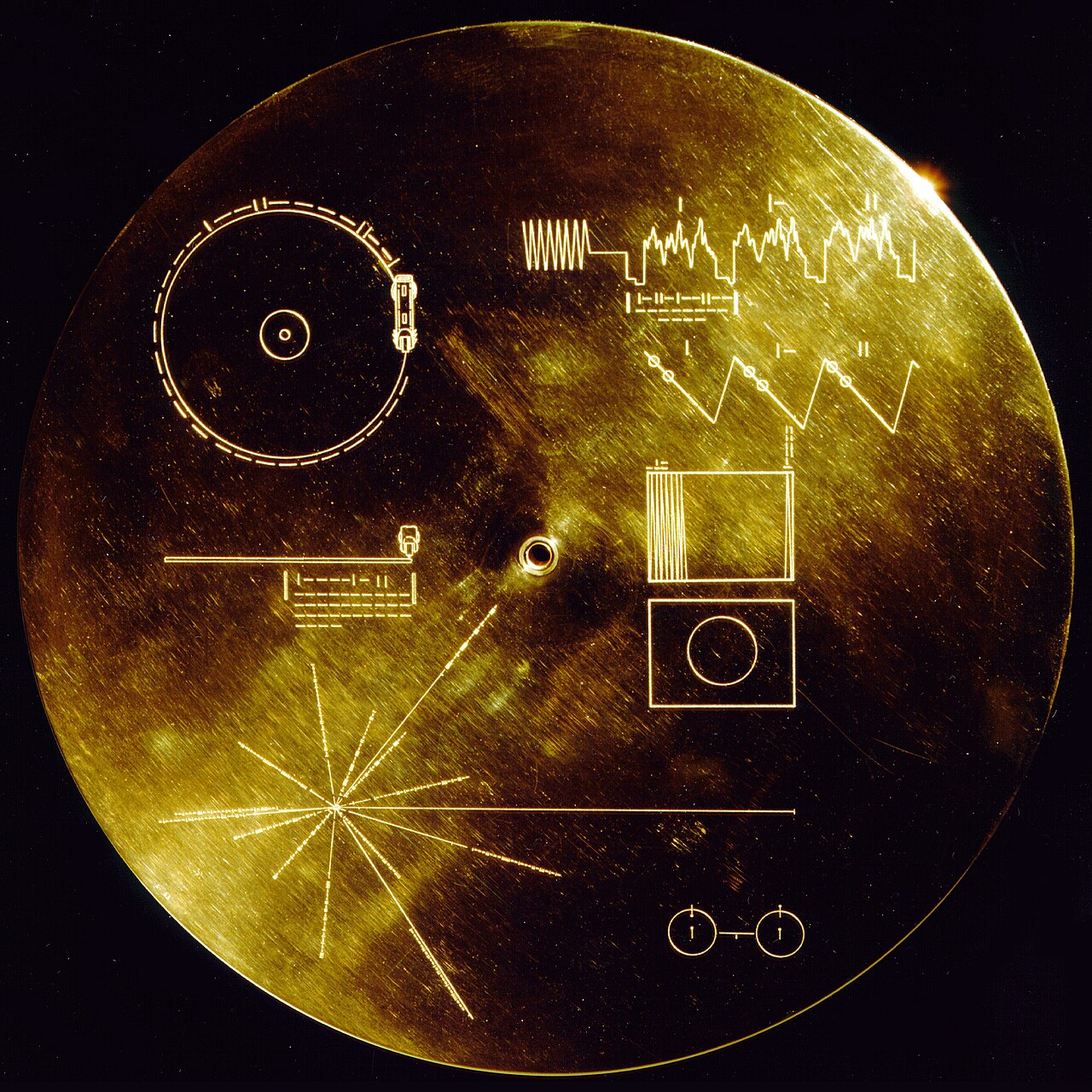
The cover of the Voyager Golden Record, launched in 1977.
NASA/JPL, via Wikimedia Commons · Public domain · Image source ↗
I would want to know where everything came from.
But before asking for answers, I would ask something even more important:
How do you know?
An advanced visitor could still be wrong. Its civilization might have myths, rival theories, incomplete instruments, or questions beyond its reach. Technology does not guarantee omniscience.
So I would not treat the encounter as revelation.
I would treat it as the greatest interview in human history.
Many of my questions would come from the idea I explore in God Plays Dice: that our Big Bang may have been the local aftermath of a violent event in a larger-dimensional arena. That is a hypothesis, not an established finding. The questions below are not evidence for it. They are what I would ask if someone arrived who might know more than we do.
A few plain definitions first:
A dimension is an independent direction in which something can be located or move. We experience three dimensions of space, along with time.
Dark matter is the name for unseen matter inferred from its gravitational effects.
Dark energy is the name given to whatever is driving the accelerated expansion of the universe.
A multiverse is the proposal that our universe may be one among many. We do not currently have confirmed evidence of another universe.
Now I would begin.
Questions about the beginning
1. What did your civilization discover about the earliest moment of our universe?
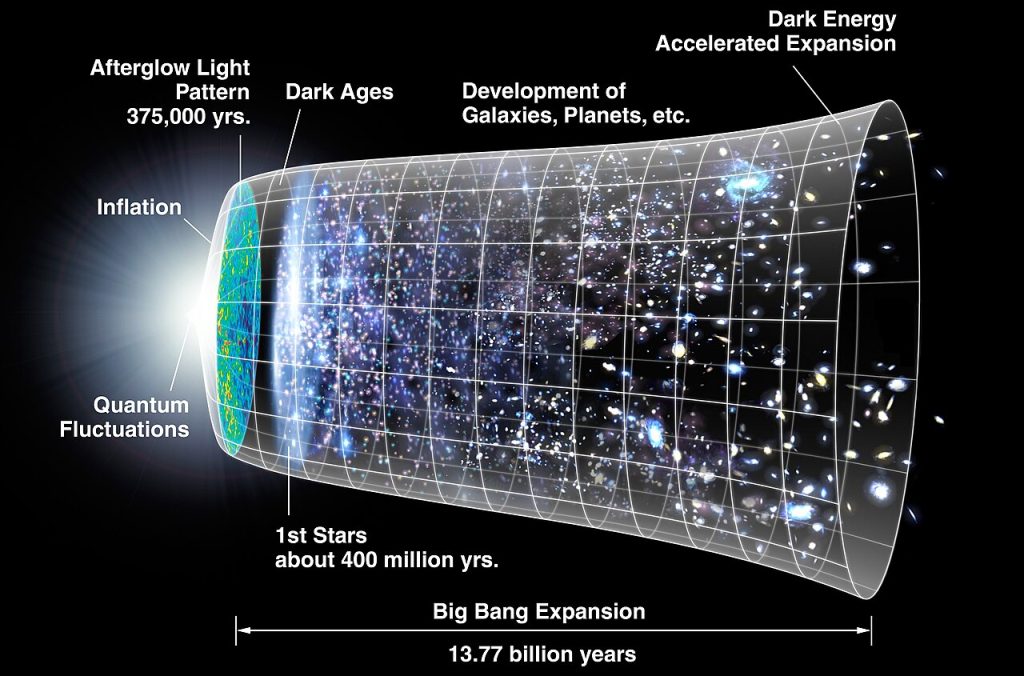
Did space and time begin with the Big Bang, or was the Big Bang a transition inside something larger?
2. Is “before the Big Bang” a meaningful physical question?
If it is, what existed? If it is not, what does your evidence show that makes the question fail?
3. Did our hot, dense beginning come from a specific event?
Was it a collision, collapse, phase transition, bounce, fluctuation, blast, or something no human language yet describes?
4. What observation settled the question for you?
Was it a gravitational-wave spectrum, a pattern in the cosmic microwave background, particle behavior, geometry, or a kind of measurement we have not invented?
Questions about extra dimensions
5. Are extra dimensions physically real, or only useful mathematics?
If they are real, are they tiny and curled up, large but hidden, or accessible only to gravity?
6. Is our observable universe embedded in a larger-dimensional environment?
If so, what is that environment made of, and what keeps ordinary matter confined to our familiar world?
7. Could a violent event in that larger arena have produced our Big Bang?
If the answer is yes, what fingerprint would such an event leave today?
8. Does the gravitational-wave background contain a record of that event?
Is there a bend, peak, cutoff, polarization pattern, or correlation that would separate a primordial source from populations of black holes?
Questions about other universes
9. Are there other universes?
Not as a philosophical possibility, but as a conclusion supported by evidence.
10. If other universes exist, are they born by the same mechanism?
Do they share our physical laws, or can their particles, forces, dimensions, and histories differ?
11. Is our universe ordinary?
Are we small, large, young, old, stable, unusual, or one typical outcome among many?
12. Is there a hierarchy beyond the larger arena?
If universes can exist inside something larger, is that larger reality itself part of another level—or does the hierarchy end?
Questions about the dark universe
13. What are dark matter and dark energy?
Are they particles or fields inside our universe, effects of gravity we do not yet understand, or signs of a larger geometry?
14. Is cosmic acceleration telling us something about what surrounds our universe?
Or is it fully explained by physics inside our own spacetime?
I would be especially careful here. It is easy to use “higher dimensions” as an answer to anything mysterious. I would want a measurable distinction, not another story.
Questions about life and reality
15. How common is life—and how common is intelligence?
Did life arise many times in your civilization’s surveys? Do most living worlds remain microbial? How often does technology survive its own power?
16. Can civilizations travel between stars, dimensions, or universes—and have you found evidence that reality is simulated?
I would ask what is physically possible, what is only theoretical, and what their civilization has actually done. I would also ask whether the simulation question can ever be tested, or whether it remains philosophy dressed in technological language.
The question behind the questions
Nobody on Earth can answer these sixteen questions with certainty, including me.
Some may be badly framed. Some may assume things that do not exist. A visitor from another world might laugh at our categories the way we might smile at a child asking what color gravity is.
That would still teach us something.
A good question is not valuable because it guarantees the answer we hoped for. It is valuable because it reveals what we assumed, what evidence we lack, and what instrument we need next.
So if I could ask the visitor one final question, it would be this:
What did your civilization once believe about the universe that better evidence forced it to abandon?
That answer might tell us more than any map of the stars.
And if you had one question for a visitor from another world, what would you ask?
Nobody knows yet whether life exists beyond Earth. The Fermi paradox names a gap: our galaxy has many planets and has had a long time for life to arise, yet we…
Sources & further reading
(7)
Dark matter ↗Dark matter inferred from its gravitational effect; about 27% of the universe; dark energy about 68%; ordinary matter about 5%.
Philosophy of Cosmology ↗The multiverse arises from speculation about inflation and faces unresolved challenges; not an established finding.
Centillion ↗A 1 followed by 303 zeros in U.S. usage, 600 zeros in older British usage.
Voyager Golden Record overview ↗Launched in 1977 on both Voyagers; the cover carries instructions for playing the record and finding Earth. Used for the image caption.
The Big Bang explains an early hot, dense universe. It may not be the first page of reality. Here is my best current hypothesis—and the evidence that would have to judge it.
We keep imagining advanced civilizations as someone else, somewhere else. From the eyes of our ancestors—or another species—the advanced civilization may already be us.
Planets are everywhere, yet the sky seems silent. Here is what that silence does and doesn't tell us, and how scientists are listening now.
Open question6 min read
THE OCCASIONAL LETTER
Stay curious.
New stories, book updates, and notes from God Plays Dice, delivered when there is something worth sharing.
EMAIL UPDATES ↗
500 DIGITAL COPIES • GIVEAWAY PREVIEW
Be first to know when the 500-copy reader giveaway opens.
Join for the book launch, verified retailer links, and the announcement for a planned giveaway of 500 digital copies. The giveaway is not open yet: dates, eligibility, a dedicated entry form, and Official Rules will be published first.
Privacy · Check your inbox to confirm your subscription. Newsletter signup alone is not a giveaway entry.