
Life in the UniverseExplainer
The Fermi Paradox: Where Is Everybody?
Planets are everywhere, yet the sky seems silent. Here is what that silence does and doesn't tell us, and how scientists are listening now.
THE QUESTION LIBRARY LIFE IN THE UNIVERSE
The gap between a vast universe and no confirmed alien contact is a question, not evidence that we are alone.
Nobody knows yet whether life exists beyond Earth. The Fermi paradox names a gap: our galaxy has many planets and has had a long time for life to arise, yet we have no confirmed sign of alien life or technology. It is a question, not proof that aliens exist or that we are alone. Life might be rare. Tools might be short-lived or hard to spot. We may also have searched too little to know.
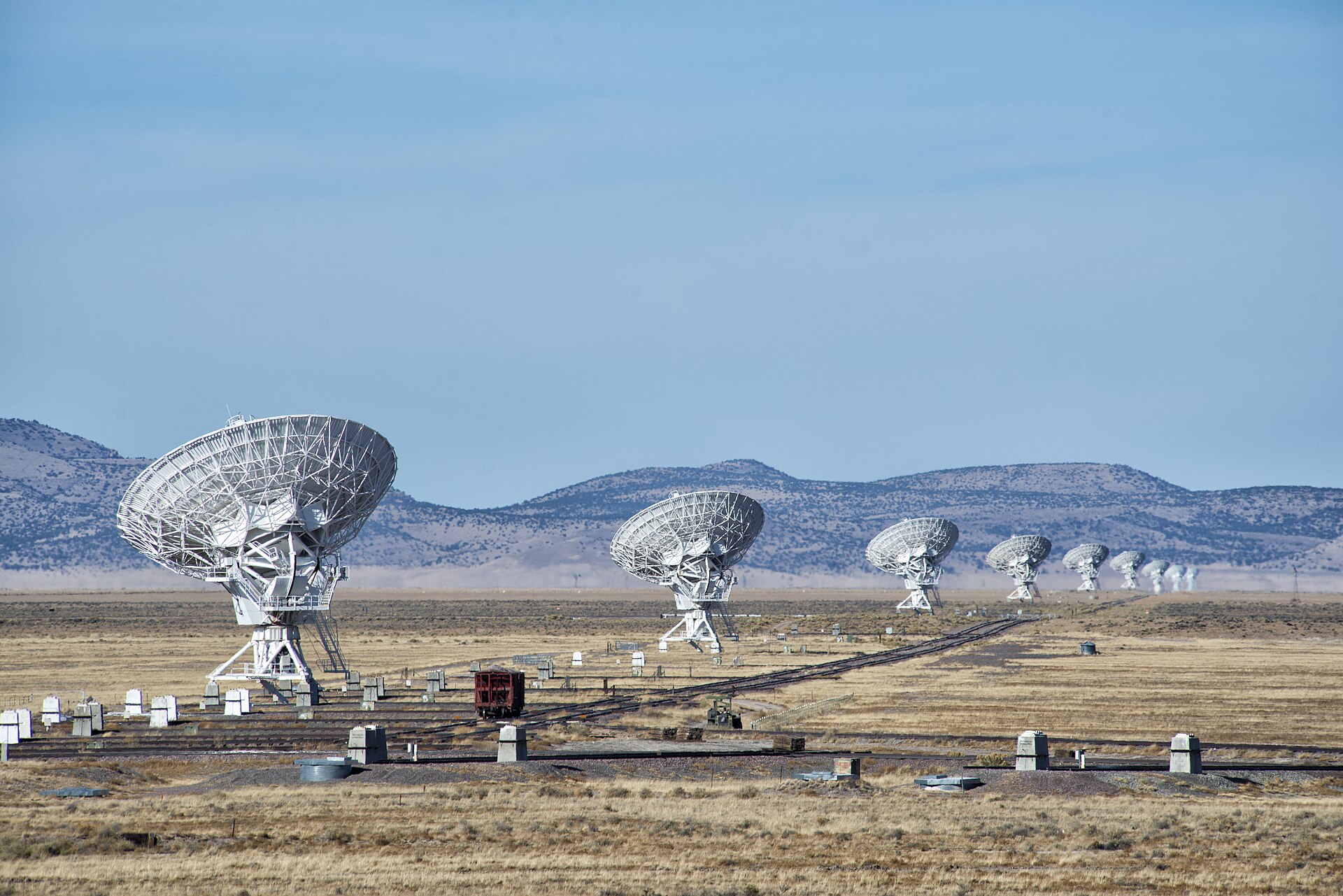
Dishes of the Very Large Array, a radio observatory in New Mexico, photographed in 2012. Radio searches can test specific signals, directions and times.
WHERE THE EVIDENCE STANDS
WHAT WE DON’T KNOW YET
We do not know how often life begins or builds tools. We also do not know what signs, if any, such tools would make.
WHAT WOULD CHANGE THIS ANSWER
A confirmed sign of life or alien tools would change this answer. Wider searches could also rule out more kinds of signals, even if they found none.
Nobody knows yet whether anybody else is out there. The Fermi paradox is the name for a striking mismatch: our galaxy contains a great many planets, and it has existed for a long time, but no alien life or technology has been confirmed. Physicist Enrico Fermi asked a version of “Where is everybody?” over lunch at Los Alamos, probably in the summer of 1950, according to a 1985 Los Alamos report that gathered his companions’ accounts. The question became a way to test our assumptions about life in the universe.
NASA has confirmed thousands of planets around other stars. That establishes that planets are common, not that life is. We know life happened here, on one planet. We do not yet know how readily it begins elsewhere, whether it develops intelligence, or whether intelligent beings build tools we could notice. Each step matters. A galaxy can have many worlds and still leave the number of detectable civilizations unknown.
Searches also have limits. A radio telescope can listen at only some frequencies, in some directions, at some times, and down to a set signal strength. As an analogy, hearing no reply after listening briefly on one radio channel does not establish that no one else owns a radio. The analogy breaks because extraterrestrial technology might not use radio at all. A 2018 study modeled the many dimensions of radio search and concluded that the portion covered was very small under its chosen boundaries.
There are several possible answers to Fermi's question. Life might be rare. Technological societies might be uncommon or short-lived. They might be distant, quiet, or using signals we do not recognize. None has been shown to be the explanation. The silence is a real observation about our searches so far; it is not a verdict on the entire universe.
Free long answer 1 of 3 this month.
A paradox is a result that seems to clash with what we expected. NASA calls the universe’s silence the Fermi paradox. It notes that even at slow travel speeds, billions of years give technological beings plenty of time to cross the galaxy. So why is the cosmos so quiet? In a strong form of the argument, made by Michael Hart in 1975, a technological civilization could fill the galaxy in a few million years, which is short compared with the galaxy’s age. If that happened often, why do we see no clear evidence of one here?
The word “paradox” does not mean we have proved a contradiction in nature. It means our expectations may be wrong or incomplete. The expectation that many worlds should produce many detectable visitors rests on several unknown steps. How often does life begin? How often does it become complex? How often does it make technology? Would a technological society travel or send recognizable signals? Would its activity overlap with our brief period of searching? We have poor answers to most of these questions.
In 1985, Eric M. Jones of Los Alamos National Laboratory gathered accounts from Fermi’s lunch companions: Emil Konopinski, Edward Teller and Herbert York. Konopinski recalled that the walk to lunch began with talk of flying saucers. The three remember the question differently, from “But where is everybody?” to “Don’t you ever wonder where everybody is?” Jones judged the summer of 1950 “quite probable.” Because memories of the exact wording vary, a quotation should not carry the argument. The lasting idea is the comparison between a seemingly hospitable galaxy and an absence of verified contact.
We have found many planets. NASA's exoplanet program lists thousands of confirmed worlds outside our solar system, and many more remain to be discovered. Some are in regions around their stars where liquid water might be possible under suitable conditions. A planet in such a region is not automatically habitable, and a habitable planet is not automatically inhabited. Those are separate claims.
We have not confirmed life beyond Earth. NASA says plainly that it has found no credible evidence of extraterrestrial life. It also says there is no evidence that unexplained aerial phenomena are extraterrestrial. An unidentified object is an observation that lacks a settled explanation; it is not itself evidence for an alien origin.
Astronomers have searched for possible technological signs, called technosignatures, including some radio signals. A search with no confirmed detection gives useful limits within its scope. It does not rule out all possible signals, all locations or all times. The distinction between “we did not find it in this search” and “it does not exist anywhere” is central to the Fermi question.
Imagine searching for one message. You must choose a place to look, a time to listen, a frequency, a minimum strength, and an idea of what the message looks like. Each choice leaves possibilities out. An alien signal could be too faint, too brief, directed elsewhere, or unlike what the search was built to find. These are possibilities, not claims that such signals exist.
In 2018, Jason Wright, Shubham Kanodia and Emily Lubar built an eight-dimensional model of the “cosmic haystack” for radio searches. They compared several major search programs with the volume of possibilities in that model. Their conclusion was that the fraction searched was very small, roughly like a small pool's volume compared with Earth's oceans. The image is an analogy whose size depends on the model's boundaries; it is not a literal measurement of every way to seek alien life.
The searches still matter. A well-designed nondetection can exclude a specified kind of strong, persistent signal from a specified set of targets. As instruments, observing time and methods improve, those limits become more informative. They cannot be stretched beyond the signals the equipment could have detected.
One possibility is that life is rare. Earth shows it can happen, but one known example cannot tell us how often. Another is that simple life may be common while technological life is rare. A third is that civilizations may exist but not at the same time as us, or not close enough to be noticed. A fourth is that they may not transmit the kinds of signs we seek. Their technology could be quiet, short-lived, or beyond our current recognition.
Fermi may have raised some of these himself. York recalled that Fermi suggested interstellar flight might be impossible, or always judged not worth the effort, or that technological civilization might not last long enough. York said he was hazy about these last remarks, so they are a memory, not a record.
There are more dramatic suggestions, such as civilizations destroying themselves or deliberately avoiding contact. They make interesting stories and sometimes lead to testable questions, but we have no evidence that either explains the apparent silence. It is easy to mistake a vivid answer for a measured one. The responsible answer is to keep the possibilities separate from what has been observed.
The strongest objection to calling this a paradox is that we should not expect to have found anything yet. The 2018 paper notes that Tarter and colleagues argued in 2010 that bright radio beacons might be common without our knowing, because so little has been searched. The search-space study supports taking that objection seriously for radio signals. On the other hand, it does not show that life exists, and it does not remove every version of the question about large-scale or long-lived activity. The point is to specify which expectation is being tested and what a real search could have seen.
“Many planets” does not mean “many civilizations” (see whether life is likely to be rare or common). We do not yet know the rates of life's origin or the steps to technology. “No confirmed signal” does not mean “no alien life.” Searches have boundaries. “Unexplained” does not mean “extraterrestrial” (see what official UFO reviews found). A claim of alien origin needs positive evidence that distinguishes it from ordinary possibilities. Likewise, the Fermi paradox does not prove that Earth is special, that travel is impossible, or that someone is hiding. Each is an additional hypothesis with its own burden of evidence.
The Drake equation is often used to organize these unknown rates. It does not provide an answer when most terms remain uncertain. Its value is in showing which measurements would help. Exoplanet discoveries have improved our knowledge of planets. Biology beyond Earth, technological prevalence, and lifetimes remain much harder to constrain.
Read NASA's “Are We Alone?” page and identify where it separates confirmed planets from unconfirmed life. Then read NASA's UAP questions and answers, which states what has and has not been found. Finally, read the abstract of the 2018 cosmic-haystack paper. Notice that its conclusion concerns a defined radio search space; it does not measure every kind of life or technology.
When someone offers a neat solution, ask what observation supports it. Ask what signal or artifact it predicts and whether our instruments could detect it. If the answer is merely that the galaxy is large or that no signal has been heard, the key unknowns remain. A careful search can shrink uncertainty over time, even while the broad question stays open.
THREE THINGS TO REMEMBER
Next on the path “I saw something. How would we know?” · step 6 of 8
Why do extraordinary claims need extraordinary evidence?
Because a claim that clashes with a huge amount of well-tested evidence starts out unlikely, and it takes strong evidence to outweigh all of that.
See this path: I saw something. How would we know?
God Plays Dice answers big questions in plain words, with sources and one of six honest labels.
See a mistake? Report a problem. Corrections are made openly.
CONTINUE THE THREAD
Life in the UniverseExplainer
Planets are everywhere, yet the sky seems silent. Here is what that silence does and doesn't tell us, and how scientists are listening now.
Life in the UniverseAnswer
Identical twins develop from one fertilized egg and begin with almost the same DNA. Yet their conditions before birth, later environments and gene activity can differ. Shared DNA…
Life in the UniverseAnswer
Humans and chimpanzees inherited much of their DNA from a shared ancestor. Similar DNA can produce different bodies when some protein instructions and patterns of gene activity differ.…
The Architect AI companion · All Access
Labels describe the evidence for a claim, not the people who hold it.
Match my phone uses your device’s light or dark setting.