God & BeliefEssay
Science and Faith: Enemies, Strangers, or Partners?
The 'war' between science and religion makes a dramatic story, but the real history, and what scientists actually believe, is more surprising and more welcoming.
THE QUESTION LIBRARY GOD & BELIEF
Evolution is established science; many faith traditions make room for it and some reject it, so here is what several of them say in their own words.
Yes. Many people accept evolution and keep their faith. The Catholic Church, many Protestant churches and many Jewish and Muslim scholars teach that evolution and belief in a Creator can fit together. Other believers, often those who read their scripture literally, reject it. Evolution itself is established science, backed by fossils and DNA. Whether God stands behind it is a question science cannot answer, so we label it Beyond science.
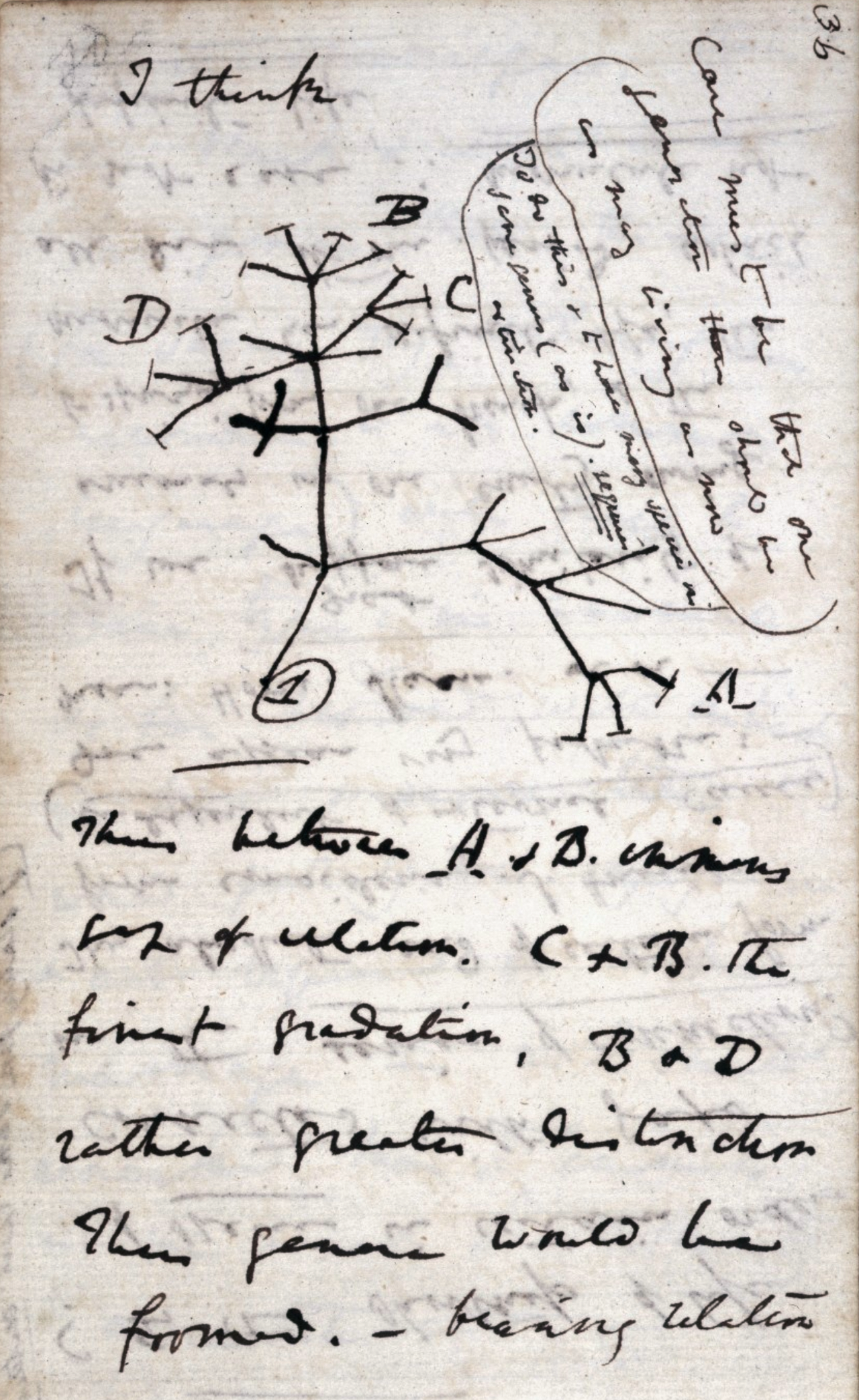
A page from Charles Darwin’s Notebook B, begun in July 1837. Under the words “I think,” he sketched living things branching from a common ancestor, marked 1.
WHERE THE EVIDENCE STANDS
WHAT WE DON’T KNOW YET
Scientists still study how evolution works in detail, such as how some early human species are related, but not whether it happened. Survey numbers shift with how a question is worded. Whether God guided the process is a question science cannot answer.
WHAT WOULD CHANGE THIS ANSWER
The science would change only if strong new evidence overturned common descent, which has stood up to more than a century of testing. The religious picture would change if major traditions revised their teaching, or if new surveys found different views.
Yes. Many people accept evolution and keep their faith. The Catholic Church, many Protestant churches, and many Jewish and Muslim thinkers teach that evolution and belief in a Creator can fit together. Other believers reject evolution, often because they read their scripture literally, for example taking the opening chapters of Genesis as a day-by-day history. Both groups include sincere, thoughtful people.
People ask this for different reasons. A student may love biology class but worry about what her church will say. A parent may wonder what to tell a curious child. Someone may have left a faith over this very question, or kept it and never talked about it. These are fair questions, and they deserve clear answers.
Start with the science. Evolution means that the inherited traits of living things change over many generations. The U.S. National Academies of Sciences, Engineering, and Medicine say the idea has stood up to testing by many thousands of scientists for more than a century. The Smithsonian points to fossils and to DNA, which shows that humans and chimpanzees share an ancestor that lived between 8 and 6 million years ago. We label evolution Established.
Now the faith side. In 1996, Pope John Paul II said that new knowledge had led to seeing evolution as “more than a hypothesis.” More than 15,700 Christian clergy have signed a letter saying the Bible and modern science “may comfortably coexist.” Christians in science, rabbis and Muslim scholars have made their own cases, in their own terms. Others, such as the ministry Answers in Genesis, reject evolution because they read Genesis as a factual account of creation in six 24-hour days. Some skeptics also see a conflict, and argue that evolution counts against belief in God.
What science cannot tell you is whether God stands behind the process. That question is Beyond science. This page lets each view speak in its own words, and it does not tell you what to believe. You are welcome here, whatever you believe.
Free long answer 2 of 3 this month.
The National Academies define evolution as changes in the inherited traits of a population as one generation replaces another. New variations come from mutations, which are changes in DNA. Natural selection means that living things with helpful traits tend to leave more offspring, so those traits spread.
Fossils record creatures that lived long ago. Scientists predicted they would find fossils in between fish and land animals with limbs in rocks about 375 million years old. They found one, called Tiktaalik, and the National Academies say the discovery confirmed the prediction. DNA gives an independent check. According to the Smithsonian, humans and chimpanzees differ by about 1.2% in the genes they share, and by another 4 to 5% when deleted, copied and moved stretches of DNA are counted. Several independent dating methods indicate that Earth is about 4.5 billion years old, which gives evolution the time it needs.
Scientists still debate details, such as how some early human species are related, but the National Academies say they no longer question whether evolution happened. That is why we label it Established.
Each tradition speaks here in its own words.
In his 1950 encyclical Humani generis, a papal letter to the Church’s bishops, Pope Pius XII said the Church does not forbid research and discussion of evolution as an account of the human body. He also warned against treating it as already settled. He added that God creates each human soul directly, and that Catholics may not hold that humanity comes from many first parents rather than one Adam. In 1996, John Paul II told the Pontifical Academy of Sciences that new knowledge had led to recognizing evolution as “more than a hypothesis.” But theories that treat the mind as a mere product of matter, he said, cannot “ground the dignity of the person.” In 2014, Pope Francis warned against picturing God as a magician with a magic wand, and said that evolution does not conflict with creation, because evolution needs created beings that can evolve.
Protestants differ widely. The National Academies quote the General Assembly of the Presbyterian Church: “there is no contradiction between an evolutionary theory of human origins and the doctrine of God as Creator.” The Clergy Letter Project, which grew out of a 2004 statement that Michael Zimmerman prepared with Wisconsin clergy, hosts a Christian letter with 15,747 signatures as of September 26, 2026. It says most Christians do not read the Bible literally, “as they would a science textbook,” and that the Bible and modern science “may comfortably coexist.”
BioLogos was founded by Francis Collins, who led the Human Genome Project and directed the National Institutes of Health. It calls its view evolutionary creation: God created and sustains all things, and evolution is the best scientific explanation of how life is related. BioLogos treats the Bible as God’s inspired, authoritative word and affirms the Resurrection. People who hold this view differ on Adam and Eve: some see them as a historical couple, others read the story as symbolic. Randy Isaac, emeritus executive director of the American Scientific Affiliation, speaks of two books from God, the Bible and the universe, and adds: “Science can tell us what happened but not why.”
Rabbi Elliot Dorff, of Conservative Judaism, writes that Judaism holds God to be Creator but does not claim to know how God created the world. He notes that the Bible gives at least three different descriptions of creation, and that the rabbis taught, “There are 70 faces to the Torah,” meaning each verse can be read in many ways. A Clergy Letter Project letter from rabbis, with 847 signatures, says one can be inspired by the Bible without reading it literally while accepting evolution. Views differ inside Judaism too. In a Pew survey in Israel in 2014–15, 53% of Jews said humans evolved, from 83% of secular Jews to 3% of ultra-Orthodox (Haredi) Jews.
Mustansir Mir, a professor of Islamic studies at Youngstown State University, writes that a scientific account of human origins is mainly biological, while a religious account is mainly moral. If that is accepted, he says, “no conflict need exist” between them on this question. In a 2021 book, the scholar Shoaib Ahmed Malik maps four Muslim positions: rejecting evolution entirely; accepting it for all life except humans; accepting it for humans too, except Adam and Eve; and accepting it with no exceptions. Some theologians, such as Nuh Ha Mim Keller, treat belief in human evolution as unbelief. Others, such as Salman Younas, think an evolutionary reading of the Quran is mistaken, but say it does not make a devout Muslim an unbeliever. In a 2013 Pew report, at least half of Muslims said humans evolved in 13 of the 22 countries where the question was asked. In four, at least half said humans have always existed in their present form.
For many who reject evolution, the first issue is how to read the Bible. Answers in Genesis, a Christian ministry, calls Genesis 1–11 a factual account of real events and holds that the Bible’s authority covers history and science. It teaches that the days of creation were “six consecutive, 24-hour days” and that about 4,000 years passed from creation to Christ. It teaches that death and suffering entered the world as a direct result of the first humans’ sin, and it rejects any view that fits evolution or millions of years into Genesis, including evolutionary creation. The National Academies note that religious groups that reject evolution tend to be those that read their sacred texts strictly literally.
Scientists reply that their confidence rests on evidence from many parts of the natural world. BioLogos adds a believer’s reply: it reads each Bible passage for what it meant to its first audience, and does not expect the Bible to reveal scientific facts its first authors would not have understood.
Some skeptics see a conflict from the other side. Malik notes that for New Atheist writers such as Richard Dawkins and Daniel Dennett, evolution makes a strong claim against belief in God. Dennett called Darwinian evolution a “universal acid.” The Stanford Encyclopedia of Philosophy adds that findings on human origins challenge traditional teachings about the special creation of humans, a historical Adam and Eve, and original sin. Writers on science and religion have rethought ideas such as human uniqueness and original sin in response. Malik himself moved, while writing his book, from accepting evolution with no exceptions to the view that everything evolved except Adam and Eve.
The answer stays the same. Many people accept evolution and keep their faith, others reject it, and whether God guided it is Beyond science.
THREE THINGS TO REMEMBER
Next on the path “Can faith and science share a table?” · step 6 of 8
Is the universe fine-tuned for life?
Many physicists say yes, in a limited sense: life as we know it seems to depend on some numbers of nature falling in narrow ranges.
See this path: Can faith and science share a table?
God Plays Dice answers big questions in plain words, with sources and one of six honest labels.
See a mistake? Report a problem. Corrections are made openly.
CONTINUE THE THREAD
God & BeliefEssay
The 'war' between science and religion makes a dramatic story, but the real history, and what scientists actually believe, is more surprising and more welcoming.
Life in the UniverseExplainer
Small inherited differences, filtered over countless generations, add up to the variety of life. Here is how evolution works and how we know.
God & BeliefAnswer
There is no single religious creation account. Here are three selected texts: Genesis, the Quran and a Rigveda hymn. These examples do not speak for every religion or…
The Architect AI companion · All Access
Labels describe the evidence for a claim, not the people who hold it.
Match my phone uses your device’s light or dark setting.