
Life in the UniverseExplainer
How Does Evolution Actually Work?
Small inherited differences, filtered over countless generations, add up to the variety of life. Here is how evolution works and how we know.
THE QUESTION LIBRARY LIFE IN THE UNIVERSE
Evolution mixes chance with patterns that repeat, so here is what flasks of bacteria, eyes that evolved more than once, and a famous debate reveal about how predictable life really is.
Partly. If life’s history could be rerun, many details would very likely differ, because chance mutations and rare events steer each path. But evolution also repeats itself. Bacteria in separate flasks often evolve the same kinds of fixes, and eyes capable of true vision arose separately several times in different animal groups. So evolution mixes chance with repeatable patterns. How similar a rerun living world would be in its big picture is still debated among scientists. Separate populations test repeatability; simulations explore assumptions; plans recorded before outcomes help distinguish predictions from discoveries made afterward.
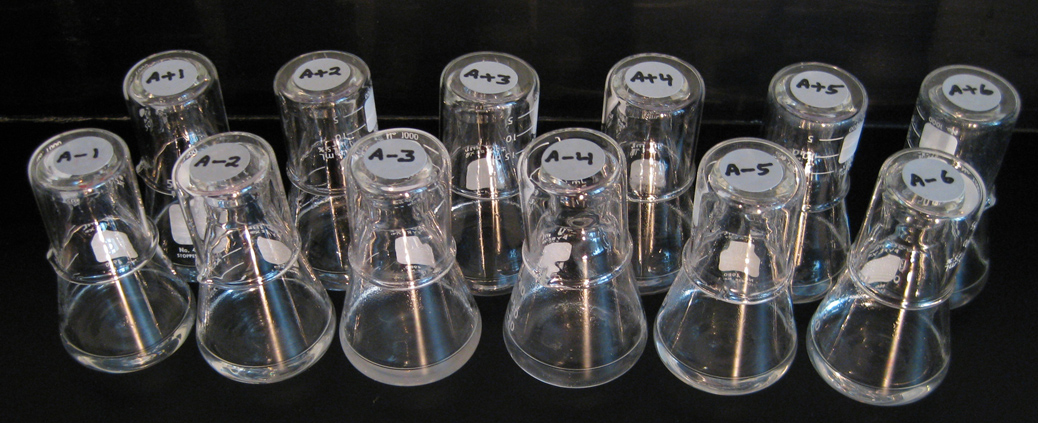
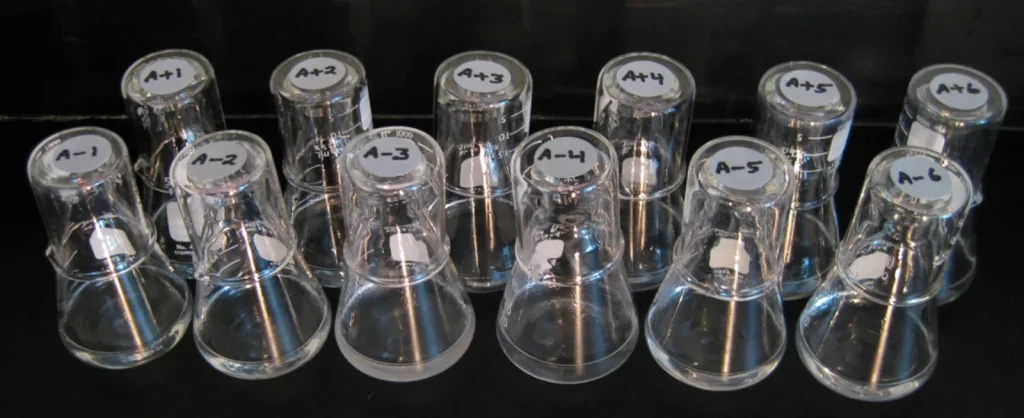
The 12 populations of Richard Lenski’s long-term evolution experiment on 25 June 2008. The cloudy flask, Ara-3 (labeled A-3), holds the population that evolved to use citrate, so it grows far more cells than the others.
WHERE THE EVIDENCE STANDS
WHAT WE DON’T KNOW YET
Nobody knows how often key steps in life’s history, such as the rise of complex cells or of minds like ours, would happen again in a replay. It is also hard to count how often convergence happens across all of nature.
WHAT WOULD CHANGE THIS ANSWER
More replay experiments in many kinds of living things, run for longer and started from more distant points in history, would sharpen this answer. Finding life elsewhere, with its own separate history, would give the first test of evolution on another world.
Partly. If we could rewind the history of life and press play again, many details would very likely come out differently. But not everything. Evolution keeps finding some of the same solutions, again and again.
The question has a famous history. In 1989, the scientist Stephen Jay Gould wrote a book called Wonderful Life. He argued that evolution is full of chance and quirky turns. If we replayed the “tape of life” from the distant past, he said, the living world would look far different from today’s. Simon Conway Morris, an Earth scientist at the University of Cambridge, argued back. He pointed to convergent evolution, when unrelated living things evolve the same kind of trait on their own. In his view, life takes many routes but reaches only a few destinations.
We cannot rewind all of life. But we can replay small pieces of it. In 1988, the biologist Richard Lenski started 12 flasks of the same bacteria, E. coli, and let them evolve side by side. By 2008 they had passed 40,000 generations. Samples are frozen along the way, so the team can go back in time and run history again.
The results show both sides. All 12 populations got better at living in their flasks, often through similar changes. But only one population evolved the ability to eat a food called citrate, after more than 30,000 generations, as a 2008 paper reported. Replays showed that it needed earlier changes first. That is chance and history at work.
Nature shows the same mix. Eyes capable of true vision arose separately several times in different animal groups. Sharp, high-resolution eyes come in different designs, such as camera eyes and compound eyes.
So the plain answer is that evolution mixes chance with patterns that repeat. That much is Established. Our overall answer, “partly,” is Supported, still debated. Whether a full replay would give a broadly similar world, including anything like us, is an Open question.
Free long answer 1 of 3 this month.
Stephen Jay Gould made the idea famous in his 1989 book Wonderful Life: The Burgess Shale and the Nature of History. A 2021 article in BioScience sums up his claim: if we rewound the tape of life and replayed it from the Cambrian, a time more than 500 million years ago, we would be unlikely to end up with anything like humans. A 2008 paper by Zachary Blount, Christina Borland and Richard Lenski in the journal PNAS explains his reasoning. Evolution depends on long chains of earlier events, and small changes in them can have huge effects later. So, Gould argued, replaying the tape of life from some point in the distant past would give a living world far different from the one we see today. Scientists call this contingency: when an outcome depends on the particular history that came before.
The same paper gives the other side. Simon Conway Morris, of the University of Cambridge’s Department of Earth Sciences, argued that natural selection pushes living things toward a fairly small number of good designs. His summary: the routes are many, but the destinations are limited. In a 2010 essay for the Royal Society, he went further. He wrote that evolution is remarkably predictable, and that some major steps in life’s history were very probable, if not inevitable. He also called this a heterodox idea, meaning it goes against the usual view.
Neither side says evolution is pure chance or pure destiny. The argument is about the balance.
Lenski’s long-term evolution experiment started in 1988 with 12 populations of E. coli, all founded from the same starting strain. They live in a liquid with a little glucose, a sugar, as food. Each day, a small sample of each is moved into a fresh flask. The bacteria grow about 6.6 generations a day, so the experiment moves through thousands of generations each year. By 2008 it had passed 40,000 generations. Every so often, samples are frozen. Those frozen samples are a living fossil record that can be thawed and run again.
The 12 flasks show a lot of parallel change. According to the 2008 paper, all 12 populations improved in fitness, quickly at first and then more slowly. All evolved faster growth on glucose and bigger cells. At least three genes changed in all 12 populations. That is the repeatable side of evolution, and it answers one of the most common questions: bacteria in separate flasks often evolve the very same fix because they face the very same challenge.
The flasks also contain citrate, a compound E. coli normally cannot use as food when oxygen is present. For more than 30,000 generations, no population learned to eat it, even though each one tried out billions of mutations. Then, by generation 31,500, one population, called Ara-3, evolved the trait. The team noticed it after about 33,127 generations, when that flask turned much cloudier with extra cells.
Was this just one rare lucky mutation? The team tested it by replaying history. They thawed clones from different points in Ara-3’s past and started 72 new replay populations, which evolved for about 3,700 generations. The citrate trait evolved again in four of them, and all four were founded from later-generation clones. The researchers concluded that some earlier change, which arose by generation 20,000, made the trait much easier to reach. They call this a potentiating mutation.
A 2012 paper in Nature by Blount and colleagues read the genomes. The trait arose when a stretch of DNA was duplicated, which switched on a citrate transporter gene that had been silent. The genome work also found that several earlier potentiating mutations arose during the population’s history. So the citrate story is both: a new trait that became reachable only in a population whose history had set the stage.
One population gives one history. Separate populations can take different paths in the same environment, because mutations occur in different orders. Comparing populations reveals how often an outcome appears and how much results vary. Many cells from one population do not provide many separate evolutionary histories.
A 2010 experiment started six populations per food regime. Testing evolved bacteria against their ancestor under matched conditions distinguished inherited improvement from temporary adjustment to the surroundings.
It shows what follows from chosen rules for reproduction, survival and population size. Those assumptions matter: the authors of SLiM 3, an evolution simulator, describe how simplifying life cycles can limit which situations a model represents.
The 2026 mutation-bias study used a simple model to explore possibilities, then tested predictions in real bacterial populations. Running a simulation is useful; checking its predictions against living things supplies the biological test. This does not mean a model captures all of evolution.
Researchers record their question, planned measurements and analysis before learning the outcomes, usually in a registry. This separates an advance prediction from an explanation built after seeing results. Plans can change; researchers should report what changed and why. Preregistration does not guarantee a sound experiment or a correct idea.
Existing data can still be useful, but researchers must say what they already knew. A pattern discovered while examining data is exploratory; a later test can fix its plan before examining fresh outcomes.
Outside the lab, scientists look for convergent evolution. Eyes are a classic case. In a 2013 review, Dan-E. Nilsson of the Lund Vision Group at Lund University in Sweden concluded that the move from simply sensing light toward true vision happened several times on its own in different animal groups. Eyes built for sharp, high-resolution vision evolved only in vertebrates (animals with backbones), cephalopods (such as octopuses and squid) and arthropods (such as insects and crabs). Some are camera-type eyes, like ours. Others are compound eyes, like an insect’s, made of many small units. These are different solutions to the same problem.
There is a twist. A gene called Pax-6 helps control how eyes develop in both vertebrates and many invertebrates. Some scientists took that as a sign that eyes evolved only once. Nilsson argues that his picture of several separate origins, built from simple light-sensing cells that early animals already shared, fits with that shared gene too. Why do eyes keep evolving? In Nilsson’s account, animals kept evolving more demanding behaviors guided by sight, and those behaviors pushed eyes to perform better.
The strongest objection to “evolution would repeat” is that we have never replayed the big picture. A 2018 review in Science by Blount, Lenski and Losos weighed the evidence. They found that evolution tends to be surprisingly repeatable among closely related lineages. But different outcomes become more likely the deeper history runs. They also note that it is hard to measure how often convergence happens in nature.
A newer piece of the puzzle is mutation bias: some mutations simply happen more often than others. A 2026 study in Nature Communications by J. N. Barber and A. Couce used two strains of E. coli with high, lopsided mutation rates that evolved resistance to the antibiotic cefotaxime. The usual view is that mutation bias matters less in large populations. They found it can fade in some cases, but it can also persist and even grow stronger in large populations, depending on how well it lines up with what selection favors. They describe a view in which evolution favors not just the fittest, but “the likeliest among the fittest.” They also write that the idea is still controversial.
“Evolution is random.” Mutations arise by chance, but natural selection is not random. The 2018 review calls selection a deterministic force, meaning it pushes steadily in a direction.
“Repeated traits mean everything was bound to happen.” Repeats show that some solutions are likely. They do not show that every step, or every species, would come back.
“Lenski’s bacteria prove Gould right,” or “prove him wrong.” They support parts of both views: lots of parallel change, and one key trait that depended on history.
The answer stays the same after all this detail. Evolution mixes chance with repeatable patterns. How alike a replayed world would be is still debated.
Author’s hypothesis. Ricardo’s natural-dominance proposal compares how often competing mutation routes occur and when they take hold. A route here means a possible genetic change. The software description for version 2.6.5, dated 5 September 2026, calls it a proposed framework. It considers the supply of new mutations, their biological accessibility, whether they establish, and the setting.
Its question is which routes we could predict, and how often. For the standard meaning of “survival of the fittest,” and how fitness, luck and timing relate, see our fitness and evolution answer. TMD still needs to show whether its models predict better than appropriate alternatives.
Author’s hypothesis. The relationship stated in the Research Notebook, reviewed 1 October 2026, is narrower: TMD has not established a new law of evolution or replaced natural selection. It proposes tests of mutation-route models. That leaves a research question to investigate; it does not establish that Darwin’s account has been overturned. The cited passages do not settle the author’s precise historical comparison with Darwin.
Author’s hypothesis. A title containing “Theory” is not a biological test. The version 0.8 description, dated 12 October 2025, used “pre‑theory” and made the full name conditional on passing checks specified in advance. Version 2.6.5 describes a proposed framework and leaves improved prediction to independent comparisons planned before new outcomes are examined.
The methods report, version 0.5.0, dated 30 September 2026 and posted 1 October, claims no new laboratory experiment or matched biological validation. The cited passages support a proposal awaiting such testing, not a claim that its biological predictions have passed those tests.
Author’s hypothesis. The Research Notebook proposes a broad comparison: an outside lab fixes its test in advance, then TMD’s picks do no better than a standard model of mutation bias plus selection. That would count against the proposed extra predictive benefit. It is the Notebook’s suggested criterion, not a completed experiment.
The version 0.5.0 report describes a narrower condition. After its recovery correction, if the ranges from different conditions share no common value, that challenges the “proposed common contrast” under its stated assumptions. Here, the contrast is a comparison between routes. If the ranges overlap, the question remains unsettled.
This conditional result concerns a shared comparison under those assumptions. It does not establish rejection of every TMD claim or identify a biological mechanism. The cited passages do not supply a full laboratory rejection protocol for the whole framework. Follow the Test Ledger for the Notebook’s dated test status.
THREE THINGS TO REMEMBER
WHERE THE AUTHOR’S RESEARCH TOUCHES THIS
Author’s hypothesis. The Research Notebook’s Evolution & mutation page describes a research program by Ricardo Maldonado, author of GOD PLAYS DICE, called the Theory of Mutation by Natural Dominance (TMD). It starts from the pattern on this page: when many populations of the same microbe face the same challenge, such as an antibiotic, they often evolve similar fixes. It asks whether the “winning” mutations follow patterns we could predict, and how much the setting matters.
Its newest software version, 2.6.5, is dated 5 September 2026 and was posted on Zenodo on 30 September 2026. It is for analysis only. Its tools include a check that a lab runs first, checks on results sent in from outside, and a log of every step that others can replay. Version 2.6.4 compares the proposed patterns with competing explanations based on known mechanisms. Passing software checks does not show the pattern happens in nature.
On the same day, Ricardo posted a separate report. It says its aim is “to make predictions that can fail fairly on new data.” It corrects how earlier work used some counts, and it takes a new look at data that other scientists published in 2021. It calls that look “exploratory, not preregistered.” Because it reuses published data, it is not a test fixed in advance. Neither version 2.6.5 nor the report describes a new lab experiment, and TMD does not establish a new law of evolution or replace natural selection.
The Research Notebook’s status, reviewed 30 September 2026, is: software and workflow release; no new lab test reported. Its strongest challenge is the mainstream work on mutation bias described above: to count, TMD would have to pick the winners better than those models, on new data. You can follow what would count against it on the Test Ledger.
Nobody knows yet.
God Plays Dice answers big questions in plain words, with sources and one of six honest labels.
See a mistake? Report a problem. Corrections are made openly.
CONTINUE THE THREAD
Life in the UniverseExplainer
Small inherited differences, filtered over countless generations, add up to the variety of life. Here is how evolution works and how we know.
Life in the UniverseAnswer
Identical twins develop from one fertilized egg and begin with almost the same DNA. Yet their conditions before birth, later environments and gene activity can differ. Shared DNA…
Life in the UniverseAnswer
Humans and chimpanzees inherited much of their DNA from a shared ancestor. Similar DNA can produce different bodies when some protein instructions and patterns of gene activity differ.…
The Architect AI companion · All Access
Labels describe the evidence for a claim, not the people who hold it.
Match my phone uses your device’s light or dark setting.