Skip to content
BackGOD PLAYS DICE™Big questions, honest answers

THE QUESTION LIBRARY GOD & BELIEF

Did Jesus exist, and what do historians conclude?

Nearly all historians, of every background, conclude that a Jewish preacher named Jesus lived and was crucified; here are the sources, the debates over them, and the questions history leaves to faith.

THE SHORT ANSWER

Yes. Nearly all historians, believers and nonbelievers alike, conclude that Jesus of Nazareth was a real Jewish preacher who was crucified in Jerusalem around 30 CE, under the Roman prefect Pontius Pilate. The main evidence is Paul’s letters, the Gospels, and short mentions by the Jewish historian Josephus and the Roman historian Tacitus. A small number of writers argue that he never existed. Whether he rose from the dead or was divine is a question of faith that history alone cannot settle.
  • Scholars who conclude that Jesus existed include Christians and nonbelievers, such as Bart Ehrman, who calls himself both an agnostic and an atheist.
  • Paul’s letters, begun around 50 CE, are the earliest surviving Christian texts; the Gospels followed between about 60 and 90 CE.
  • The Roman historian Tacitus wrote that Christ was executed by Pontius Pilate while Tiberius was emperor.
  • Josephus mentions Jesus twice in a work from 93/94 CE, but Christian copyists later changed the longer of the two passages.
  • Miracles, the resurrection and Jesus’ divinity are questions of faith that historical methods alone cannot settle.
On this page
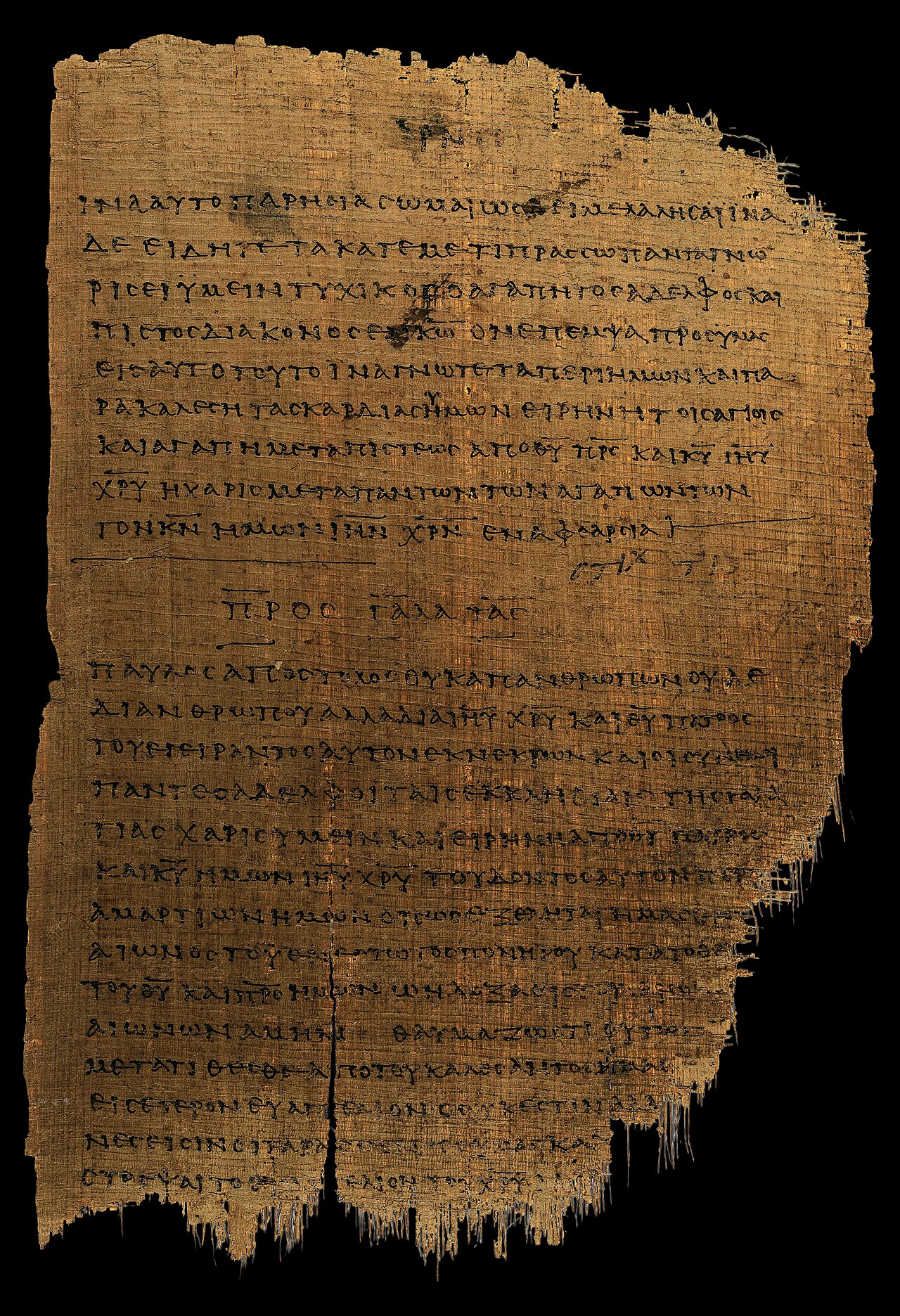
A ragged, tan sheet of ancient papyrus on a black background, covered in rows of handwritten Greek capital letters. Near the middle, a short centered heading, the Greek title of the letter to the Galatians, separates the end of one text from the start of the next. The bottom edge is frayed and split.
About this picture

The opening of Paul’s letter to the Galatians in Papyrus 46, a book of Paul’s letters made in Egypt. The Chester Beatty, which holds most of its surviving pages, dates it to the third century AD and calls it the oldest surviving almost complete copy of his letters. Later in this letter, Paul says he saw “James the Lord’s brother.”

University of Michigan (P.Mich.inv. 6238, Papyrus 46), via Wikimedia Commons · Public domain · Image source ↗

WHERE THE EVIDENCE STANDS

How sure are we?

  • A Jewish preacher named Jesus lived in Galilee and was crucified in Jerusalem under Pontius Pilate.Britannica (E. P. Sanders): baptized by John the Baptist, a traveling preacher and healer, executed in Jerusalem between 29 and 33 CE. Tacitus names Pilate and Tiberius. Ehrman reports that historians of every background, Christian, Jewish, Muslim, agnostic and atheist, conclude that Jesus existed.
  • Every word of Josephus’s longer passage about Jesus is his own.Britannica says its hint that Jesus was divine could not have come from Josephus; Sanders calls it heavily revised by Christian scribes. Gathercole calls the second mention, of “the brother of Jesus, who was called Christ,” not suspicious; Carrier argues that both references to Jesus were added later.
  • Jesus never lived as a real person.Ehrman points to Paul’s meetings with Peter and with Jesus’ brother James; Gathercole finds no one in the ancient world who questioned that Jesus lived. Richard Carrier, who has a Ph.D. in ancient history, defends the idea, but he himself says the mainstream consensus favors a historical Jesus.
  • Jesus rose from the dead, worked miracles and was divine.Ehrman argues historians can only judge what probably happened, and a miracle is by definition the least probable event. Craig and Wright argue the resurrection best explains the evidence, though Wright adds that past that point the historian alone cannot help. Denzey Lewis calls these theological ideas, not historical statements.
What the labels mean

WHAT WE DON’T KNOW YET

Historians cannot pin down many details of Jesus’ life, such as his exact birth year, and they know almost nothing about his childhood. Scholars still debate how much of the longer Josephus passage he wrote. Whether Jesus rose from the dead is a question of faith that historical method alone cannot settle.

WHAT WOULD CHANGE THIS ANSWER

The historical answer would shift only with strong new evidence, such as signs that Paul’s letters came much later than scholars think, or that the Josephus and Tacitus passages were entirely added. A newly found ancient text could add detail. Faith questions would stay open either way, because history alone cannot settle them.

Yes. Nearly all historians who study the ancient world conclude that Jesus of Nazareth was a real person. He was a Jewish preacher and healer from Galilee who was crucified in Jerusalem around 30 CE, when Pontius Pilate governed Judea for Rome. Historians who hold this view include devout Christians and nonbelievers alike.

People ask for many reasons. Some have seen a video claiming that Jesus was invented. Some are believers who want to know what history can add to faith. Some are questioning what they were raised to believe and want honest answers either way. All of these are fair reasons to ask.

The main evidence is written: documents by Christian, Jewish and Roman authors. The earliest surviving Christian writings are the letters of Paul, begun around 50 CE. In one, Paul says that on a visit to Jerusalem he saw “James the Lord’s brother.” The four Gospels followed between about 60 and 90 CE. Outside the church, the Jewish historian Josephus mentions Jesus twice, and the Roman historian Tacitus writes that Christ was executed under Pilate. Christian copyists later changed one of the Josephus passages, and scholars still debate how much.

A small number of writers, including the historian Richard Carrier, argue that Jesus never lived as a person. Most historians, including atheists such as Bart Ehrman, find that the evidence points the other way. We label the historical core Established.

History has limits. It weighs evidence for what probably happened. Scholars disagree about whether it can judge a miracle such as the resurrection. N. T. Wright, who argues that the evidence points to it, still says that past a point “the historian alone cannot help.” Whether Jesus worked miracles, rose from the dead or was the Son of God is a question of faith, which we label Beyond science. You are welcome here, whatever you believe.

THE LONG ANSWER

Free long answer 1 of 3 this month.

What are the sources, and what do historians conclude?

Historians test ancient sources by asking how early and how independent they are. E. P. Sanders, author of The Historical Figure of Jesus, explains in Britannica that one key test is multiple attestation: a report found in two or more independent sources is likely to be authentic. Here are the main sources.

Paul’s letters. Paul began writing around 50 CE, and his letters are the earliest surviving Christian texts. Scholars agree that his earliest letters were written within 25 years of Jesus’ death at the latest, notes Simon Gathercole of the University of Cambridge. Paul says little about Jesus’ life. But in 1 Corinthians 15 he passes on an early tradition about Jesus’ death, burial and appearances to his followers. In Galatians, he says he stayed fifteen days in Jerusalem with Cephas and saw “James the Lord’s brother.” Cephas is the Aramaic form of the name Peter; both names mean “rock” (John 1:42). Sanders calls Paul’s letters reliable but meager evidence.

The Gospels. Mark was written around 60–80 CE, and Matthew, Luke and John around 75–90 CE. Sanders calls Matthew, Mark and Luke the primary sources for the historical Jesus, but notes that they are theological documents, not academic biographies. Writing for the Society of Biblical Literature’s Bible Odyssey site, New Testament professor Mark Allan Powell says historians are skeptical of miracle stories, yet widely accept much of what these Gospels report as reliable.

Josephus. Flavius Josephus was a Jewish historian who wrote in Rome; his Antiquities of the Jews appeared in 93/94 CE. It mentions Jesus twice. The longer passage calls Jesus “a wise man, if it be lawful to call him a man” and says “He was [the] Christ.” Britannica says this hint that Jesus was divine could not have come from Josephus and reflects “tampering (if not invention)” by a later Christian copyist. Scholars disagree about how much is original. Gathercole writes that Christian scribes probably turned a negative account into a more positive one. Sanders says Josephus’s original words cannot now be recovered. D. S. Wallace-Hadrill, in a 1974 journal article, judged that the arguments against the passage’s authenticity outweigh those for it. The shorter passage describes how a high priest had “the brother of Jesus, who was called Christ, whose name was James” stoned. Gathercole calls that reference not suspicious.

Tacitus. About 20 years after Josephus, the Roman historian Tacitus described how Nero blamed Christians for a fire in Rome. He explains that their name came from Christus, who “suffered the extreme penalty during the reign of Tiberius at the hands of one of our procurators, Pontius Pilatus.” Gathercole notes that this fits the Gospels’ timeline. Sanders adds a caution: Tacitus’s knowledge depended on familiarity with early Christianity, so it is not independent evidence about Jesus.

What historians conclude. From these sources, Sanders describes a short public career. Jesus was baptized by John the Baptist, became a traveling preacher and healer, and was executed in Jerusalem at Passover, sometime between 29 and 33 CE. Britannica’s article says we have fairly good general knowledge of his life and message, though many details are uncertain or dubious. Bart Ehrman, a scholar who calls himself both an agnostic and an atheist, sums up one key argument: Paul personally knew Jesus’ closest disciple, Peter, and his brother James. “If Jesus did not exist, you would think his brother would know it.” Ehrman adds that before Christianity no Jews expected a crucified messiah. The messiah was to be a figure of power who would overthrow the enemy, so no one making up a messiah would have him crucified.

What is the strongest objection?

The strongest challenge is mythicism, the view that Jesus never lived as a person. Richard Carrier, who holds a Ph.D. in ancient history from Columbia University, defends it in books he describes as peer reviewed. He argues that Christianity began with revelations, and that the Gospels are later literary works that Christians came to treat as history. He treats the argument from Paul’s letters as “a respectable point of debate,” but argues that the passages in Josephus and Tacitus were either added later or derived from Christian stories. He also challenges the crucified-messiah argument. In a new article for the Canadian-American Theological Review, he argues that some fringe groups of Jews before Christianity did expect a messiah who would die and rise, though he grants that this finding is “not evidence either way” on whether Jesus existed.

Most historians are not persuaded. They point to Paul’s meeting with James, to Josephus’s second passage, and to the fact that, in Gathercole’s words, “we know of no one in the ancient world who questioned whether Jesus lived.” Ancient critics attacked Jesus instead: early rabbinic writings called him a sorcerer, and the pagan writers Lucian and Celsus dismissed him as a scoundrel. Gathercole adds that the two mainstream historians who have written most against mythicism, Maurice Casey and Bart Ehrman, are atheists.

What can history not settle?

History deals in probabilities. In a 2006 debate, Ehrman argued that historians can only say what probably happened, and a miracle is by definition the least probable event, so history cannot show that one occurred. “I’m not saying it didn’t happen,” he added; for him, the resurrection has to be taken on faith. His opponent, William Lane Craig, argued the Christian side: the resurrection, he said, is the best explanation for facts most scholars accept, namely Jesus’ burial, the empty tomb, his appearances after death and his followers’ belief that he had risen. Craig replied that Ehrman’s case against miracles repeats an old argument made by David Hume in the 18th century, which Craig said most philosophers today reject. In a 2002 lecture, N. T. Wright argued that historians’ usual method, inference to the best explanation, points strongly toward the bodily resurrection, but he added that from that point on “the historian alone cannot help.”

Others draw the line sooner. Nicola Denzey Lewis, writing for Bible Odyssey, says we cannot verify that Jesus performed miracles or that he is the Son of God, because these are theological ideas, not historical statements. Britannica’s article notes that the sources disagree about who saw the risen Jesus and where, and that deliberate fraud by the first believers seems unlikely. As Gathercole puts it, the more interesting question, “whether Jesus died and lived,” goes beyond history. That is why we label these questions Beyond science.

What do people often get wrong?

  • “No one outside the Bible mentions Jesus.” Within a few decades, Gathercole notes, he is mentioned by Jewish and Roman historians, Josephus and Tacitus among them.
  • “Records from his own time would mention him.” Ehrman notes that Roman sources from Jesus’ day mention scarcely anyone from his time and place.
  • “Historians have confirmed the Gospel stories.” They accept a historical core, not every story. Britannica says many details are uncertain, and Powell notes that historians are skeptical of miracle stories.
  • “Jesus was copied from pagan gods.” Ehrman says the claimed parallels mostly exist in the modern imagination: we have no accounts of others who were born to virgins, died to atone for sin and were raised from the dead.
  • “Hardly anyone doubts that Jesus existed.” Among the public, many do. Gathercole cites a survey in which 40% of adults in England did not believe Jesus was a real historical figure. Asking is reasonable; the evidence is what matters.

Where can believers and skeptics agree?

  • Jesus of Nazareth was a real person. Scholars who argue for the resurrection, such as N. T. Wright, and nonbelievers such as Bart Ehrman agree on this.
  • History and faith ask different questions. Wright says that past a point the historian alone cannot help, and Ehrman says historians have no access to God.
  • Honest handling of sources matters. Scholars on every side discuss openly how copyists changed Josephus, and they weigh each source’s limits.
  • Questions are welcome. Whether you are deepening a faith or rethinking one, our answers on questioning what you were raised to believe and on loving science while believing in God may help.

How can you check this yourself?

  • Read the ancient texts. Tacitus, Annals 15.44, and Josephus, Antiquities 18.63 and 20.200, are free at the Perseus Digital Library in older English translations.
  • Read Paul. Galatians 1:18–19 and 1 Corinthians 15:3–8 are only a few lines long.
  • Hear both sides. Read Ehrman’s short essay “Did Jesus Exist?” and Carrier’s essay “Why Is a Historical Jesus an Obsolete Paradigm?”, and compare how each handles the same sources.
  • Separate the questions. Ask whether a claim is about what happened, which history can weigh, or about what it means, which faith answers. In the strict sense, proof belongs to mathematics; our answer on what science can and cannot settle explains why. History, like science, weighs evidence.

The answer stays the same. Nearly all historians conclude that Jesus lived and was crucified. What that means is a question each reader answers in faith or in doubt, beyond what history can settle.

THREE THINGS TO REMEMBER

  1. Nearly all historians, believers and nonbelievers, conclude that Jesus of Nazareth was a real person.
  2. The key sources are Paul’s letters, the Gospels, Josephus and Tacitus, and each has limits.
  3. Miracles and the resurrection are questions of faith that history alone cannot settle.
Words worth knowing (5)
Historical Jesus
Jesus as historians reconstruct him from the sources, using the same methods they use for other ancient figures, apart from faith claims.
Gospels
The four accounts of Jesus in the New Testament: Matthew, Mark, Luke and John. Matthew, Mark and Luke are called the Synoptic Gospels.
Multiple attestation
A historian’s test: a report found in two or more independent sources is more likely to be authentic.
Testimonium Flavianum
The name scholars give to the longer paragraph about Jesus in Josephus’s Antiquities of the Jews (book 18), which Christian copyists later changed.
Mythicism
The view that Jesus never lived as a real person. Its defenders, such as Richard Carrier, call themselves mythicists.

Sources & further reading

(10) · Checked Sep 29, 2026
  1. Jesus (sections: Introduction; Sources for the life of Jesus; The Resurrection) ↗Encyclopaedia Britannica (E. P. Sanders and Jaroslav Pelikan)The live site returns HTTP 403 to scripted requests, so Internet Archive copies were read: main page 20260911075723 (last modified 2026-09-08); sources section on /biography/Jesus/The-Jewish-religion-in-the-1st-century (20260926232200; byline E. P. Sanders, “Arts and Science Professor of Religion, Duke University. Author of Jesus and Judaism and The Historical Figure of Jesus”); Resurrection section on /biography/Jesus/Scribes-and-Pharisees (20260724034710; page header shows Jaroslav Pelikan, the section ends with Sanders’s name, so the text credits “Britannica’s article”). Used: born c. 6–4 BCE, died c. 30 CE; Luke 2:41–52 aside, no other evidence of his childhood; baptized by John, itinerant preacher and healer, short public career, Passover sometime between 29 and 33 CE, arrested, tried and executed; Pilate “the prefect”; Paul’s letters written beginning in 50 CE, the earliest surviving Christian texts, “reliable but meagre evidence,” 1 Corinthians 15 evokes an early tradition of Jesus’ death and appearances; Mark 60–80 CE, Matthew, Luke and John 75–90 CE; the Synoptic Gospels are the primary sources but theological documents, not the equivalent of an academic biography; multiple attestation; Tacitus’s knowledge dependent on familiarity with early Christianity, not independent evidence; Josephus’s paragraph heavily revised by Christian scribes, his original remarks cannot be discerned; sources disagree on who saw the risen Jesus and where; deliberate fraud unlikely; “fairly good general knowledge, though many details are uncertain or dubious.”
  2. Flavius Josephus ↗Encyclopaedia Britannica (Gary William Poole; last updated 11 Sept 2026)Read from the Internet Archive copy of 16 Sept 2026. The Antiquities has two famous references to Jesus; Book XX calls him the “so-called Christ”; the implication of divinity in Book XVIII could not have come from Josephus and reflects the “tampering (if not invention) of a later Christian copyist.”
  3. Josephus, Antiquities of the Jews 18.63 and 20.200 (William Whiston translation) ↗Perseus Digital Library, Tufts University18.63: “a wise man, if it be lawful to call him a man”; “He was [the] Christ”; condemned to the cross by Pilate. 20.200 (https://www.perseus.tufts.edu/hopper/text?doc=Perseus%3Atext%3A1999.01.0146%3Abook%3D20%3Awhiston%20chapter%3D9%3Awhiston%20section%3D1): the high priest Ananus brought “the brother of Jesus, who was called Christ, whose name was James” and had them stoned. Debate: D. S. Wallace-Hadrill, “Eusebius of Caesarea and the Testimonium Flavianum,” Journal of Ecclesiastical History 25(4), 1974, pp. 353–362, doi:10.1017/S0022046900049435 (opening extract read): scholarly opinion long divided; arguments against authenticity outweigh. Date of the Antiquities (93/94 CE) and Josephus writing in Rome: Steve Mason, “Josephus,” Bible Odyssey (https://www.bibleodyssey.org/articles/josephus/).
  4. Tacitus, Annals 15.44 (Church and Brodribb translation) ↗Perseus Digital Library, Tufts UniversityNero fastened guilt for the fire on the Christians; “Christus, from whom the name had its origin, suffered the extreme penalty during the reign of Tiberius at the hands of one of our procurators, Pontius Pilatus.”
  5. Galatians 1:18–19, 1 Corinthians 15:3–8 and John 1:42 (NRSVUE) ↗Bible Gateway (New Revised Standard Version Updated Edition)Paul visited Cephas in Jerusalem, stayed fifteen days and saw no other apostle except “James the Lord’s brother.” 1 Corinthians 15:3–8 (https://www.biblegateway.com/passage/?search=1%20Corinthians%2015%3A3-8&version=NRSVUE): what Paul received and handed on, that Christ died, was buried, was raised and appeared to Cephas, the twelve, more than five hundred, James, all the apostles and Paul. John 1:42 (https://www.biblegateway.com/passage/?search=John%201%3A42&version=NRSVUE): “You are to be called Cephas” (which is translated Peter), with NRSVUE notes “Aramaic for rock” and “Greek for rock.” Image caption facts from the Chester Beatty record for P46 (https://viewer.cbl.ie/viewer/object/BP_II_ff_15_90/1/LOG_0000/): written in Greek on papyrus, made in Egypt in the third century AD; the oldest surviving almost complete copy of the Pauline Epistles; 86 of 112 folios survive, 56 at the Chester Beatty and 30 at the University of Michigan.
  6. Did Jesus Exist? ↗HuffPost (Bart D. Ehrman, 20 March 2012)Published 20 March 2012. Virtually every historian, “Christian, Jewish, Muslim, pagan, agnostic, atheist,” concludes Jesus existed; mythicists “call themselves mythicists”; Jesus is not mentioned in Roman sources of his day, which mention scarcely anyone from his time and place; Paul knew first hand Jesus’ closest disciple Peter and his brother James (“If Jesus did not exist, you would think his brother would know it.”); before Christianity no Jews expected a crucified messiah, the messiah was to be a figure of grandeur and power who overthrew the enemy; the alleged pagan parallels in most instances reside in the modern imagination, with no accounts of others born to virgin mothers who died as an atonement for sin and were raised. Ehrman’s self-description: “On Being an Agnostic Atheist” (23 May 2021, https://ehrmanblog.org/on-being-an-agnostic-atheist/): “it is possible to be both an agnostic and an atheist. And that’s how I understand myself.” His harsher 2012 words about mythicists are not used.
  7. What is the historical evidence that Jesus Christ lived and died? ↗The Guardian (Simon Gathercole, Reader in New Testament Studies, University of Cambridge; 14 April 2017)Mentioned by Jewish and Roman historians within a few decades of his supposed lifetime; scholars agree Paul’s earliest letters were written within 25 years of Jesus’ death at the very latest; Josephus around AD 93, two references, one thought corrupted by Christian scribes (probably turning a negative account more positive), the James reference not suspicious; about 20 years after Josephus, Tacitus: executed while Pilate was Roman prefect of Judaea (AD 26–36) and Tiberius emperor, fitting the Gospels’ timeframe; never any ancient debate about whether Jesus lived; rabbinic literature denounced him as a sorcerer, Lucian and Celsus as a scoundrel; “we know of no one in the ancient world who questioned whether Jesus lived”; the two mainstream historians who have written most against these arguments, Maurice Casey and Bart Ehrman, are atheists; a recent survey found 40% of adults in England did not believe Jesus was a real historical figure (no date or sponsor given); “The more interesting question – which goes beyond history and objective fact – is whether Jesus died and lived.”
  8. Jesus; How Does the New Testament Relate to History? ↗Bible Odyssey, Society of Biblical Literature (Mark Allan Powell, 2016; Nicola Denzey Lewis)Powell (18 May 2016; professor of New Testament, Trinity Lutheran Seminary): historians analyze the Gospels with the criteria used for other ancient writings, are skeptical of miracle stories, yet much of what the Gospels (especially the Synoptics) report is widely accepted as reliable. Denzey Lewis (https://www.bibleodyssey.org/articles/how-does-the-new-testament-relate-to-history/): “we can’t verify that Jesus performed miracles, or that he is the Son of God—these are theological ideas, not historical statements.” Site © Society of Biblical Literature.
  9. Is There Historical Evidence for the Resurrection of Jesus? The Craig–Ehrman Debate ↗Reasonable Faith (transcript; College of the Holy Cross, 28 March 2006)College of the Holy Cross, 28 March 2006. Ehrman: historians can only establish what probably happened, and by definition a miracle is the least probable occurrence; “I’m not saying it didn’t happen”; historians have no access to God; the resurrection has to be taken on faith. Craig: four facts he says the majority of scholars accept (burial, empty tomb, post-mortem appearances, the disciples’ belief) and the resurrection as the best explanation; Ehrman’s argument is a warmed-over version of David Hume’s 18th-century reasoning, rejected as fallacious by most contemporary philosophers (Craig’s claim). N. T. Wright, “Jesus’ Resurrection and Christian Origins,” Gregorianum 83/4 (2002), 615–635, the McCarthy lecture of 13 March 2002 (https://ntwrightpage.com/2016/07/12/jesus-resurrection-and-christian-origins/): inference to the best explanation points strongly towards the bodily resurrection; from that point on “the historian alone cannot help.”
  10. Why Is a Historical Jesus an Obsolete Paradigm? ↗Richard Carrier Blogs (17 September 2026)Carrier’s own case (17 September 2026): Christianity began with revelations and the Gospels are later literary creations that Christians came to treat as history; his monographs described as peer reviewed; Paul referring to a historical Jesus is “a respectable point of debate”; the Josephus and Tacitus passages were forged or derived from fiction; he says “the mainstream consensus today favors a vague ordinary Jesus.” Bio (site sidebar): Ph.D. in ancient history, Columbia University. “New Journal Publication on Jewish Expectations of a Dying Messiah” (5 August 2026, https://www.richardcarrier.info/archives/43806): lead article in the Canadian-American Theological Review, vol. 14 (the journal’s delayed 2025 issue), finding that a dying messiah was a live option in some fringe groups of Jews; in his own reply in the comments he says this “does not verify mythicism” and is “not evidence either way.” In the same comment thread on the 17 September post he says he does not hold that Cephas is not Peter. His tone toward other scholars is combative; only his arguments are used here.

See a mistake? Report a problem. Corrections are made openly.

The Architect AI companion · All Access

Your next question can go further.

Included with All Access →Up to 5 questions a day while available.

Put God Plays Dice on your Home Screen

On iPhone: tap Share (on iOS 26, tap ••• first), then Add to Home Screen, then Add.

On Android: In Chrome, you can also open the ⋮ menu and choose Add to Home screen or Install.

The Home Screen version keeps its own memory on iPhone, so your nights and saved answers start fresh there.

Search the Question Library

149 answers to read · 0 questions awaiting answers Your search runs on your device.

Answers about death, grief and crisis are always free, in full. If a question is personal right now →