
Extraordinary ClaimsAnswer
What does research say about people who report memories of past lives?
What past-life memory research investigates, what reported matches can show, and why case studies do not by themselves establish reincarnation.
THE QUESTION LIBRARY EXTRAORDINARY CLAIMS
A visitor from another star raised a fair question, so here is what was observed, what was inferred, whether the evidence supports an alien probe, and what is still unresolved.
No evidence shows that it was. 3I/ATLAS, found on July 1, 2025, is only the third object known to have visited us from another star system. It had a dusty coma and tails and released comet gases such as carbon dioxide and water. NASA and ESA call it a comet, and radio searches found no artificial signals. Astrophysicist Avi Loeb argued that its oddities deserved a technology check. Some puzzles remain, but even he wrote that it is most likely natural.
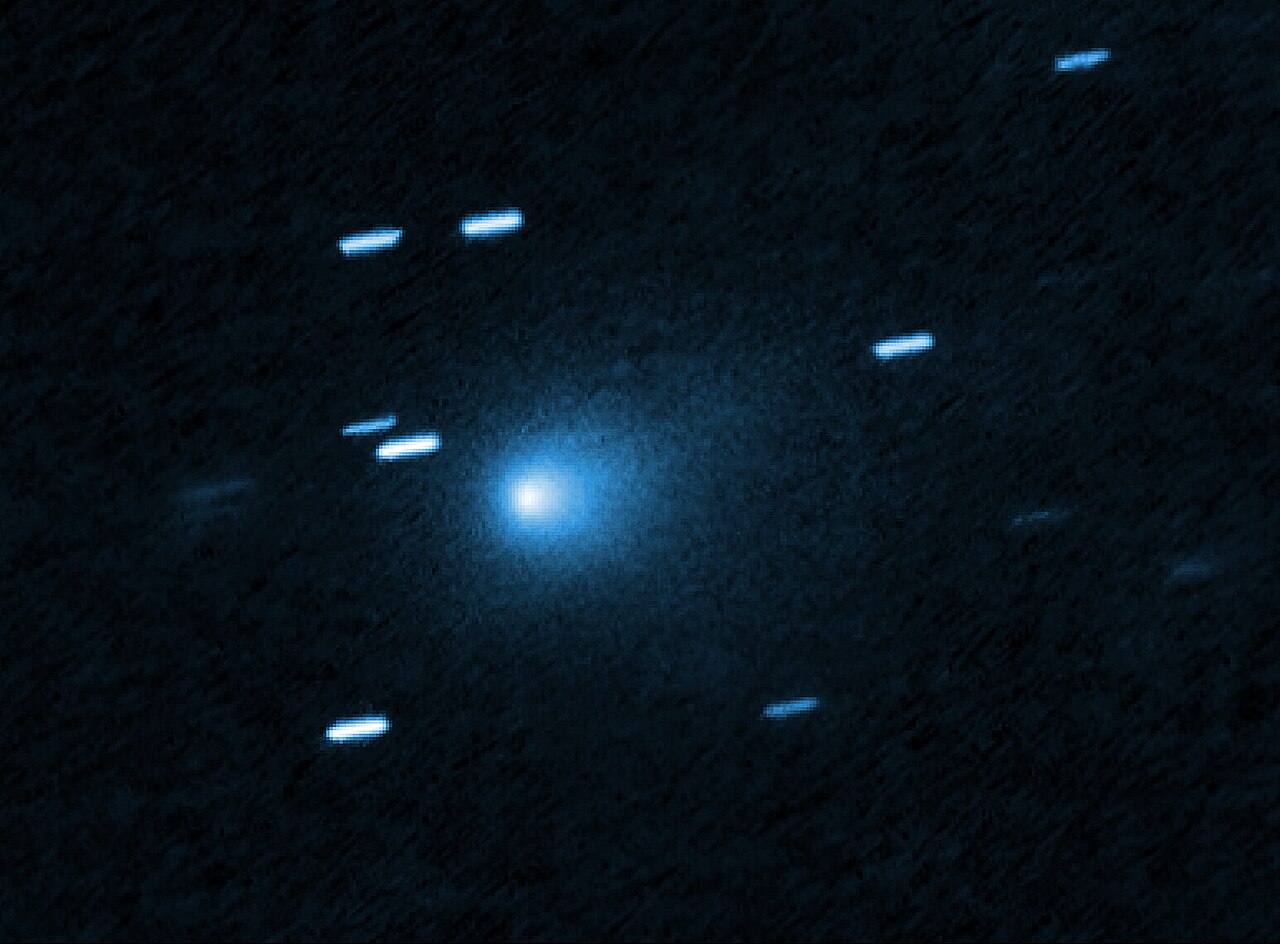
Hubble photographed 3I/ATLAS on July 21, 2025, and showed a teardrop-shaped cocoon of dust coming off its solid, icy core. NASA said its dust behaved much like that of comets from our own solar system. The short streaks are background stars, smeared because Hubble was tracking the moving comet.
WHERE THE EVIDENCE STANDS
WHAT WE DON’T KNOW YET
Nobody knows exactly how big its solid core is: Hubble limits as of August 2025 put it between 440 meters and 5.6 kilometers across. Scientists are still working out why its gas was so rich in carbon dioxide and why nickel showed up early. Its home star is unknown.
WHAT WOULD CHANGE THIS ANSWER
A narrow radio signal traced to the object, a change of course that escaping gas cannot explain, or objects released from it, confirmed by independent teams using public data, would change this answer. Loeb himself named releases near Jupiter, artificial lights or unexpected maneuvers as possible signs.
No. Nothing found so far shows that 3I/ATLAS was an alien probe, and every test points to a natural comet from another star system. But the question is fair, and it deserves a careful look, not a laugh.
3I/ATLAS was spotted on July 1, 2025, by the NASA-funded ATLAS survey telescope in Chile. The name tells its story. The “I” stands for interstellar, and the “3” means it is the third known object to pass through our solar system from outside it, after ‘Oumuamua in 2017 and 2I/Borisov in 2019. It moved too fast for the Sun’s gravity to hold it, so it made one pass and headed back out.
Why did people wonder? Its path lies close to the flat plane the planets move in, but it travels the opposite way. It was hidden behind the Sun, as seen from Earth, at its closest point to the Sun. Early data showed a glow pointing toward the Sun and more nickel than iron in its gas. Avi Loeb, a Harvard astrophysicist, co-wrote a paper asking whether it could be alien technology. Rumors of an alien ship spread, and NASA officials later moved to dispel them.
Then the data poured in. More than a dozen NASA missions, including Hubble and Webb, watched it, along with European spacecraft at Mars and on the way to Jupiter. They saw what comets do: a cloud of dust and gas, tails, and gases such as carbon dioxide, water, carbon monoxide and methane. Radio telescopes found no artificial signals, though they did pick up natural radio fingerprints of gases around it. NASA and the European Space Agency both call it a comet.
Some puzzles remain. Its gas was unusually rich in carbon dioxide, and its chemistry hints that it may be older than our Sun. Those are real mysteries, but they are mysteries about a comet. Asking “could it be artificial?” was reasonable. So far, the evidence says no.
Free long answer 2 of 3 this month.
On July 1, 2025, the NASA-funded ATLAS survey telescope in Río Hurtado, Chile, first reported it to the Minor Planet Center. The discovery team measured an orbital eccentricity of about 6.1, a strongly open path. Its orbit is tilted about 175 degrees, so it lies close to the plane of the planets but runs the opposite way. It reached its closest point to the Sun at the end of October 2025, just inside the orbit of Mars.
It was active from the start. The discovery team’s images showed a compact coma, the fuzzy cloud of gas and dust around a comet’s icy core. Hubble saw a teardrop-shaped cocoon of dust and a plume from the Sun-warmed side, much like our own comets. On August 6, 2025, the Webb telescope found carbon dioxide, water, carbon monoxide and water ice, plus a tentative sign of carbonyl sulfide. Its ratio of carbon dioxide to water was among the highest ever seen in a comet. Spectra from the Very Large Telescope in Chile showed nickel gas but, at first, no iron.
More than a dozen NASA missions observed it, along with ESA’s Mars orbiters and its Jupiter-bound Juice spacecraft. After it passed the Sun, Webb detected methane, the first direct detection of that gas on an interstellar visitor, NASA says, and measured about 30 times more deuterium, a heavy form of hydrogen, than in solar system comets. Its path also bent very slightly away from the course gravity alone predicts, a small push called non-gravitational acceleration.
NASA and ESA drew the plain inference: a comet from another star. NASA’s FAQ says its characteristics, color, speed and direction all fit a comet, and ESA says its shape and behavior indicate one. At a NASA briefing on November 19, 2025, associate administrator Amit Kshatriya said the agency is always looking for life beyond Earth, “but 3I/Atlas is a comet,” PBS News reported.
A second inference got more attention. On July 16, 2025, Adam Hibberd, Adam Crowl and Avi Loeb posted a paper titled “Is the Interstellar Object 3I/ATLAS Alien Technology?” They pointed to its path lying within about 5 degrees of the planets’ plane (a chance they put near 0.2%), to passes near Venus, Mars and Jupiter (about 0.005% or less), and to its being hidden behind the Sun, seen from Earth, near its closest point to the Sun, when a spacecraft could brake unseen. They also counted a lack of comet gas in its spectrum and a size too large for an asteroid. They raised the idea that it could be technological and even hostile. Yet they called the paper “largely a pedagogical exercise,” and its conclusion says a completely natural object, probably a comet, is by far the most likely outcome, while adding that the work offered “compelling insights” into the technology idea.
Loeb, a Harvard professor who heads the Galileo Project, kept a public list of anomalies on his blog. By late November 2025 it included a forecast pass by Jupiter at almost exactly Jupiter’s Hill radius, roughly the farthest distance at which Jupiter’s gravity can hold a moon, which he said might mean it intends to release devices there; more nickel than iron in its gas, which he compared to industrial nickel alloys; a jet pointing toward the Sun; a very massive nucleus; extreme negative polarization of its light (a pattern in how its light waves line up); and very fast brightening near the Sun. He rated it 4 on his 0-to-10 Loeb Scale, which runs from a natural comet or asteroid (0) to alien technology that could threaten humanity (10). Levels 8 to 10 are kept for confirmed artificial objects, so a 4 marks it as anomalous, not artificial. He also wrote, more than once, that it is most likely a natural object, but that a black swan, a small chance with huge stakes, deserves a close look. In April 2026, he still rated it 4, while noting that its fading light showed no sign of artificial light.
So far, no. Each argument has been checked against data.
This is the strongest objection. We have seen only three interstellar objects, so nobody knows what normal looks like for them. Researchers who search for signs of alien technology take them seriously: a 2025 review by James Davenport and colleagues, posted on arXiv, argues that checking them for technosignatures must become routine as new telescopes find more.
But keeping a question open is different from treating an oddity as evidence. The same review urges care before calling something a technosignature mainly because it differs from solar system objects. An object from another star should differ, and Wright notes that no two comets seem quite alike. The checks were done, and they found a comet.
What do people often get wrong? “Anomalous” does not mean “artificial.” It means “not yet explained.” And the data are not locked away. NASA’s open-data page points to public archives for Webb, TESS, SPHEREx and MAVEN data. Officials said a federal government shutdown had kept them from answering every theory, PBS reported. For the wider question of secrecy, see our answer on whether governments are hiding evidence of aliens. If a video claims to show a spaceship, our guide on checking viral videos can help.
Quite a lot. Nobody knows exactly how big the solid core is: Hubble limits as of August 2025 put it between 440 meters and 5.6 kilometers across. The Webb team suggested its ices saw more radiation than those of our comets, or formed near the zone in its star’s disk where carbon dioxide freezes. In November 2025, Wright listed its high nickel, extreme polarization, odd water level and fast brightening as puzzles that interest planetary scientists.
Its exact time and place of origin remain highly uncertain, the Webb team wrote in 2026. But Webb found little carbon-13, a heavier form of carbon that builds up in galaxies over time, and with the high deuterium that points to a very old, cold birthplace. In a Nature paper published in June 2026, the team says it may have formed as long as 12 billion years ago, while noting significant uncertainties in that age. Our Sun formed 4.5 billion years ago. ESA said its teams were analyzing Juice’s observations, and in April 2026 Loeb was still waiting for data from NASA’s Juno spacecraft at Jupiter.
Asking whether 3I/ATLAS was a probe was fair. Every test so far says it was a comet from another star, and a strange and fascinating one.
THREE THINGS TO REMEMBER
Next on the path “I saw something. How would we know?” · step 4 of 8
Are governments hiding evidence of aliens? What do the records show?
Not according to any public evidence so far.
See this path: I saw something. How would we know?
God Plays Dice answers big questions in plain words, with sources and one of six honest labels.
See a mistake? Report a problem. Corrections are made openly.
The Architect AI companion · All Access
Labels describe the evidence for a claim, not the people who hold it.
Match my phone uses your device’s light or dark setting.