
The UniverseAnswer
Why do physicists still call the matter-antimatter imbalance unsolved?
Why the matter surplus remains unexplained, what Sakharov's conditions require, and how sphalerons and proposed neutrino mechanisms might connect.
THE QUESTION LIBRARY THE UNIVERSE
The force picture and the spacetime picture explain the same world at different levels of detail.
Both: gravity acts as a force in Newton’s model and as curved space and time in Einstein’s. The force model works well for many everyday problems. General relativity gives a deeper account that has passed demanding tests. Planets orbit because their motion carries them onward as gravity bends their paths. The Moon keeps much the same face toward Earth because it spins once during each orbit. A complete quantum account of gravity is still missing.
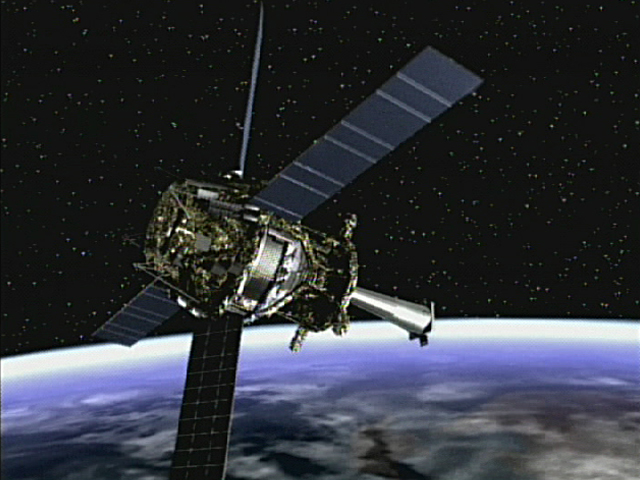
An artist’s concept of Gravity Probe B, which tested predicted spacetime effects with gyroscopes in Earth orbit.
WHERE THE EVIDENCE STANDS
WHAT WE DON’T KNOW YET
Nobody knows yet which full quantum theory of gravity, if any of the proposed accounts, nature follows. That gap does not stop us from testing gravity on larger scales.
WHAT WOULD CHANGE THIS ANSWER
A clear, repeatable mismatch with general relativity would show where a better model is needed. A quantum theory would gain support by making new predictions that tests could distinguish from its rivals.
Both descriptions work: gravity is a force in Newton's model, and a change in the shape of space and time in Einstein's. Which description you need depends on what you are trying to explain. They are ways to describe the same world, with different ranges of use.
The question often starts with a small puzzle. A dropped cup falls, but the Moon stays up. Astronauts float, yet their spacecraft stays near Earth. These scenes can seem to call for different rules. Looking at the motion helps connect them.
An orbiting planet is still falling toward the Sun. Its sideways motion carries it onward while gravity bends its path. A spacecraft in orbit falls too. The people and loose objects inside fall with it, so they float relative to one another. Floating does not mean that Earth's gravity has switched off.
The Moon gives us another useful clue. It turns once on its axis during each trip around Earth. That matched motion keeps much the same side facing us. Earlier in its history, tides changed its spin. This is called tidal locking; it does not mean the Moon stands still.
You do not have to choose between an apple and a curved universe. The force picture helps with everyday motion. The deeper picture connects gravity to spacetime: the combined description of where and when events happen. Tests with satellites and waves from distant events let scientists check that picture against measurements.
There is still a frontier. Physicists do not yet have a tested, complete account joining gravity with the quantum rules used for tiny particles. That gap matters. It does not erase the parts of gravity that we can measure and use.
Free long answer 3 of 3 this month.
In Newton's account, masses attract one another. A force changes motion. This language works well for planning many orbits and describing falling objects. In Einstein's general relativity, gravity changes the geometry of spacetime. A freely falling object follows the paths set by that geometry. NASA's introduction to general relativity describes this change in the gravitational picture.
Spacetime is a way of keeping track of events using both place and time. The phrase curved spacetime does not mean that Earth sits on a hidden sheet. It means that the rules for distances, times and free motion differ from those in flat spacetime.
An analogy can help: routes drawn on a globe differ from routes on a flat map. The analogy breaks because gravity involves time as well as space, and spacetime is not the surface of a physical ball. No one needs to stand outside the universe to hold it up.
Falling and orbiting can be the same motion. A planet has motion along its path, while gravity keeps bending that path toward the Sun. It keeps moving past the place it would hit if it had no sideways motion. NASA's account of orbital mechanics explains how an inward force changes direction, even when speed stays the same.
Picture an analogy: a ball swung on a string follows a curved path because the string pulls inward. The analogy breaks because planets need no string. Gravity supplies the inward influence across space. It also breaks if you imagine that there must be a second outward force balancing gravity in a simple inertial frame, a viewpoint that is not itself turning with the planet.
The inward pull does not cancel the planet's motion and leave it parked. It changes the motion. NASA's gravity questions use the ball-and-string example to explain why an object continues onward if the inward pull is removed.
Not every path near a star is an orbit that lasts. Motion matters. Asking whether something will orbit, strike the star or escape requires its starting position and speed. The phrase gravity pulls inward is only part of that question.
A spacecraft in Earth orbit is in free fall. The astronaut, the spacecraft and a loose apple fall together. The astronaut does not see the apple racing toward the cabin floor, because the floor is falling too. NASA's microgravity explanation makes this point directly.
Here is an analogy: imagine a sealed room falling with everything inside it. For a short time, the objects would seem to hover relative to the room. The analogy breaks because an ordinary falling room soon hits the ground. An orbiting spacecraft has enough sideways motion to keep falling around Earth.
Standing on the ground is different. The ground supports your feet and prevents you from following a free-fall path. That support is why a scale can register your weight. In orbit, the familiar support from a floor is absent. Strong gravity and floating can therefore occur together.
The useful question is not simply whether someone feels weight. Ask what their surroundings are doing. A video of a floating astronaut shows relative motion inside a falling spacecraft; it cannot establish that space has no gravity.
The Moon rotates. Its spin period matches its orbital period around Earth, so much the same hemisphere faces us. NASA's tidal-locking explanation describes how Earth's uneven pull across the Moon helped produce this match.
Gravity stretches the Moon slightly. When the Moon was spinning faster, its stretched shape and the timing of the tidal response let Earth exert a turning influence on it. That process lost mechanical energy as heat and changed the spin. Over time, rotation became matched to the orbit.
You can model the matched motion without a telescope. Put a chair in the middle of a room. Walk around it while keeping your face toward it. During one circuit, you turn through a full rotation relative to the room. Now repeat while always facing the same wall. Your face no longer keeps pointing at the chair.
This demonstration is an analogy for the geometry, not a model of how tides caused the change. Your feet do the turning. It also leaves out the small variations in our view of the real Moon. The main point survives: keeping one face toward Earth requires rotation, rather than its absence.
It is fair to ask whether curved spacetime is more than a helpful picture. The strongest reply comes from measurements that test the theory's predictions. In the Gravity Probe B team's results, spinning instruments called gyroscopes in Earth orbit changed direction at rates consistent with the predicted effects of curved spacetime and Earth's rotation. Those are measured effects, not merely a drawing of a rubber sheet.
Another line of evidence comes from gravitational waves, disturbances in spacetime. A study of LIGO and Virgo observations examines their travel speed. A neutron-star merger seen in both gravitational waves and light gave a strong check that the signals travel at almost the same speed. The speed measurements have limits and uncertainties; the result is not an unlimited license to claim every detail of gravity is settled.
The serious unfinished part is quantum gravity. Quantum theory describes tiny particles, while general relativity describes gravity. CERN explains that gravity is absent from the Standard Model of particle physics, and that the frameworks are hard to combine. A proposed carrier particle called the graviton has not been found.
That is the strongest objection to treating today's account as complete. It is incomplete. A better theory would still need to explain why the existing tests work, while making fresh predictions that observations could check. For that larger problem, see What would a theory of everything explain?
Start by separating three common mix-ups. Floating does not mean no gravity. Orbiting does not mean no falling. A Moon that keeps facing Earth is not a Moon that fails to spin. Each mistaken statement leaves out the motion of the observer or the object.
Try the chair demonstration, then read NASA's tidal-locking page to distinguish the visible pattern from its cause. Read its microgravity page with a second question: what falls together? These are small checks that make the explanation harder to misread.
For spacetime, compare a prediction with a measurement in the Gravity Probe B abstract. You can notice whether the predicted and observed values are close without mastering the units. For gravitational waves, look at how the speed study describes its uncertainties. A test is most useful when it states what it can rule out and where its reach ends.
Finally, keep the layers separate when you read a headline. A useful calculation, a physical model and an unanswered question can all appear in one subject. The unanswered part is a reason to keep testing, not a reason to throw away every measured result.
THREE THINGS TO REMEMBER
Next on the path “Where did everything come from?” · step 5 of 7
How do we know dark matter exists if we cannot see it?
We know it from its gravity.
See this path: Where did everything come from?
God Plays Dice answers big questions in plain words, with sources and one of six honest labels.
See a mistake? Report a problem. Corrections are made openly.
The Architect AI companion · All Access
Labels describe the evidence for a claim, not the people who hold it.
Match my phone uses your device’s light or dark setting.