
Extraordinary ClaimsAnswer
What does research say about people who report memories of past lives?
What past-life memory research investigates, what reported matches can show, and why case studies do not by themselves establish reincarnation.
THE QUESTION LIBRARY EXTRAORDINARY CLAIMS
Some scientists have studied the question carefully, so here is what a real trace would look like, what the searches have found, what archaeologists learned about the pyramids and the Nazca Lines, and who makes crop circles.
Nobody knows yet whether aliens ever visited Earth, but no confirmed trace has been found. The question is a fair one. Scientists who asked whether we could even detect an ancient civilization or a small alien probe found the odds can be low: time erases a lot, and many places are poorly searched. A 2024 Pentagon review found no evidence that any U.S. government investigation had confirmed alien technology. The famous examples, such as the pyramids and the Nazca Lines, show the skill of ancient people.
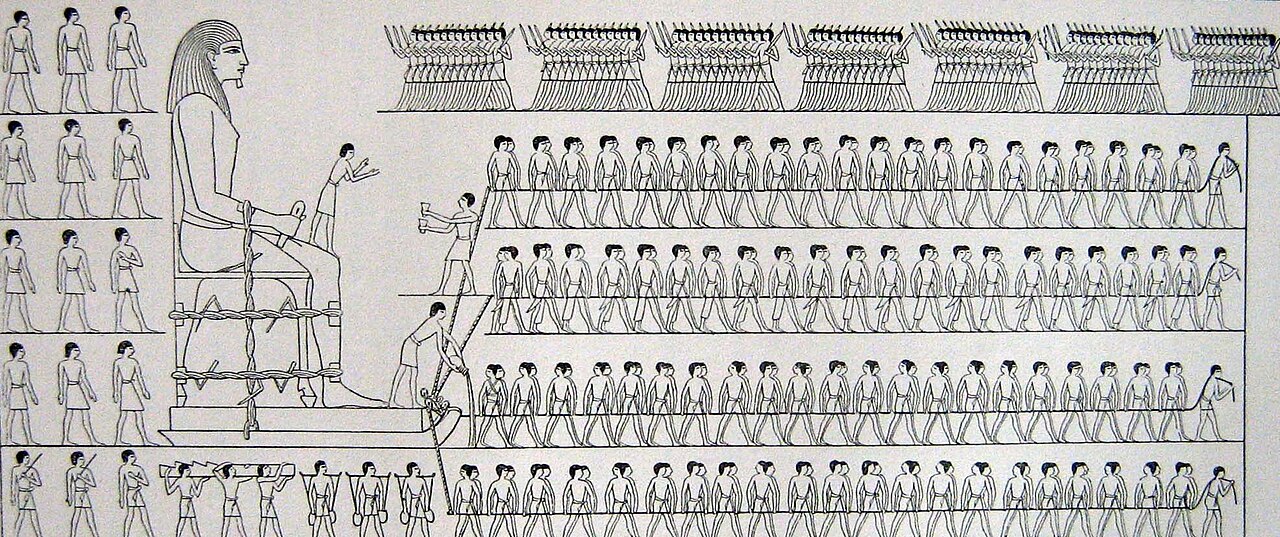
A drawing published in 1854 by John Gardner Wilkinson of a scene from the tomb of Djehutihotep at el-Bersheh, Egypt. Rows of workers haul a giant statue on a sledge while a man at the front pours water on the sand. Physicists found in 2014 that wetting sand with the right amount of water can halve the pulling force.
WHERE THE EVIDENCE STANDS
WHAT WE DON’T KNOW YET
Nobody knows whether anyone ever visited Earth. A 2012 study called Earth the best-searched place in the solar system, though caves, parts of the ocean and the ground beneath us may not be searched well enough, and it said few searches could spot a probe 1 to 10 meters across. Where some unusual seafloor spheres came from is also still debated.
WHAT WOULD CHANGE THIS ANSWER
An object that nature and people could not have made, found in a dated place and confirmed by several independent labs, would change this answer. So would a signal or probe that other teams could observe too.
Nobody knows yet whether aliens ever visited Earth, and no one has found a confirmed trace of alien visitors so far. But the question is a fair one, and some scientists have studied it carefully. Many people wonder about it. In a 2018 Chapman University survey, 41.4% of Americans agreed that aliens visited Earth in the ancient past.
Why would scientists ask? Our own technology is very young. Humans have had industry for only about 300 years, while complex life has lived on land for about 400 million. So what would a much older visit, or an older civilization, leave behind? In 2018, Gavin Schmidt of NASA and Adam Frank of the University of Rochester studied a related puzzle: could we even detect an industrial civilization that lived on Earth millions of years ago? For anything older than about 4 million years, they concluded, the chance of finding its objects or fossils is small. So they focused on chemical clues instead. Our own industrial age, they noted, might show up in seafloor mud as a layer only a few centimeters thick.
So a missing trace does not settle the matter. But the searches so far have found nothing that holds up. In 2024, the Pentagon’s office for UFO reports reviewed U.S. government investigations back to 1945. It found no evidence that any of them had confirmed alien technology. NASA says it has found no credible evidence of life beyond Earth.
What about the famous examples, like the pyramids of Egypt and the Nazca Lines of Peru? Here the evidence points to people. Archaeologists found a town where pyramid builders lived and ate, the cemetery where they were buried, and a logbook kept by an official whose crew shipped stone to the Great Pyramid. The Nazca figures were made by clearing away surface gravel to show lighter ground beneath.
That is a story of human skill, and it takes nothing away from the wonder. The larger question stays open. It deserves careful looking, not easy answers.
Free long answer 1 of 3 this month.
A real trace would be something that neither nature nor the people of the time could have made. It would sit in a place or rock layer that can be dated, and more than one lab would have to test it.
Schmidt and Frank named their question the “Silurian hypothesis,” after a 1970 episode of the TV series Doctor Who. The record is thin. Objects rarely survive and get found: even our own cities cover less than 1% of Earth’s surface. Old ocean floor gets recycled, so seafloor mud only goes back about 170 million years. The authors speculated that the markers unique to industry would be plastics, long-lasting man-made molecules and, after a nuclear disaster, long-lived radioactive fallout. They wrote that they “strongly doubt” an earlier industrial civilization existed, but that asking the question carefully raises useful questions. Their paper is about an Earth-born civilization, not aliens, but the lesson carries over: time erases a lot.
In 2012, Jacob Haqq-Misra and Ravi Kopparapu argued that an alien probe about 1 to 10 meters across could sit in our solar system without anyone knowing. At the time, they wrote, few if any searches could have spotted a probe that small. They called Earth the best-searched place, though caves, parts of the ocean and the ground beneath us may not have been searched well enough. Other scientists search for “technosignatures,” signs of technology such as radio signals or pollution in a planet’s air, and NASA says it funds a handful of grants for this work.
Nothing that holds up as alien. The Pentagon’s All-domain Anomaly Resolution Office (AARO) reviewed U.S. government efforts since 1945 in a 2024 historical report. Its summary says: “AARO found no evidence that any USG investigation, academic-sponsored research, or official review panel has confirmed that any sighting of a UAP represented extraterrestrial technology.” (USG means the U.S. government; UAP is the newer name for UFOs.) The office also found that a piece of metal said to come from a crashed alien craft was a manufactured alloy from Earth, mostly magnesium, zinc and bismuth. It remains open, the report says, to new, verifiable information.
By mid-September 2026, the Pentagon had also posted six batches of old and recent UFO files from several agencies. NBC News reported that the first batch showed no sign that the U.S. government had interacted with beings from other planets or had reason to think they had visited Earth. The Pentagon said many files had not yet been analyzed.
Harvard’s Galileo Project looks for objects rather than signals. Over five months, its infrared sky cameras traced about 500,000 flight paths. After the team checked about 80,000 oddly wiggly ones by hand, 144 stayed unclear: likely ordinary objects, it says, that the cameras alone could not yet identify.
In 2023, an expedition led by astrophysicist Avi Loeb towed a magnetic sled across the Pacific seafloor near the path of a 2014 fireball and collected hundreds of tiny spheres. In a 2024 paper, the team reported that some of them have a chemistry unlike any known solar system material, from an unknown source. Another researcher found the chemistry consistent with coal ash. A separate review argued that the simplest explanation is that the fireball’s speed, the original reason to think it came from outside the solar system, was overestimated. That dispute is not settled.
The first known visitor from another star, ‘Oumuamua, was found on October 19, 2017, by the Pan-STARRS1 telescope in Hawaii. It was long and thin, showed no sign of comet activity, and sped up slightly in a way gravity alone could not explain. In 2018, Shmuel Bialy and Avi Loeb suggested that if sunlight caused the push, it might be a thin sheet, natural or perhaps an artificial light sail. In 2019, a team of 14 researchers reviewed the data and found the observations “consistent with a purely natural origin.” Several natural causes for the push have been proposed; in 2023, one study argued that hydrogen gas escaping from its ice did it. NASA calls a later visitor, 3I/ATLAS, first reported on July 1, 2025, a comet; see our answer on whether 3I/ATLAS was an alien probe.
What was observed. The Giza pyramids went up about 4,500 years ago, and King Khufu’s Great Pyramid stood 146 meters (481 feet) tall when first built. For centuries, travelers saw these monuments standing in splendid isolation, with little sign of the many people needed to build them.
What was inferred. That gap, the Smithsonian notes, gave rise to claims that space aliens, or people from Atlantis, built them.
Does the evidence support it? No. Starting in 1988, archaeologists with Ancient Egypt Research Associates dug up a town 400 meters south of the Sphinx. It was the base for building the pyramids of kings Khafre and Menkaure, and probably Khufu. It covers more than 7 hectares (17 acres), with bakeries, workshops, houses and huge grain silos. Its cemetery lies on the hillside just west of it. Egypt’s antiquities ministry says most of the bodies show hard labor, and most broken bones had healed correctly, a sign of good medical care. In 2013, Pierre Tallet’s team found the oldest known papyri at Wadi al-Jarf, an ancient Red Sea harbor. They include the logbook of an official named Merer, who led about 200 men. It records boatloads of limestone carried from the Tura quarry along the Nile to Giza, for the Great Pyramid.
What is unresolved. Exactly how the blocks were raised. Archaeologists generally agree the builders used ramps, but how the ramp system worked has been a long-standing mystery. The open questions are about ramps, ropes and sledges, not who did the work.
The Nazca Lines tell a similar story. UNESCO says they were scratched into the desert of southern Peru between 500 BC and AD 500 by removing weathered surface gravel to reveal lighter ground. They include animals, plants, imaginary beings and lines several kilometers long. In a 2007 interview, a geographer on a team led by Markus Reindel of the University of Bonn said they were ceremonial sites, not landing strips, and that making them was part of a religious practice. In a 2022–23 field survey guided by AI, another team found 303 new figures, nearly doubling the known number. The smaller figures sit, on average, 43 meters from ancient footpaths. The team concluded they were meant to be seen by people walking the trails, and that the giant figures were probably used by whole communities for rituals.
Crop circles are much newer. Britannica says simple circles began appearing regularly in fields in southern England in the late 1970s. Some who studied them were convinced that their intricacy, and plants that seemed bent but not broken, ruled out human makers. But in 1991, Doug Bower and Dave Chorley of Southampton said they had made more than 200 since the late 1970s with nothing more complex than ropes and boards. Even people who see crop circles as messages accept that a significant portion are made by people.
Many places where traces could hide have not been searched closely, deep time erases most things, and a small probe could still escape notice. That is fair.
But an open question is not the same as a likely answer. Schmidt and Frank warned that their own idea “cannot be regarded as likely merely because no other valid idea presents itself.” For the pyramids, Nazca and crop circles, we do have valid ideas, backed by towns, graves, logbooks and the makers’ own accounts. So the careful position has two parts: the famous examples have human explanations, and the search for real traces goes on.
“Unexplained means alien.” Unexplained means the answer is missing. AARO reports that past investigations found most sightings were ordinary objects that people misidentified, and that the vast majority of cases lack good data.
“Ancient people could not have done it.” The builders left their homes, bakeries and graves, and a boat crew left its logbook. Giving them credit fits what they left behind.
“The government has already confirmed it.” AARO found no empirical evidence that the U.S. government and private companies have been reverse-engineering alien technology. See our answer on whether governments are hiding aliens.
So nobody knows yet, and the question is still worth asking.
THREE THINGS TO REMEMBER
God Plays Dice answers big questions in plain words, with sources and one of six honest labels.
See a mistake? Report a problem. Corrections are made openly.
The Architect AI companion · All Access
Labels describe the evidence for a claim, not the people who hold it.
Match my phone uses your device’s light or dark setting.