Einstein CentennialExplainer
Is the Universe Truly Random?
A rolled die is unpredictable but not mysterious. Quantum events may be different. Here is where science draws the line, and where the debate begins.
THE QUESTION LIBRARY EINSTEIN CENTENNIAL
Dice, coins and weather follow fixed rules we can’t track, but quantum events are different, and whether they are random at the deepest level is still argued.
Nobody knows yet. Most everyday randomness, like dice, coins and weather, comes from details too small to track, not from nature itself. Quantum events are different. Quantum theory gives only the odds of when a single radioactive atom will decay, and experiments honored by the 2022 Nobel Prize ruled out one kind of hidden cause: local, pre-set instructions carried by particles. But some readings of quantum theory keep the world fully determined. So quantum outcomes are unpredictable in practice, while whether they are random at the root is still open.

Tracks of radioactive decay in a cloud chamber. Each V shape marks a thoron (radon-220) atom giving off an alpha particle, followed moments later by a second one from the atom it became. Quantum theory gives the odds of when such an atom decays, but not the moment.
WHERE THE EVIDENCE STANDS
WHAT WE DON’T KNOW YET
Nobody knows whether quantum outcomes are random at the root, or follow a deeper order we cannot see, such as hidden particle positions, branching worlds, or a shared cause in the distant past. Bohmian mechanics, for one, predicts the same measurement results as standard quantum theory, so today’s experiments cannot tell them apart.
WHAT WOULD CHANGE THIS ANSWER
An experiment that caught quantum results following a hidden pattern would change this answer. So would a new theory that explains the quantum odds and makes a new prediction that passes a test.
Nobody knows yet, but we know much more than we used to. Scientists separate two kinds of randomness. The first comes from ignorance: causes fix the outcome, but we can’t track them. The second is fundamental randomness: nothing at all fixes the outcome until it happens. Most of what we call random in daily life is the first kind. Quantum physics, the science of atoms and light, is where the second kind might live.
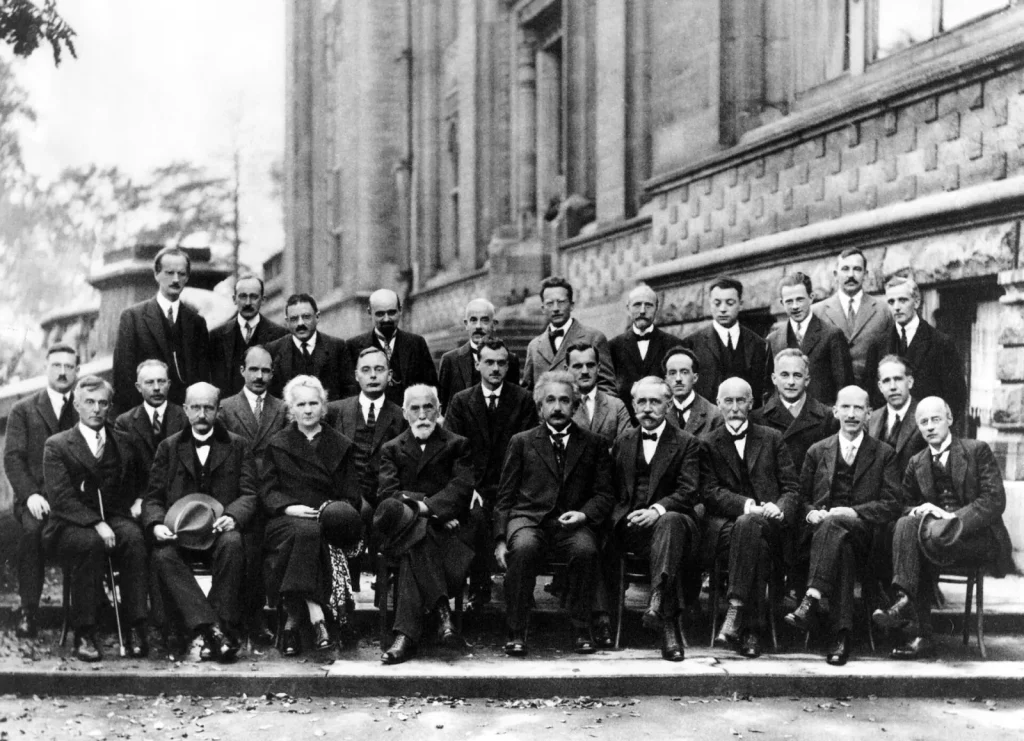
People ask for many reasons. A gambler wonders if dice can be beaten. A believer wonders whether chance leaves room for God. A skeptic wonders whether everything is set in advance. The question also has a birthday this year. On December 4, 1926, Albert Einstein wrote to his friend Max Born that he was convinced “He is not playing at dice.” “He” meant “the Old One,” Einstein’s name here for God, used as a figure of speech for nature’s deepest laws.
Start with dice. A die obeys the ordinary laws of motion. Its top face depends on the throw, the spin, the air and the table. Coins work the same way. In a study of 350,757 coin flips, coins landed on the side they started on 50.8% of the time, close to what a physics model predicted. Weather adds chaos: the rules are fixed, but tiny differences grow so fast that forecasts fail.
Quantum events are different. Quantum theory can give the odds that a radioactive atom will decay, but not the moment a given atom will. Einstein hoped hidden details would fill that gap. Experiments that began in 1972, honored by the 2022 Nobel Prize in Physics, ruled out the simplest version of that hope: pre-set instructions carried inside each particle.
Yet some ways of reading quantum theory keep the world fully determined. So quantum outcomes are unpredictable in practice, which is Established. Whether they are random at the root is an Open question.
Free long answer 3 of 3 this month.
A die, a coin and a storm all follow the ordinary laws of motion. We call them random because the causes are too small, too many or too fast for us to follow. That is randomness from ignorance.
Coins show this well. In 2007, the researchers Diaconis, Holmes and Montgomery built a physics model of a human coin toss. It predicted that a flipped coin lands on the side it started on about 51% of the time. A team led by František Bartoš then collected 350,757 coin flips made by people. Their result, published in 2025 in the Journal of the American Statistical Association, was 50.8% same side. Heads and tails still came up equally often overall. The small bias varied from person to person. A coin, in other words, is not a tiny lottery built into nature. It is physics we usually can’t track.
Weather adds a twist called chaos. A chaotic system follows fixed rules, but very small differences in its starting point grow very fast. In 1963, the scientist Edward Lorenz showed that a weather model had this “sensitive dependence” on its starting conditions. The popular image is the butterfly effect: a butterfly flapping its wings in Argentina could, in principle, change whether a tornado hits Texas three weeks later. The Stanford Encyclopedia of Philosophy stresses a point people often miss: chaotic behavior is always deterministic. Chaos makes the future hard to predict. It does not make it undecided.
Take a lump of radioactive material. Its half-life, the time for half of its atoms to decay, can be measured very precisely. Some half-lives are seconds long and some are billions of years, as the U.S. Environmental Protection Agency explains. But quantum theory gives only odds for a single atom. It does not say when that atom will decay.
Einstein asked whether this meant the theory was incomplete. The Stanford Encyclopedia uses exactly this example: could an atom decay at a definite moment even though the theory does not say when? If so, the odds would reflect missing details, like the odds for a coin. For decades, nobody knew how to test that idea.
In 1964, the Northern Irish physicist John Bell, who worked at CERN, found a way. He showed that if particles carry hidden instructions, and nothing travels faster than light between them, then measurements on linked pairs must stay under a fixed limit. Physicists call such hidden instructions “local hidden variables.” Quantum theory predicts that the limit can be broken.
In 1972, John Clauser and Stuart Freedman measured pairs of linked, or “entangled,” photons and broke Bell’s limit. In 1982, Alain Aspect’s team switched the measurement settings after the photons had left their source. The filters were six metres away, so the switch had to happen within a few billionths of a second. That closed an important gap in the argument. In 2015, three teams, in Delft, Vienna and Boulder, each closed the two main remaining loopholes, or gaps, at the same time. The Delft team placed its two measuring stations 1.3 kilometres apart.
In 2022, Aspect, Clauser and Anton Zeilinger shared the Nobel Prize in Physics “for experiments with entangled photons, establishing the violation of Bell inequalities and pioneering quantum information science.” The Stanford Encyclopedia’s entry on Bell’s theorem says that if we accept these results, at least one of the assumptions behind Bell’s limit must go. Our story How Scientists Tested Einstein’s Hunch tells the full story.
The experiments rule out one kind of explanation. They do not decide between the stories that remain, and some of those stories have no fundamental randomness at all.
Standard readings of quantum theory, by contrast, treat each outcome as truly undecided until it happens. In 2025, a Nature survey reported that physicists “disagree wildly” on what quantum mechanics says about reality.
The strongest objection is that quantum randomness is already real enough to use. In 2018, the U.S. National Institute of Standards and Technology (NIST) turned a Bell test into random numbers. From 55,110,210 trials it produced 1,024 bits certified as nearly perfectly uniform. In 2025, NIST and the University of Colorado Boulder launched a public randomness beacon called CURBy. In its first 40 days, it produced random numbers 7,434 times out of 7,454 attempts. NIST’s announcement says scientists have “proved that Einstein was wrong.”
This objection is right about practice. Nobody can predict these numbers, and that is why they are useful. But the certification rests on assumptions, one of which appears in the 2018 paper’s title: the impossibility of sending signals faster than light. The Stanford Encyclopedia describes such numbers as unpredictable to anyone limited by general physical principles, such as relativity. It also notes that this reasoning works even if a deterministic theory, such as Bohmian mechanics, is true at the deepest level. So the tests rule out local hidden variables, not every hidden variable. A believer in Bohmian mechanics would agree that nobody can predict the numbers, while saying that something still fixed them.
“Chaos proves the world is random.” Chaotic systems are deterministic. They are hard to predict, which is a different thing.
“The Nobel Prize proved that nature is random.” The prize honored experiments that broke Bell’s limit and ruled out local hidden variables. NobelPrize.org’s plain-language guide goes further. It says Aspect’s result showed that “quantum mechanics is correct and there are no hidden variables.” Careful sources, like the Stanford Encyclopedia, draw a narrower line: the tests rule out local hidden variables, and nonlocal theories such as Bohmian mechanics survive.
“If it’s random, anything can happen.” Quantum randomness follows precise rules. A radioactive sample still has a steady half-life, even though no single atom’s moment can be predicted.
“Random means meaningless.” Whether chance has any meaning is a question for philosophy and faith, not physics. People of faith and skeptics alike can agree on the measurements.
After all this detail, the answer stands. Everyday randomness is ignorance. Quantum outcomes are unpredictable in practice. Whether they are random at the root is still an open question.
THREE THINGS TO REMEMBER
Did Einstein lose his argument that God does not play dice?
Mostly, but not completely.
God Plays Dice answers big questions in plain words, with sources and one of six honest labels.
See a mistake? Report a problem. Corrections are made openly.
CONTINUE THE THREAD
Einstein CentennialExplainer
A rolled die is unpredictable but not mysterious. Quantum events may be different. Here is where science draws the line, and where the debate begins.
Einstein CentennialFeature
A century ago, Einstein told Max Born that "the Old One" does not throw dice, starting an argument that reshaped physics and is still not finished.
Einstein CentennialAnswer
What happened to OPERA's 2011 faster-than-light claim, how relativity is tested, and why successful measurements do not prove every possible prediction.
The Architect AI companion · All Access
Labels describe the evidence for a claim, not the people who hold it.
Match my phone uses your device’s light or dark setting.