The UniverseExplainer
What Is Dark Energy?
In 1998 astronomers found that the universe's expansion is speeding up, and "dark energy" is the name for a cause nobody yet understands.
THE QUESTION LIBRARY THE UNIVERSE
The acceleration is well supported by observations. What drives it, and whether that driver changes with time, remain open questions.
Nobody knows yet what causes the large-scale expansion to accelerate. Distant exploding stars first showed that the universe had expanded more than expected in a gravity-only picture. Astronomers call the unknown ingredient or effect “dark energy.” The simplest model treats it as a constant property of space. A recent galaxy survey, combined with other data, hints that it may change over time, but that has not been established.
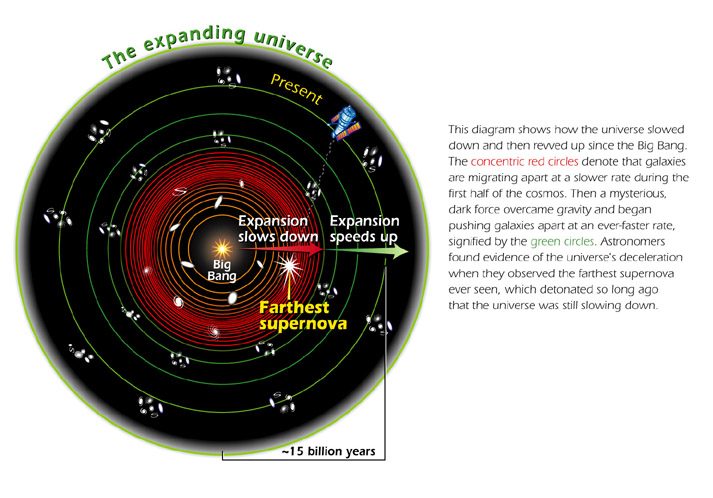
This illustration separates the earlier slowing of cosmic expansion from its later acceleration; it is a model diagram, not a photograph.
WHERE THE EVIDENCE STANDS
WHAT WE DON’T KNOW YET
We do not know what drives the acceleration. It might be a fixed property of space, a changing effect, or a sign that our model of gravity needs work. We also do not know if the DESI hint will hold up.
WHAT WOULD CHANGE THIS ANSWER
New star and galaxy maps could show how expansion changed with time. If different methods agree, they could favor one model over another. A clear physical test could help identify the cause.
For a long time, astronomers expected gravity to slow the universe’s expansion. Galaxies were moving apart, but their mutual pull should have slowed the growth of distance, like a brake. That is only an analogy: gravity does not press on a galaxy moving along a road. In the late 1990s, two teams studied distant exploding stars and found the opposite story: the expansion had begun to speed up. Later measurements strengthened that result.
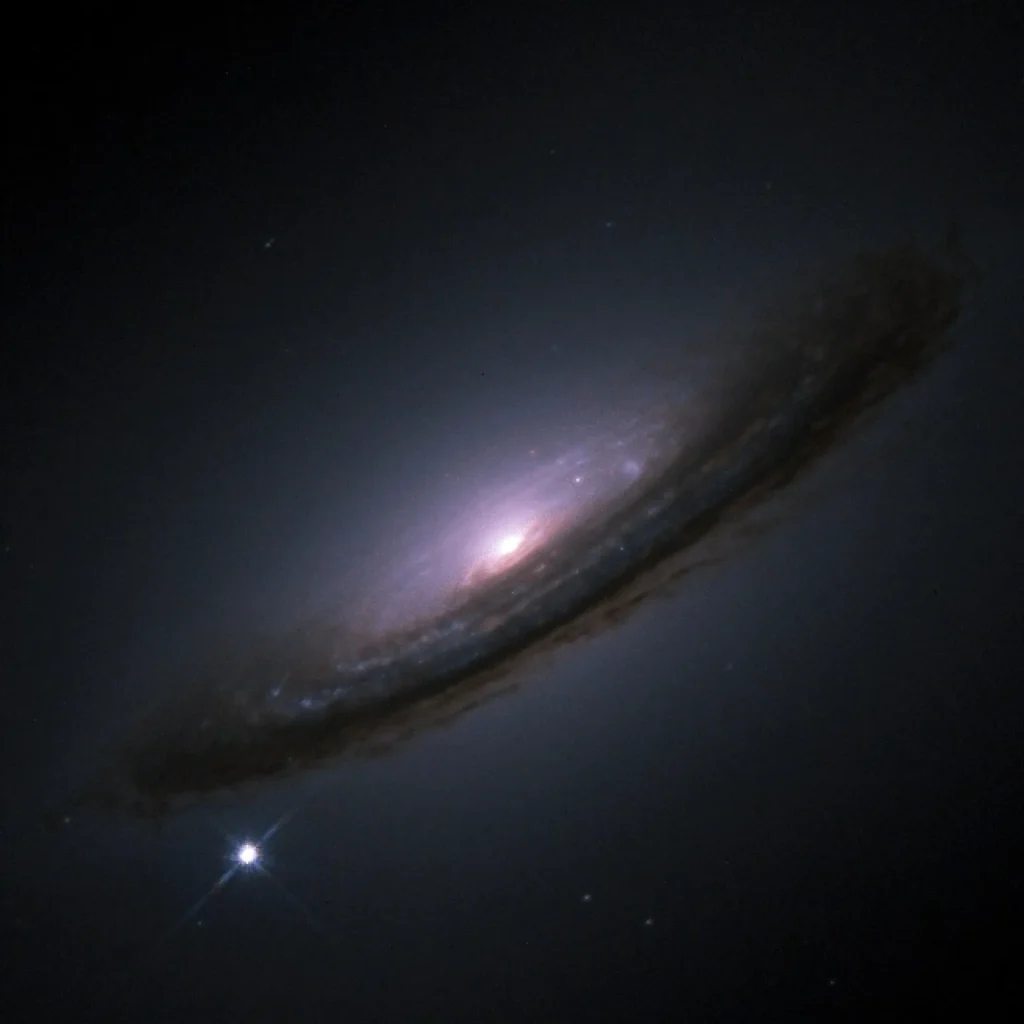
The stars were Type Ia supernovae. After careful calibration, their brightness tells us roughly how far away they are. Their light also tells us how much the universe expanded while it traveled. The distant supernovae looked dimmer than expected for their redshifts, meaning they were farther away than a slowing-only history predicted. It was a clue about how the expansion rate changed over billions of years, not a movie of galaxies visibly accelerating during one night.
What causes it? We call the missing explanation dark energy. That name does useful work: it points to an effect that must be accounted for in our best models. But it does not tell us what the effect physically is. The simplest standard model uses a cosmological constant, a term that acts like a fixed property of space. Other models let the effect vary with time or change how gravity behaves across immense distances.
There is a fresh reason to keep the question open. In March 2025 the DESI collaboration reported that, when its galaxy map is combined with other observations, a changing dark-energy model may fit better than the constant one. DESI’s data alone remain consistent with the standard constant model. The combined hint did not reach the usual discovery threshold. Cosmic acceleration is well supported; the identity and history of its cause remain active research questions.
THE LONG ANSWER · ABOUT 6 MINUTES
The short answer, how sure we are, what we don’t know, what would change our mind and every source stay free on every page, for everyone.
All Access members read the long answer: the evidence piece by piece, the strongest objections, and how to check it yourself.
Join All Access · $1 a week Or $6 a month
Billed $52 once a year. Cancel anytime in your account.
Until December 4, 11:59 pm Pacific: the Founding rate is $39 a year, and it stays $39 while you stay a member.
Create a free account: 6 long answers a month, email only.
Paying never buys a different answer. Our Paywall Promise
Why do physicists still call the matter-antimatter imbalance unsolved?
Known physics supplies important ingredients, but no confirmed mechanism accounts for the observed matter surplus.
God Plays Dice answers big questions in plain words, with sources and one of six honest labels.
See a mistake? Report a problem. Corrections are made openly.
CONTINUE THE THREAD
The UniverseExplainer
In 1998 astronomers found that the universe's expansion is speeding up, and "dark energy" is the name for a cause nobody yet understands.
The UniverseExplainer
Galaxies spin too fast and light bends too much, so something unseen seems to be out there, but nobody yet knows what it is.
The UniverseAnswer
Why the matter surplus remains unexplained, what Sakharov's conditions require, and how sphalerons and proposed neutrino mechanisms might connect.
The Architect AI companion · All Access
Labels describe the evidence for a claim, not the people who hold it.
Match my phone uses your device’s light or dark setting.