
The UniverseExplainer
Can Anything Travel Faster Than Light?
Shadows, stretching space and a famous neutrino scare all seem to break the cosmic speed limit. Here is why the limit still stands.
THE QUESTION LIBRARY THE UNIVERSE
The limit belongs to the structure of space and time; light in a vacuum travels at that limit because it has no rest mass.
Because space and time obey rules that give every local observer the same speed for light in a vacuum: exactly 299,792,458 meters per second. As an object with mass gets closer to that speed, each extra push adds less speed and requires ever more energy. It cannot reach the limit. Light can travel more slowly through water or glass, but that does not change the vacuum limit for signals and objects moving through space. A sweeping shadow or laser spot can move faster across a surface, but cannot carry a message between its successive positions.
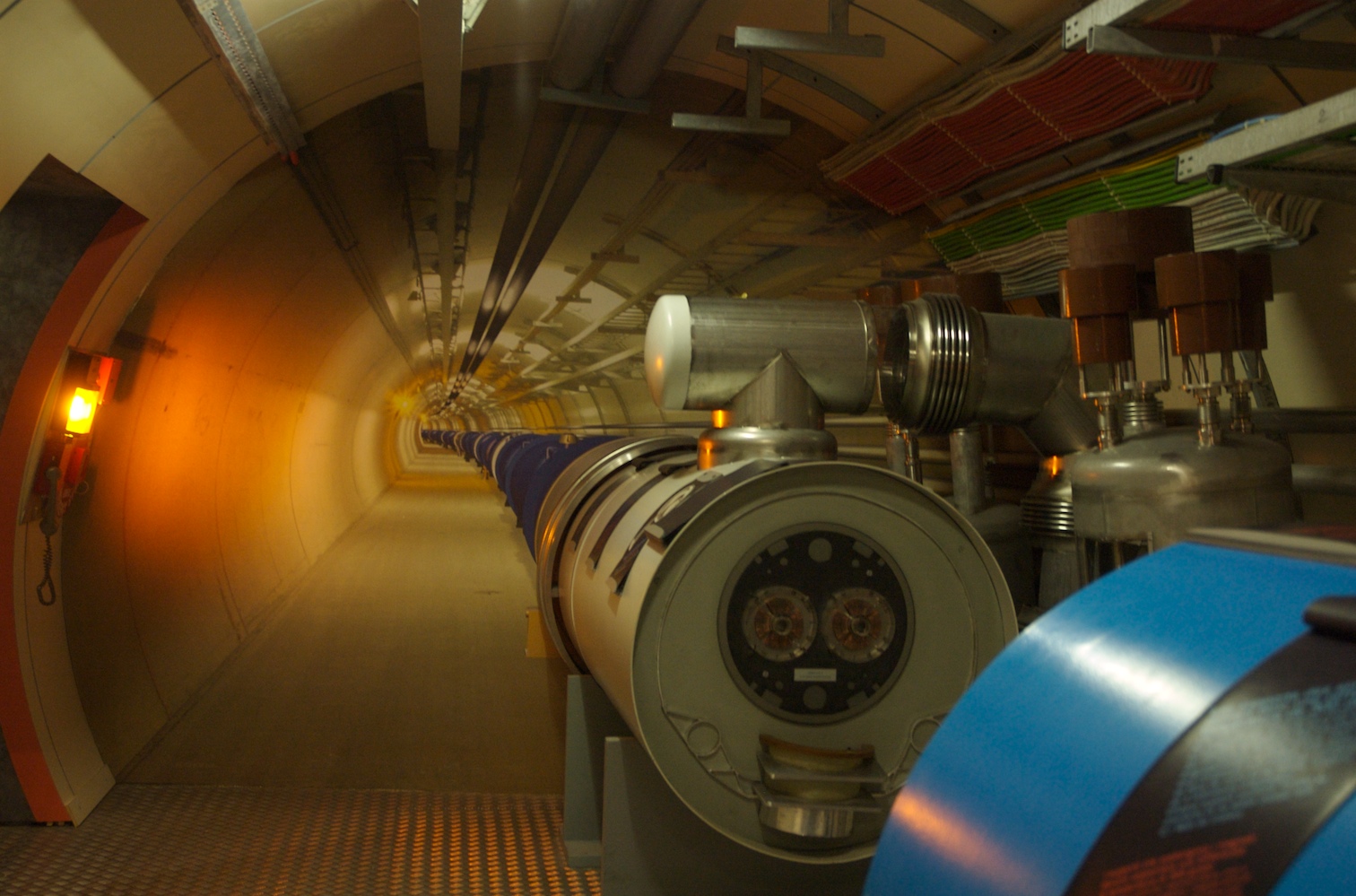
CERN accelerators push particles close to the vacuum speed of light, while additional energy yields ever smaller gains in speed.
WHERE THE EVIDENCE STANDS
WHAT WE DON’T KNOW YET
Relativity has passed many tests, but physicists still seek a theory that joins gravity and quantum physics, and there is no guarantee the light-speed limit will keep the same meaning in such a theory. That open problem does not make a working faster-than-light ship or signal an established possibility.
WHAT WOULD CHANGE THIS ANSWER
A repeatable, well-controlled measurement of information or a massive object moving locally faster than vacuum light, after ruling out timing and distance errors, would force a major revision of relativity.
There is a speed you cannot beat by pushing harder. In empty space, light travels at exactly 299,792,458 meters per second. That number is called c. It is more than a property of lamps and lasers. It is the local speed limit built into Einstein’s description of space and time.
Imagine trying to make a proton go faster in a particle accelerator. At first, adding energy raises its speed noticeably. Near c, the same added energy gives only a tiny increase in speed. CERN describes accelerators that push protons to speeds close to that of light, and Fermilab notes that such particles never exceed it. The closer a particle with mass gets, the more energy it takes for an ever smaller gain. Reaching c would require an unlimited amount of energy.
Why should light get special treatment? A photon has no rest mass. In a vacuum it travels at c; it is not a heavy object that begins at rest and accelerates to that speed. NASA notes that, according to Einstein, all kinds of light, from the colors we see to radio waves, travel at this same speed. The surprise is not that light happens to be fast. It is that the rules of space and time give one speed a special role.
Now put a glass of water in the way. Light moves more slowly through it. That seems to break the rule until we state the rule carefully: c is the speed of light in a vacuum. Materials interact with the light passing through them. NIST describes a material’s refractive index as the ratio of light’s speed in a vacuum to its speed in the material. A slower beam in water does not mean a spaceship could outrun the vacuum limit. It means the material changes how the light travels.
Free long answer 2 of 3 this month.
Einstein’s special relativity describes how space and time measurements change when observers move relative to each other. Two observers moving relative to each other can disagree about how much time passes (NASA notes that GPS satellites must allow for this effect), yet agree on the speed of a light beam in a vacuum. Their measurements fit together through the same rules, and those rules contain a finite speed that no local signal can exceed. We call it c because light in a vacuum travels at that speed.
“Local” matters. It means measuring a nearby object or signal with clocks and rulers in your own region. In that setting, the limit protects cause and effect. The Physics FAQ explains that in special relativity, something moving faster than light in one frame of reference would be traveling back in time in another. Faster-than-light messages could then be sent into the past, and the FAQ calls the resulting paradoxes a very strong argument against faster-than-light travel. The limit is therefore more than an inconvenience for future spacecraft; it is woven into the tested structure of relativity.
At everyday speeds, adding energy to a moving object can make it move much faster. Close to c, the relationship changes. The energy of an object with rest mass contains a factor that grows without bound as its speed approaches c. You can keep adding energy and edge closer, but there is no finite final push that gets it all the way there. In the formula the Physics FAQ gives, the rest mass stays the same; it is the energy that grows without limit as the speed approaches c. That is clearer than the older phrase that mass “turns infinite.”
Particle accelerators give this idea a practical test. CERN explains that in a circular accelerator particles get an energy boost on each turn, and that protons in its Large Hadron Collider reach speeds close to that of light. Fermilab gives the formula linking a particle’s energy, mass and speed, and says particles in high-energy accelerators travel at nearly the speed of light but never exceed it. Its worked example gives protons at 980 GeV in its Tevatron accelerator a speed of 99.999954 percent of light speed. The Physics FAQ adds that particles are routinely pushed to such speeds, so the theory is well established.
No. The vacuum speed is the ceiling. In a material, light interacts with atoms and its overall travel through the material is slower. NIST describes a refractive index as the ratio of vacuum light speed to the speed of light in a material. Water’s value is about 1.33. That means a light wave crosses water more slowly than the same distance in a vacuum. Diamond’s index is about 2.419, so light takes almost two and a half times longer to cross it than the same distance of vacuum; glass also slows light. This is also why light can bend as it passes between air and water.
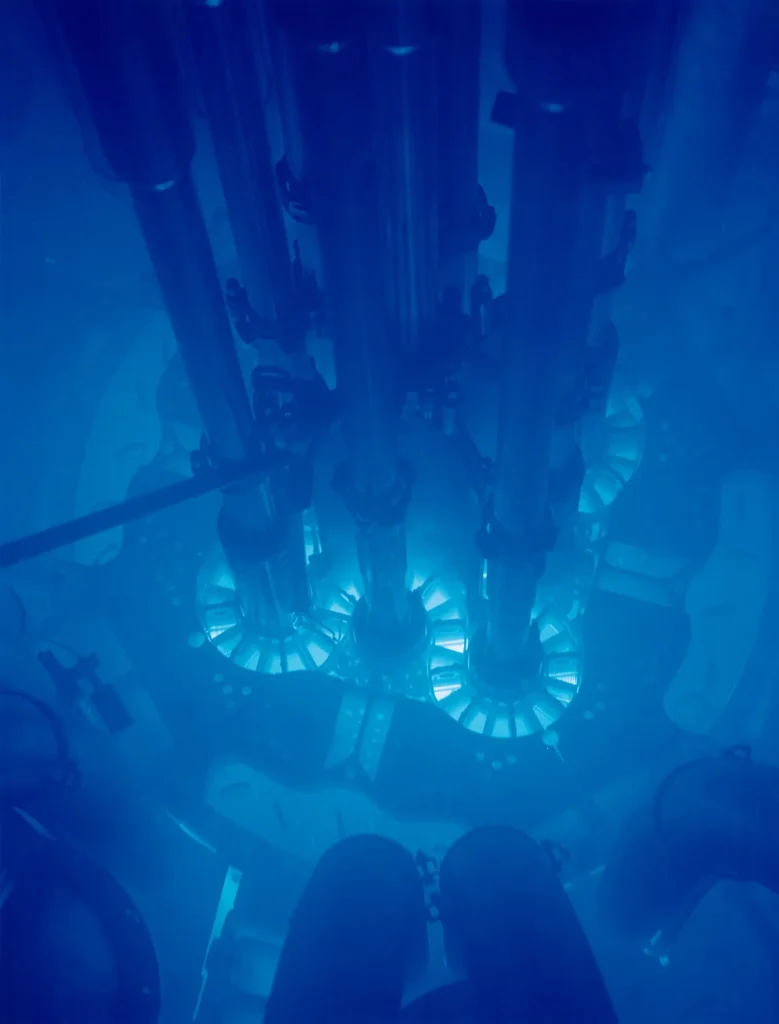
A charged particle can even move through water faster than light moves through that water, while staying below c. That produces Cherenkov light, the blue glow seen in the water around nuclear reactor cores. The Department of Energy notes that light in water travels at about 75 percent of its vacuum speed. The Physics FAQ says Cherenkov light is not a real example of faster-than-light travel. The local vacuum limit remains intact.
Yes: a sweeping shadow or laser spot can cross a surface faster than vacuum light. But the spot is a pattern formed at successive locations by arriving light. Nothing travels from the first spot to the next along the surface. The lamp or laser can send a normal light signal to each location; the sweep does not let one location send a faster-than-light message to another.
A tachyon is a hypothetical particle or signal that would travel faster than vacuum light.
No confirmed faster-than-light particle is established in the sources reviewed here. Hertzberg, Loeb and Morehouse’s paper, revised April 25, 2025, describes known particles as slower than or at vacuum light speed. Its black-hole calculation constrains certain proposed tachyons under model assumptions; it does not report detecting one. This source review is not an exhaustive census of every search.
Field theory also uses tachyonic for a negative mass-squared term: an unstable field state, rather than a particle outrunning light. With the usual propagation terms, called canonical kinetic terms, the field still cannot send a signal outside the ordinary light boundary. That conclusion concerns this specific class of fields.
This is the strongest apparent objection. Cosmologists sometimes say very distant galaxies recede from us at more than c. Does that overturn Einstein? The crucial distinction is between an object flying past its local neighbors and the large-scale distance between remote places increasing as space expands. Relativity forbids the first from beating c. It allows the second. The Physics FAQ explains that general relativity treats such galaxies as at rest relative to one another while the space between them expands. NASA’s Ask an Astrophysicist makes the same distinction for the rapid early expansion called inflation: it was an expansion of space, and no matter or information was carried between two points faster than light.
This does not give us a way to send an instant message to another galaxy. Any signal we launch travels locally, and locally it remains subject to the limit. The expansion of the universe and the speed of a spacecraft are different measurements, even when both are described with the word “speed.”
Start with NIST’s exact value for c. Then read Fermilab’s explanation of particle energy and speed. Notice that the energy can keep growing while the speed approaches the same limit. For the water question, use NIST’s refractive-index definition and its value for water. Finally, read NASA’s explanation of cosmic expansion and ask whether it describes motion through nearby space or changing distance between distant places.
Those checks also expose the limit of an analogy. A car has an engine and can be pushed harder along a road; a photon does not start from rest and accelerate like a car. A speedometer reading on Earth is local; a separation across billions of light-years is not. If we keep those differences clear, the speed limit stops sounding like a rule with easy exceptions and starts looking like a precise claim we can test.
Here is a practical way to see why the water example matters. Suppose light enters a pool from the air. Its path bends at the surface, and it takes longer to cross the water than it would to cross the same length of empty space. Neither fact changes the value NIST lists for light in a vacuum. If a fast charged particle passes through the pool faster than the light waves travel through water, it can make a blue Cherenkov glow. The particle still moves more slowly than c. The United States Department of Energy uses this effect to explain the blue glow seen around nuclear reactor cores. A headline that says “faster than light in water” is accurate only with those last two words attached.
Likewise, a claim about an engine that will “eventually” reach c has to confront the energy curve. Doubling the energy of a nearly light-speed proton does not double its speed. Fermilab’s energy–speed relation shows energy rising while speed crowds closer to the limit. That pattern does not come from a weak accelerator; it comes from the tested relationship between energy, rest mass and speed. A better machine can get closer. It cannot turn a finite amount of energy into the final missing step.
Relativity is not beyond question. The Physics FAQ notes that there is no guarantee light speed will keep the same meaning as a limit in a more complete future theory. But a proposal needs a measurement that a second team can repeat, with timing and distance errors ruled out. Science fiction is free to imagine a shortcut. Physics needs a method that survives those checks. For the next step, read the story Can Anything Travel Faster Than Light? and the Library answers on entanglement and messages and time travel.
THREE THINGS TO REMEMBER
Are black holes or wormholes doorways to other places?
Observed black holes are not established doorways.
God Plays Dice answers big questions in plain words, with sources and one of six honest labels.
See a mistake? Report a problem. Corrections are made openly.
CONTINUE THE THREAD
The UniverseExplainer
Shadows, stretching space and a famous neutrino scare all seem to break the cosmic speed limit. Here is why the limit still stands.
The UniverseAnswer
Why the matter surplus remains unexplained, what Sakharov's conditions require, and how sphalerons and proposed neutrino mechanisms might connect.
The UniverseAnswer
How matter and antimatter differ in some decays, what quarks have to do with it, and why hydrogen–antihydrogen spectroscopy tests a different symmetry.
The Architect AI companion · All Access
Labels describe the evidence for a claim, not the people who hold it.
Match my phone uses your device’s light or dark setting.