Skip to content
BackGOD PLAYS DICE™Big questions, honest answers

THE QUESTION LIBRARY MIND & MORTALITY

Why do we need sleep, and why do we dream?

Everyone needs sleep and everyone dreams, yet science is still working out why; here is what sleep does, the leading ideas about dreams, and what a dream can and cannot tell us.

THE SHORT ANSWER

We need sleep because the brain and body stop working well without it, but its deepest purpose is still unknown, and nobody knows yet why we dream. Sleep helps us hold on to what we learn. It may also help clear waste from the brain, but that is debated. Dreams are usually most vivid in REM sleep. Leading theories say dreams rehearse dangers, sort memories, keep learning flexible, or are side effects of brain activity. Whether a dream is a message from God or a loved one is beyond science.
  • The U.S. National Institute of Neurological Disorders and Stroke (NINDS) says everyone needs sleep, but its biological purpose remains a mystery.
  • In a 2003 lab study, healthy adults allowed 6 hours or less in bed for two weeks slipped on tests as much as after up to two nights without sleep, and seemed largely unaware of it.
  • A 2021 analysis of 177 papers found that people remember more after sleep than after the same time awake, though the gain is moderate.
  • Whether sleep speeds up waste removal in the brain is debated: a 2013 mouse study found faster clearing during sleep, and a 2024 mouse study found slower.
  • NINDS says we spend about two hours a night dreaming; dreams can come in every sleep stage but are usually most vivid in REM sleep.
On this page
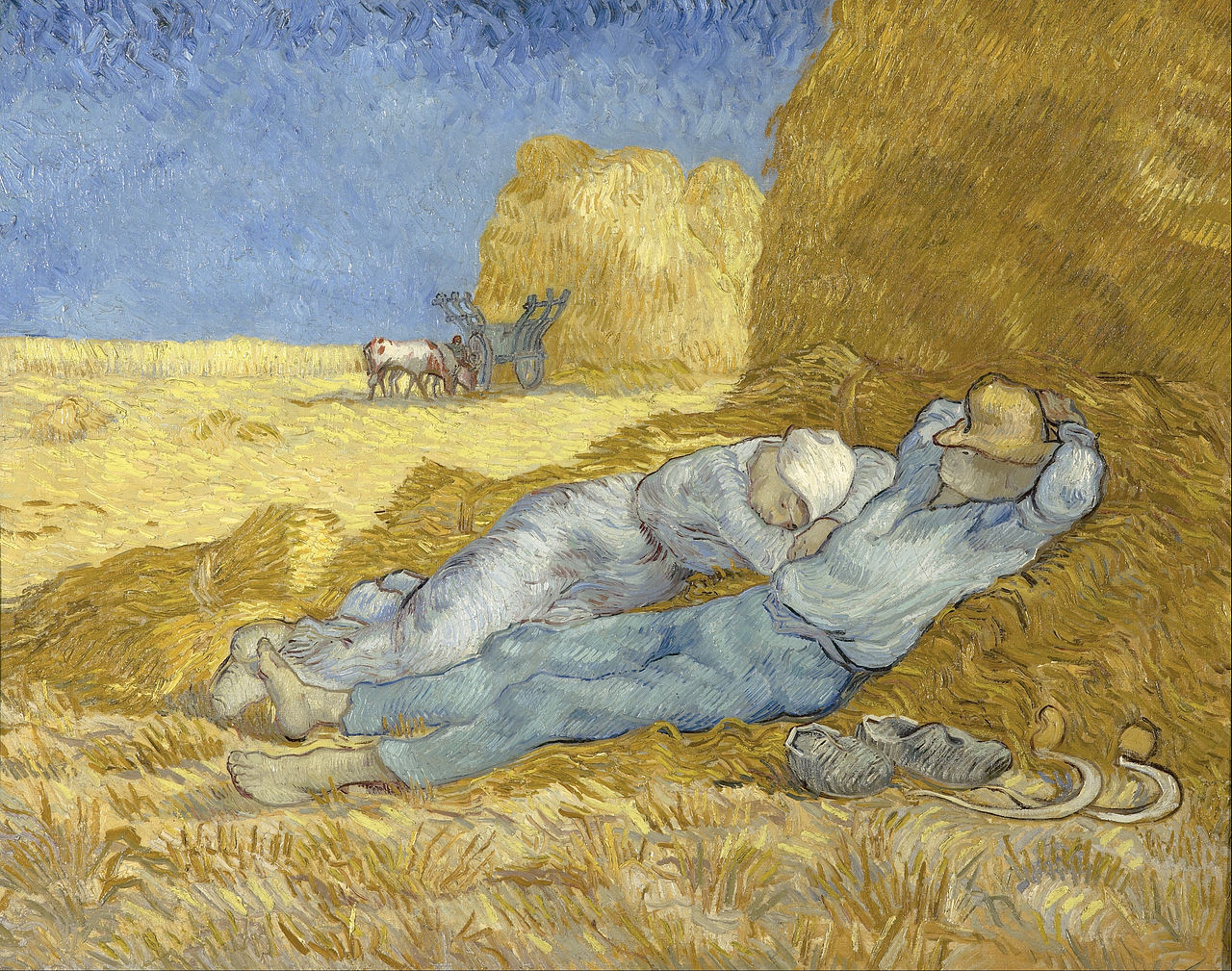
Painting in thick, swirling brushstrokes of a man and a woman asleep on golden hay in the shade of a tall haystack, his straw hat pulled over his face and his hands behind his head, her head in a white bonnet resting near him. Their wooden shoes and two sickles lie beside them, and an ox cart stands in a cut wheat field under a blue sky.
About this picture

Two farm workers nap beside a haystack in Vincent van Gogh’s The Siesta (after Millet). We spend about a third of our lives asleep, and science is still working out exactly why.

Vincent van Gogh, The Siesta (after Millet), Musée d’Orsay, Paris; image from Google Arts & Culture, via Wikimedia Commons · Public domain · Image source ↗

WHERE THE EVIDENCE STANDS

How sure are we?

  • Everyone needs sleep, and regularly getting too little harms thinking and is linked to poorer health.NINDS calls quality sleep as essential to survival as food and water. Van Dongen and colleagues (2003) found that two weeks of 6 hours or less in bed impaired performance on every task. The American Academy of Sleep Medicine and Sleep Research Society (2015) link regularly sleeping under 7 hours with weight gain, diabetes, high blood pressure, heart disease, depression and accidents.
  • People remember more after sleep than after the same amount of time awake.Berres and Erdfelder’s 2021 meta-analysis (823 effect sizes, 177 papers, 1967 to 2019) found a moderate benefit that stayed significant after a correction for selective reporting, and Rasch and Born (2013) write that more than a century of research has established it. Cordi and Rasch (2021) caution that the effect is smaller and less robust than once assumed, and that several key findings behind the leading theories could not be replicated or held only under some conditions.
  • Sleep speeds up the brain’s removal of waste.Xie and colleagues (2013, mice) found 60% more space between brain cells and faster clearing of beta-amyloid during sleep; Hauglund and colleagues (2025, mice, same senior author) tied clearing in non-REM sleep to slow pulses of blood vessels. Miao and colleagues (2024, mice, another lab) found clearance markedly reduced during sleep. In 24 people given a tracer in the spinal fluid, one night without sleep slowed its clearing (Eide and colleagues, 2021).
  • Dreams serve a purpose, such as rehearsing threats, sorting memories or keeping learning flexible.NINDS says the exact purpose of dreaming isn’t known. Competing ideas include threat simulation (Revonsuo, 2000), memory processing (Wamsley and colleagues, 2010; a 2023 meta-analysis of 16 studies by Wamsley’s team links task dreams to better memory, an association rather than a shown cause), activation-synthesis (Hobson and McCarley, 1977) and the overfitted brain (Hoel, 2021), while other theories treat dreams as by-products with no job. Tests of threat simulation have pointed both ways (Valli and colleagues, 2005; Malcolm-Smith and colleagues, 2008).
  • Some dreams carry messages from God or from loved ones who have died.The Hebrew Bible, the Gospel of Matthew, the Quran and the hadith collection Sahih al-Bukhari describe dreams through which God speaks or guides, and in a 2023 Pew survey 46% of U.S. adults said a dead family member had visited them in a dream (Pew did not ask what they meant). Research can study who has such dreams and how they affect people, but it cannot test where a dream’s meaning comes from.
What the labels mean

WHAT WE DON’T KNOW YET

Nobody knows yet what sleep is most deeply for, or why we dream at all. Whether sleep speeds up waste removal in the brain is still argued, mostly from studies in mice. How much each theory of dreaming explains is also unsettled.

WHAT WOULD CHANGE THIS ANSWER

If one theory of dreaming could predict what people dream and show a benefit that other labs could repeat, dreaming would stop being an open question. Larger human studies of brain cleaning during sleep could settle that debate as well.

Every night you spend hours doing something that looks like nothing at all. You lie still, you lose track of the world, and then you wake. We spend about a third of our lives asleep. So why do we need it, and what are dreams for? They are fair questions, and science has some answers.

Here is the short answer. We do need sleep. The U.S. National Institute of Neurological Disorders and Stroke (NINDS) calls good sleep as essential to survival as food and water. Without enough of it, attention, memory and mood suffer, and the risk of some health problems goes up. Yet the same agency says the biological purpose of sleep remains a mystery. Scientists have strong clues, not one final answer.

One strong clue is memory. Across nearly a century of studies, people remember more after sleep than after the same time awake. The effect is real but moderate, and some key findings about how it works could not be repeated or held only in some conditions. Another clue is cleanup. A 2013 study in mice found that sleep sped up the removal of waste from the brain, but a 2024 mouse study found the opposite. That question is still debated.

Dreams are even more of a puzzle. Sleep comes in stages. In the stage called REM sleep, short for rapid eye movement, the eyes dart under closed lids, and dreams are usually most vivid. Everyone dreams, NINDS says, for about two hours a night, though we may not remember most of our dreams. Scientists have several competing ideas about why. Dreams might rehearse dangers, help sort memories, keep learning flexible, or be a side effect of brain activity. None has won.

Many people also wonder whether dreams carry meaning. Research finds that dreams often echo our waking lives and feelings. Whether a dream can carry a message from God or a loved one is a question science cannot test. We label that Beyond science, and the main question here an Open question.

THE LONG ANSWER

Free long answer 1 of 3 this month.

What happens in the brain while we sleep?

NINDS describes two basic types of sleep, REM and non-REM. Non-REM sleep runs from light sleep, where we spend the most time, to the deep sleep we need to feel refreshed. REM sleep first arrives about 90 minutes after we fall asleep. The arm and leg muscles go limp, which keeps us from acting out our dreams, and brain waves look closer to waking.

In a 2017 study, people woken from both REM and non-REM sleep sometimes reported dreams, and in both, dreaming went with fewer slow brain waves toward the back of the brain. But in a small 2020 test, analysts who could not see the dream reports used brain-wave readings, including that signal, to spot dreaming and did no better than chance. For how brain activity becomes experience, see Is the mind just the brain? When REM’s muscle shutdown lingers after waking, a person can be awake but unable to move; see our answer on sleep paralysis.

What does sleep do for us?

It helps us keep what we learn. A 2021 meta-analysis (a study that pools many studies) combined 823 results from 177 papers published from 1967 to 2019. People recalled more after sleep than after an equal time awake. The benefit was moderate, and it shrank but held after a correction for results that may have gone unreported. A leading explanation, from a 2013 review, is that the sleeping brain replays new memories during deep sleep and moves them into long-term storage. In a 2020 meta-analysis of 91 experiments, playing sounds or smells tied to a lesson during non-REM sleep helped memory, but playing them in REM sleep or while awake did not. Still, a 2021 review by Maren Cordi and Björn Rasch reported that several key findings behind these theories could not be replicated or held only under some conditions, and that the effects seem smaller than once assumed.

It may help clean the brain. In a 2013 study of live mice, sleep came with a 60% increase in the space between brain cells, and a waste protein called beta-amyloid was cleared faster. But a 2024 study from another lab, also in mice, found clearance “markedly reduced, not increased” during sleep. A 2025 mouse study with the same senior author as the 2013 study, Maiken Nedergaard, tied this cleaning, which scientists call the glymphatic system, to slow pulses of blood vessels in non-REM sleep. In a 2021 study of 24 people in Norway who had a tracer put into their spinal fluid, one night without sleep slowed the tracer’s clearing from most brain regions. We label this cleaning role Supported, still debated.

Too little of it does real harm. In a 2003 lab study, healthy adults held to 6 hours or less in bed for two weeks slipped on attention and thinking tests as much as people kept awake for up to two nights, yet seemed largely unaware of it. Sleep experts link regularly sleeping under 7 hours to weight gain, diabetes, high blood pressure, heart disease, depression and accidents, though, as NINDS notes, it is not always clear which causes which.

Why do we dream?

Dreams are hard to study because, as a 2021 study notes, reports made after waking are open to “distortion and forgetting.” Several theories compete:

  • Threat rehearsal. In 2000, Antti Revonsuo proposed that dreams evolved to rehearse threats so we could practice escaping them. A 2005 study by his team found that severely traumatized Kurdish children reported more dreams, with more threats that were also more severe, than less traumatized Kurdish children or Finnish children who had not faced trauma. But a 2008 study by another team found fewer threat dreams in a high-crime area of South Africa than in Wales, and realistic survival threats in under 20% of dreams.
  • Memory processing. In a 2010 study of 99 people learning a virtual maze, the four nappers whose dream reports mentioned the maze improved about ten times as much as other nappers; thinking about it while awake did not predict any gain. The authors noted the small numbers and did not claim the dreams caused the gain. Erin Wamsley, who led it, saw the link again in a small overnight study in 2019, and her team’s 2023 meta-analysis of 16 studies tied task dreams to better memory, mainly for dreams from non-REM sleep. A link is not a cause.
  • Activation-synthesis. In 1977, Hobson and McCarley proposed that during dreaming sleep the brainstem fires in bursts, and the forebrain builds a dream by comparing those signals with stored memories.
  • The overfitted brain. In 2021, Erik Hoel of Tufts University borrowed an idea from artificial intelligence: a computer network that learns its examples too narrowly fails on new ones, and programmers often fix this by adding noise. He argued that dreams, with their odd, scrambled scenes, add that noise so the brain can generalize, and he listed ways to test the idea.

NINDS adds another idea: dreaming may help us process emotions. The strongest objection is that dreams may have no job at all. As both Revonsuo and Hoel note, several theories treat dreams as by-products of the sleeping brain. With tests pointing different ways, we label the purpose of dreaming an Open question.

Do dreams mean anything?

What research can say. In a 2003 diary study, people who spent more time on an activity by day tended to dream about it more, though focused tasks such as reading and writing rarely showed up. NINDS adds that people under stress or anxiety are more likely to have frightening dreams. In studies published in 2009, people from Eastern and Western cultures believed dreams reveal hidden truths, but found a dream more meaningful when it fit what they already believed, about friends or about God. They also reported being as reluctant to fly after dreaming of a plane crash as after learning of one.

What faith traditions teach. For many believers, some dreams matter because of where they come from. In the Hebrew Bible, God says of prophets, “I speak with them in a dream” (Numbers 12:6), and Joseph, meeting two prisoners troubled by their dreams, says, “Surely God can interpret!” (Genesis 40:8). In the Gospel of Matthew, the angel of the Lord appears to Joseph, the husband of Mary, in a dream (Matthew 1:20). The Quran tells of Joseph (Yusuf) seeing eleven stars, the sun and the moon bowing down to him in a dream (Quran 12:4), and in Sahih al-Bukhari the Prophet Muhammad is reported to say, “A true good dream is from Allah, and a bad dream is from Satan.” In a 2023 Pew survey, 46% of U.S. adults said a dead family member had visited them in a dream; Pew did not ask what they meant by it. See also Is it normal to feel that someone who died is still with me? Whether a dream was sent by God or a loved one is Beyond science.

Where people of faith and skeptics can agree

  • Many dreams echo the day. Research finds waking life in dreams. The Talmud records a rabbi teaching that a person is shown in a dream only “the thoughts of his heart when he was awake” (Berakhot 55b), and a saying recorded in Sahih al-Bukhari names “the reflection of one’s thoughts and experiences” as one of three kinds of dreams.
  • Not every dream is a message. Both of these texts tell kinds of dreams apart, and research shows we find dreams more meaningful when they fit what we already believe.

Why do we forget most of our dreams?

Dreaming and remembering a dream are different questions. One proposed explanation for forgetting is that a dream does not become a lasting memory.

In a 2017 laboratory reanalysis, 36 frequent and infrequent dream recallers slept while sounds were played. Frequent recallers had longer awakenings during sleep. The authors proposed that these intervals allow dream memories to be stored.

This association supports a memory-encoding account; it does not establish why every forgotten dream disappears. The sounds also make this different from an ordinary night.

What is a lucid dream, and can anyone learn to have one?

A lucid dream is one in which you recognize that you are dreaming while the dream continues. That awareness can occur without control over the story.

In a 2020 international study, selected adult volunteers reported more lucid dreams during a week of training than during their baseline week, including participants without prior technique experience.

That suggests some people can learn to have lucid dreams more often. It does not show that anyone can reliably do so: many volunteers dropped out, reports were self-recorded, and practice lasted only one week.

What do people often get wrong?

“I never dream.” NINDS says everyone dreams, but we may not remember most of our dreams.

“Dreams only happen in REM sleep.” They happen in non-REM sleep too.

“I can catch up on the weekend.” NINDS says extra weekend sleep may not make up for all you missed.

How can you sleep better and check this yourself?

  • Know the target. The CDC recommends 8 to 10 hours for teens, 7 or more for adults 18 to 60, 7 to 9 for ages 61 to 64, and 7 to 8 from age 65.
  • Build habits. The CDC and the American Academy of Sleep Medicine suggest the same bedtime and wake time every day, a quiet, cool bedroom, screens off at least 30 minutes before bed, and no caffeine in the afternoon or evening. If you can’t fall asleep after 20 minutes, the Academy suggests getting up for a quiet activity in dim light.
  • Get help when needed. See a doctor if you have trouble sleeping or feel unusually tired during the day; NINDS says most sleep disorders can be treated effectively. For chronic insomnia, the Academy calls cognitive behavioral therapy the most effective long-term treatment.
  • Keep a dream journal. Write down your dreams for a few weeks and ask: how often does your day show up at night?

The answer stays the same: we need sleep, its deepest purpose is unsettled, and why we dream remains an open question.

THREE THINGS TO REMEMBER

  1. Sleep is essential, and experts advise adults to get at least 7 hours a night.
  2. Sleep helps memory; its role in cleaning the brain is still debated.
  3. Why we dream is an open question, and a dream’s message is beyond science.

Keep asking

What is sleep paralysis, and why do people sometimes sense a presence in the dark?

Sleep paralysis is a short spell, while falling asleep or waking up, when your mind is awake but your body cannot move.

EstablishedRead the answer

Words worth knowing (5)
REM sleep
Rapid eye movement sleep, the stage when the eyes dart under closed lids, the arm and leg muscles go limp, and dreams are usually most vivid.
Non-REM sleep
The other main type of sleep, made up of three stages from light to deep. Dreams can happen here too, but they are usually less vivid.
Memory consolidation
The process that turns a new, fragile memory into a lasting one. Sleep appears to help it.
Glymphatic system
A proposed network that moves fluid through the brain to wash out waste. Whether it works faster during sleep is debated.
Meta-analysis
A study that pools the results of many studies on the same question to get a clearer overall answer.

Sources & further reading

(12) · Checked Sep 30, 2026
  1. Brain Basics: Understanding Sleep ↗National Institute of Neurological Disorders and Stroke (NINDS), U.S. National Institutes of Health (last reviewed February 25, 2025)About one-third of our time asleep; quality sleep “as essential to survival as food and water”; without sleep, harder to learn, form memories and concentrate; mood among the systems sleep affects; chronic lack of sleep raises the risk of high blood pressure, cardiovascular disease, diabetes, depression and obesity; “Everyone needs sleep, but its biological purpose remains a mystery”; housekeeping role that removes toxins (“recent findings suggest”); REM and three non-REM stages; more of the cycles in stage 2 (light sleep); stage 3 is the deep sleep needed to feel refreshed; REM about 90 minutes after falling asleep, wake-like brain waves, arm and leg muscles temporarily paralyzed; most dreaming in REM but some in non-REM; everyone dreams, about two hours a night, but may not remember most dreams; exact purpose of dreaming not known, may help process emotions; stress or anxiety makes frightening dreams more likely; dreams in all stages, usually most vivid in REM; weekend catch-up may not be enough; see a doctor for problems sleeping or unusual daytime tiredness, most sleep disorders can be treated effectively; open question whether lack of sleep leads to disorders or diseases cause lack of sleep. Also: MedlinePlus, Sleep paralysis (https://medlineplus.gov/ency/article/000801.htm, review date 4/10/2025): waking suddenly from REM leaves the brain awake while the body is still in REM mode and cannot move.
  2. About Sleep ↗U.S. Centers for Disease Control and Prevention (May 15, 2024)Recommended hours: teens 13 to 17, 8 to 10; adults 18 to 60, 7 or more; 61 to 64, 7 to 9; 65 and older, 7 to 8; enough sleep can reduce stress and improve mood; habits (going to bed and getting up at the same time every day, quiet, relaxing, cool bedroom, electronic devices off at least 30 minutes before bedtime, no large meals or alcohol before bed, no caffeine in the afternoon or evening, regular exercise); talk to a provider about regular sleep problems. Also AASM, Healthy Sleep Habits (https://sleepeducation.org/healthy-sleep/healthy-sleep-habits/, updated August 2020): get up at the same time every day; if not asleep after 20 minutes, get out of bed for a quiet activity without a lot of light exposure; cool, quiet room; devices off 30 minutes before bed; no afternoon or evening caffeine; CBT is “the most effective long-term treatment for people with chronic insomnia.”
  3. Recommended Amount of Sleep for a Healthy Adult: A Joint Consensus Statement of the American Academy of Sleep Medicine and Sleep Research Society (Watson and colleagues) ↗Journal of Clinical Sleep Medicine 11 (2015): 591–592Full text (PMC4442216): “Adults should sleep 7 or more hours per night on a regular basis to promote optimal health”; regularly sleeping under 7 hours associated with weight gain and obesity, diabetes, hypertension, heart disease and stroke, depression, increased risk of death, impaired immune function, impaired performance, increased errors and greater risk of accidents; individual sleep need varies. Also: Van Dongen and colleagues, Sleep 26 (2003), doi:10.1093/sleep/26.2.117 (48 healthy adults aged 21 to 38; 4, 6 or 8 hours in bed for 14 days, or 3 nights without sleep; deficits on all tasks; 6 hours or less produced deficits equivalent to up to 2 nights of total deprivation; sleepiness ratings suggest subjects were largely unaware).
  4. The sleep benefit in episodic memory: An integrative review and a meta-analysis (Berres and Erdfelder) ↗Psychological Bulletin 147 (2021): 1309–1353823 effect sizes, 271 samples, 177 articles (1967 to 2019); moderate overall sleep benefit (g = 0.44), reduced but still significant after accounting for selective reporting (g = 0.28); “almost a century of research.” Also: Rasch and Born, Physiological Reviews 93 (2013), doi:10.1152/physrev.00032.2012 (more than a century of research has established that sleep benefits memory retention; consolidation from reactivation of new memory representations during slow-wave sleep, integrated into long-term memory); Hu, Cheng, Chiu and Paller, Psychological Bulletin 146 (2020), doi:10.1037/bul0000223 (targeted memory reactivation, 91 experiments, N = 2,004, g = 0.29; effective in NREM stage 2 and slow-wave sleep, not in REM or wake; cues such as sounds and odors, per full text PMC7144680); Cordi and Rasch, Current Opinion in Neurobiology 67 (2021), doi:10.1016/j.conb.2020.06.002 (several key findings “could not be replicated or occurred only under certain conditions”; effects smaller, more task-dependent, less robust than assumed).
  5. Sleep drives metabolite clearance from the adult brain (Xie and colleagues) ↗Science 342 (2013): 373–377Live mice; natural sleep or anesthesia associated with a 60% increase in interstitial space; faster beta-amyloid clearance during sleep; restorative function may come from removing potentially neurotoxic waste. Senior author Maiken Nedergaard. Also: Hauglund and colleagues, Cell 188 (2025), doi:10.1016/j.cell.2024.11.027 (mice; same senior author; norepinephrine-driven slow vasomotion acts as a pump driving CSF into the brain during NREM sleep); Eide and colleagues, Brain 144 (2021), doi:10.1093/brain/awaa443 (Oslo; tracer gadobutrol given intrathecally, into the spinal fluid; 7 sleep-deprived versus 17 control individuals; one night of total sleep deprivation impaired tracer clearance from most brain regions, not compensated by the next night’s sleep).
  6. Brain clearance is reduced during sleep and anesthesia (Miao and colleagues) ↗Nature Neuroscience 27 (2024): 1046–1050Imperial College London; male mice; movement of fluorescent molecules independent of sleep, wake or anesthesia; brain clearance “markedly reduced, not increased, during sleep and anesthesia.”
  7. The reinterpretation of dreams: An evolutionary hypothesis of the function of dreaming (Antti Revonsuo) ↗Behavioral and Brain Sciences 23 (2000): 877–901University of Turku, Finland; hypothesis that dreaming simulates threatening events to rehearse threat perception and threat avoidance; notes that several theories call dreaming a random by-product of REM sleep physiology with no function. Tests: Valli and colleagues, Consciousness and Cognition 14 (2005), doi:10.1016/S1053-8100(03)00019-9 (severely traumatized Kurdish children reported more dreams, more and more severe threats, than less traumatized Kurdish and non-traumatized Finnish children); Malcolm-Smith and colleagues, Consciousness and Cognition 17 (2008), doi:10.1016/j.concog.2007.07.002 (high-crime South Africa n = 208 versus low-crime Wales n = 116; South Africans reported significantly fewer threat dreams; under 20% of dreams had realistic survival threats; “contradicts key aspects” of the theory).
  8. The overfitted brain: Dreams evolved to assist generalization (Erik Hoel) ↗Patterns 2 (2021): 100244Tufts University; overfitting in deep neural networks often solved by noise injections; dreams as corrupted sensory inputs that aid generalization; testable predictions; contemporary neuroscientific theories often view dreams as epiphenomena. Also: Hobson and McCarley, American Journal of Psychiatry 134 (1977), doi:10.1176/ajp.134.12.1335 (activation-synthesis: intense and sporadic activation of brainstem circuits; the forebrain synthesizes the dream by comparing brainstem information with information stored in memory); Wamsley and colleagues, Current Biology 20 (2010), doi:10.1016/j.cub.2010.03.027 (full text PMC2869395: n = 99, 50 nappers; the four nappers with maze-related reports improved tenfold more than the 46 others; waking task thoughts did not predict improvement; the authors do not contend that dreams cause consolidation; small-sample caution); Wamsley and Stickgold, Journal of Sleep Research 28 (2019), doi:10.1111/jsr.12749 (replication in an overnight study; dream content reflecting the maze associated with better next-morning performance); Hudachek and Wamsley, Sleep 46 (2023), doi:10.1093/sleep/zsad111 (meta-analysis of 16 studies, 45 effects; significant association between task-related dreaming and memory, SMD 0.51; significant for NREM dreams, not REM dreams; earlier results inconsistent).
  9. The neural correlates of dreaming (Siclari and colleagues) ↗Nature Neuroscience 20 (2017): 872–878Dreaming occurs in both NREM and REM sleep; dream reports linked to local decreases in low-frequency activity in posterior cortex; monitoring this posterior “hot zone” predicted dream reports in NREM sleep. Also: Wong and colleagues, Neuroscience of Consciousness 2020, doi:10.1093/nc/niaa006 (Dream Catcher experiment: 9 participants, 54 one-minute NREM recordings; a blinded analysis team using EEG spectral-power features, including Siclari’s hot-zone features, never classified dreaming better than chance); Konkoly and colleagues, Current Biology 31 (2021), doi:10.1016/j.cub.2021.01.026 (retrospective reports “subject to distortion and forgetting”); Schredl and Hofmann, Consciousness and Cognition 12 (2003), doi:10.1016/S1053-8100(02)00072-7 (dream diaries; time spent on waking activities reflected in dream content; highly focused activities such as reading and writing rare in dreams; the continuity hypothesis needs a more specific form); Morewedge and Norton, Journal of Personality and Social Psychology 96 (2009), doi:10.1037/a0013264 (Eastern and Western participants believed dreams contain hidden truths; meaning moderated by preexisting beliefs, including faith in God; equally reluctant to fly after dreaming or learning of a plane crash); Pew Research Center, August 23, 2023 (https://www.pewresearch.org/short-reads/2023/08/23/many-americans-report-interacting-with-dead-relatives-in-dreams-or-other-ways/): 5,079 U.S. adults, March 27 to April 2, 2023; 46% visited by a dead family member in a dream; the survey did not ask what respondents meant.
  10. Numbers 12:6 and Genesis 40:8 (The JPS Tanakh: Gender-Sensitive Edition) and Talmud Berakhot 55b (William Davidson Edition) ↗SefariaNumbers 12:6: “I speak with them in a dream.” Genesis 40:1–8: the cupbearer and baker, in prison with Joseph, are troubled by their dreams; “Surely God can interpret!” Berakhot 55b (https://www.sefaria.org/Berakhot.55b): Rabbi Shmuel bar Nahmani, citing Rabbi Yonatan, says a person is shown in a dream only “the thoughts of his heart when he was awake”; the same page lists dreams that are fulfilled. Also: Matthew 1:20, New American Bible Revised Edition (https://bible.usccb.org/bible/matthew/1, U.S. Conference of Catholic Bishops; live page read on September 30, 2026): the angel of the Lord appeared to Joseph in a dream. Quran 12:4, Sahih International (https://quran.com/12/4): Joseph saw [in a dream] eleven stars and the sun and the moon prostrating to him. Sahih al-Bukhari 6984 and 7017, Book of the Interpretation of Dreams (https://sunnah.com/bukhari/91, read via the Internet Archive copy of August 3, 2026, because sunnah.com shows a bot check): “A true good dream is from Allah, and a bad dream is from Satan”; in 7017, Muhammad bin Seereen reports a saying that there are three types of dreams, including “the reflection of one’s thoughts and experiences” (the text does not attribute this part to the Prophet).
  11. Increased Evoked Potentials to Arousing Auditory Stimuli during Sleep: Implication for the Understanding of Dream Recall ↗Vallat and colleagues, Frontiers in Human Neuroscience 11:132 (2017)
  12. Findings From the International Lucid Dream Induction Study ↗Frontiers in Psychology 11:1746 (2020)

See a mistake? Report a problem. Corrections are made openly.

The Architect AI companion · All Access

Your next question can go further.

Included with All Access →Up to 5 questions a day while available.

Put God Plays Dice on your Home Screen

On iPhone: tap Share (on iOS 26, tap ••• first), then Add to Home Screen, then Add.

On Android: In Chrome, you can also open the ⋮ menu and choose Add to Home screen or Install.

The Home Screen version keeps its own memory on iPhone, so your nights and saved answers start fresh there.

Search the Question Library

149 answers to read · 0 questions awaiting answers Your search runs on your device.

Answers about death, grief and crisis are always free, in full. If a question is personal right now →