
The UniverseAnswer
Why do physicists still call the matter-antimatter imbalance unsolved?
Why the matter surplus remains unexplained, what Sakharov's conditions require, and how sphalerons and proposed neutrino mechanisms might connect.
THE QUESTION LIBRARY THE UNIVERSE
A vast number of stars does not mean their light has filled every direction for an unlimited time.
The night sky is dark because stars have not shone forever, and light takes time to reach us. Our cosmic expansion history goes back about 13.8 billion years. Its expansion also stretches light to longer wavelengths and makes distant light fainter. An endless, unchanging universe filled with long-lived stars would present a different picture. A dark visible sky does not mean space contains no light.
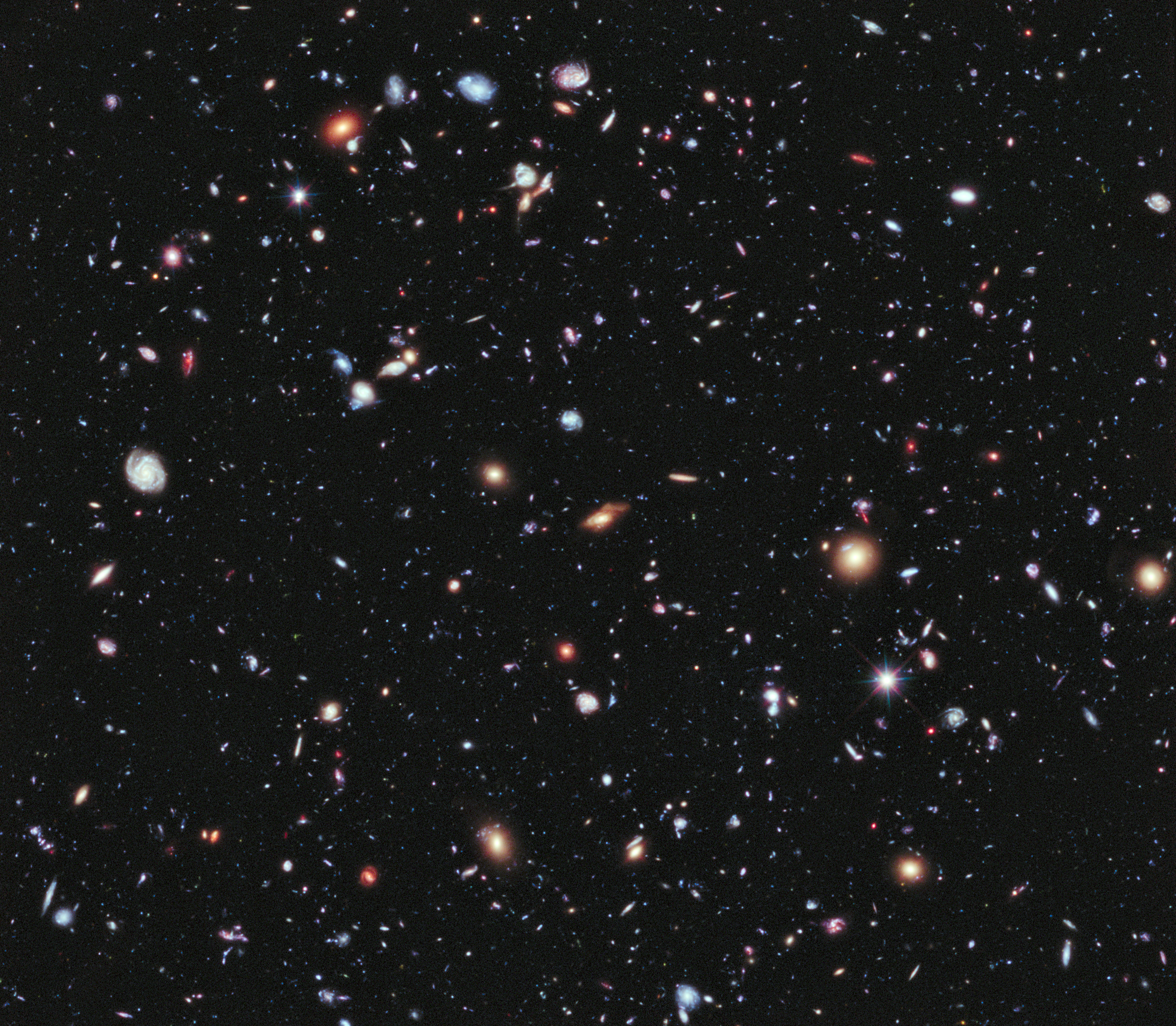
The Hubble Extreme Deep Field combines long exposures to reveal faint galaxies in a small dark-looking patch; this is not a naked-eye view.
WHERE THE EVIDENCE STANDS
WHAT WE DON’T KNOW YET
We do not know the full size of the universe or whether space extends without end. We also lack exact counts of all stars and all sand grains on Earth.
WHAT WOULD CHANGE THIS ANSWER
Repeatable measurements of cosmic background light that disagreed with predictions from the measured expansion and star-formation history would challenge this account. An alternative would need to explain the light, expansion, and galaxy observations together; better counts can also refine stellar estimates.
A dark sky holds bright stars and stretches that seem black. Why does light from countless distant stars not fill every gap?
This question is called Olbers’ paradox. It tests a particular picture: a universe that is static, has no limit in space, and has been full of shining stars for an unlimited time. In that picture, more distant layers of space contain more stars. Each star looks fainter, but there are more of them. The two effects balance in a way that prevents distance alone from solving the puzzle.
Our universe does not fit that picture. Its known expansion history goes back about 13.8 billion years, with stars forming later. Light travels at a finite speed. We do not receive light from an unlimited past filled with stars. Space also expands. That stretches light’s wavelength, shifting some of it beyond what our eyes can see and reducing the light we receive.
Darkness is not the same as absence. A long telescope exposure can reveal faint galaxies in a patch that looks empty to our eyes. Other instruments detect light beyond the visible range. The sky carries a faint background of radiation as well as individual bright objects.
None of this requires a wall around the whole universe. The region whose light can reach us is not automatically the full extent of space. It also does not require an exact tally of every star. The important question is how much light arrives, over what history, and in which wavelengths. Once those limits enter the picture, a huge population of stars and a dark night sky can fit together.
Are there more stars than sand grains on Earth? There is no exact census or definitive winner here. A comparison needs a stated stellar estimate for the observable universe and a defined sand inventory, with uncertainty for both.
Free long answer 1 of 3 this month.
Begin with an imagined universe rather than a photograph. Give it stars spread roughly evenly through space. Let space extend without end. Keep the whole picture static, so the distances do not change. Then let the stars have been shining for an unlimited time. These assumptions work together; dropping one can change the result.
Think of space around us as a set of thin shells, like layers around the center of an onion. This is a counting analogy. Space is not made of onion skins. A farther shell has more area, so it contains more stars if their average density stays the same. Each star sends us less light as its distance grows.
In this model, the increased star count offsets that decrease in brightness. Adding ever more shells keeps adding light. Another way to picture the issue is to follow a line of sight: with an unlimited supply of stars and time, it should eventually end at a shining stellar surface.
Blocking a far star with a nearer star does not create a dark patch. It replaces one bright surface with another. The idealized sky would therefore look very different from the one we see.
This is not a claim that the actual stars form a perfectly even grid. The argument asks what follows from a simple large-scale picture. Its value is that an everyday observation can expose a problem in the starting assumptions. To read about the broader size question, see whether the universe is infinite.
Light needs time to travel. When a telescope receives light from a distant galaxy, it shows the galaxy at an earlier stage. It does not give us an instant view of that galaxy as it is today. Looking farther away also means looking further into the past.
NASA’s current account traces our cosmic expansion history back about 13.8 billion years. This does not establish what, if anything, preceded that early history. Stars appeared during that history; they were not already shining through an unlimited earlier era. A hypothetical static universe full of eternal stars gives us light that our real history has never supplied.
The visible sky is therefore built from sources whose light can reach us now. There are limits on that light, and there is a changing history of star formation. You cannot keep adding equally productive star-filled shells without checking whether those stars existed when their light would have had to leave.
An important distinction follows. A finite cosmic age does not establish that the whole universe has a finite spatial size. A limit on what we can observe is not a measured edge of everything. Also, the present distance of a distant object is not simply its light’s travel time multiplied by light’s speed. Space changed while that light traveled.
The answer needs no claim that the cosmos is a small ball in a larger dark room. It needs the observed history of light and stars. How we estimate the universe’s age explores why the age comes from measurements and a tested model rather than a count of birthdays.
Dust does block some visible starlight. It can hide parts of our own galaxy and distant galaxies. That is a real effect, but it does not rescue the imagined eternal, static, star-filled universe. Absorbing light transfers energy into the dust. The dust then gives off radiation, often in the infrared, which our eyes cannot see.
If the imagined dust keeps receiving light for an unlimited time, it cannot serve as an endless sink that makes the energy disappear. This is the reason dust alone fails as the full solution to the classical puzzle. It can change where light goes and which wavelengths carry it. It cannot remove energy from the account.
Distance alone has the other problem already described: in the idealized universe, the larger number of stars in distant layers balances their lower individual brightness. Real galaxies can be extremely faint, but the original question was about the total light from unlimited layers, not whether we could see one particular star.
Expansion adds another change to the real picture. As light crosses expanding space, its wavelength grows. This is called cosmological redshift. Some light that started in the visible range reaches us at infrared wavelengths instead. Expansion also affects the received energy and rate of arrival.
These explanations fit together rather than compete as slogans. Dust can hide a galaxy. Distance can make it hard to detect. Expansion can change the light that arrives. The finite history removes the unlimited supply of past starlight assumed in the original bright-sky model.
The comparison expresses a useful sense of scale, but it is not an exact counted fact. Neither side is a complete inventory. For stars, astronomers use samples of galaxies, their light, and estimates of their stellar populations. Small, faint galaxies and hidden stars make the total harder to pin down.
For sand, the question needs a definition. Are we counting beach sand, deserts, or sand beneath other ground? How deep do we go? What grain sizes count? Change those choices and the estimate changes. A number without those boundaries can look much more precise than the question allows.
ESA explains how counting stars resembles estimating grains on a beach. Count a sample, estimate the size of the larger system, and multiply. This is an analogy about method. It does not establish that someone counted every grain on Earth or every star in all of space.
For that reason, this answer does not give a definitive winner or a falsely exact ratio. Huge rough totals can make the comparison plausible under stated choices. A sound comparison would need a defined sand inventory and a stated stellar estimate for the observable universe, with uncertainty for both.
The distinction between observable and whole matters here too. We do not know the total extent of space. A count estimated for the region we can observe cannot automatically become a count for the entire universe. And whichever side wins a chosen comparison, it does not settle the light-history question behind the dark sky.
Open NASA’s Hubble deep-field page and compare the observing method with ordinary vision. The telescope collected many exposures of a small patch that looked relatively empty. The combined result reveals distant galaxies. Long exposure allows faint light to add up in a detector. It does not mean your eyes see the same view at a glance.
The image on this page is the Hubble Extreme Deep Field. Many of its bright shapes are galaxies, not individual nearby stars. Its colors and depth come from combined observations. It is evidence of objects that are hard to see, rather than evidence that the whole night sky should appear bright to human eyes.
Next, ask which wavelengths an observation uses. Visible light is only part of the range. Infrared and microwave observations reveal radiation outside it. Darkness in an ordinary photograph does not guarantee a complete absence of radiation.
The universe also contains a faint background from accumulated starlight. NASA’s account of work using the Fermi telescope explains an indirect way to study this background through its effects on high-energy light. Measurement can reach below what a glance at the sky would reveal.
Finally, check the date and scope of a source. Older teaching pages can explain the classical argument well while listing old ages. Use the current NASA history for the age quoted here. Keep three questions apart: why daylight lights our atmosphere, why the night background is faint, and how much of the cosmos we can observe. Clear boundaries make the answer easier to test.
THREE THINGS TO REMEMBER
Nobody knows yet.
God Plays Dice answers big questions in plain words, with sources and one of six honest labels.
See a mistake? Report a problem. Corrections are made openly.
The Architect AI companion · All Access
Labels describe the evidence for a claim, not the people who hold it.
Match my phone uses your device’s light or dark setting.