
The UniverseAnswer
Why do physicists still call the matter-antimatter imbalance unsolved?
Why the matter surplus remains unexplained, what Sakharov's conditions require, and how sphalerons and proposed neutrino mechanisms might connect.
THE QUESTION LIBRARY THE UNIVERSE
The gold on your finger was made in space before the Earth existed, most likely when dead stars called neutron stars collided, so here is the evidence, the debate, and gold’s long trip into the ground.
Most likely from collisions of dead stars, called neutron stars, long before Earth formed. Most gold is made when atoms swallow neutrons very fast, and colliding neutron stars do just that. In 2017, astronomers watched one such crash throw fresh heavy elements into space. Some scientists argue that rare exploding stars made much of the gold, and the shares are still debated. Most of Earth’s gold then sank to its core. The gold we mine may have arrived afterward with meteorites.
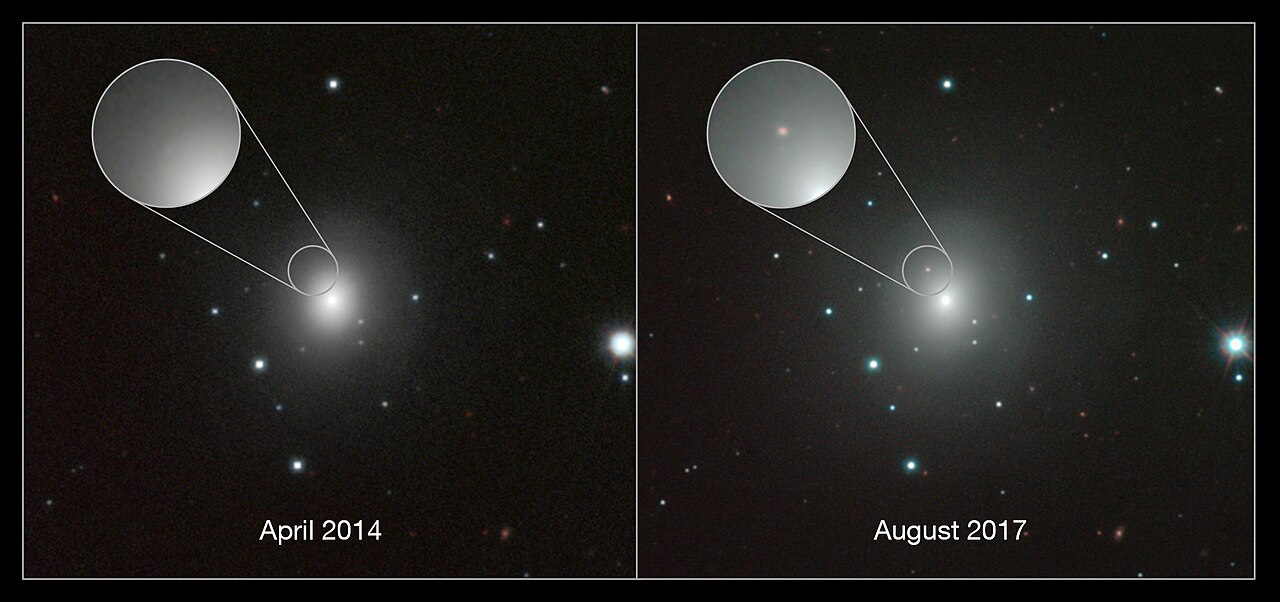
The galaxy NGC 4993, about 130 million light-years away, before and after two neutron stars collided in it. The small red dot at right is the kilonova, the glowing debris of the collision, which carried freshly made heavy elements.
WHERE THE EVIDENCE STANDS
WHAT WE DON’T KNOW YET
Nobody knows yet what share of the universe’s gold comes from neutron-star collisions, and how much from rare exploding stars or magnetar flares. Scientists are also still working out exactly how the gold near Earth’s surface got there.
WHAT WOULD CHANGE THIS ANSWER
If new measurements showed that neutron-star collisions make much less gold than expected, other sources would take the lead. NASA’s COSI gamma-ray telescope, expected to launch in 2027, may measure the elements made in magnetar flares, and new studies of ancient rocks could shift the story of how gold reached the crust.
The gold in a wedding ring is older than the Earth. Its atoms were made in space, most likely when collapsed stars called neutron stars smashed together. Such crashes throw fresh gold into the gas between the stars. Our Sun and planets later formed from a cloud of gas and dust, about 4.6 billion years ago, and the gold came along.
People ask this for good reasons. A ring marks a promise, and it is natural to wonder where its metal began. Many people have also heard that “we are made of stardust” and wonder whether that is really true. And in 2017, astronomers announced that they had watched two dead stars collide. One university headline spoke of striking “cosmic gold.”
Here is the core picture. Stars make new elements by fusing light atoms together, but that works only up to iron. Most gold needs a different recipe: a place so crowded with neutrons, one of the building blocks of atoms, that atoms can swallow many of them very fast. On August 17, 2017, detectors in the United States and Italy caught ripples in space-time, called gravitational waves, from two neutron stars colliding about 130 million light-years away. About 70 observatories then studied the glowing debris, called a kilonova. It carried the signs of freshly made heavy elements.
Some parts are still open. Scientists debate how much of the universe’s gold comes from these collisions and how much from other rare blasts. On Earth, most gold sank into the planet’s iron core long ago. The gold we mine may have arrived later, with a shower of meteorites. So we label the big picture Supported, still debated: strong evidence, with details still being worked out. Either way, the metal on your finger links you to violent events in deep space, long before the Earth was born.
Free long answer 1 of 3 this month.
Stars are element factories, with limits. All of the universe’s hydrogen and almost all of its helium formed in about the first five minutes after the Big Bang, NASA explains. Stars then fuse light atoms into heavier ones, but only up to iron. Beyond iron, making elements that way takes too much energy.
Heavier elements are built by adding neutrons. An atom’s element is set by its protons. When an atom captures an extra neutron, it can become unstable. Then a neutron may turn into a proton, which moves the atom up the periodic table. In the neutron-packed debris of a torn-apart neutron star, atoms can grab neutrons so fast that they grow into elements as heavy as uranium, NASA explains. This is the rapid neutron-capture process, or r-process. Most of our solar system’s gold was made this way, the astronomer Jennifer Johnson notes on the blog of the Sloan Digital Sky Survey (SDSS).
As an analogy, picture a snowball rolling through deep, fresh snow: the more snow, the faster it grows. Here the “snow” is neutrons. The analogy breaks down because a snowball stays a snowball, while an atom that swallows neutrons keeps turning into new elements as some of its neutrons become protons.
On August 17, 2017, the two LIGO detectors, in Washington state and Louisiana, picked up gravitational waves from two objects spiraling together. Their masses, about 1.1 to 1.6 times the Sun’s, fit neutron stars. About two seconds after the waves, NASA’s Fermi telescope caught a flash of gamma rays. The event was named GW170817.
Telescopes soon found a new point of light in the galaxy NGC 4993, about 130 million light-years away, and about 70 observatories studied it. LIGO reported that it was the first cosmic event seen in both gravitational waves and light. It matched a long-predicted blast called a kilonova: hot debris blown far out into space, glowing as it goes.
The debris raced outward at up to one-fifth the speed of light. Its color shifted from very blue to very red within days, the European Southern Observatory (ESO) reports. Astronomers think the glow came mostly from radioactive elements decaying in the debris. ESO’s spectra, the patterns of colors in the light, suggested caesium and tellurium. A Caltech-led team saw the fingerprint of neodymium. The LIGO team said the results revealed signatures of freshly made material, including gold and platinum. It said they solved a decades-long mystery: where about half of all elements heavier than iron are made.
A neutron star is the collapsed core left when a massive star explodes as a supernova. It packs more mass than the Sun into a ball about as wide as New York City’s Manhattan Island is long. A teaspoon of it would have a mass of about a billion tons, according to LIGO and NASA. NASA calls a neutron star the densest object astronomers can observe directly.
Inside, in the outer core, pressure squeezes protons and electrons into a sea of mostly neutrons. Nobody knows yet what lies at the very center: neutrons all the way down, smaller particles called quarks, or something stranger. NASA’s NICER telescope measured two neutron stars, of about 1.4 and 2.1 times the Sun’s mass, and found both about 16 miles (26 kilometers) across. So this matter resists squeezing more than some scientists predicted. Still, NASA says, the matter in their cores is on the verge of collapsing into a black hole.
The debate is not mainly about whether neutron-star collisions make heavy elements; even researchers who favor other sources say GW170817 supports that. It is about amounts and timing.
Timing. NASA notes that neutron-star mergers happen too late in the universe’s history to explain the earliest gold and other heavy elements.
Collapsars. In 2019, Daniel Siegel, Jennifer Barnes and Brian Metzger reported simulations in the journal Nature of collapsars: rapidly spinning massive stars whose collapse sets off a supernova. Collapsars are rarer than mergers, but each may throw out more material. The team estimated that they may supply more than 80 percent of the universe’s r-process elements. They also cited element-rich stars in a small galaxy, Reticulum II, that fit rare supernovae better than mergers.
Magnetars. In 2025, a team led by Anirudh Patel of Columbia University found signs of heavy elements being made in a giant flare seen in December 2004. It came from a magnetar, a neutron star with an extremely strong magnetic field. The authors estimate that such flares make 1 to 10 percent or more of the galaxy’s r-process elements.
The merger side has strong points too. In 2017, NASA said crashing neutron stars may be the universe’s main source of many of the heaviest elements, including gold. Johnson’s chart credits most of our gold to merging neutron stars. She called the r-process site “currently in dispute,” while noting compelling evidence for mergers. NASA’s COSI gamma-ray telescope, expected to launch in 2027, should be able to identify elements made in magnetar flares.
Our solar system formed about 4.6 billion years ago from a cloud of gas and dust, NASA says, and heavy elements from earlier stars were already in it. But as Earth formed, molten iron sank to the center to make the core, and it took the vast majority of the gold and platinum with it. The core holds enough precious metal to cover the whole Earth in a layer about four meters (13 feet) thick, the University of Bristol says. Researchers at the University of Göttingen put the core’s share of Earth’s gold and other precious metals at more than 99.999 percent.
That leaves a puzzle. Gold and similar “iron-loving” metals are tens to thousands of times more common in Earth’s rocky mantle, the layer above the core, than expected. A long-standing explanation is the late veneer: a shower of meteorites that hit Earth after the core formed, adding gold to the mantle. In 2011, Matthias Willbold and colleagues at Bristol tested it with tungsten, a rare metal that should also have sunk into the core. They studied 3.8-billion-year-old rocks from Isua, Greenland, which keep a chemical memory of the time before the shower. Their tungsten differed from that of modern rocks by a small but significant amount, in good agreement with a late veneer.
The late veneer has strong support, but the story may not be complete. Nature’s editors called the 2011 result a boost for the idea, while noting that earlier evidence had been indirect and much debated. Then, in 2025, a Göttingen team that included Willbold found traces of the metal ruthenium in Hawaiian lavas that point to core material, including gold, leaking into the mantle. Some of our gold may have come from the core, they say, though whether this happened in the distant past is still open. Either way, geological processes later gathered gold into the ore deposits mined today.
The answer stays the same after all this detail. The gold in a ring was most likely forged when neutron stars collided, before the Earth existed. How much other blasts added, and how gold reached the crust, are still being worked out. If that makes a ring feel more remarkable, see why the night sky stirs awe.
THREE THINGS TO REMEMBER
Next on the path “Can I feel wonder without a creed?” · step 4 of 8
Nobody knows yet.
See this path: Can I feel wonder without a creed?
God Plays Dice answers big questions in plain words, with sources and one of six honest labels.
See a mistake? Report a problem. Corrections are made openly.
The Architect AI companion · All Access
Labels describe the evidence for a claim, not the people who hold it.
Match my phone uses your device’s light or dark setting.