
The UniverseExplainer
What Is Dark Energy?
In 1998 astronomers found that the universe's expansion is speeding up, and "dark energy" is the name for a cause nobody yet understands.
THE QUESTION LIBRARY THE UNIVERSE
Removing matter does not remove the physical fields used to describe nature.
No single material is what empty space is made of. Real space contains some matter, light and fields. A quantum vacuum is the lowest-energy state of fields. It is a physical state. Tests measure quantum effects. Drawings of particles popping into view are not films of measured events. Atoms in laboratories can be colder than the cosmic background radiation. How vacuum energy fits with gravity is still unknown.
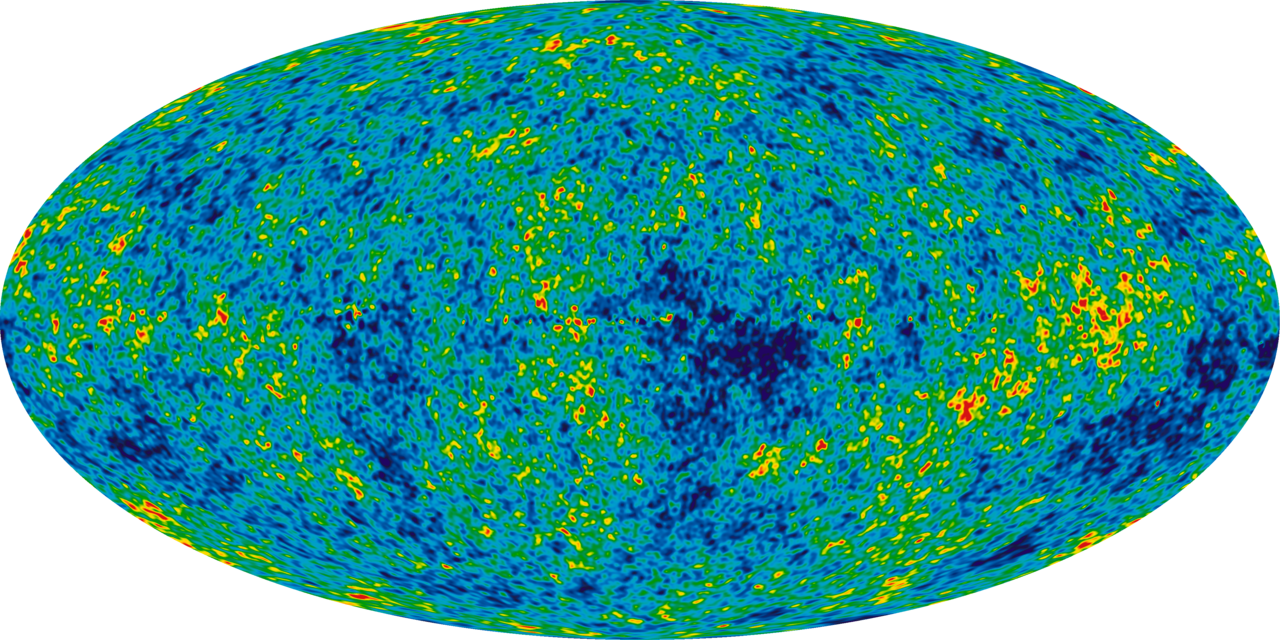
A map of the cosmic microwave background from WMAP. Its colors show small temperature differences in radiation that fills cosmic space; this is not a picture of the quantum vacuum.
WHERE THE EVIDENCE STANDS
WHAT WE DON’T KNOW YET
Nobody knows yet what dark energy is. We also lack a full tested account joining quantum fields with gravity.
WHAT WOULD CHANGE THIS ANSWER
A theory that explained cosmic expansion and passed new tests could clarify the vacuum’s role. If lab tests stopped matching today’s quantum rules, we would need to change those rules.
No single material is what empty space is made of. The phrase empty depends on what you have removed. Pump the air from a chamber and you get a vacuum, a region with very little gas. You have not removed space, physical fields or every trace of radiation.
Space between stars also contains scattered matter and light. It can be empty enough for some purposes without being absolute nothingness. This matters when a video moves from a statement about a vacuum to a claim about why anything exists. A physical vacuum is already part of a world with physical properties.
A field is a physical quantity described across space and time. A familiar magnetic field changes how a compass points. Modern particle theory uses quantum fields. Particles are excitations of those fields. An excitation is a state with more energy than the vacuum. Removing particles does not remove the framework that describes them.
The vacuum is the lowest-energy state in that framework. It has quantum properties that affect predicted measurements. Pictures of tiny particles appearing and disappearing can help introduce a calculation, but they should not be treated as a film of things that instruments have directly watched.
Cold is another word that needs care. The background microwave radiation has a temperature near 2.7 kelvin, a few degrees above absolute zero. Gas, dust and an object in sunlight can have different temperatures. Atoms in a laboratory can be cooled far below the background radiation’s temperature.
One deep puzzle remains. Vacuum energy should enter our account of gravity, yet theory does not naturally explain the small value associated with cosmic acceleration. That gap is real. It leaves an unanswered question about quantum fields and gravity, while laboratory tests still support many parts of quantum physics.
Free long answer 1 of 3 this month.
A vacuum is a region with very little ordinary matter, especially gas. It is a practical concept with measurable limits. At a particle accelerator, remaining gas molecules can interrupt a beam. CERN’s engineering description explains why its beam pipes need a very low gas pressure and how vacuum systems serve different purposes.
Removing most molecules is an impressive achievement. It does not turn a laboratory chamber into a place without physical laws or fields. The chamber walls, the apparatus and the conditions around it still matter. When someone says a vacuum is empty, ask what their experiment has removed and what it continues to include.
The same question helps with outer space. A dark view does not tell you that there is no radiation there. The cosmic microwave background, for example, is detectable radiation spread across the sky. Distinguish a region with few atoms from an ideal quantum vacuum, and both from the philosophical idea of no physical world at all.
A field gives a physical description at different places and times. The magnetic field around a magnet is a familiar example. Quantum field theory extends this language to particles. In this account, a particle is an excitation of a field. CERN’s Higgs explanation describes light as waves in the electromagnetic field and the Higgs boson as an excitation of the Higgs field.
Consider an analogy: water can be present without a wave moving across its surface. That helps separate a background from an excitation. The analogy breaks because a quantum field is not water or another fluid made of little pieces. Nor does it establish that space itself is a substance made from fields.
In a simple quantum-field description, the vacuum is the ground state, the state with the lowest energy. Its properties differ from a classical picture in which every physical quantity sits motionless at zero. A quantum fluctuation concerns the spread and links in field measurements. It need not mean that an observer could watch a tiny object repeatedly blink into existence.
Felix Karbstein’s lectures distinguish virtual processes in quantum calculations from real particles. Treating virtual particles as ordinary objects with brief, measurable lives goes beyond that description. Predictions for an experiment are the useful test. A cartoon of what supposedly happens between measurements does not carry the same evidential weight.
Yes, quantum theory predicts measurable effects in systems that include a vacuum. A widely discussed example is the Casimir force between nearby surfaces. NIST describes measured forces between simple conducting surfaces and calculations for more complicated shapes. Surface properties and the experimental arrangement matter to the result.
A common explanation uses a difference in the electromagnetic modes allowed by the surfaces. A mode is a possible pattern of a field. Changing the arrangement changes the system’s energy and its forces. This connects a calculation with something instruments can measure, rather than with an imagined photograph of vacuum particles.
The strongest objection is that a measured force does not automatically establish every story told about its cause. That objection is sound. In a paper on the Casimir effect, R. L. Jaffe explains that Casimir forces can also be calculated without treating zero-point energies as the starting point. The effect involves quantum interactions between matter and electromagnetic fields.
The careful conclusion is narrower than many headlines. Casimir measurements test a system and its predicted forces. They do not by themselves measure the absolute vacuum-energy density responsible for the universe’s expansion. Accepting the laboratory result does not require claiming that the cosmological problem has been solved.
Yes, if you mean colder than the cosmic microwave background. NASA’s COBE archive gives a background temperature near 2.725 kelvin. Kelvin is a temperature scale whose zero is absolute zero. The often repeated phrase space is about 2.7 kelvin refers to this radiation bath, rather than a uniform temperature for every object in space.
Atoms in laboratories can be much colder. The NIST-hosted report of Bose-Einstein condensation describes a trapped gas with condensation appearing near 180 nanokelvins. A nanokelvin is one billionth of a kelvin. This is a temperature of a prepared atomic system, not a claim that an entire room or all nearby radiation is equally cold.
The comparison makes sense only when you name what has a temperature. Sparse gas, radiation and a spacecraft need not share one temperature. An ideal vacuum state is not ordinary cold gas with atoms moving slowly. Removing matter and cooling matter are different operations, even when both require careful laboratory equipment.
Dark energy names the unknown cause of the observed acceleration of cosmic expansion within the usual cosmological account. NASA lists vacuum energy as one candidate. The cosmological constant is a term in the equations of general relativity that can represent a constant background energy density. Whether this explains dark energy remains unresolved.
Quantum fields contribute to the theoretical vacuum energy. Straightforward estimates produce values far larger than the small value inferred from cosmic expansion. Yet there is no single universal mismatch number independent of the calculation. Jérôme Martin’s review explains why the familiar enormous numerical comparison needs qualifications. This page avoids turning it into a fixed measured ratio.
A more precise version asks why the small final value remains small as quantum corrections are included. Antonio Padilla’s lectures explain the repeated adjustment needed in ordinary treatments. Matching a parameter to one observation is possible; explaining why the match remains stable is harder. Nobody has an accepted, experimentally established resolution.
Begin with CERN’s vacuum-engineering page. Notice that it discusses gas pressure and remaining molecules. Then compare the Higgs description: a field and its particle excitation are related concepts with different roles. This keeps two meanings of empty from sliding together unnoticed.
Read NIST’s Casimir explanation alongside Jaffe’s abstract. Both discuss the force, but the second cautions against using it to establish an absolute cosmic vacuum energy. Compare the actual measured claim with the larger interpretation someone wants you to accept.
Finally, compare the COBE radiation temperature with the atomic temperature in the condensation report. Name the system in each case. When a headline mentions vacuum energy, ask whether it reports a laboratory measurement, a cosmological inference or a proposed explanation. Those questions leave room for discovery without making the unknown parts sound settled.
THREE THINGS TO REMEMBER
Nobody knows yet what causes the large-scale expansion to accelerate.
God Plays Dice answers big questions in plain words, with sources and one of six honest labels.
See a mistake? Report a problem. Corrections are made openly.
CONTINUE THE THREAD
The UniverseExplainer
In 1998 astronomers found that the universe's expansion is speeding up, and "dark energy" is the name for a cause nobody yet understands.
The UniverseAnswer
Why the matter surplus remains unexplained, what Sakharov's conditions require, and how sphalerons and proposed neutrino mechanisms might connect.
The UniverseAnswer
How matter and antimatter differ in some decays, what quarks have to do with it, and why hydrogen–antihydrogen spectroscopy tests a different symmetry.
The Architect AI companion · All Access
Labels describe the evidence for a claim, not the people who hold it.
Match my phone uses your device’s light or dark setting.