
Life in the UniverseExplainer
How Does Evolution Actually Work?
Small inherited differences, filtered over countless generations, add up to the variety of life. Here is how evolution works and how we know.
THE QUESTION LIBRARY LIFE IN THE UNIVERSE
Any two people share almost all of their DNA, so here is what that number means, where our shared family tree leads, and what race does and does not capture.
Very closely. Any two people’s DNA is about 99.6% the same when every kind of difference is counted. Counting only single-letter changes, it is about 99.9%. Most of the small differences are found among people of the same population, not between populations. All living people trace most of their ancestry to Africa. Our species arose there about 300,000 years ago. And family-tree models suggest that everyone alive today shares ancestors who lived just a few thousand years ago.
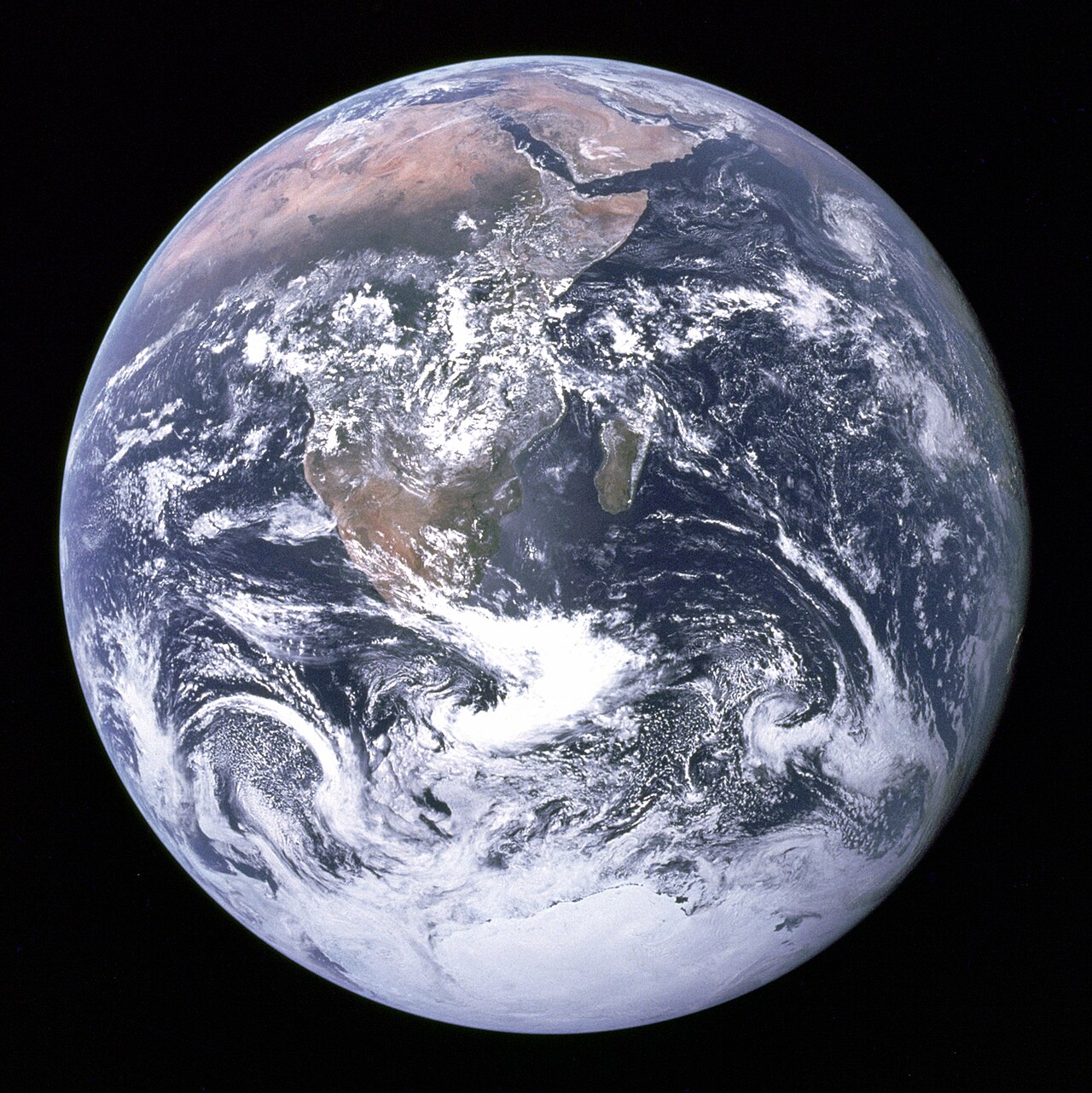
The Blue Marble, photographed in December 1972 by the crew of Apollo 17, the final Apollo mission, on the way to the Moon. Africa, where our species arose about 300,000 years ago, is near the top.
WHERE THE EVIDENCE STANDS
WHAT WE DON’T KNOW YET
Exactly where and how our species first took shape in Africa is still being worked out, and so are the details of how people moved out of Africa and back again. The dates for our shared family-tree ancestors come from models, so they are estimates.
WHAT WOULD CHANGE THIS ANSWER
Finding that people fall into sharply separate genetic groups would change this answer, but large studies find gradual change across geography instead. New fossils or ancient DNA could shift the dates for when our species arose and spread.
Very closely. Pick any two people on Earth, from any two countries, and their DNA will be almost the same. The U.S. National Human Genome Research Institute (NHGRI) says two people’s genomes are, on average, about 99.6% identical when every kind of difference is counted. You may have heard 99.9%. That figure counts only differences in single DNA letters.
People ask this for many reasons. Some are curious after an ancestry test. Some wonder whether the lines we draw between nations and races run deep in our biology. Some simply feel wonder that billions of strangers could belong to one family.
Here is the core picture. Our species, Homo sapiens, arose in Africa about 300,000 years ago. Its descendants spread across much of the world within the past 100,000 years. That is recent in evolutionary terms, and groups of people have moved and mixed again and again, so most of our genetic variety is shared across the world. In one large study, differences between people within the same population made up 93 to 95% of the genetic variation. Differences between major groups made up only 3 to 5%.
Family trees overlap, too. Each generation back doubles the number of places in your family tree. Soon there are more places than people who were alive, so the same ancestors show up again and again. Family-tree models suggest that everyone alive today shares ancestors who lived just a few thousand years ago.
What about race? NHGRI and the U.S. National Academies of Sciences, Engineering, and Medicine describe race as a social label. It matches poorly with the way human genetic variation is spread, which changes gradually from place to place. The essay Before We Are Nations, We Are Life, on this site, argues for human dignity. This page sticks to the science: how much DNA we share, where our family tree leads, and what race does and does not capture. What we owe one another is a question of values that science alone cannot settle.
Free long answer 1 of 3 this month.
Your genome is the full set of DNA instructions in your cells. It is written in four chemical letters: A, T, C and G. One copy has about 3 billion letters, and most cells carry two copies, one from each parent. That makes about 6 billion letters in all, according to NHGRI’s fact sheet on human genomic variation.
Compared with a reference genome, a typical person differs at about 5 million single letters. On top of that come about 600,000 small insertions or deletions, and about 25,000 structural variants: stretches of 50 or more letters that are added, missing, flipped or moved. Together these touch about 27 million letters, or about 0.4% of the genome. That is why NHGRI says any two genomes are, on average, about 99.6% identical. The often-quoted 99.9% figure counts only single-letter differences, which show up about once every 1,300 letters. NHGRI calls that an over-simplification. Either way, we are nearly identical.
We also have less genetic variety than many other species. A pair of human chromosomes differs at only about 1 in 1,000 sites, compared with about 3 in 1,000 in chimpanzees, according to a 2023 National Academies report. The Smithsonian adds that one chimpanzee subspecies, living only in central Africa, has more genetic diversity than all humans worldwide.
Back to Africa. The National Academies report sums it up: anatomically modern humans arose somewhere in Africa about 300,000 years ago, and their descendants spread across much of the rest of the world within the past 100,000 years. Fossils from Jebel Irhoud, in Morocco, are dated to about 315,000 years ago, give or take 34,000 years. The team that described them in 2017 concluded that the processes that produced our species involved the whole African continent.
DNA agrees. The 1000 Genomes Project read the genomes of 2,504 people from 26 populations. People from populations with African ancestry carried the most genetic variants, as the out-of-Africa model predicts. Most common variants turned up all over the world, while rarer ones tended to stay within closely related populations. The story is not perfectly tidy: Neanderthals contributed up to 1 to 4% of the genomes of people whose ancestors lived outside Africa, and a 2020 study found Neanderthal DNA in African populations too, a sign that genes flowed back and forth over time. Even so, the Smithsonian says, most of our genome still comes from Africa.
You also have two kinds of family tree. Your genealogical tree holds everyone you descend from: parents, grandparents, great-grandparents and so on. Your genetic tree holds only the ancestors whose DNA actually reached you. Each parent passes on only half of their DNA, reshuffled, and most of your distant ancestors left no DNA in you, the National Academies explain.
Genealogical trees overlap fast. Each step back doubles the places in the tree: 2 parents, 4 grandparents, 8 great-grandparents. Thirty generations back there are more than a billion places. Because there have only ever been so many people, the same ancestors fill many places, and different people’s trees soon merge. In 2004, Douglas Rohde, Steve Olson and Joseph Chang built two models of this. Both included real-world limits: people tend to choose partners from their own group, and groups far apart are partly cut off. In both models, the most recent common ancestor of everyone alive today lived just a few thousand years ago. Go back a few thousand years more, and in the models everyone alive today has exactly the same set of ancestors.
These are models, not measurements, so the dates are estimates. The National Academies call the result likely: by several thousand years ago, all modern humans probably share all their genealogical ancestors. Shared genetic ancestors are much older: for any one stretch of DNA, the most recent ancestor that everyone shares is typically far more ancient (Matsen and Evans, 2008). Our answers on how life on Earth began and on whether evolution would turn out the same if replayed trace the longer story behind us.
Within them. In 1972, R. C. Lewontin published a study of how human genetic diversity is divided among groups. The split often quoted in this debate, as A. W. F. Edwards summed it up in 2003, is about 85% of the variation within populations and 15% between populations or ethnic groups. Later studies found the same pattern. A 2002 study of 1,056 people from 52 populations found that differences among people within a population made up 93 to 95% of the genetic variation, and differences among major groups only 3 to 5%. The Smithsonian’s summary: in general, 5 to 15% of human genetic variation lies between large groups living on different continents.
Gene variants also tend to change in frequency gradually with distance, with slightly bigger jumps across barriers such as oceans or mountains. The National Academies note that these geographic boundaries do not line up with racial groupings. NHGRI’s glossary calls race a social construct used to group people, often by physical appearance, social factors and cultural background, and it notes that there is more genetic variation within self-identified racial groups than between them. Large genome projects, the National Academies report says, confirmed a poor correspondence between racial groups and the way human genetic variation is spread. Its 2023 recommendations say researchers should not use race as a stand-in for genetic variation.
Looks can mislead. Skin color, for example, closely tracks the strength of sunlight where a person’s ancestors lived, the Smithsonian explains. Darker skin protects against strong ultraviolet light near the equator, and lighter skin lets the body make enough vitamin D where sunlight is weaker.
If race is a social label, how can a DNA test tell where your ancestors lived? It is a fair question. In 2003, Edwards argued that Lewontin’s conclusion, that the genetic data do not justify dividing humans into such groups, was unwarranted. Most of the information that tells populations apart, he wrote, lies in the way many markers vary together, not in any single marker. The 2002 study is an example. Without using any information about where people came from, the researchers found six main genetic clusters, and five of them matched major geographic regions.
Both findings can be true at once, a 2007 study explained. The share of variation between populations is modest, and two people from different populations can be more alike than two people from the same one. Yet with enough data, people can be sorted into populations accurately. The National Academies add that the labels given to such groups, such as a region or an ethnicity, come from outside genetics, and that the underlying variation changes continuously from place to place. So genetic ancestry is real and can be estimated, but it changes gradually across geography. It is not a set of sharp boxes, and it does not map neatly onto race.
“If we are 99.9% the same, genes cannot matter.” Small differences can matter. NHGRI notes that some variants influence traits like eye color and height, and some directly cause diseases such as cystic fibrosis and sickle cell disease. Being nearly identical and being unique are both true.
“If we all share ancestors from a few thousand years ago, we all carry their DNA.” Not necessarily. Most of a person’s distant genealogical ancestors passed no DNA to them, the National Academies explain, and which ancestors did pass on DNA changes from one part of the genome to another.
“People from one continent share one genetic type.” The 1000 Genomes Project found the most genetic variants in people from populations with African ancestry. A single label for a whole continent hides a great deal of variety. The National Academies report cites researchers who call continental labels such as European, African and Asian very broad.
The answer stays the same. Every person alive belongs to one young species, and we are far more alike than different. In the National Academies’ words, “modern humans are all embedded within the same enormous family tree, with some members more closely related than others.”
The arithmetic of ancestors. A family tree doubles with each generation back: 2 parents, 4 grandparents, 8 great-grandparents. After n generations there are 2 to the power n places. After 10 generations that is 1,024 places. After 20, it is 1,048,576. After 30, it is 1,073,741,824, more than a billion. The places grow far faster than any real population, so the same people must fill many of them. This is why genealogical trees merge so quickly, and why the models built by Rohde, Olson and Chang find shared ancestors only a few thousand years back.
Why one marker says little and many markers say more. Witherspoon and colleagues (2007) measured how often two people from different populations are more alike than two people from the same population. With 100 variable DNA sites, people could be sorted into populations accurately, yet that measure of overlap stayed sizable, even for groups as distinct as sub-Saharan Africans and Europeans. The number of sites studied was the most important factor. The authors concluded that traits shaped by a dozen or fewer sites can be expected to overlap a lot between human populations.
THREE THINGS TO REMEMBER
Next on the path “Can I feel wonder without a creed?” · step 8 of 8
Before We Are Nations, We Are Life
A cosmic case for human dignity. Before we are nations, we are life. Before we inherit a border, we inherit a planet.
See this path: Can I feel wonder without a creed?
God Plays Dice answers big questions in plain words, with sources and one of six honest labels.
See a mistake? Report a problem. Corrections are made openly.
CONTINUE THE THREAD
Life in the UniverseExplainer
Small inherited differences, filtered over countless generations, add up to the variety of life. Here is how evolution works and how we know.
Life in the UniverseAnswer
Identical twins develop from one fertilized egg and begin with almost the same DNA. Yet their conditions before birth, later environments and gene activity can differ. Shared DNA…
Life in the UniverseAnswer
Humans and chimpanzees inherited much of their DNA from a shared ancestor. Similar DNA can produce different bodies when some protein instructions and patterns of gene activity differ.…
The Architect AI companion · All Access
Labels describe the evidence for a claim, not the people who hold it.
Match my phone uses your device’s light or dark setting.