
The UniverseAnswer
Why do physicists still call the matter-antimatter imbalance unsolved?
Why the matter surplus remains unexplained, what Sakharov's conditions require, and how sphalerons and proposed neutrino mechanisms might connect.
THE QUESTION LIBRARY THE UNIVERSE
The Sun’s broad future is well understood, while the final path of Earth depends on uncertain tides and mass loss.
The Sun will become a red giant and later leave a white dwarf, a dense remnant that slowly cools. In roughly five billion years, it will leave its current core-hydrogen phase. Earth will grow too hot for familiar surface life before the largest giant stages. Whether the rocky planet is swallowed remains uncertain. The Sun is too small to end in a collapse supernova or become a black hole.
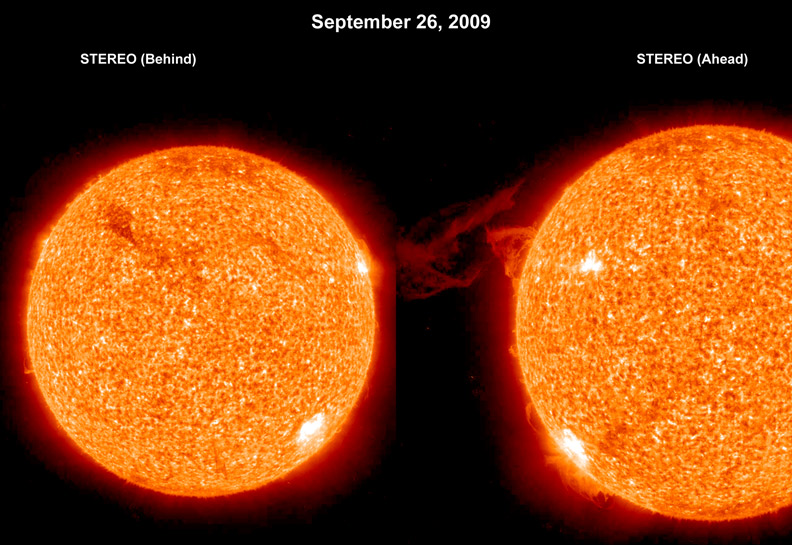
The STEREO spacecraft observed the same solar eruption from different angles. An eruption is not the Sun beginning its final stellar stages.
WHERE THE EVIDENCE STANDS
WHAT WE DON’T KNOW YET
Nobody knows yet the exact final orbit of Earth. Uncertain mass loss and tides affect whether the rocky planet survives the Sun’s giant phases.
WHAT WOULD CHANGE THIS ANSWER
Better measurements of mass loss and tidal effects in aging stars could narrow the Earth-survival forecast. They would help test the inputs that cause different stellar models to give different outcomes.
The Sun will swell into a red giant and later leave a white dwarf, a small, dense remnant that slowly cools. It will not end in the kind of supernova that marks the collapse of a much more massive star. Its future is a long sequence of changes, rather than one sudden event.
It is easy to picture the Sun as a permanent fixture. It rises, sets and comes back. The word death can make its future sound like a single final day. For a star, though, the word describes changes in its fuel, its structure and the way it shines.
Right now, the Sun joins hydrogen nuclei together in its core, making helium and releasing energy. This is nuclear fusion. Its current long phase is called the main sequence. Astronomers expect it to leave that phase in roughly five billion years. Later, the outer layers expand while the core changes. Eventually, much of the outer material is shed.
Earth's future needs its own careful answer. A hotter, brighter Sun will make our planet less hospitable long before its largest giant stages. Whether the rocky planet is physically swallowed is a different question. That depends on how much material the Sun loses and how tides change Earth's orbit. Models do not all give the same outcome.
The larger pattern is well supported: astronomers see ordinary stars, giants and white dwarfs elsewhere. The precise future of Earth's orbit remains less settled. Keeping those two levels separate helps us avoid turning an uncertain detail into doubt about the whole picture.
And if you have heard a question about the Sun suddenly disappearing, treat it as a thought experiment. Stars do not vanish on command. In that impossible setup, changes in light and gravity would take about eight minutes to reach Earth. Without the Sun’s pull, Earth would keep moving onward rather than stop. This is not a forecast for our Sun.
Free long answer 1 of 3 this month.
The Sun is powered by fusion, not by an ordinary fire. Hydrogen nuclei join through a chain of reactions that makes helium and releases energy. NASA's Sun facts describe the core as the source of the energy that eventually reaches us as sunlight. There is no need for the Sun to draw in oxygen from surrounding space.
Gravity pulls a star inward. The pressure supported by its hot interior resists that pull. In the long main-sequence phase, the balance allows the star to keep shining while its core fuel changes. NASA's stellar-life overview describes this balance and the stages that follow it.
When core hydrogen runs low, the structure changes. The core contracts and heats, and the outer layers expand. Later, helium fusion can make heavier elements. Different regions of the star can behave differently: a shrinking core does not require every outer layer to shrink too.
An analogy is a building whose inner support changes while its outer structure moves outward. The analogy breaks because a star is hot gas, not walls and beams. It is a reminder to separate the core from the envelope, the star's outer material, rather than an account of the forces involved.
A red giant has much more extended outer layers than the Sun has now. Its surface can be cooler while the star as a whole shines more brightly. Surface temperature, size and total light output are different properties. Saying the Sun becomes redder does not mean that Earth will receive less energy.
ESA's diagram of the Sun's future traces changes in temperature and luminosity, the total energy it gives off each second. It places the Sun on an evolving path toward the red-giant phase, then toward a white dwarf. The broad timetable is billions of years; it is not a countdown to a single day.
Later, much of the outer material is lost. What remains is a dense core called a white dwarf. NASA's guide to stellar types explains that these remnants are usually roughly Earth-sized and cool over billions of years. They are not planets, despite the comparison in size. Their matter is packed far more tightly.
Clouds around dying stars show one possible part of the process. NASA's Helix Nebula description identifies glowing gas expelled by a star like the Sun. Such a cloud is called a planetary nebula, a historical name that does not mean planets made it. The exact cloud our Sun might produce is less settled than its eventual white-dwarf fate.
There are two questions here: can Earth remain a place with familiar surface conditions, and can the rocky body avoid being engulfed? A planet can survive as a body while losing the conditions that made it habitable.
The 2008 study Distant future of the Sun and Earth revisited describes increasing solar brightness making Earth hotter long before the Sun becomes a giant. Its orbital model also predicts engulfment. In that calculation, tides overcome the outward expansion of Earth's orbit caused by solar mass loss. That outcome is a model result, not an observation of a future event.
A 2026 model study gets a different result with updated descriptions of tidal energy loss and the Sun's later mass loss. Earth survives the giant phases in some of its calculations. Other choices lead to engulfment. The authors say that the outcome remains uncertain because those inputs are not well constrained.
This is the strongest objection to a simple statement that Earth will definitely be swallowed: the outcome depends on processes that are still being studied. It does not overturn the red-giant forecast. It changes our confidence about one planet's final path. ESA's Sun overview also separates harsh future surface conditions from the possibility of engulfment. Avoiding the Sun's outer layers would not preserve Earth as it is today.
The Sun does not have enough mass for that ending. NASA's explanation of why it will not become a black hole distinguishes the Sun's white-dwarf future from the collapse of much more massive stars.
There is no single ending shared by every star. A star's starting mass helps set the pace at which it uses its fuel and the stages it can reach. A much more massive star can pass through further stages and end in a collapse that leaves a neutron star or black hole. Applying that story to our Sun would mix together different kinds of stars.
Three common mistakes follow from that mix-up. A photo of a solar eruption does not show the Sun beginning its final collapse. A red giant is not a supernova. A white dwarf is not a black hole. Each name refers to a different process or object.
Another mistake is to imagine that the Sun uses up all its fuel everywhere at once. The location of fusion matters, and stars have stages rather than an on-off switch. To explore other stellar endings, see What is a black hole?
This is a deliberately impossible setup, not something stellar evolution predicts. Instantaneously erasing the Sun is not a physical event allowed by the model. The useful lesson is about causality: a distant change cannot send news to Earth instantly.
NASA's gravity questions explain that even an imagined sudden change in solar mass would not affect Earth's gravity immediately. The relevant signal takes about eight minutes to cross the Sun-Earth distance. Light also needs that journey time. In the simplified disappearance story, Earth would keep receiving light already on its way until that light had passed.
If the Sun's gravitational influence were then absent in the imagined setup, Earth would no longer follow the same solar orbit. It would continue moving roughly along the direction it already had, rather than suddenly stopping. This leaves out the other bodies' smaller gravitational effects.
Earth's own gravity would still exist. Removing the Sun from a thought experiment does not remove the mass of Earth or switch off gravity everywhere. For the signal-speed limit, see Why can’t anything outrun light?. Neither thought experiment describes how our Sun will actually end.
Begin with the diagrams on NASA's star pages and ESA's solar-evolution page. Check whether a time refers to the star's total age or to time from now. Those are different quantities, and confusing them can shift a forecast by billions of years.
Then compare the Earth-survival studies. Read what each treats as an input: mass loss, tides and the star's changing size. Ask whether a result holds for every choice examined or only for some. A calculation that changes with its inputs should be presented as conditional.
Separate observations from forecasts too. Astronomers observe giants, white dwarfs and expelled gas today. They use physical models to connect those stages and predict the Sun's future. The existence of those objects is evidence; an exact date for our own Sun remains a forecast.
Finally, look at what a claim actually means. Surviving as a rocky planet is different from staying habitable. Losing core hydrogen is different from instantly going dark. Keeping those distinctions in view lets the main answer stay clear while its uncertain details remain visible.
THREE THINGS TO REMEMBER
Will the universe end, and if so, how?
Nobody knows yet.
God Plays Dice answers big questions in plain words, with sources and one of six honest labels.
See a mistake? Report a problem. Corrections are made openly.
The Architect AI companion · All Access
Labels describe the evidence for a claim, not the people who hold it.
Match my phone uses your device’s light or dark setting.