
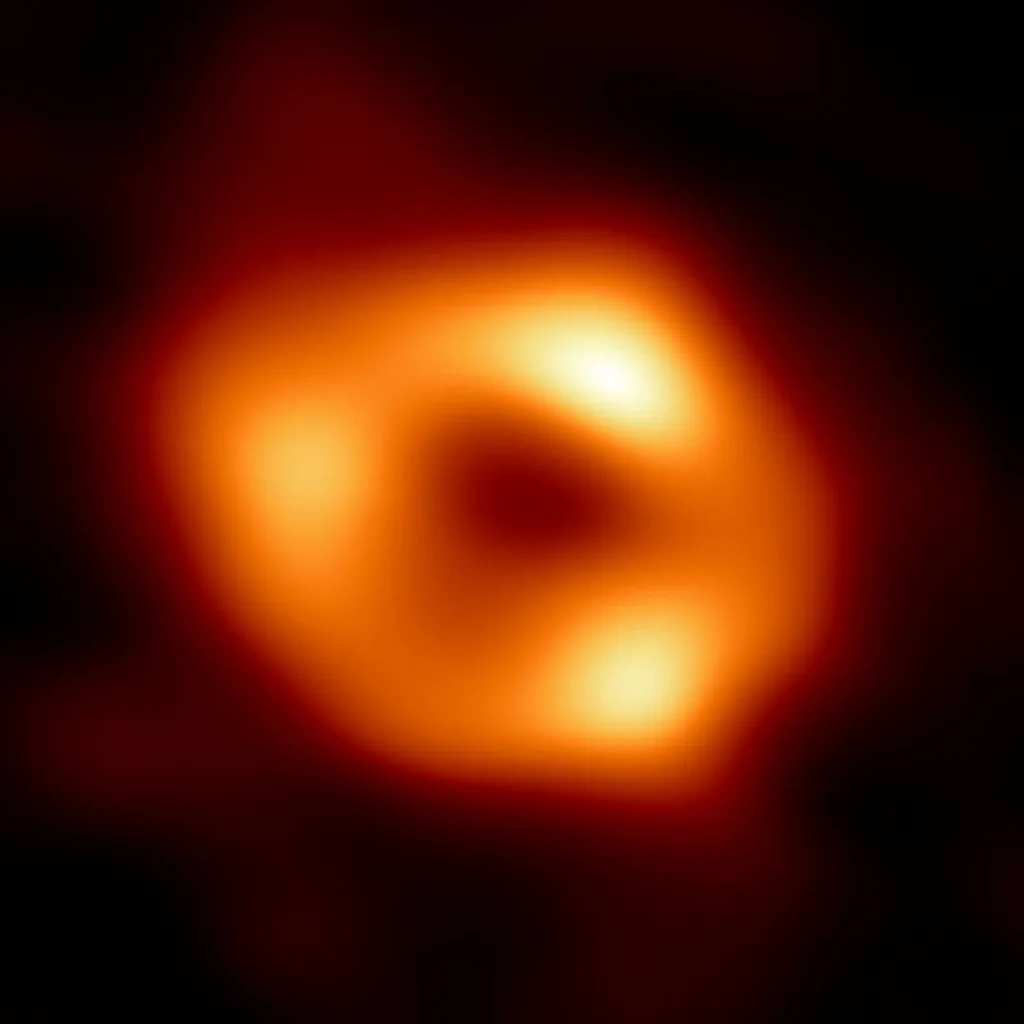
The UniverseExplainer
What Is a Black Hole, Really?
Not really holes and not cosmic vacuum cleaners, black holes are places where matter is packed so tightly that not even light can climb back out.
THE QUESTION LIBRARY THE UNIVERSE
Laser beams and the pulse times of distant stars reveal tiny, traveling changes in space and time.
Gravitational waves are traveling changes in space and time that very slightly stretch and squeeze distances. Laser detectors compare light paths in two long arms to measure them. Astronomers also time pulses from many spinning stellar remnants to look for much slower waves. Agreement across detectors or across pulsar pairs, together with careful noise checks, separates a cosmic signal from disturbances in the measuring system.
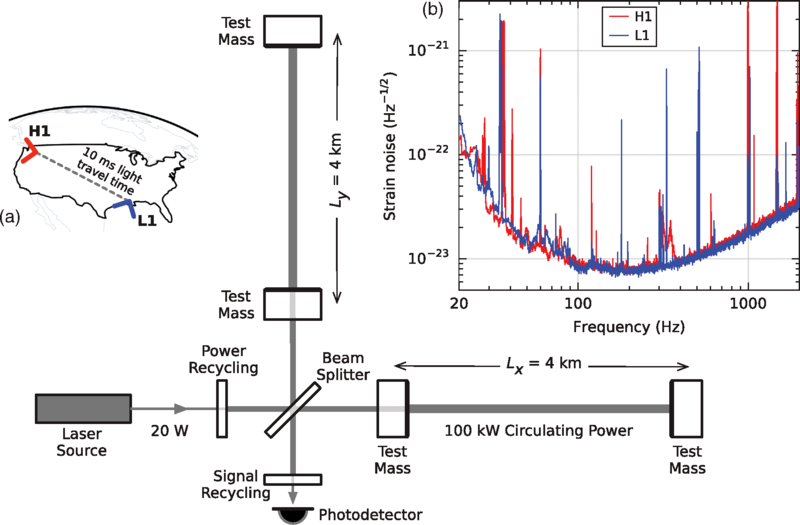
Simplified Advanced LIGO detector diagram, not to scale · Insets show site locations and historical noise-sensitivity curves from the first detection’s 2016 paper. The curves are not an event waveform, and the labeled powers are not a statement of current hardware settings.
WHERE THE EVIDENCE STANDS
WHAT WE DON’T KNOW YET
The exact mix of sources behind the very slow gravitational-wave background is still being studied. A background signal does not identify each individual black-hole pair.
WHAT WOULD CHANGE THIS ANSWER
A stronger explanation for the same signals would need to match the measured patterns and survive the detector and noise checks. More pulsar data and better models can change what we infer about the slow background’s sources without undoing the established laser detections.
Gravitational waves are small, traveling changes in space and time. As a wave passes, distances can stretch in one direction and shrink in another. Scientists detect these changes with laser beams on Earth and, for much slower waves, with pulses from distant stars. The waves are real; they have been measured.
Picture dots drawn in a circle that briefly becomes a tall oval, then a wide one. That is a sketch of one simple wave pattern, not a picture of material floating through space. Space and time are not a sheet of cloth. The useful part of the sketch is the changing distance between the dots.
LIGO uses two long arms at right angles. Laser light travels along both, reflects from mirrors and comes back together. A passing wave changes the two light paths by tiny, different amounts. The way the returning light combines reveals that change. One detector alone has a harder job telling a cosmic signal from a local disturbance, so scientists compare distant instruments and their noise records.
The famous black-hole “chirp” is this measured pattern turned into sound for our ears. It is not a microphone recording sound crossing empty space. As two black holes spiral together, their wave pattern speeds up. Playing that pattern through a speaker makes the pitch rise.
Other waves change too slowly for that approach. Astronomers instead track the regular radio pulses of many spinning stellar remnants called pulsars. A wave can make those pulses arrive slightly early or late. The test is a shared pattern across stars in different directions, not one late tick. Laser detectors and pulsar timing study different parts of the same physical phenomenon.
Free long answer 1 of 3 this month.
A gravitational wave is a traveling change in the geometry of space and time. That sounds abstract, but its effect is a change in distances and in the travel time of light. NASA describes waves that move at the speed of light and alternately stretch and squeeze what they pass.
Two black holes circling one another are one source. They lose energy through gravitational waves, move closer and eventually merge. The changing wave pattern carries information about that motion. It comes from the moving pair and the merger; it does not require light to escape from inside a black hole.
The circle-to-oval picture is a useful sketch of a simple wave crossing a plane. It exaggerates the effect enormously. Nobody sees Earth visibly wobble into an oval when a distant merger passes. Instruments measure an extremely small change.
LIGO means Laser Interferometer Gravitational-wave Observatory. Its U.S. sites are in Washington and Louisiana, about 3,000 kilometers apart. At each site, two arms run at right angles, each four kilometers long. The LIGO Laboratory overview shows the layout.
A beam splitter sends laser light along both arms. Mirrors reflect it back, and the returning beams combine. Light has a repeating wave pattern. If the two journeys change relative to each other, the returning patterns line up differently. That changes the light reaching a sensor. This comparison is called interference.
For one favorable wave direction and orientation, one arm lengthens while the other shortens, then the changes reverse. Other directions give different responses. The instrument is measuring a pattern of relative changes, not pointing a camera at the source.
The actual optical design makes light bounce between mirrors many times, increasing sensitivity. Vacuum tubes and carefully isolated mirrors reduce unwanted disturbances. The simple two-arm picture explains the principle; those extra systems make the measurement possible.
Yes. A change in a laser signal is not automatically a gravitational wave. Ground motion, faults in the instrument and other disturbances can also alter the reading. LIGO's FAQ explains the use of sensors that monitor the environment and checks across distant instruments.
A local disturbance need not appear at another site. A wave from space should produce related patterns at the two detectors, with an arrival-time difference that fits travel at light speed. The patterns need not have exactly the same strength: each detector's orientation affects its response.
The first direct detection, on September 14, 2015, was called GW150914. The original research paper reports checks of both detector operation and environmental records. Researchers also searched using predicted merger patterns and a separate method with fewer assumptions about the wave's shape.
They estimated false coincidences by shifting one site's data in time, breaking any real shared event while preserving much of the noise behavior. The important result was a signal supported by several checks. Agreement between two sites is powerful evidence, but it does not excuse checking shared disturbances or bad calibration.
As a black-hole pair spirals together, its orbital motion speeds up and the gravitational-wave pattern repeats faster. Convert those changes into speaker motion and the pitch rises: a short chirp followed by a fade. This gives our ears access to the timing of the measured pattern.
The Gravitational Wave Open Science Center's audio page distinguishes measured data, a predicted signal and versions shifted upward in pitch. The data are processed to reduce noise. A clearer or higher-pitched clip is not necessarily the untouched detector output.
Gravitational waves are not sound waves. Sound needs matter to carry pressure changes; a gravitational wave can travel through a vacuum. Playing the signal is closer to converting radio data into an audible message than hearing a crash from across the universe. A pleasing chirp is a helpful illustration, not the test that establishes the detection.
A pulsar is a spinning neutron star, a dense remnant of a dead star. Its radiation beam can sweep past Earth like a lighthouse beam, giving us repeated pulses. NASA's pulsar guide explains that the pulse comes from rotation, not a star repeatedly turning on and off.
Radio telescopes record when pulses arrive. Astronomers model the expected timing, accounting for the star's spin and motion. A gravitational wave can change the travel time, leaving pulses a little early or late. Using many pulsars in different sky directions makes a pulsar timing array: a detector whose light paths extend across our galaxy.
Those measurements search for much slower variations. NANOGrav's frequency guide describes periods of months to decades, rather than LIGO's rapid merger signals. Different detectors therefore explore different sources.
Pulsars are not perfect clocks. Gas between stars delays radio waves, and errors in Earth's clocks or the modeled motion of the solar system can affect timing. NANOGrav's noise account explains why these effects must be measured and modeled.
The key test is how timing changes are related across pairs of pulsars at different angles on the sky. In its 2023 analysis, NANOGrav reported evidence for the pattern expected from a background of gravitational waves. That supports the wave interpretation. It does not by itself identify every source; giant black-hole pairs are a leading explanation, with other possibilities still being tested.
Start with the LIGO layout and trace the laser from splitter to mirrors and back. Then compare the original paper's two detector records. Ask which features agree, how the arrival times are compared, and what noise checks accompany the result.
On the audio page, compare the measured-data clip with the predicted signal and shifted-pitch version. For pulsar timing, read the 2023 paper's discussion of correlations and noise checks. Notice the distinction between finding a pattern and identifying its sources. Each method earns confidence through measurable expectations, comparisons and attempts to account for other causes. The plots are a starting point; reconstructing the full result also requires the calibration, noise models and analysis described in the paper.
THREE THINGS TO REMEMBER
Is gravity a force, or a bend in space and time?
Both: gravity acts as a force in Newton’s model and as curved space and time in Einstein’s.
God Plays Dice answers big questions in plain words, with sources and one of six honest labels.
See a mistake? Report a problem. Corrections are made openly.
CONTINUE THE THREAD
The UniverseExplainer
Not really holes and not cosmic vacuum cleaners, black holes are places where matter is packed so tightly that not even light can climb back out.
The UniverseAnswer
Why the matter surplus remains unexplained, what Sakharov's conditions require, and how sphalerons and proposed neutrino mechanisms might connect.
The UniverseAnswer
How matter and antimatter differ in some decays, what quarks have to do with it, and why hydrogen–antihydrogen spectroscopy tests a different symmetry.
The Architect AI companion · All Access
Labels describe the evidence for a claim, not the people who hold it.
Match my phone uses your device’s light or dark setting.