
Mind & MortalityAnswer
Why do humans fear death?
Why death can feel frightening: loss, separation, uncertainty and the dying process, with clear limits on psychological explanations.
THE QUESTION LIBRARY MIND & MORTALITY
Everyone needs sleep and everyone dreams, yet science is still working out why; here is what sleep does, the leading ideas about dreams, and what a dream can and cannot tell us.
We need sleep because the brain and body stop working well without it, but its deepest purpose is still unknown, and nobody knows yet why we dream. Sleep helps us hold on to what we learn. It may also help clear waste from the brain, but that is debated. Dreams are usually most vivid in REM sleep. Leading theories say dreams rehearse dangers, sort memories, keep learning flexible, or are side effects of brain activity. Whether a dream is a message from God or a loved one is beyond science.
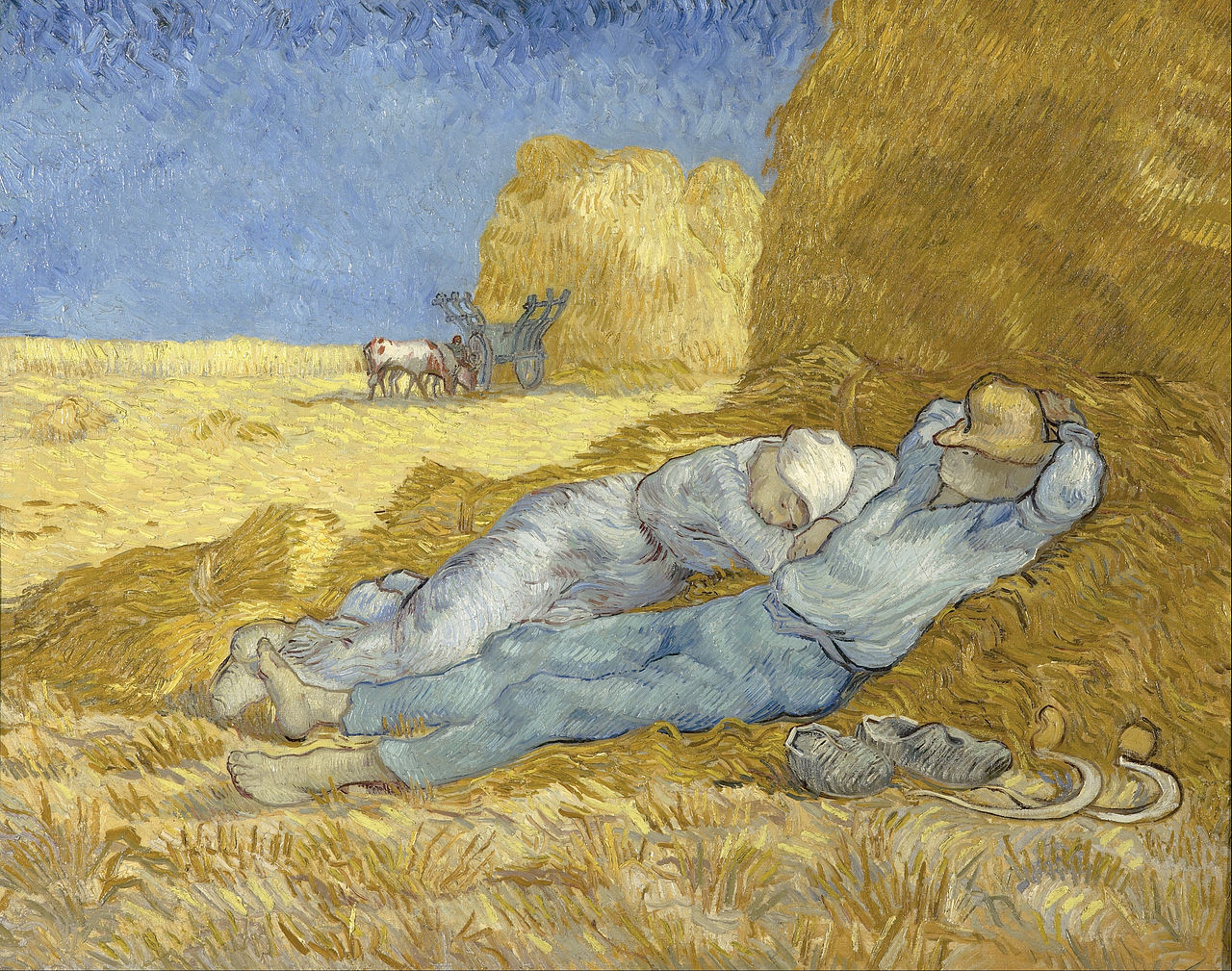
Two farm workers nap beside a haystack in Vincent van Gogh’s The Siesta (after Millet). We spend about a third of our lives asleep, and science is still working out exactly why.
WHERE THE EVIDENCE STANDS
WHAT WE DON’T KNOW YET
Nobody knows yet what sleep is most deeply for, or why we dream at all. Whether sleep speeds up waste removal in the brain is still argued, mostly from studies in mice. How much each theory of dreaming explains is also unsettled.
WHAT WOULD CHANGE THIS ANSWER
If one theory of dreaming could predict what people dream and show a benefit that other labs could repeat, dreaming would stop being an open question. Larger human studies of brain cleaning during sleep could settle that debate as well.
Every night you spend hours doing something that looks like nothing at all. You lie still, you lose track of the world, and then you wake. We spend about a third of our lives asleep. So why do we need it, and what are dreams for? They are fair questions, and science has some answers.
Here is the short answer. We do need sleep. The U.S. National Institute of Neurological Disorders and Stroke (NINDS) calls good sleep as essential to survival as food and water. Without enough of it, attention, memory and mood suffer, and the risk of some health problems goes up. Yet the same agency says the biological purpose of sleep remains a mystery. Scientists have strong clues, not one final answer.
One strong clue is memory. Across nearly a century of studies, people remember more after sleep than after the same time awake. The effect is real but moderate, and some key findings about how it works could not be repeated or held only in some conditions. Another clue is cleanup. A 2013 study in mice found that sleep sped up the removal of waste from the brain, but a 2024 mouse study found the opposite. That question is still debated.
Dreams are even more of a puzzle. Sleep comes in stages. In the stage called REM sleep, short for rapid eye movement, the eyes dart under closed lids, and dreams are usually most vivid. Everyone dreams, NINDS says, for about two hours a night, though we may not remember most of our dreams. Scientists have several competing ideas about why. Dreams might rehearse dangers, help sort memories, keep learning flexible, or be a side effect of brain activity. None has won.
Many people also wonder whether dreams carry meaning. Research finds that dreams often echo our waking lives and feelings. Whether a dream can carry a message from God or a loved one is a question science cannot test. We label that Beyond science, and the main question here an Open question.
Free long answer 1 of 3 this month.
NINDS describes two basic types of sleep, REM and non-REM. Non-REM sleep runs from light sleep, where we spend the most time, to the deep sleep we need to feel refreshed. REM sleep first arrives about 90 minutes after we fall asleep. The arm and leg muscles go limp, which keeps us from acting out our dreams, and brain waves look closer to waking.
In a 2017 study, people woken from both REM and non-REM sleep sometimes reported dreams, and in both, dreaming went with fewer slow brain waves toward the back of the brain. But in a small 2020 test, analysts who could not see the dream reports used brain-wave readings, including that signal, to spot dreaming and did no better than chance. For how brain activity becomes experience, see Is the mind just the brain? When REM’s muscle shutdown lingers after waking, a person can be awake but unable to move; see our answer on sleep paralysis.
It helps us keep what we learn. A 2021 meta-analysis (a study that pools many studies) combined 823 results from 177 papers published from 1967 to 2019. People recalled more after sleep than after an equal time awake. The benefit was moderate, and it shrank but held after a correction for results that may have gone unreported. A leading explanation, from a 2013 review, is that the sleeping brain replays new memories during deep sleep and moves them into long-term storage. In a 2020 meta-analysis of 91 experiments, playing sounds or smells tied to a lesson during non-REM sleep helped memory, but playing them in REM sleep or while awake did not. Still, a 2021 review by Maren Cordi and Björn Rasch reported that several key findings behind these theories could not be replicated or held only under some conditions, and that the effects seem smaller than once assumed.
It may help clean the brain. In a 2013 study of live mice, sleep came with a 60% increase in the space between brain cells, and a waste protein called beta-amyloid was cleared faster. But a 2024 study from another lab, also in mice, found clearance “markedly reduced, not increased” during sleep. A 2025 mouse study with the same senior author as the 2013 study, Maiken Nedergaard, tied this cleaning, which scientists call the glymphatic system, to slow pulses of blood vessels in non-REM sleep. In a 2021 study of 24 people in Norway who had a tracer put into their spinal fluid, one night without sleep slowed the tracer’s clearing from most brain regions. We label this cleaning role Supported, still debated.
Too little of it does real harm. In a 2003 lab study, healthy adults held to 6 hours or less in bed for two weeks slipped on attention and thinking tests as much as people kept awake for up to two nights, yet seemed largely unaware of it. Sleep experts link regularly sleeping under 7 hours to weight gain, diabetes, high blood pressure, heart disease, depression and accidents, though, as NINDS notes, it is not always clear which causes which.
Dreams are hard to study because, as a 2021 study notes, reports made after waking are open to “distortion and forgetting.” Several theories compete:
NINDS adds another idea: dreaming may help us process emotions. The strongest objection is that dreams may have no job at all. As both Revonsuo and Hoel note, several theories treat dreams as by-products of the sleeping brain. With tests pointing different ways, we label the purpose of dreaming an Open question.
What research can say. In a 2003 diary study, people who spent more time on an activity by day tended to dream about it more, though focused tasks such as reading and writing rarely showed up. NINDS adds that people under stress or anxiety are more likely to have frightening dreams. In studies published in 2009, people from Eastern and Western cultures believed dreams reveal hidden truths, but found a dream more meaningful when it fit what they already believed, about friends or about God. They also reported being as reluctant to fly after dreaming of a plane crash as after learning of one.
What faith traditions teach. For many believers, some dreams matter because of where they come from. In the Hebrew Bible, God says of prophets, “I speak with them in a dream” (Numbers 12:6), and Joseph, meeting two prisoners troubled by their dreams, says, “Surely God can interpret!” (Genesis 40:8). In the Gospel of Matthew, the angel of the Lord appears to Joseph, the husband of Mary, in a dream (Matthew 1:20). The Quran tells of Joseph (Yusuf) seeing eleven stars, the sun and the moon bowing down to him in a dream (Quran 12:4), and in Sahih al-Bukhari the Prophet Muhammad is reported to say, “A true good dream is from Allah, and a bad dream is from Satan.” In a 2023 Pew survey, 46% of U.S. adults said a dead family member had visited them in a dream; Pew did not ask what they meant by it. See also Is it normal to feel that someone who died is still with me? Whether a dream was sent by God or a loved one is Beyond science.
Dreaming and remembering a dream are different questions. One proposed explanation for forgetting is that a dream does not become a lasting memory.
In a 2017 laboratory reanalysis, 36 frequent and infrequent dream recallers slept while sounds were played. Frequent recallers had longer awakenings during sleep. The authors proposed that these intervals allow dream memories to be stored.
This association supports a memory-encoding account; it does not establish why every forgotten dream disappears. The sounds also make this different from an ordinary night.
A lucid dream is one in which you recognize that you are dreaming while the dream continues. That awareness can occur without control over the story.
In a 2020 international study, selected adult volunteers reported more lucid dreams during a week of training than during their baseline week, including participants without prior technique experience.
That suggests some people can learn to have lucid dreams more often. It does not show that anyone can reliably do so: many volunteers dropped out, reports were self-recorded, and practice lasted only one week.
“I never dream.” NINDS says everyone dreams, but we may not remember most of our dreams.
“Dreams only happen in REM sleep.” They happen in non-REM sleep too.
“I can catch up on the weekend.” NINDS says extra weekend sleep may not make up for all you missed.
The answer stays the same: we need sleep, its deepest purpose is unsettled, and why we dream remains an open question.
THREE THINGS TO REMEMBER
What is sleep paralysis, and why do people sometimes sense a presence in the dark?
Sleep paralysis is a short spell, while falling asleep or waking up, when your mind is awake but your body cannot move.
God Plays Dice answers big questions in plain words, with sources and one of six honest labels.
See a mistake? Report a problem. Corrections are made openly.
The Architect AI companion · All Access
Labels describe the evidence for a claim, not the people who hold it.
Match my phone uses your device’s light or dark setting.