Skip to content
BackGOD PLAYS DICE™Big questions, honest answers

THE QUESTION LIBRARY THE UNIVERSE

Where did the gold in a wedding ring come from?

The gold on your finger was made in space before the Earth existed, most likely when dead stars called neutron stars collided, so here is the evidence, the debate, and gold’s long trip into the ground.

THE SHORT ANSWER

Most likely from collisions of dead stars, called neutron stars, long before Earth formed. Most gold is made when atoms swallow neutrons very fast, and colliding neutron stars do just that. In 2017, astronomers watched one such crash throw fresh heavy elements into space. Some scientists argue that rare exploding stars made much of the gold, and the shares are still debated. Most of Earth’s gold then sank to its core. The gold we mine may have arrived afterward with meteorites.
  • Fusion in stars can build elements only up to iron; most gold needs atoms to capture neutrons very fast.
  • On August 17, 2017, detectors caught gravitational waves from two neutron stars colliding about 130 million light-years away, and about 70 observatories then studied the glow.
  • That glowing debris, called a kilonova, carried the signs of freshly made heavy elements, which the teams linked to gold and platinum.
  • A neutron star packs more mass than the Sun into a ball about as wide as Manhattan is long, and a teaspoon of it would have a mass of about a billion tons.
  • Most of Earth’s gold sank into its iron core; a long-standing idea says the gold nearer the surface came later, with a shower of meteorites.
On this page
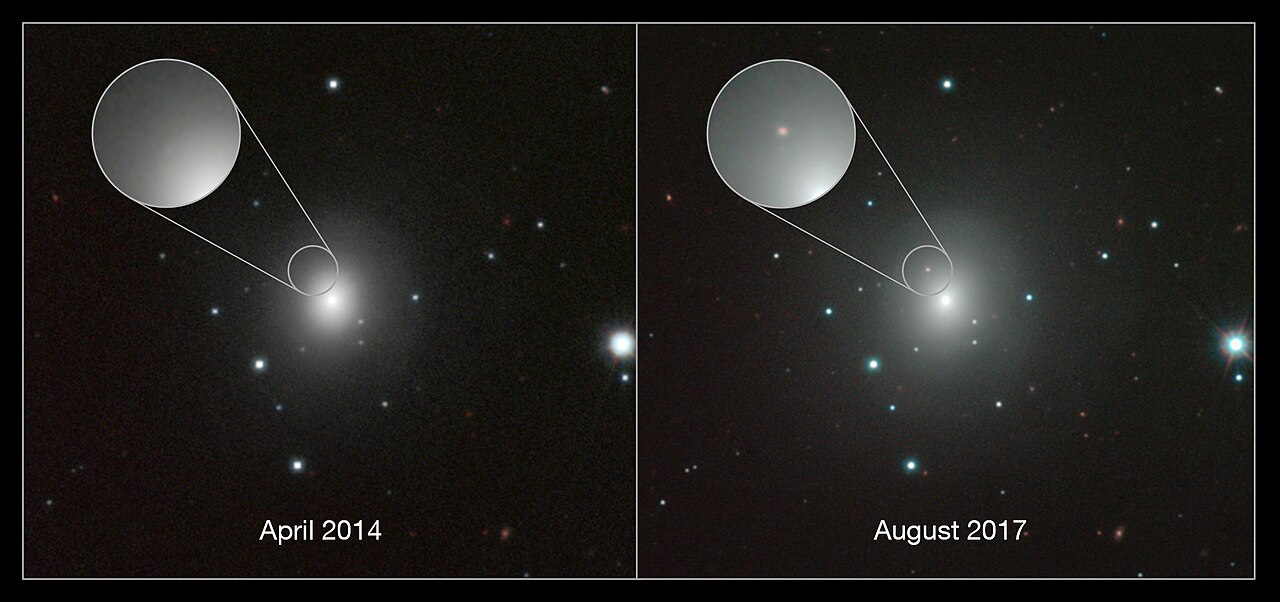
Two side-by-side telescope views of the same fuzzy, glowing galaxy among scattered stars on a black sky. In the left panel, labeled April 2014, a magnified circle near the galaxy’s bright center shows only smooth glow. In the right panel, labeled August 2017, the same magnified spot shows a small new reddish dot.
About this picture

The galaxy NGC 4993, about 130 million light-years away, before and after two neutron stars collided in it. The small red dot at right is the kilonova, the glowing debris of the collision, which carried freshly made heavy elements.

ESO/N.R. Tanvir, A.J. Levan and the VIN-ROUGE collaboration, via Wikimedia Commons · CC BY 4.0 · Image source ↗

WHERE THE EVIDENCE STANDS

How sure are we?

  • The 2017 collision of two neutron stars, GW170817, made fresh heavy elements.Seen in gravitational waves and by about 70 observatories (LIGO). ESO spectra suggested caesium and tellurium; a Caltech-led team saw neodymium’s fingerprint; NASA says astronomers think the glow comes mainly from the decay of radioactive elements formed in the debris.
  • Neutron-star collisions made most of the gold in our solar system.Johnson’s SDSS chart credits most gold to merging neutron stars, and NASA (2017) called them a possible dominant source. Siegel, Barnes and Metzger (Nature, 2019) argue collapsars may supply over 80% of r-process elements; Patel and colleagues (2025) estimate that magnetar flares add 1 to 10 percent or more.
  • Most of Earth’s gold sank into its iron core while the planet was forming.Willbold and colleagues (Nature, 2011): core formation should have removed iron-loving metals such as gold to the deep interior. University of Bristol: the vast majority went into the core. Göttingen researchers (2025): more than 99.999%.
  • The gold near Earth’s surface was delivered by a late shower of meteorites, the “late veneer.”Tungsten in 3.8-billion-year-old Isua rocks fits it (Willbold et al., 2011), and Nature’s editors called that a boost for an idea whose evidence had been indirect and much debated. Messling et al. (Nature, 2025) found signs of core material in Hawaiian lavas; the Göttingen team says core material, including gold, is leaking into the mantle, so at least some of our gold may come from the core.
  • Every atom in your body was made in an exploding star.NASA: all of the hydrogen formed in about the first five minutes after the Big Bang. Johnson’s SDSS chart shows many elements come from dying low-mass stars that do not explode.
What the labels mean

WHAT WE DON’T KNOW YET

Nobody knows yet what share of the universe’s gold comes from neutron-star collisions, and how much from rare exploding stars or magnetar flares. Scientists are also still working out exactly how the gold near Earth’s surface got there.

WHAT WOULD CHANGE THIS ANSWER

If new measurements showed that neutron-star collisions make much less gold than expected, other sources would take the lead. NASA’s COSI gamma-ray telescope, expected to launch in 2027, may measure the elements made in magnetar flares, and new studies of ancient rocks could shift the story of how gold reached the crust.

The gold in a wedding ring is older than the Earth. Its atoms were made in space, most likely when collapsed stars called neutron stars smashed together. Such crashes throw fresh gold into the gas between the stars. Our Sun and planets later formed from a cloud of gas and dust, about 4.6 billion years ago, and the gold came along.

People ask this for good reasons. A ring marks a promise, and it is natural to wonder where its metal began. Many people have also heard that “we are made of stardust” and wonder whether that is really true. And in 2017, astronomers announced that they had watched two dead stars collide. One university headline spoke of striking “cosmic gold.”

Here is the core picture. Stars make new elements by fusing light atoms together, but that works only up to iron. Most gold needs a different recipe: a place so crowded with neutrons, one of the building blocks of atoms, that atoms can swallow many of them very fast. On August 17, 2017, detectors in the United States and Italy caught ripples in space-time, called gravitational waves, from two neutron stars colliding about 130 million light-years away. About 70 observatories then studied the glowing debris, called a kilonova. It carried the signs of freshly made heavy elements.

Some parts are still open. Scientists debate how much of the universe’s gold comes from these collisions and how much from other rare blasts. On Earth, most gold sank into the planet’s iron core long ago. The gold we mine may have arrived later, with a shower of meteorites. So we label the big picture Supported, still debated: strong evidence, with details still being worked out. Either way, the metal on your finger links you to violent events in deep space, long before the Earth was born.

THE LONG ANSWER

Free long answer 2 of 3 this month.

Why can’t ordinary stars make gold?

Stars are element factories, with limits. All of the universe’s hydrogen and almost all of its helium formed in about the first five minutes after the Big Bang, NASA explains. Stars then fuse light atoms into heavier ones, but only up to iron. Beyond iron, making elements that way takes too much energy.

Heavier elements are built by adding neutrons. An atom’s element is set by its protons. When an atom captures an extra neutron, it can become unstable. Then a neutron may turn into a proton, which moves the atom up the periodic table. In the neutron-packed debris of a torn-apart neutron star, atoms can grab neutrons so fast that they grow into elements as heavy as uranium, NASA explains. This is the rapid neutron-capture process, or r-process. Most of our solar system’s gold was made this way, the astronomer Jennifer Johnson notes on the blog of the Sloan Digital Sky Survey (SDSS).

As an analogy, picture a snowball rolling through deep, fresh snow: the more snow, the faster it grows. Here the “snow” is neutrons. The analogy breaks down because a snowball stays a snowball, while an atom that swallows neutrons keeps turning into new elements as some of its neutrons become protons.

What did the 2017 collision show?

On August 17, 2017, the two LIGO detectors, in Washington state and Louisiana, picked up gravitational waves from two objects spiraling together. Their masses, about 1.1 to 1.6 times the Sun’s, fit neutron stars. About two seconds after the waves, NASA’s Fermi telescope caught a flash of gamma rays. The event was named GW170817.

Telescopes soon found a new point of light in the galaxy NGC 4993, about 130 million light-years away, and about 70 observatories studied it. LIGO reported that it was the first cosmic event seen in both gravitational waves and light. It matched a long-predicted blast called a kilonova: hot debris blown far out into space, glowing as it goes.

The debris raced outward at up to one-fifth the speed of light. Its color shifted from very blue to very red within days, the European Southern Observatory (ESO) reports. Astronomers think the glow came mostly from radioactive elements decaying in the debris. ESO’s spectra, the patterns of colors in the light, suggested caesium and tellurium. A Caltech-led team saw the fingerprint of neodymium. The LIGO team said the results revealed signatures of freshly made material, including gold and platinum. It said they solved a decades-long mystery: where about half of all elements heavier than iron are made.

What is a neutron star, and how dense can matter get?

A neutron star is the collapsed core left when a massive star explodes as a supernova. It packs more mass than the Sun into a ball about as wide as New York City’s Manhattan Island is long. A teaspoon of it would have a mass of about a billion tons, according to LIGO and NASA. NASA calls a neutron star the densest object astronomers can observe directly.

Inside, in the outer core, pressure squeezes protons and electrons into a sea of mostly neutrons. Nobody knows yet what lies at the very center: neutrons all the way down, smaller particles called quarks, or something stranger. NASA’s NICER telescope measured two neutron stars, of about 1.4 and 2.1 times the Sun’s mass, and found both about 16 miles (26 kilometers) across. So this matter resists squeezing more than some scientists predicted. Still, NASA says, the matter in their cores is on the verge of collapsing into a black hole.

What is the strongest objection?

The debate is not mainly about whether neutron-star collisions make heavy elements; even researchers who favor other sources say GW170817 supports that. It is about amounts and timing.

Timing. NASA notes that neutron-star mergers happen too late in the universe’s history to explain the earliest gold and other heavy elements.

Collapsars. In 2019, Daniel Siegel, Jennifer Barnes and Brian Metzger reported simulations in the journal Nature of collapsars: rapidly spinning massive stars whose collapse sets off a supernova. Collapsars are rarer than mergers, but each may throw out more material. The team estimated that they may supply more than 80 percent of the universe’s r-process elements. They also cited element-rich stars in a small galaxy, Reticulum II, that fit rare supernovae better than mergers.

Magnetars. In 2025, a team led by Anirudh Patel of Columbia University found signs of heavy elements being made in a giant flare seen in December 2004. It came from a magnetar, a neutron star with an extremely strong magnetic field. The authors estimate that such flares make 1 to 10 percent or more of the galaxy’s r-process elements.

The merger side has strong points too. In 2017, NASA said crashing neutron stars may be the universe’s main source of many of the heaviest elements, including gold. Johnson’s chart credits most of our gold to merging neutron stars. She called the r-process site “currently in dispute,” while noting compelling evidence for mergers. NASA’s COSI gamma-ray telescope, expected to launch in 2027, should be able to identify elements made in magnetar flares.

How did the gold get into the ground?

Our solar system formed about 4.6 billion years ago from a cloud of gas and dust, NASA says, and heavy elements from earlier stars were already in it. But as Earth formed, molten iron sank to the center to make the core, and it took the vast majority of the gold and platinum with it. The core holds enough precious metal to cover the whole Earth in a layer about four meters (13 feet) thick, the University of Bristol says. Researchers at the University of Göttingen put the core’s share of Earth’s gold and other precious metals at more than 99.999 percent.

That leaves a puzzle. Gold and similar “iron-loving” metals are tens to thousands of times more common in Earth’s rocky mantle, the layer above the core, than expected. A long-standing explanation is the late veneer: a shower of meteorites that hit Earth after the core formed, adding gold to the mantle. In 2011, Matthias Willbold and colleagues at Bristol tested it with tungsten, a rare metal that should also have sunk into the core. They studied 3.8-billion-year-old rocks from Isua, Greenland, which keep a chemical memory of the time before the shower. Their tungsten differed from that of modern rocks by a small but significant amount, in good agreement with a late veneer.

The late veneer has strong support, but the story may not be complete. Nature’s editors called the 2011 result a boost for the idea, while noting that earlier evidence had been indirect and much debated. Then, in 2025, a Göttingen team that included Willbold found traces of the metal ruthenium in Hawaiian lavas that point to core material, including gold, leaking into the mantle. Some of our gold may have come from the core, they say, though whether this happened in the distant past is still open. Either way, geological processes later gathered gold into the ore deposits mined today.

What do people often get wrong?

  • “Gold comes from ordinary supernovas.” For a long time, scientists thought only exploding massive stars made elements heavier than iron, NASA notes. Newer research points to neutron-star collisions. Rare collapsars, a kind of supernova, are still in the running.
  • “Telescopes saw gold itself.” They recorded light whose colors pointed to freshly made heavy elements such as tellurium and neodymium. In 2025, NASA put it carefully: the event could have created gold.
  • “Every atom in your body came from an exploding star.” Not quite, though much of you is stardust. Your hydrogen formed minutes after the Big Bang, and many elements came from dying low-mass stars that did not explode. But carbon, oxygen, iron and most other elements in us were made by stars, as Johnson’s chart shows.

How can you check this yourself?

  • See the new light. ESO’s press release shows NGC 4993 before and after the collision, with the kilonova as a new dot.
  • Find gold on the chart. Johnson’s periodic table of origins colors each element by where it was made. Find gold (Au, number 79), then hydrogen, carbon, oxygen and iron.
  • Check the dates. Johnson’s chart is from 2017, the collapsar study from 2019 and the magnetar study from 2025. A claim that one kind of event made all the gold goes further than the evidence.
  • Keep exploring. Read What Happened in the First Second After the Big Bang?, which covers the first atomic nuclei, and how old the universe is.

The answer stays the same after all this detail. The gold in a ring was most likely forged when neutron stars collided, before the Earth existed. How much other blasts added, and how gold reached the crust, are still being worked out. If that makes a ring feel more remarkable, see why the night sky stirs awe.

THREE THINGS TO REMEMBER

  1. Most gold is made when atoms swallow neutrons very fast, which ordinary fusion in stars cannot do.
  2. Colliding neutron stars forge heavy elements, as astronomers saw in 2017; how much gold other sources add is still debated.
  3. Most of Earth’s gold sank to the core; the gold we mine may have come later with meteorites.

See this path: Can I feel wonder without a creed?

Words worth knowing (6)
Neutron star
The collapsed core left when a massive star explodes as a supernova. It packs more mass than the Sun into a ball about as wide as Manhattan Island is long.
Kilonova
The glow of hot, radioactive debris blown out into space after two neutron stars collide. It carries freshly made heavy elements.
r-process (rapid neutron capture)
A way of building heavy elements in which atoms grab neutrons so fast that they grow into elements such as gold and uranium.
Gravitational waves
Ripples in space-time given off by massive objects in motion, such as two neutron stars spiraling together.
Late veneer
The idea that a shower of meteorites added gold and other “iron-loving” metals to Earth’s mantle after the core had formed.
Collapsar
A rapidly spinning massive star whose collapse sets off a supernova. Some researchers think collapsars make much of the universe’s gold.

Sources & further reading

(10) · Checked Sep 29, 2026
  1. ESO Telescopes Observe First Light from Gravitational Wave Source (eso1733) ↗European Southern Observatory (ESO), 16 October 2017Kilonovae disperse heavy elements such as gold and platinum; GW170817 detected 17 August 2017 by LIGO with Virgo; short gamma-ray burst about two seconds later (Fermi, INTEGRAL); NGC 4993, a lenticular galaxy in Hydra, about 130 million light-years away; neutron stars are the extremely dense, collapsed cores of high-mass stars left after supernovae; about 70 observatories; debris moving as fast as one-fifth of the speed of light; colour shifted from very blue to very red over the next few days; spectra suggest caesium and tellurium; the observations pin down r-process formation of elements heavier than iron. Before-and-after image page: https://www.eso.org/public/images/eso1733r/
  2. GW170817 Press Release: LIGO and Virgo make first detection of gravitational waves produced by colliding neutron stars ↗LIGO Laboratory, CaltechFirst cosmic event viewed in both gravitational waves and light; about 70 observatories; neutron stars are the smallest, densest stars known, formed when massive stars explode; signal about 100 seconds; gamma rays about two seconds after the waves; detected Aug. 17 by the LIGO detectors in Hanford and Livingston, with Virgo near Pisa; about 130 million light-years; masses about 1.1 to 1.6 times the Sun’s; a teaspoon of neutron-star material has a mass of about a billion tons; signatures of recently synthesized material, including gold and platinum, solving a decades-long mystery of where about half of all elements heavier than iron are produced; kilonova material blown far out into space. Companion Caltech release “Caltech-Led Teams Strike Cosmic Gold” (Oct. 16, 2017; https://www.caltech.edu/about/news/caltech-led-teams-strike-cosmic-gold-80074): the teaspoon figure; elements up to iron fused in stars; spectral bumps indicating neodymium; Kasliwal (Caltech assistant professor of astronomy): a cosmic mine forging more than 10,000 Earth-masses of heavy elements.
  3. NASA Missions Catch First Light from a Gravitational-Wave Event ↗NASA, October 16, 2017NGC 4993, about 130 million light-years away in Hydra; neutron stars are the crushed, leftover cores of massive stars that exploded as supernovas; astronomers think a kilonova’s visible and infrared light arises mainly from heating by the decay of radioactive elements formed in the neutron-rich debris; crashing neutron stars “may be the universe’s dominant source for many of the heaviest elements, including platinum and gold.”
  4. Where Does Gold Come From? NASA Data Has Clues ↗NASA Science, April 29, 2025Protons set an element’s identity; neutron capture followed by decay moves an atom up the periodic table; in a disrupted neutron star atoms rapidly capture many neutrons, making elements as heavy as uranium; neutron stars are so dense that a teaspoon would weigh as much as a billion tons; the 2017 collision confirmed the event could have created gold, platinum and other heavy elements; mergers happen too late to explain the earliest gold; Anirudh Patel (Columbia University) led a study of 20-year-old data from the December 2004 magnetar giant flare; flares could contribute up to 10% of the galaxy’s elements heavier than iron; COSI expected to launch in 2027. Study: Patel et al., “Direct Evidence for r-process Nucleosynthesis in Delayed MeV Emission from the SGR 1806–20 Magnetar Giant Flare,” Astrophysical Journal Letters 984, L29 (2025), doi:10.3847/2041-8213/adc9b0 (arXiv:2501.09181); its abstract (Crossref and arXiv) says giant flares contribute “at least ∼1%–10%” of total Galactic r-process abundances, so the page gives the paper’s range rather than NASA’s “up to 10%.”
  5. Collapsars as a major source of r-process elements (Siegel, Barnes and Metzger) ↗Nature 569, 241–244 (2019)Abstract (arXiv:1810.00098 and Crossref): r-process production in neutron-star mergers is expected theoretically and supported by GW170817; collapsars are the supernova-triggering collapse of rapidly rotating massive stars; stars rich in r-process elements in the dwarf galaxy Reticulum II fit rare supernovae better than mergers; collapsars are rarer but eject more per event; they may supply more than 80 per cent of the r-process content of the Universe.
  6. Origin of the Elements in the Solar System (Jennifer Johnson) ↗Science Blog from the SDSS (Sloan Digital Sky Survey), January 9, 2017, updated June 28, 2017Opens with Carl Sagan’s “We are made of starstuff”; periodic table color-coded by origin (big bang fusion, merging neutron stars, dying low-mass stars, exploding massive stars, exploding white dwarfs, cosmic ray fission); gold (Au, 79) shown mostly as merging neutron stars with a small share from dying low-mass stars; hydrogen from the big bang; dying low-mass stars make substantial heavy elements, including most of the lead; most gold forms in the rapid neutron-capture process, whose site “is currently in dispute,” with compelling evidence for merging neutron stars.
  7. Are we really made of star stuff? ↗NASA Science (Astrobiology learning resources)All of the hydrogen and almost all of the helium formed within about the first five minutes after the Big Bang; fusion in stars makes elements up to iron, and making heavier ones inside stars takes too much energy; for a long time it was thought only supernovae made elements heavier than iron, but neutron-star mergers can form many heavy elements; matter made in stars is older than the Sun. Also NASA Solar System Facts (https://science.nasa.gov/solar-system/solar-system-facts/): the solar system formed about 4.6 billion years ago from a dense cloud of interstellar gas and dust.
  8. What’s Inside a ‘Dead’ Star? ↗NASA Science (2021, updated 2026)Stars about 8 to 25 times the Sun’s mass leave neutron stars, heavier ones black holes; more mass than the Sun in a sphere about as wide as Manhattan Island is long; “the densest object astronomers can observe directly”; matter in their cores is on the verge of collapsing into a black hole; outer core a sea of mostly neutrons; the inner core is unknown (neutrons, quarks or other particles); NICER measured the sizes of two neutron stars: J0030 about 1.4 solar masses and 16 miles across, J0740 about 2.1 solar masses and also about 16 miles across, so the matter is less squeezable than some predicted. (This page also compares a teaspoon to the mass of Mount Everest; this answer uses the billion-ton figure given by LIGO, Caltech and NASA’s 2025 article.)
  9. The tungsten isotopic composition of the Earth’s mantle before the terminal bombardment (Willbold, Elliott and Moorbath) ↗Nature 477, 195–198 (2011)Abstract: iron-loving metals such as gold are surprisingly abundant in the accessible Earth given core formation; one explanation is a “late veneer” of meteorites after core formation; 3.8-billion-year-old Isua, Greenland, rocks show a tungsten isotope difference in good agreement with a late veneer. Editorial summary: evidence for the late veneer “remains indirect, and its influence has been much debated.” University of Bristol release, 7 September 2011 (https://www.bristol.ac.uk/news/2011/7885.html): molten iron took the vast majority of precious metals into the core, enough to cover the Earth in a four-metre layer; precious metals tens to thousands of times more abundant in the mantle than anticipated; tungsten, “a very rare element,” shows a 15 ppm change, “small but significant” (Nature abstract: about 13 ppm, “significantly higher”); bombardment more than 200 million years after Earth formed; about 20 billion billion tonnes of asteroidal material (Willbold); geological processes concentrated precious metals in ore deposits mined today.
  10. Tapping into the World’s largest gold reserves (University of Göttingen release) ↗EurekAlert! (AAAS), news release 22 May 2025More than 99.999% of Earth’s gold and other precious metals lie in the metallic core, under about 3,000 km of rock; ruthenium isotope traces in Hawaiian lavas show core material, including gold, leaking into the mantle; at least some of our gold may have come from the core; whether this operated in the past is not yet shown. Paper: Messling et al., “Ru and W isotope systematics in ocean island basalts reveals core leakage,” Nature 642, 376–380 (2025), doi:10.1038/s41586-025-09003-0.

See a mistake? Report a problem. Corrections are made openly.

The Architect AI companion · All Access

Your next question can go further.

Included with All Access →Up to 5 questions a day while available.

Put God Plays Dice on your Home Screen

On iPhone: tap Share (on iOS 26, tap ••• first), then Add to Home Screen, then Add.

On Android: In Chrome, you can also open the ⋮ menu and choose Add to Home screen or Install.

The Home Screen version keeps its own memory on iPhone, so your nights and saved answers start fresh there.

Search the Question Library

149 answers to read · 0 questions awaiting answers Your search runs on your device.

Answers about death, grief and crisis are always free, in full. If a question is personal right now →