Einstein CentennialExplainer
What Is Quantum Entanglement, and Why Did Einstein Call It Spooky?
Two particles can share one quantum state, even far apart. Here is what that means, why Einstein distrusted it, and why it still cannot carry a message.
THE QUESTION LIBRARY EXTRAORDINARY CLAIMS
The wonder is earned and the physics really is strange, so here is what experiments show, what they do not, and where the open questions about the mind actually are.
Standard quantum physics does not say that your mind creates reality, and it does not show that “quantum” products heal. The physics is real and strange: tiny particles can be in blends of states and can be entangled. But the “observer” in quantum physics means a measuring interaction, not a human mind, and entanglement cannot send messages faster than light. Whether quantum effects help produce consciousness is an open question, and a much-debated proposal, Orch OR, is unconfirmed.
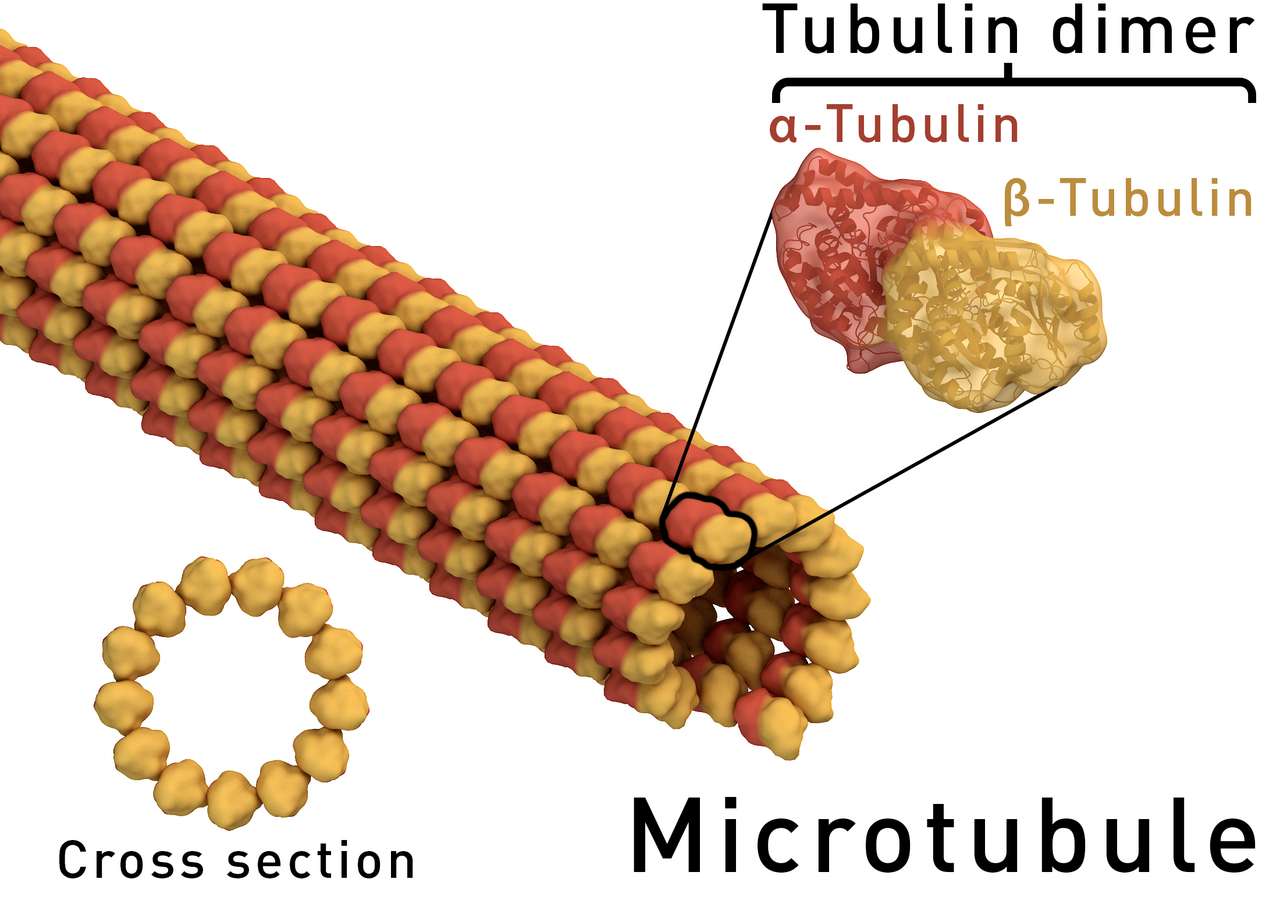
A microtubule, one of the tiny protein tubes inside cells, built from pairs of alpha- and beta-tubulin. The Orch OR proposal places quantum events in the microtubules of brain cells; that idea is still unconfirmed.
WHERE THE EVIDENCE STANDS
WHAT WE DON’T KNOW YET
Physicists still debate what measurement really is, and nobody knows yet how the brain produces conscious experience. Whether quantum effects play any special role in the brain is still being tested.
WHAT WOULD CHANGE THIS ANSWER
A repeatable, well-controlled experiment in which a person’s intention alone changed quantum measurement results would change this answer. So would fair trials showing healing that only quantum physics can explain. Clear evidence of long-lived quantum states tied to awareness in the brain would strengthen the case for Orch OR.
Standard quantum physics does not say that your mind creates reality, and it does not show that “quantum” products heal. But the wonder people feel about quantum physics is earned. The physics really is strange, and experts still debate parts of what it means.
Quantum physics is the study of matter and energy at the most basic level. The word quantum comes from Latin and means “how much.” Its discoveries gave us lasers and transistors. Three of its ideas matter most for this question. Superposition means a tiny object, such as an electron, is described as a blend of several possible states at once. Entanglement means two particles can be linked, so that measuring one tells you something about the other, even far away. Measurement is when a blend gives way to one definite result.
Here is where the story often goes wrong. Early physicists were puzzled that simply observing an experiment influenced the outcome. The word “observing” made it sound as if a watching mind changed reality. Caltech’s science explainer says the word is misleading. “Measurement” describes it better: a change in outcome can come from the interaction between the particle and its surroundings, including the measuring device. And entanglement cannot be used to send messages faster than light.
Could quantum effects still help explain consciousness? Some scientists have proposed that they could. One much-debated proposal, called Orch OR, comes from Roger Penrose and Stuart Hameroff. It says moments of awareness arise from quantum events inside microtubules, tiny protein tubes in brain cells. A critic calculated that the warm, wet brain would erase such quantum states in less than a trillionth of a second. Supporters dispute that math. So Orch OR is a real scientific hypothesis, but it is unconfirmed.
As for healing, some products sold with “quantum energy” claims turned out to contain radioactive material. A U.S. regulator says it cannot say whether they work as advertised. People who buy them are looking for health, and they deserve better information.
Free long answer 1 of 3 this month.
Take this step by step: what was observed, what people inferred, whether the evidence supports it, and what is unresolved.
Quantum physics grew out of experiments on atoms in the late 1800s and early 1900s that did not make sense in the older physics, as Caltech’s explainer recounts. Scientists found that matter and energy come in small packets, or quanta. Light of one frequency, for example, arrives in packets called photons.
Superposition. Caltech offers an analogy: two sets of ripples on a pond can overlap and combine. Likewise, an electron’s possible states can combine, so it can be described as being in more than one place at once. The analogy breaks down in one important way. Pond waves are made of water. Quantum waves are mathematical. They give the chances of finding the particle in each place or state.
Measurement and decoherence. When a particle in a blend is measured, one definite result appears. Caltech notes that what is often called “collapse” is more accurately called decoherence. The Stanford Encyclopedia of Philosophy describes decoherence as interactions between a system and its environment that suppress quantum interference.
Entanglement. Two particles can be linked so that measuring one tells you about the other, even far apart. In the 1930s, Einstein and others suggested the answers might be set in advance and simply hidden. Theoretical work by John Stewart Bell in the 1960s, and experiments by John Clauser and others starting in the 1970s, ruled out that kind of “local hidden variable” explanation. For the full story, see What Is Quantum Entanglement, and Why Did Einstein Call It Spooky? and Did Einstein lose his argument that God does not play dice?
Caltech says many quantum ideas are “difficult if not impossible” to picture, so the field depends on mathematics.
Three popular leaps each start from something true.
“The observer is the mind.” An old, unorthodox view traces back to von Neumann in the 1930s. Wigner pushed it further in the 1960s, and Henry Stapp later defended it. It links conscious acts to the collapse of quantum states. The Stanford Encyclopedia says adding the observer’s mind to standard quantum physics is unorthodox and “highly speculative from a contemporary perspective.” Caltech is blunter. The word “observation” is misleading, it says, because it suggests consciousness is involved. “Measurement” describes it better: a change in outcome may come from an interaction with the environment, including the measuring device. So the claim that a watching mind creates reality is Not supported.
“Entanglement connects everything, so thoughts or healing can travel.” Entanglement is real and passes test after test. But Caltech notes that experiments show entangled particles are not signaling each other faster than light, and that quantum physics cannot be used to send faster-than-light messages. As Thomas Vidick puts it on Caltech’s page, “There can be correlation without communication.” See Can quantum entanglement send messages faster than light?
“Quantum products can heal.” The U.S. Nuclear Regulatory Commission (NRC) says products advertised as giving off negative ions, “scalar energy,” “quantum energy” or “quantum science” have been sold online for well over a decade, from pendants to pillows. Their ads promise things like better blood flow, protection of DNA and a stronger “biofield.” When government agencies and universities tested several of them, they found measurable amounts of uranium, thorium or radium. The whole-body dose is likely low, but wearing a pendant all the time can raise the dose to the skin. The NRC says it “cannot say whether these products work as advertised.” In December 2021, the Dutch radiation authority said ten products, including one sold as a “Quantum Pendant,” gave off low levels of ionizing radiation. It told owners to stop wearing them and told sellers that their sale was prohibited. The claim that such products heal through quantum physics is Not supported.
If the link between mind and body is what draws you, see Can meditation change the brain?
In the mid-1990s, Roger Penrose and Stuart Hameroff proposed Orch OR, short for “orchestrated objective reduction.” As their 2014 review explains, it says consciousness depends on coordinated quantum processes in microtubules inside brain cells. Each process ends in a physical collapse of the quantum state, following a rule proposed by Lajos Diósi and Penrose, and that collapse is taken to produce a moment of conscious awareness. Penrose argues that such a collapse needs new physics that joins quantum theory and gravity. Hameroff, whose background is in anesthesiology, suggested microtubules as a place where it could happen.
An influential objection came in 2000 from Max Tegmark. He calculated that quantum states in the brain would decohere in about 10⁻¹³ to 10⁻²⁰ seconds, while brain processes take about a thousandth to a tenth of a second. That is far too fast to matter, he argued, so the brain activity tied to thinking should be treated as an ordinary, non-quantum system. In 2002, Hameroff and two colleagues replied that Tegmark had modeled a different setup from theirs. Their corrected estimate was 10⁻⁵ to 10⁻⁴ seconds, and they argued that other effects could stretch it to a hundredth or a tenth of a second. The argument is not settled.
Experiments have started to test parts of the idea. In a test reported in 2020, a team that included Diósi himself used the Gran Sasso underground laboratory to measure the faint radiation that Penrose-style collapse should produce. Their result ruled out the natural, “parameter-free” version of the Diósi–Penrose model. This test did not rule out versions with a larger “size” setting. Another result is friendlier to the idea. In 2024, researchers at Wellesley College gave rats a drug that stabilizes microtubules. Under the anesthetic gas isoflurane, those rats took an average of 69 seconds longer to lose consciousness. The authors say this is what models of consciousness as a quantum state of microtubules predict. The experiment did not measure a quantum state, and the authors note that the result may also fit ordinary, non-quantum models of consciousness.
The Stanford Encyclopedia calls Orch OR the most speculative of the quantum-brain proposals it reviews. It also says the idea has inspired real experiments on anesthetics and microtubules, and that it “should neither be too quickly celebrated nor offhandedly dismissed.” We label Orch OR an Open question.
A thoughtful reader might ask: if physicists do not fully understand measurement, and nobody understands consciousness, how can anyone rule anything out? Parts of that are right. Caltech says a full understanding of how measurement relates to outcomes is still needed. The Stanford Encyclopedia’s entry on decoherence notes that decoherence alone does not solve the “measurement problem.” Its entry on quantum approaches to consciousness reports theoretical studies in which entanglement can last in hot, noisy systems under particular conditions.
But an open question is not evidence for a particular answer. Not knowing exactly how measurement works does not show that minds control it. Not knowing how the brain makes experience does not show that pendants heal. That is why the claims on this page get different labels. For the wider puzzle, see Is the mind just the brain? and our story What Is Consciousness?
The answer stays the same after all this detail. Quantum physics does not say that your mind creates reality or that quantum products heal. Whether quantum effects help make consciousness is still an open question.
THREE THINGS TO REMEMBER
Nobody knows yet.
God Plays Dice answers big questions in plain words, with sources and one of six honest labels.
See a mistake? Report a problem. Corrections are made openly.
CONTINUE THE THREAD
Einstein CentennialExplainer
Two particles can share one quantum state, even far apart. Here is what that means, why Einstein distrusted it, and why it still cannot carry a message.
Mind & MortalityExplainer
Science can map which brain activity goes with experience. Why any of it feels like something from the inside remains one of the great open questions.
Extraordinary ClaimsAnswer
What past-life memory research investigates, what reported matches can show, and why case studies do not by themselves establish reincarnation.
The Architect AI companion · All Access
Labels describe the evidence for a claim, not the people who hold it.
Match my phone uses your device’s light or dark setting.