Einstein CentennialExplainer
What Is Quantum Entanglement, and Why Did Einstein Call It Spooky?
Two particles can share one quantum state, even far apart. Here is what that means, why Einstein distrusted it, and why it still cannot carry a message.
THE QUESTION LIBRARY EINSTEIN CENTENNIAL
Einstein called it “spooky action at a distance,” and the matching is real, but here is why nobody can use it to send a message faster than light.
No. Entanglement makes the results of measurements on two particles match more closely than any built-in instructions could explain, even far apart. But each person sees only random results. The match shows up only when the two lists are compared, and comparing them needs an ordinary signal, like a phone call, that is no faster than light. Physicists have shown that standard quantum theory rules out using entanglement to send faster-than-light messages, and experiments agree.
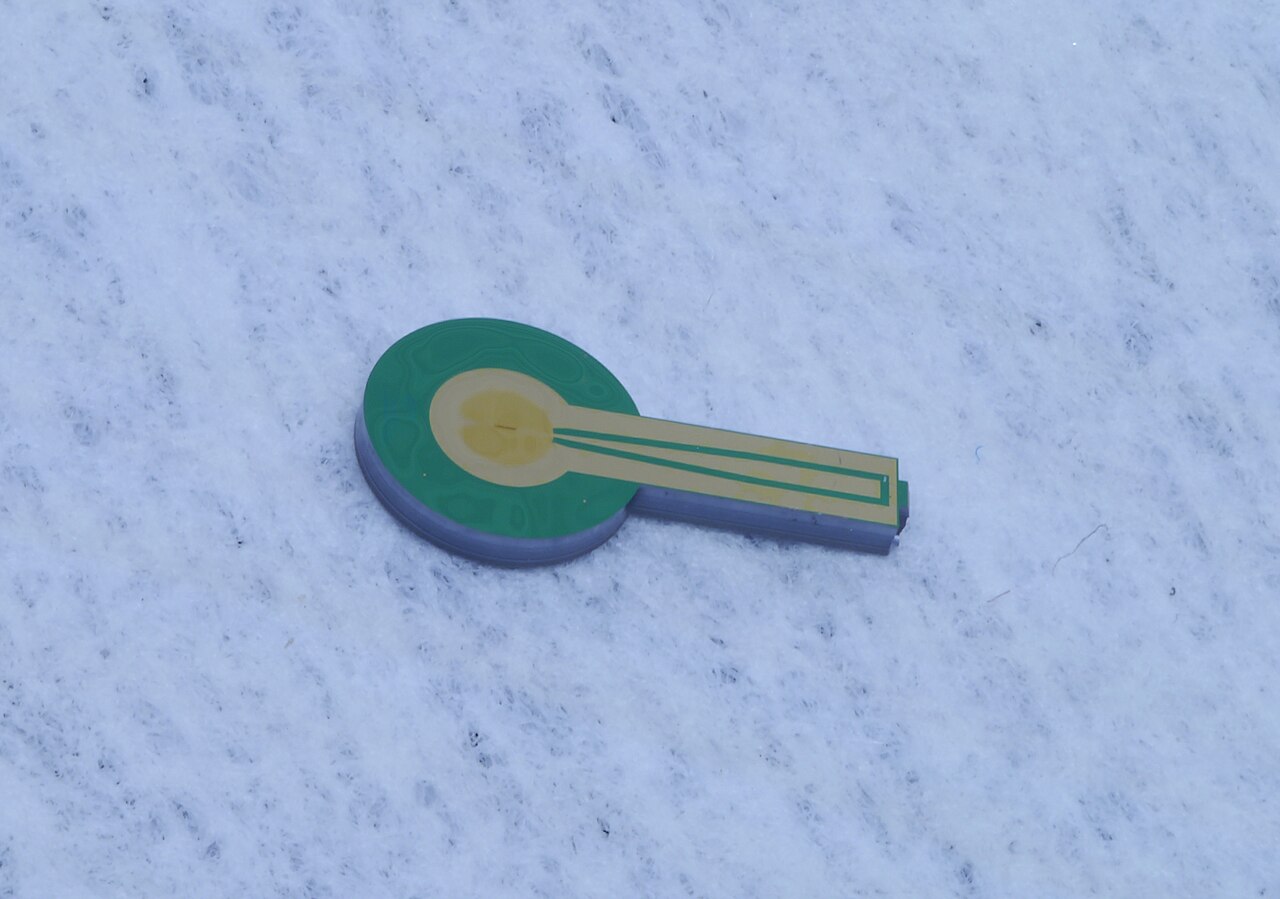
A NIST chip holding a single-photon detector made of superconducting nanowires. Detectors like this can register single particles of light, and NIST used superconducting nanowire detectors in its 2015 test of entanglement.
WHERE THE EVIDENCE STANDS
WHAT WE DON’T KNOW YET
Physicists still disagree about what entanglement really is. Some think something truly nonlocal happens between the particles, and others read the theory differently. Nobody knows yet how quantum theory and relativity fit together at the deepest level.
WHAT WOULD CHANGE THIS ANSWER
A repeatable experiment in which one person’s choice of measurement changed what a far-away partner sees, before any ordinary signal could arrive, would change this answer. Standard quantum theory forbids that, so the theory itself would need to change.
No. Entanglement cannot send a message faster than light. The link between entangled particles is real, and it is one of the strangest things in physics. But it cannot carry news.
Here is why people ask. Entanglement is a link between particles that have interacted in a special way. Measure one particle, and you instantly know something about the result for its partner, even if the partner is far away. Albert Einstein called this “spooky action at a distance.” If something happens instantly across any distance, it seems as if we should be able to use it to talk to Mars with no delay.
The catch is in what each person actually sees. Picture two scientists, Alice and Bob, far apart, each with one particle from many entangled pairs. Alice measures her particles and writes down her results. They look like coin flips: random. Bob does the same, and his results look random too. Nothing Alice does can change the odds of what Bob sees. The amazing pattern shows up only later, when they put their two lists side by side. To do that, one of them has to send the list by phone, email or radio. Those signals travel no faster than light.
So the matching is instant, but the knowledge is not. Physicists proved this about standard quantum theory in several papers from 1978 to 1982. Experiments have tested entanglement across a lab building, between two villages 18 kilometers apart, and between ground stations more than 1,200 kilometers apart. The matching was always there. A faster-than-light message never was.
That is why we label the idea of entanglement messages Not supported. What entanglement really is, deep down, is still debated. But on the practical question, the answer is clear. You can’t use it to beat light.
Free long answer 1 of 3 this month.
In 1935, Einstein and two colleagues, Boris Podolsky and Nathan Rosen, argued that quantum theory must be leaving something out. The problem was entanglement. Two particles that have interacted can share one quantum state, the math physicists use to predict results. Measure one, and you learn at once about the other. The Royal Swedish Academy of Sciences’ popular science background on the 2022 Nobel Prize notes that Einstein talked about “spooky action at a distance.”
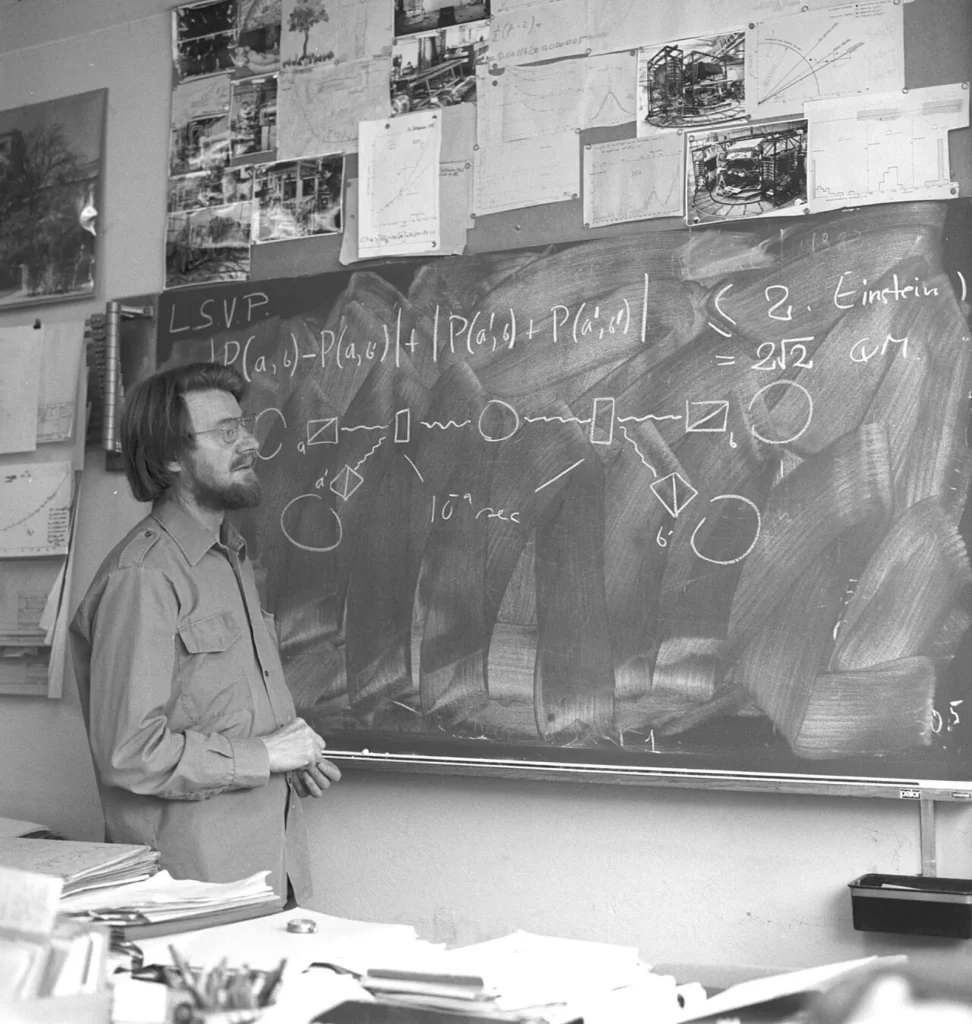
Einstein and his colleagues argued that a more complete description must exist. One way that could work is if the particles carried hidden instructions from the start, which physicists call hidden variables. Then nothing spooky would be needed. In 1964, John Bell showed how that idea could be tested. If particles carry built-in instructions, the matching between results can never go above a fixed limit, now called a Bell inequality. Quantum theory predicts more matching than that. Starting with a 1972 experiment by John Clauser and Stuart Freedman, tests kept siding with quantum theory. In 2022, Alain Aspect, John Clauser and Anton Zeilinger won the Nobel Prize in Physics “for experiments with entangled photons, establishing the violation of Bell inequalities and pioneering quantum information science.” Our story How Scientists Tested Einstein’s Hunch tells that history, and Did Einstein lose the dice argument? looks at what it means for his larger hope.
Go back to Alice and Bob. To send a message, Alice would need to change something Bob can see on his own, like making his particle give “up” more often. She can’t. The physicist Asher Peres summed up what quantum theory says: two people sharing an entangled system cannot send any information at all using only their own local measurements, without sending real objects between them. Bob’s odds come out the same whatever Alice chooses to measure.
Here is an analogy, and it has limits. Imagine two sealed decks of cards that were shuffled together in a special way. Each of you draws cards and gets what looks like a random run. Only when you compare the runs do you see they match in a surprising pattern. You can’t pick which card you draw, so you can’t spell out a word. The analogy breaks down in one big way. Real cards carry their faces from the start, and Bell tests show entangled particles do not behave like that. What carries over is the key point: neither side controls its own results.
The Stanford Encyclopedia of Philosophy lists proofs of this by Eberhard (1978), by Ghirardi, Rimini and Weber (1980), and by Page (1982). In standard quantum theory, quantum correlations cannot be used to send signals faster than light. Caltech’s Science Exchange puts it simply: it is a common misconception that the particles talk to each other faster than light, and quantum physics cannot be used to send faster-than-light communications. Thomas Vidick, a professor of computing and mathematical sciences at Caltech, puts the idea in five words: “There can be correlation without communication.”
In all of these, the matching was there. These were tests of the matching, not attempts to send messages, and the proofs above say no message could ride on it.
The best objection goes like this. If Bell tests rule out built-in instructions, then surely something passes between the particles instantly. And if something passes instantly, why can’t we ride it?
Bell himself took the first half seriously. In 1964 he wrote that if extra hidden details were added to quantum theory to decide each result, without changing its predictions, the setting of one measuring device would have to influence the reading of another, however far away, and the influence would have to act instantly. Some versions of quantum theory do include something like that. The Stanford Encyclopedia points to the de Broglie-Bohm theory, in which the setting on one side can affect the result on the other, yet which still does not allow signaling. Whether Bell’s theorem shows a real clash between quantum theory and relativity depends, the Stanford Encyclopedia says, on what one takes relativity to require, and Bell’s own view changed over time.
So the deep question, what entanglement is, stays open. The practical question does not. Whatever links the particles, nobody can steer it to carry a chosen message. Peres added one more point. He showed that a particular kind of change to quantum theory, a “nonlinear” one, would let a message through. As the theory stands, it cannot.
“It’s like a pair of gloves.” Mail one glove of a pair to a friend and keep the other. Open your box, see a left glove, and you know your friend has the right one. The entanglement story explains why this picture falls short: gloves carry their answers from the start, and Bell tests show entangled particles show more matching than that allows. The gloves do get one thing right. Opening your box sends nothing to your friend.
“Quantum teleportation is faster-than-light travel.” It is not. In the 1993 proposal by Charles Bennett and colleagues, the sender makes a measurement and then must send the result to the receiver as ordinary information. Only then can the receiver rebuild the state. Zeilinger and his colleagues first did this in 1997, the Royal Swedish Academy of Sciences’ popular science background notes. Nothing arrives before the ordinary message does.
“Someone already built a quantum phone.” In 1981, the journal Foundations of Physics sent Asher Peres a paper by Nick Herbert called “FLASH,” which proposed a faster-than-light communicator. Peres wrote later that he knew it was wrong, but he recommended publishing it because he expected that finding the error would lead to real progress. Another referee, GianCarlo Ghirardi, recommended rejecting it. Herbert’s scheme leaned on copying the state of a single photon. In 1982, Wootters and Zurek showed in Nature that the rules of quantum theory forbid such copying. Peres writes that John Wheeler contributed their title, “A single quantum cannot be cloned.” In Peres’s telling, the failed phone helped lead to a real result, the no-cloning theorem.
“If it can’t carry messages, it’s useless.” Not so. Entangled particles can give two people matching random numbers to use as a key for coded messages. In Artur Ekert’s method, described in the Stanford Encyclopedia, the two people still compare notes over an ordinary public channel. The entanglement adds security, not speed.
The answer stays the same after all this detail. Entanglement is real, tested and strange. It cannot send a message faster than light.
THREE THINGS TO REMEMBER
Did Einstein lose his argument that God does not play dice?
Mostly, but not completely.
God Plays Dice answers big questions in plain words, with sources and one of six honest labels.
See a mistake? Report a problem. Corrections are made openly.
CONTINUE THE THREAD
Einstein CentennialExplainer
Two particles can share one quantum state, even far apart. Here is what that means, why Einstein distrusted it, and why it still cannot carry a message.
Einstein CentennialExplainer
Einstein suspected quantum physics was hiding something. John Bell found a way to check, and decades of experiments gave a clear answer, with limits.
Einstein CentennialAnswer
What happened to OPERA's 2011 faster-than-light claim, how relativity is tested, and why successful measurements do not prove every possible prediction.
The Architect AI companion · All Access
Labels describe the evidence for a claim, not the people who hold it.
Match my phone uses your device’s light or dark setting.