OriginsExplainer
How Big Is the Universe, and Does It Have an Edge?
The part we can see is about 93 billion light-years wide, but whether the whole universe ends, loops back or goes on forever is still unknown.
THE QUESTION LIBRARY ORIGINS
Cosmic expansion means distances between faraway galaxies grow; it does not require a wall, an edge, or a room beyond space.
It need not be expanding into anything. In the standard cosmological picture, the distance between faraway galaxies grows because space itself changes with time. That does not require an outer wall or a pre-existing room. We do not know whether all of space is infinite or finite, and this answer does not settle whether any larger reality exists outside the part our physics describes.
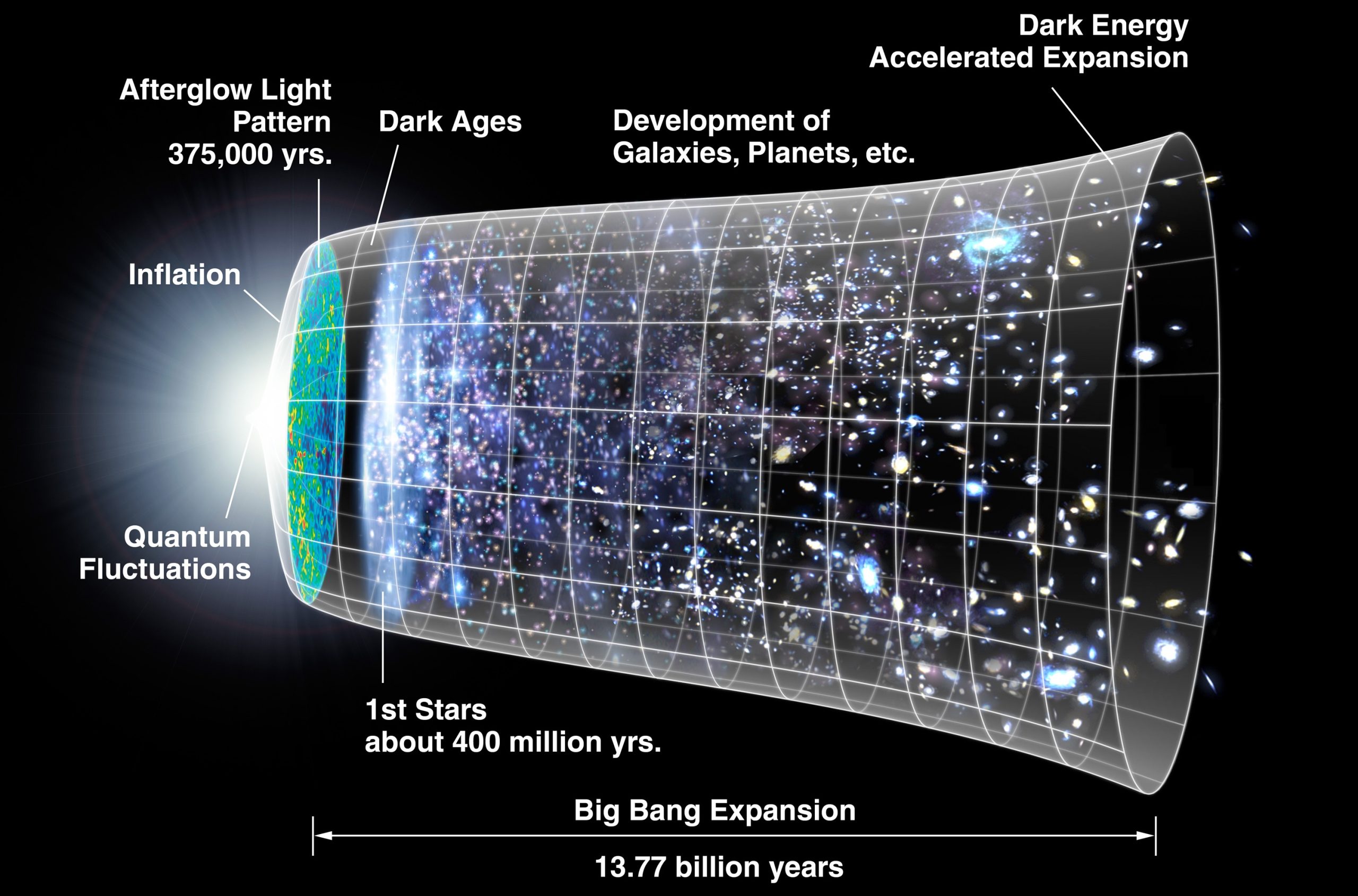
A timeline of cosmic history. The widening shape shows distances growing over time; it is not a picture of an edge or of anything outside the universe.
WHERE THE EVIDENCE STANDS
WHAT WE DON’T KNOW YET
We do not know the full size or global shape of space. We also do not know whether a wider physical setting exists beyond the universe described by current cosmology.
WHAT WOULD CHANGE THIS ANSWER
A repeatable observation that specifically reveals an edge, a center, or an external dimension would change this picture. A claim about a larger setting needs a test that distinguishes it from ordinary expansion.
Picture dots on a stretchy sheet. As the sheet stretches, the dots move farther apart without crawling across it. That is a useful analogy for distant galaxies: the distances between them can grow because the space between them changes. The analogy has a limit. The sheet sits in a room, but the cosmic model does not require a room outside the universe.
How do we know anything is expanding? Light from distant galaxies is stretched toward longer, redder wavelengths. Galaxies farther away generally show more of this redshift. Together with measured distances, that pattern reveals a universe whose large-scale distances change with time. It is a result we can test, even though we cannot watch a cosmic edge move outward.
The name “Big Bang” can mislead us. An ordinary explosion begins somewhere, sends debris into surrounding space, and has a center you can point to. The hot early universe was not that kind of event. Every region we see was once much denser and hotter. John Mather, a Nobel laureate and the Webb telescope’s senior project scientist, says the Big Bang “happened everywhere at once,” not at one special address. If observers lived in another distant galaxy, they would also see the broad pattern of faraway galaxies receding.
“No outside needed” is a statement about the model, not a declaration that every philosophical question is solved. We can see only a finite part of the universe, because light has had a finite time to reach us. Whether space as a whole continues forever, loops around, or has some larger context remains unsettled. The honest answer is that expansion tells us how distances within space change. It does not show us a container around everything.
THE LONG ANSWER · ABOUT 5 MINUTES
The short answer, how sure we are, what we don’t know, what would change our mind and every source stay free on every page, for everyone.
All Access members read the long answer: the evidence piece by piece, the strongest objections, and how to check it yourself.
Join All Access · $1 a week Or $6 a month
Billed $52 once a year. Cancel anytime in your account.
Until December 4, 11:59 pm Pacific: the Founding rate is $39 a year, and it stays $39 while you stay a member.
Create a free account: 6 long answers a month, email only.
Paying never buys a different answer. Our Paywall Promise
Next on the path “Where did everything come from?” · step 4 of 7
Is gravity a force, or a bend in space and time?
Both: gravity acts as a force in Newton’s model and as curved space and time in Einstein’s.
See this path: Where did everything come from?
God Plays Dice answers big questions in plain words, with sources and one of six honest labels.
See a mistake? Report a problem. Corrections are made openly.
CONTINUE THE THREAD
OriginsExplainer
The part we can see is about 93 billion light-years wide, but whether the whole universe ends, loops back or goes on forever is still unknown.
OriginsExplainer
From the first atomic nuclei back to a possible burst of inflation, here is what scientists have tested about the first second, and where knowledge runs out.
OriginsAnswer
An earlier history needs a calculable path to a measurement that separates it from competing explanations.
The Architect AI companion · All Access
Labels describe the evidence for a claim, not the people who hold it.
Match my phone uses your device’s light or dark setting.