
Extraordinary ClaimsAnswer
What does research say about people who report memories of past lives?
What past-life memory research investigates, what reported matches can show, and why case studies do not by themselves establish reincarnation.
THE QUESTION LIBRARY EXTRAORDINARY CLAIMS
Scientists have tested telepathy, seeing the future and mind over matter for more than a century; here is what they found, what parapsychologists claim, and what their critics reply.
Not so far, by the standard of independent labs repeating a result. Parapsychology meta-analyses of ganzfeld telepathy tests report hit rates a few percentage points above the 25% expected by chance. Critics say flaws in how targets were picked and unpublished failures could explain that. When a large, closely watched project repeated a famous “feeling the future” study with 2,115 people, guesses came out right 49.89% of the time, where chance gives 50%. Mind-over-matter tests show at most a tiny effect that unpublished studies could explain.
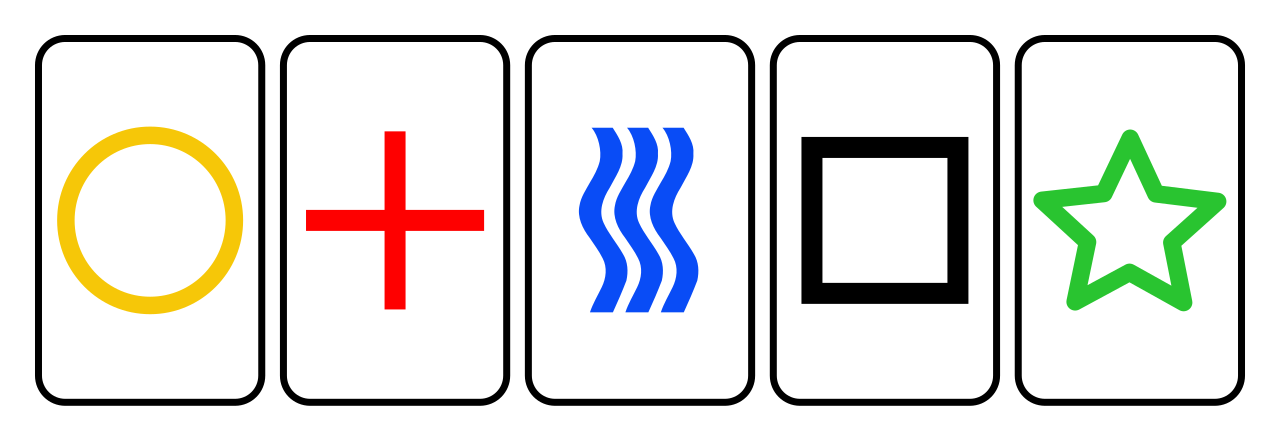
The five symbols of Zener cards, also called ESP cards, designed at Duke University for card-guessing tests. Guessing at random gets about one card in five right.
WHERE THE EVIDENCE STANDS
WHAT WE DON’T KNOW YET
Nobody knows yet why pooled ganzfeld studies keep showing a small edge over chance. It could be an effect no theory explains, or flaws and missing studies that are hard to see. Both sides have begun to use studies whose plans are fixed in advance, such as the Transparent Psi Project, which supporters and critics designed together.
WHAT WOULD CHANGE THIS ANSWER
Large preregistered studies, run by teams that include skeptics, that beat chance again and again in different labs would change this answer. So would a clear way to tell a real psychic hit from a lucky guess before the answer is known.
Maybe the phone rang and you knew who it was before you looked. Maybe you dreamed about something, and days later it happened. Maybe you felt a sudden worry about someone you love, and later learned they had been in trouble. Moments like these are common. They can feel like proof that the mind reaches beyond the body. So it is fair to ask: do psychic abilities hold up when they are tested?
Many people believe they do. In a 2005 Gallup poll of 1,002 U.S. adults, 41% said they believed in extrasensory perception, or ESP. That means getting information without the usual senses. Another 31% believed in telepathy, contact between minds, and 26% in clairvoyance, the power to know the past and predict the future.
Researchers have tested these claims for more than a century, including card-guessing tests at Duke University that began in 1930. Here is the core picture. Some tests, pooled together, show a small edge over chance. The best known is the ganzfeld test, where a relaxed person tries to pick a hidden picture from four choices. Guessing alone gets 25% right. Parapsychologists, the researchers who study these claims, report hit rates a few points higher. Critics reply that small flaws, plus failed studies that never got published, could add up to an edge that size.
A big recent test went the other way. A team that included both supporters and critics repeated a famous “feeling the future” experiment in 10 labs, with 2,115 people. Their guesses were right 49.89% of the time. Pure chance gives 50%.
So here is the fair answer. Psychic abilities have not held up in the way science asks: in careful studies that other labs can repeat and get the same result. We label the claim Not supported. Why a small edge keeps showing up in some pooled data is still an open question. And the experiences people describe are real to them, which is exactly why they deserve a careful look.
Free long answer 1 of 3 this month.
In daily life, a hunch, a dream or a feeling can seem to carry news the person could not have known. The step from “this happened to me” to “my mind picked up information without my senses” is an inference, a conclusion drawn from the experience. Testing it means blocking the ordinary routes for information and then measuring how often a person beats chance.
That is what J. B. Rhine and his team set out to do at Duke University, starting in 1930. According to the Society for Psychical Research’s Psi Encyclopedia, Rhine worked with the Duke psychologist Karl Zener on a pack of 25 cards with five symbols: a star, a circle, a cross, wavy lines and a rectangle, later a square. In the Pearce-Pratt series of 1933–1934, the student Hubert Pearce guessed cards held in another building. By the Encyclopedia’s account, he scored 558 hits in 1,850 trials, where chance predicts 370. Critics attacked his statistics and asked for more detail on his controls. The Encyclopedia says a mathematics institute later approved the statistics, and that Rhine credited the criticism with improving his methods.
Some experiences that feel psychic have well-studied causes. Sensing someone in the room at night is one; see What is sleep paralysis?
Since the 1970s, many researchers have used the ganzfeld, a German word meaning “whole field.” The person being tested, the receiver, rests with halves of ping-pong balls over the eyes, a red light, and soft noise in headphones. In the telepathy version, a sender in a distant room looks at a target picture or video clip. Afterward, the receiver picks which of the choices, usually four, was the target. Guessing alone gives a 25% hit rate.
In a 1995 review, the statistician Jessica Utts summed up the early results. Daryl Bem and Charles Honorton had reported 106 hits in 329 sessions at a lab in Princeton, New Jersey, a hit rate of 32.2%. Labs in Amsterdam, Edinburgh and North Carolina reported hit rates of 33% to 37%. Then in 1999, Julie Milton of the University of Edinburgh and Richard Wiseman pooled 30 newer ganzfeld studies from seven independent labs. They found no effect above chance and concluded that the method did not yet offer a repeatable way to produce ESP in the lab.
Later meta-analyses, which pool the results of many studies, pointed back up. Storm, Tressoldi and Di Risio pooled 29 ganzfeld studies from 1997 to 2008 and reported a small but significant effect. In 2024, Tressoldi and Storm pooled 78 studies from 1974 to 2020. They reported hit rates about 6.8 percentage points above chance; in a four-choice test, that would mean roughly 32% hits instead of 25%. They wrote that the result passed four tests for publication bias, the problem of failed studies going unpublished. They also found the effect almost three times larger in “selected” people, screened for traits thought to help.
In 2011, Daryl Bem of Cornell University published nine experiments, with more than 1,000 people, in the Journal of Personality and Social Psychology. They suggested that people’s responses could be nudged by events that had not happened yet. Eight of the nine gave statistically significant results. In the same journal, Wagenmakers and colleagues reanalyzed the data and found the evidence for psi “weak to nonexistent.”
Next came repeat attempts. In 2012, Ritchie, Wiseman and French ran three preregistered repeats of one of Bem’s experiments, with 150 people in all. Preregistered means the plan was posted before any data came in. All three failed to find an effect. In 2016, Bem and three colleagues answered with a meta-analysis of 90 experiments from 33 labs in 14 countries. They reported a small effect, far beyond chance, that held up even without Bem’s own experiments, and said most of their checks found no sign that missing studies or selective analysis explained it.
A larger test followed. The Transparent Psi Project repeated Bem’s first experiment in 10 labs in nine countries. A panel of supporters and opponents agreed on the design, and outside auditors checked the work. With 2,115 people and 37,836 scored trials, guesses were right 49.89% of the time. Bem had reported 53.07%, and chance is 50%.
Mind over matter, called psychokinesis, fares no better. According to the Psi Encyclopedia, Rhine’s team began testing dice in 1934. Later tests used random number generators, machines that produce unpredictable strings of numbers. In 2006, Bösch and colleagues pooled 380 such studies. They found a very small overall effect, but smaller studies showed bigger effects. A computer simulation showed that publication bias could in principle produce the whole pattern. Utts, whose review was favorable to psychic claims, also reported that an overall analysis of the government-sponsored experiments at SRI International from 1973 to 1988 found no evidence for psychokinesis.
What about dreams that come true? Utts herself pointed out the trap. If a few people dream of plane crashes each night, some will do so the night before a major crash, and they may read the timing as meaningful. In a 1989 statistics paper, Diaconis and Mosteller named one reason such coincidences pile up the law of truly large numbers: when enough people and events add up over time, almost any outrageous event is bound to occur.
Supporters make a serious case. Utts reviewed two decades of government-sponsored research at SRI International and the company SAIC, and compared it with ganzfeld work in other labs. She concluded that psychic functioning had been “well established” by the standards used in other sciences. She argued that similar effect sizes in several labs could not easily be blamed on flaws or fraud. Storm and his colleagues titled their reply to a critic “A meta-analysis with nothing to hide.” They argued that the evidence suggests hidden targets are actually identified rather than guessed, and called for more research.
Critics make a serious case too. Ray Hyman, of the University of Oregon, argued that Storm’s team made the data look consistent by dropping many outliers. He noted that a well-powered experiment built to their recipe had already failed. He wrote that parapsychology still lacks independently replicable evidence after more than a century of trying. Rouder and colleagues then reran Storm’s data with a different method. At first, the data favored psi by about 6 billion to 1, which they called noteworthy even for a skeptic. But studies that randomized targets by hand showed bigger effects than those that used computers. Leaving those out, and adding omitted studies, cut the odds to at most 330 to 1. They still found that unpersuasive, because no one has a plausible way psi could work, and because failed replications are almost certainly missing from the record.
Both sides agree that the effects are small and, as Storm’s team put it, that the evidence is largely statistical. Both have also begun to use studies whose plans are fixed in advance, such as the 2024 ganzfeld meta-analysis, published as a registered report, and the jointly designed Transparent Psi Project.
“Statistically significant” means strong. It does not. It means the result would be unlikely if chance alone were at work. As Utts notes, a p-value depends heavily on how big a study is, so a tiny edge can be significant in a big enough pile of trials.
“Unexplained” means psychic. A result nobody can explain yet is a puzzle. Hidden flaws, missing studies and chance have to be ruled out first. That is the idea behind why extraordinary claims need extraordinary evidence.
“No psychic test has ever come out positive.” That is not true either. Many studies have beaten chance, and several appeared in mainstream psychology journals. The dispute is about why, and whether the results hold up when others repeat them.
“One striking hit settles it.” Confirmation bias, favoring what fits what we already believe, is one of the common thinking traps. Astrology has faced similar tests; see Does astrology work?
What is unresolved? Nobody knows yet why pooled ganzfeld studies keep showing a small edge. It might be a real effect that no theory explains, or subtle problems such as hand-randomized targets and unpublished failures, as Rouder’s team suggested.
The verdict stays the same. In careful, repeated tests, psychic abilities have not held up so far. The door stays open to better evidence.
THREE THINGS TO REMEMBER
Next on the path “Astrology, psychics, awakening: what holds up?” · step 4 of 8
What is the law of attraction, and what does research say about positive thinking?
The law of attraction is the idea that your thoughts pull matching events into your life, and research does not support it.
See this path: Astrology, psychics, awakening: what holds up?
God Plays Dice answers big questions in plain words, with sources and one of six honest labels.
See a mistake? Report a problem. Corrections are made openly.
The Architect AI companion · All Access
Labels describe the evidence for a claim, not the people who hold it.
Match my phone uses your device’s light or dark setting.