
Life in the UniverseAnswer
How do astronomers find planets around other stars?
Distant worlds can reveal themselves through changes in starlight and the motion of their stars.
THE QUESTION LIBRARY LIFE IN THE UNIVERSE
A world with no sunrise could still have internal heat. The question is whether it can keep water liquid and supply usable energy.
Possibly. Some models suggest that a rogue planet—a world not bound to a star—could retain liquid water using internal heat and insulating ice or a thick atmosphere. Earth microbes show that chemical energy can sustain life without direct sunlight. But no life has been established on a rogue planet, and a modeled habitat is not evidence that anything lives there.
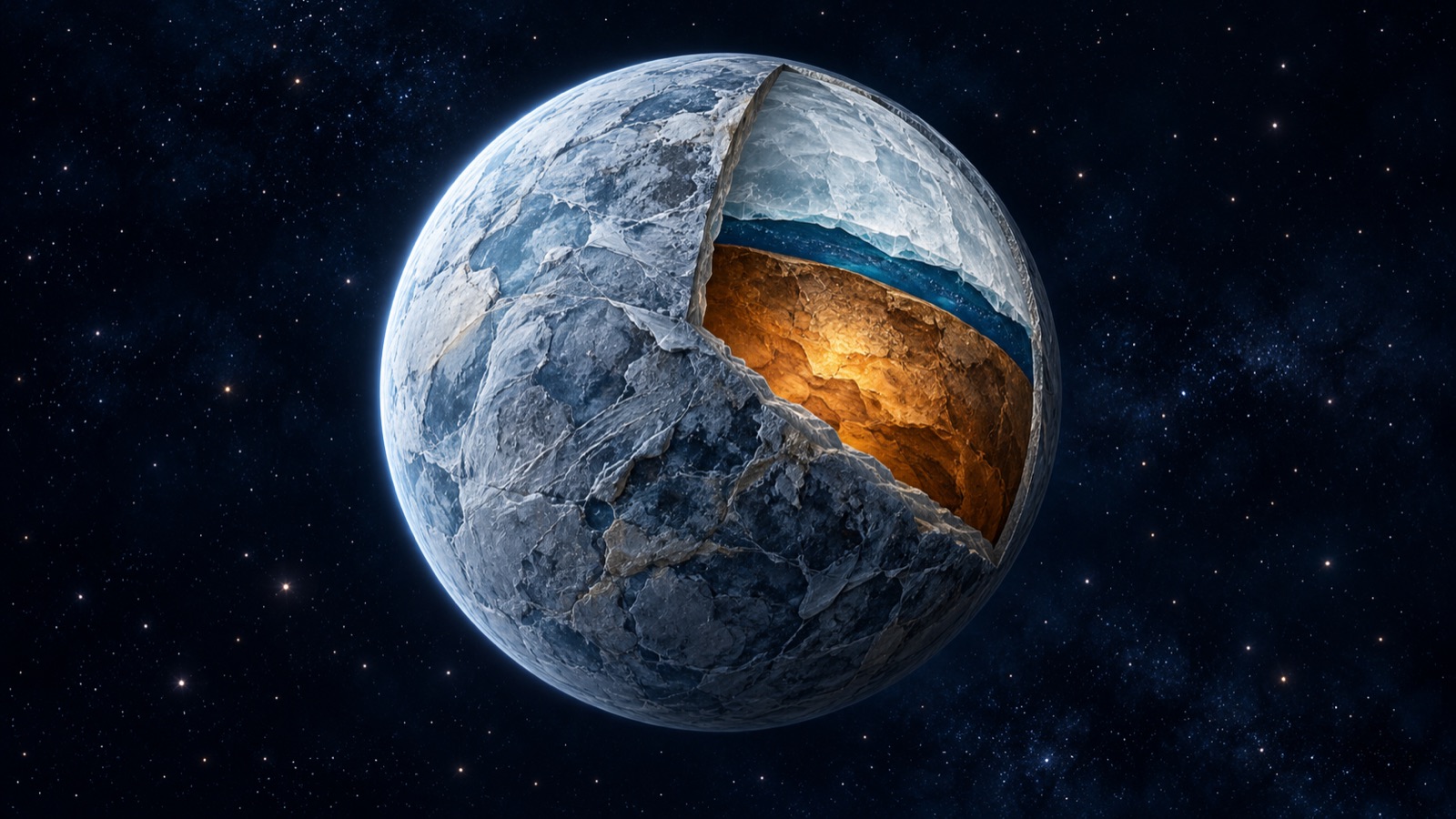
Original AI-generated conceptual illustration for God Plays Dice, October 2026. The cutaway shows one hypothetical ocean-under-ice scenario, not an observed planet. Layer sizes, colors and lighting are illustrative, not measurements.
WHERE THE EVIDENCE STANDS
WHAT WE DON’T KNOW YET
We do not know how many rogue planets retain the right water, heat and insulation, whether suitable chemistry could sustain organisms, or whether life could begin there. Neither an ocean nor life has been established on the modeled rogue worlds described here.
WHAT WOULD CHANGE THIS ANSWER
Measurements that constrain a particular rogue planet’s atmosphere, heat flow or liquid water would test habitat models. A biological signal would require independent corroboration and checks against contamination and nonliving explanations.
Imagine a world with no sunrise. Losing a star's warmth sounds like the end of every possibility for life. Researchers have asked a more specific question: could a planet carry enough heat and insulation of its own to keep some water liquid?
Free long answer 1 of 3 this month.
A rogue planet is a planetary-mass world that is not gravitationally bound to a star. It can travel through the galaxy instead of circling a sun. The word describes its situation, rather than a special material it is made of.
NASA's explanation of rogue worlds describes two possible origins. Gravitational encounters in a young planetary system can eject a planet. Some isolated planetary-mass objects may instead form directly from collapsing gas and dust. Finding a lone object does not automatically tell us which history it had.
They can look for what its gravity does to somebody else's light. In gravitational microlensing, a foreground object passes close to our line of sight to a more distant star. Its gravity bends the light, briefly making that background star appear brighter.
A 2023 NASA report on a nine-year microlensing survey describes a candidate with roughly Earth's mass. Similar mass does not mean similar oceans, air or temperatures. The detection is a gravitational clue, rather than a photograph of a living world.
Keep those questions separate when reading a discovery headline: evidence for a planet, evidence about its environment, and evidence for life are different achievements.
Under some modeled conditions, yes. Two proposed routes involve different kinds of insulation.
An ocean beneath ice. In their 2011 Steppenwolf study, Dorian Abbot and Eric Switzer calculated whether geothermal heat could maintain water underneath an insulating frozen exterior. The outcome depends on the world's mass, water inventory and insulating layers. This is a physical possibility explored with a model, not an ocean detected on a rogue planet.
A thick atmosphere. A 2022 study by Marit Mol Lous and colleagues examined hydrogen-and-helium atmospheres. At sufficient pressure, hydrogen can absorb outgoing infrared radiation and slow heat loss. Some simulated unbound worlds could have conditions allowing liquid water, powered by their interiors. The result depends on the atmosphere, mass and cooling history; a thick atmosphere is not automatically a habitable one.
The same study cautions that some long-lasting modeled habitats would develop only after billions of years of cooling. A prediction about a planet's distant future does not establish that a suitable habitat exists today.
Think of insulation around a warm container. It slows the escape of heat; it does not create an unlimited energy supply. A planet's internal heat source and cooling rate still matter.
Some Earth microbes use chemical energy instead. NOAA's chemosynthesis fact sheet describes organisms that build organic matter using energy released in chemical reactions. These microbes support food webs around deep-sea vents and seeps where sunlight does not reach.
That is an example of metabolism without direct illumination, not a demonstration that an entire Earth ecosystem is independent of everything the Sun provides. Nor does it show that life could begin on a starless planet. Maintaining liquid water, supplying usable chemical energy and producing living cells are separate problems.
We would need much more than a suitable temperature in a calculation. First, observations would have to constrain a particular world's environment. Then a proposed biological signal would need testing against contamination and nonliving explanations. NASA's guide to evaluating a life claim explains why different lines of evidence must agree.
A useful headline check is to complete three sentences:
For closer examples of possible habitats, explore the search for life on Mars and icy moons. For the larger uncertainty, read whether life is rare or common.
A planet without a star expands the range of environments worth considering. Whether any such world is inhabited remains an open question.
THREE THINGS TO REMEMBER
God Plays Dice answers big questions in plain words, with sources and one of six honest labels.
See a mistake? Report a problem. Corrections are made openly.
CONTINUE THE THREAD
Life in the UniverseAnswer
Distant worlds can reveal themselves through changes in starlight and the motion of their stars.
Life in the UniverseAnswer
Identical twins develop from one fertilized egg and begin with almost the same DNA. Yet their conditions before birth, later environments and gene activity can differ. Shared DNA…
Life in the UniverseAnswer
Humans and chimpanzees inherited much of their DNA from a shared ancestor. Similar DNA can produce different bodies when some protein instructions and patterns of gene activity differ.…
The Architect AI companion · All Access
Labels describe the evidence for a claim, not the people who hold it.
Match my phone uses your device’s light or dark setting.