EssaysEssay · personal view
Where to start in GOD PLAYS DICE if you are new to cosmology
A simple reading guide to the questions, measurements and scientific limits in GOD PLAYS DICE, Volume One.
ESSAYS PERSONAL VIEW
A short reading exercise separates understanding a proposal from accepting it, while keeping your unresolved questions visible.
You can read a science book to understand its question, examine the reasoning and decide which claims remain unconvincing. You do not have to adopt the author’s view to take the question seriously.

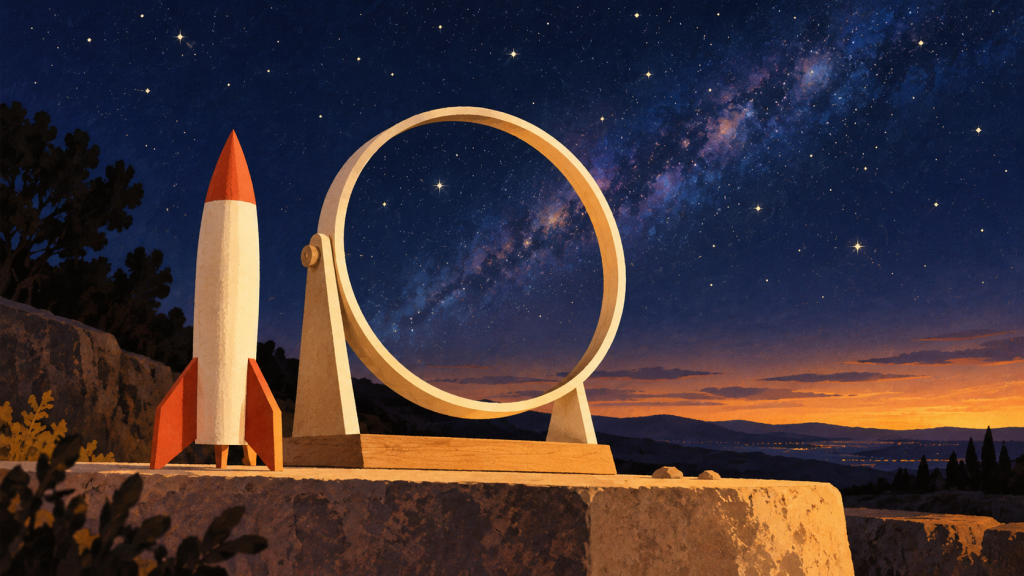
Conceptual illustration created with AI. This is a reading metaphor, not scientific data or evidence for HD-Blast.
In GOD PLAYS DICE, Volume One, I explore HD-Blast, my unproved cosmic-origin hypothesis. The question is whether our Big Bang could have been the aftershock of a higher-dimensional blast. Understanding that proposal and accepting it are separate decisions.
If a paragraph leaves you unsure, try putting its main claim into one sentence. Keep words such as might, proposes and under these assumptions when they belong there. Removing them can make a tentative idea sound stronger than the author has established.
For my book, a starting sentence could be: the author proposes a possible higher-dimensional cause of our cosmic beginning. That gives you a claim to examine. A vivid description of the proposal does not establish that the proposed event happened.
On paper or on your phone, make one note for what you understand and another for what remains unresolved. A practical example:
You can make progress on the first note while the second stays open. The questions you retain are useful reading outcomes; agreement is not the only possible result.
Try asking which part is an analogy, which part is a proposed explanation, and which part is supported by observations. My title uses “God” as a metaphor for the laws of nature and “dice” for quantum events. The title itself supplies no evidence for HD-Blast and makes no claim for or against religion.
I welcome believers, nonbelievers and readers who are unsure. You can bring your questions to the book without settling every question about existence first. One clear unresolved question is a good place to continue reading.
For another starting point, read whether you need a physics degree to read the book. Explore GOD PLAYS DICE and find the free preview.

Ricardo Maldonado, founder and editor of God Plays Dice.
More essays by Ricardo
God Plays Dice answers big questions in plain words, with sources and one of six honest labels.
CONTINUE THE THREAD
EssaysEssay · personal view
A simple reading guide to the questions, measurements and scientific limits in GOD PLAYS DICE, Volume One.
EssaysEssay · personal view
World Space Week 2026 celebrates Rocket Revolution. Ricardo Maldonado asks how curiosity about cosmic origins connects to his unproved HD-Blast hypothesis.
EssaysEssay · personal view
You can follow a question about the universe without a physics degree—or a promise to agree with the author’s hypothesis.
The Architect AI companion · All Access
Match my phone uses your device’s light or dark setting.