

Life in the UniverseAnswer
Could a planet without a star support life?
A world with no sunrise could still have internal heat. The question is whether it can keep water liquid and supply usable energy.
THE QUESTION LIBRARY LIFE IN THE UNIVERSE
Distant worlds can reveal themselves through changes in starlight and the motion of their stars.
Astronomers often find exoplanets by measuring a small, repeating dip in a star’s light when a planet crosses in front of it, or by detecting the star’s slight motion caused by a planet’s gravity. Follow-up observations help rule out other explanations. Finding a planet does not by itself show what its surface looks like or whether it hosts life.
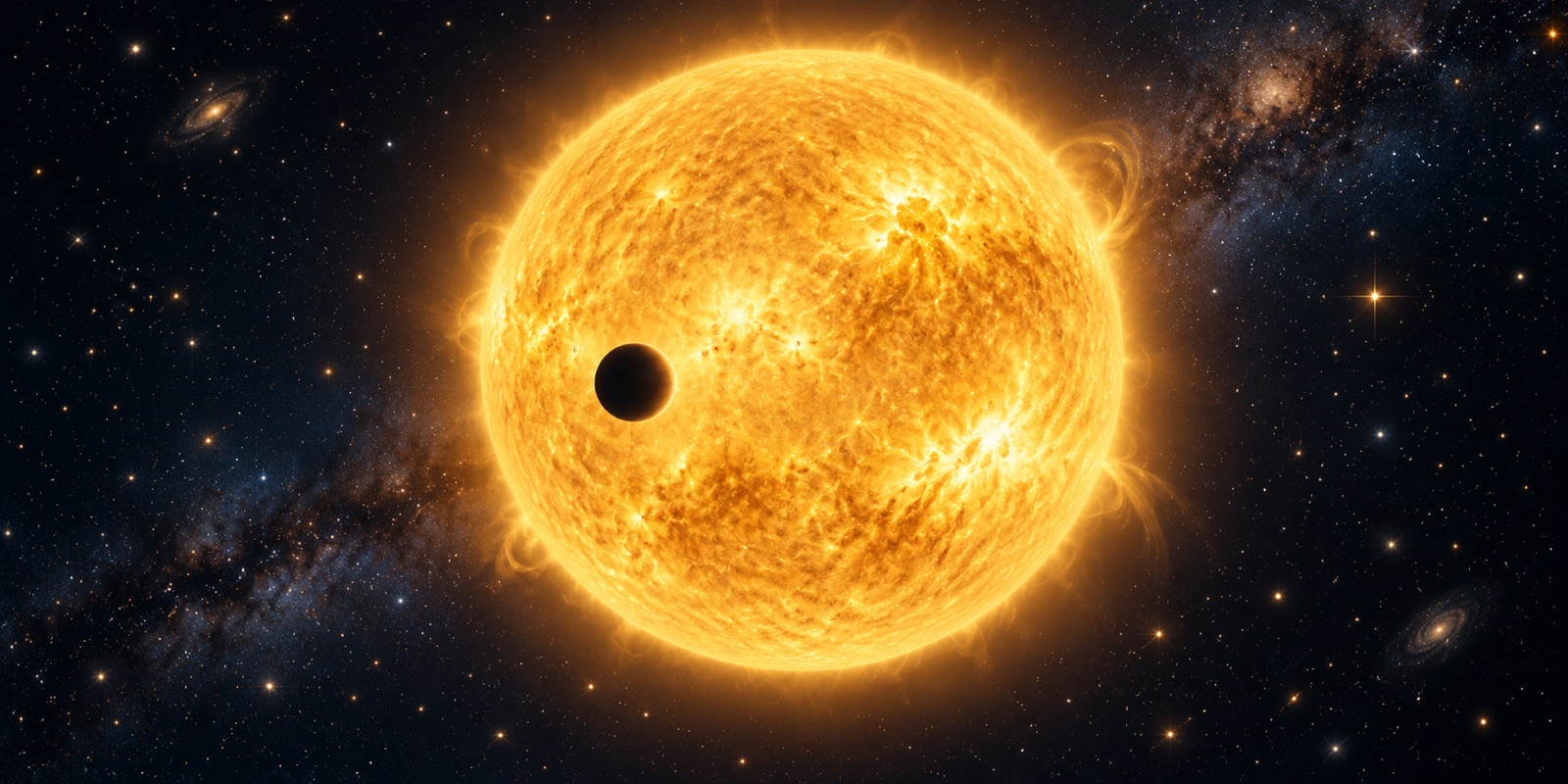
Original AI-generated conceptual illustration for God Plays Dice, October 2026. This is not a telescope photograph; the planet’s size, colors and stellar detail are illustrative.
WHERE THE EVIDENCE STANDS
WHAT WE DON’T KNOW YET
Many planets do not transit from our viewpoint. A detection alone does not establish a planet’s surface conditions, atmospheric composition or life.
WHAT WOULD CHANGE THIS ANSWER
Additional observations and independent methods can refine a candidate’s properties or show that a different source produced the signal.
A distant planet can be far too faint to pick out beside its star. Yet its presence can leave a measurable trace: a small, repeating dip in the star’s light, or a subtle wobble in the star’s motion. Those traces let astronomers discover worlds they cannot photograph in detail.
Free long answer 1 of 3 this month.
An exoplanet is a planet beyond our solar system. Many orbit other stars, although some planetary-mass worlds travel without a host star. Finding one does not mean knowing what its surface looks like, or whether it has life.
If a planet passes between its star and our telescope, it blocks a small fraction of the starlight. Astronomers call that crossing a transit. The telescope records a dip in brightness; if the alignment and observing conditions are right, the dip can recur as the planet orbits.
Imagine a moth crossing a distant porch light. You may not see the moth clearly, but the light briefly dims. The analogy has a limit: telescopes measure light carefully over time rather than simply watching a silhouette with the naked eye.
A deeper transit generally means a larger planet compared with its star. Repeated dips reveal the time between crossings, which helps estimate the orbital period. Translating the depth into a planet’s size also requires information about the star. Not every planet transits from our viewpoint: its orbit must line up closely enough with our sightline. NASA describes the transit method and other techniques.
A planet and its star pull on each other. As they orbit their common center of mass, the star moves slightly toward and away from us. That motion shifts features in its light. The radial velocity method measures those shifts, much as the pitch of a passing siren changes with motion, though light changes in wavelength rather than sound pitch.
A measured wobble can help estimate a planet’s mass. On its own, the method commonly gives a minimum mass because the orbit’s tilt may be unknown. When a planet also transits, the geometry can help constrain that tilt. With a mass and radius, scientists can estimate an average density—useful evidence about whether a planet is likely rocky or gas-rich, though not a complete inventory of its interior. See NASA’s astrobiology explanation of discovery methods.
A dip is a candidate, not a verdict. A dimming pattern can have other causes, including another star in an eclipsing binary or unrelated light blended in the same measurement. Researchers check whether the signal repeats, examine the star and its surroundings, and use follow-up observations or statistical tests to assess alternatives. NASA’s guide to confirming a planet explains why a second line of evidence matters.
Different techniques find different worlds. Transit surveys favor planets that pass in front of their stars from our perspective; frequent crossings make close-in orbits easier to monitor. Radial velocity tends to detect a stronger signal from more massive planets and those closer to their stars. A list of discovered planets is therefore not an unbiased census of everything out there.
Finding a planet is the first step, not a life detection. In favorable cases, light filtering through an atmosphere during a transit can carry signatures of particular gases. Scientists compare how much light is absorbed at different wavelengths; this is called transmission spectroscopy. NASA’s illustrated explanation of a transmission spectrum shows the principle.
But such measurements are difficult, and a chemical signal must be checked against noise, the star’s own features and other explanations. Even a well-established gas is not automatically evidence of biology: researchers must consider nonliving processes and the planet’s wider environment.
Yes, a relatively small number have been directly imaged. Their faint light must be separated from the overwhelming glare of their stars. Even then, an image is usually a dot of light, not a detailed portrait of continents, oceans or clouds. Colorful planet scenes accompanying headlines are often artists’ concepts.
The next time you see a discovery announcement, ask three questions: What was actually measured? What did the analysis infer? What still needs an independent check? A tiny dip can open a window onto another world, provided we keep the window distinct from the view we imagine beyond it.
Continue with whether a planet without a star could support life or whether life is rare or common in the universe.
God Plays Dice answers big questions in plain words, with sources and one of six honest labels.
See a mistake? Report a problem. Corrections are made openly.
CONTINUE THE THREAD
Life in the UniverseAnswer
A world with no sunrise could still have internal heat. The question is whether it can keep water liquid and supply usable energy.
Life in the UniverseAnswer
Identical twins develop from one fertilized egg and begin with almost the same DNA. Yet their conditions before birth, later environments and gene activity can differ. Shared DNA…
Life in the UniverseAnswer
Humans and chimpanzees inherited much of their DNA from a shared ancestor. Similar DNA can produce different bodies when some protein instructions and patterns of gene activity differ.…
The Architect AI companion · All Access
Labels describe the evidence for a claim, not the people who hold it.
Match my phone uses your device’s light or dark setting.