
Extraordinary ClaimsAnswer
What does research say about people who report memories of past lives?
What past-life memory research investigates, what reported matches can show, and why case studies do not by themselves establish reincarnation.
THE QUESTION LIBRARY EXTRAORDINARY CLAIMS
Striking coincidences happen far more often than they feel, and our minds are quick to notice them; what one means to you is a different question.
Mostly because striking coincidences are far more common than they feel, and our minds are quick to notice them. In a room of just 23 people, the odds are about even that two share a birthday. In a country of 250 million, a one-in-a-million daily event happens to about 250 people every day. We also remember hits and forget misses. Whether a coincidence carries a message is beyond science. What it means to you is yours to weigh.
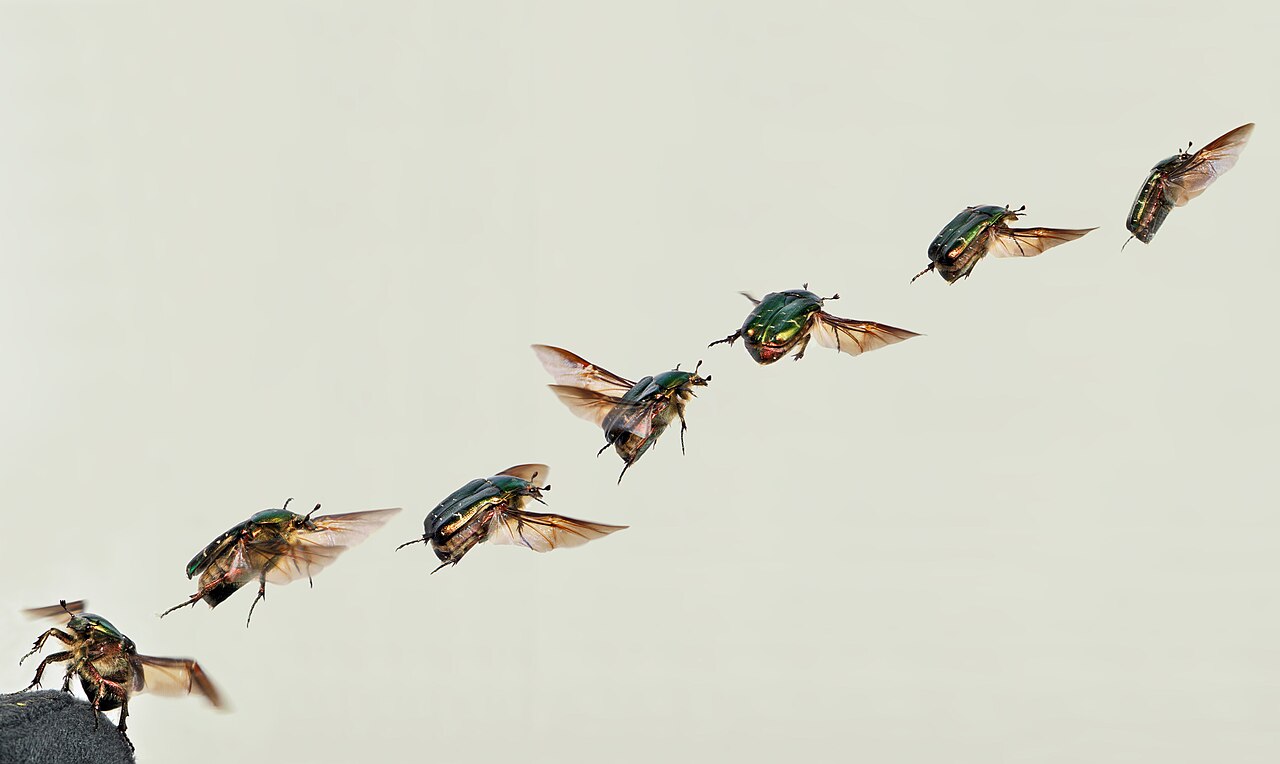
Seven photos of one rose chafer (Cetonia aurata) taking off, combined into one image; the flight path was shifted so the beetles would not overlap. In perhaps Carl Jung’s best-known story of synchronicity, a rose chafer knocked at his window as a patient told him her dream of gold scarab jewelry.
WHERE THE EVIDENCE STANDS
WHAT WE DON’T KNOW YET
In 1989, Diaconis and Mosteller noted that there was little data on how often coincidences happen in daily life, or on how that rate differs from person to person. Believers in the paranormal report more coincidences, but nobody knows yet exactly why.
WHAT WOULD CHANGE THIS ANSWER
Careful records showing that meaningful coincidences happen far more often than chance allows, in studies that count misses as carefully as hits, would change this answer. So would repeated, independent tests in which numerology readings or angel numbers matched people’s lives better than chance.
Mostly because striking coincidences are far more common than they feel, and because human minds are quick to notice them. That answer does not make your experience smaller. It helps explain why a coincidence can feel so personal, and so charged with meaning.
Start with a simple puzzle. In a room of 23 people, what are the odds that two share a birthday? The answer is about even, 50-50. With just 14 people, it is even odds that two birthdays fall within a day of each other. These numbers appear in a 1989 paper on coincidences by two Harvard researchers, the mathematician Persi Diaconis and the statistician Frederick Mosteller.
They also describe a bigger idea, which they call the law of truly large numbers: with a large enough sample, any outrageous thing is likely to happen. Suppose a coincidence strikes one person in a million each day. In a country of 250 million people, that is about 250 people a day. When a New Jersey woman won the state lottery twice, a front-page newspaper story called it a 1-in-17-trillion long shot. Two statisticians calculated that it was better than even odds that someone in the United States would win twice within seven years.
Our minds add to the effect. Once you notice something new, like a word or a car model, you start seeing it everywhere. This is called the frequency illusion. We also remember the hits and forget the misses. And a coincidence that happens to us feels more surprising than the same story about someone else.
None of this means a coincidence cannot matter to you. The psychiatrist Carl Jung called meaningful coincidences synchronicity, and numerologists read repeating numbers as messages. Whether a coincidence is a sign is beyond science. But noticing, wondering and making meaning are deeply human. You are welcome here, whatever you believe.
Free long answer 3 of 3 this month.
More often than it feels. In their 1989 paper, Diaconis and Mosteller define a coincidence as a surprising coming-together of events that seem meaningfully related, with no apparent cause linking them. Our feel for the odds is often far off, they note. With 23 people in a room, a shared birthday is about a coin flip. With 48 people, it is about 95% likely. With seven people, the odds are about even that two birthdays fall within a week of each other.
Coincidences also pile up because so many different matches would surprise us. Meet a stranger, and you might share a birthday, a job, a hometown, a school, a first name or a hobby. Diaconis and Mosteller call this the multiplicity of endpoints: the more kinds of match that count, and the more “close” matches we count as exact, the more likely some match becomes.
Then there is sheer size. The New York Times called a New Jersey woman’s two lottery wins a “1 in 17 trillion” long shot. That is the chance for one person who buys one ticket in each of two lotteries, Diaconis and Mosteller explain, and she had bought many tickets again and again. The better question is whether anyone, among the millions who play, will win twice. Stephen Samuels and George McCabe of Purdue University put that at better than even odds within seven years, somewhere in the United States.
Part of the answer is attention. In 2005, Arnold Zwicky, writing on the blog Language Log, named the frequency illusion: once you notice something, you think it happens all the time, because now you notice nearly every case. Diaconis and Mosteller give an everyday version: learn a new word, and you seem to meet it again within days.
Memory adds to it. Diaconis and Mosteller describe a 1978 lab study with word lists that gave some evidence that when a new event matches something in memory, the match gets recalled, so we may overestimate how often coincidences happen. A later study found the same with events instead of words. And in studies by Ruma Falk and her colleagues, people rated coincidences as far more surprising when they happened to themselves than when the same stories happened to others.
We are also pattern seekers. The psychologist Chris French describes patternicity, sometimes called apophenia: the spontaneous sense of connections and meaning in randomness. He suggests that biases like this helped our ancestors spot threats fast. In a 2018 set of studies, people who saw patterns in random coin tosses were more likely to hold supernatural beliefs. In a small 2013 study, paranormal and religious believers were better at finding face-like shapes in pictures of scenery, but also said “face” more often where there was none; their accuracy matched the skeptics’, and they were simply readier to say yes. A larger 2023 study of 723 people linked paranormal belief to both that readiness and lower accuracy, though the effects were small. And a 2013 study of spotting human figures found the bias went with paranormal belief but not with traditional religious belief. A 2002 study of 214 people found that believers in the paranormal reported more coincidences. Its author, Paola Bressan, proposed that believers are more inclined to connect separate events, rather than simply worse at math. These studies mostly show links, and which comes first is still debated. Our guide to common thinking traps has more.
One striking finding did not hold up. A 2008 paper in Science reported that people who felt a loss of control saw more illusory patterns. But when researchers ran seven new experiments, published in 2018, they found no such effect. When they re-ran an earlier summary of studies like it, they found strong signs of publication bias, meaning studies that found nothing tend to go unpublished. With one large failed replication and signs of bias, we label the idea that a brief loss of control makes people see more patterns Not supported, for now.
In Jung’s own terms, as the Jungian analyst Joe Cambray explains for the International Association for Analytical Psychology, of which he is a past president, synchronicity is an “acausal connecting principle”: inner, psychological events linked to outer events by meaning rather than by a chain of cause and effect. Jung told a seminar in December 1929 that he had invented the word, and he later developed the idea with the Nobel Prize-winning physicist Wolfgang Pauli. Cambray notes that Jung’s main examples were stories from his clinical work. In perhaps the best-known one, a patient was telling him her dream of being given gold jewelry shaped like a scarab beetle when he heard a knocking at the window. It was a beetle from the scarab family, a rose chafer, trying to get in. Jung caught it and handed it to her, and he wrote that the moment broke through her defensive rationalism. Cambray writes that Jung was arguing for a pattern-making tendency built into the universe, a basic property of reality. That view is Beyond science: no test can show whether a meaning was built into an event.
Jung also made a claim that can be checked. Diaconis and Mosteller report that he argued meaningful coincidences occur far more often than chance allows. In their view, four ordinary sources, hidden causes, memory and perception, loose counting of near matches, and truly large numbers, account for much of the force of synchronicity. Where rates can be checked with solid control, they wrote, coincidences occur about as often as expected. So the more-than-chance claim is Not supported. Still, the more they worked in this area, they wrote, the more they felt that Jung and the biologist Paul Kammerer were right: “We are swimming in an ocean of coincidences.” Their own explanation is that nature and we ourselves create them. For how scientists think about chance itself, see is anything truly random?
Numerology, as the numerologist Hans Decoz’s site World Numerology puts it, is “the study of the profound ways numbers impact our lives.” The site calls it a system of self-discovery, not fortune-telling. A central number is the life path number, also called the birth number, found by adding up the digits of a birth date until one digit is left. The site says it reflects a person’s natural talents and the direction their life is meant to follow. Angel numbers are repeating patterns such as 111, 222, 333 and 444, seen on clocks, receipts or license plates. Decoz writes that they appear in daily life to guide, encourage and awaken spiritual awareness, and that their message is personal. Reading numerology books since 1970, he cannot remember a mention of them until about the mid-1990s, which he says does not mean they lack validity. He calls them an offshoot of numerology, with no real basis in the methods or theories of Pythagorean numerology.
Few tests exist. In 2017, Jeremy Genovese of Cleveland State University calculated the birth numbers of 806 Nobel Prize winners. If birth numbers carry the meaning numerologists describe, he reasoned, their pattern among such rare achievers should differ from chance, and winners in different fields should differ from each other. Neither happened. Genovese found no earlier published test of numerology, and he notes a limit of his own: birth numbers might predict some other human difference that prizes do not capture. So the evidence is thin: one test, and it found nothing. We found no controlled test of angel numbers at all. The frequency illusion offers one reason they can seem to appear so often once you start looking for them. Astrology has faced similar tests; see does astrology work?
The strongest objection is that math answers the wrong question. It can say a coincidence was bound to happen to someone. It cannot say why it happened to you, now. That is fair. Science can count coincidences; it cannot settle whether one was meant. Diaconis and Mosteller themselves wrote that coincidences can point to new discoveries and alter the course of our lives. Much of scientific discovery, they add, depends on finding the cause of a puzzling coincidence.
Making meaning also seems to matter. A 2017 review of 66 studies found weak-to-moderate links between a sense of meaning in life and better physical health, strongest for people’s own ratings of their health; that is a link, not a cause. Not every tidy result lasts, though: a 2013 finding that seeing tree photos in seasonal order raised people’s sense of meaning in life failed a larger replication in 2016 that was planned and registered in advance, though its authors caution that one failed replication is not the final word.
Believers and skeptics can agree on a lot. Coincidences are real events, and the feelings they bring are real. Checking before acting on a sign is wise. If a sign nudges you toward a goal, pairing the wish with a plan for the obstacles is a tested method, as our answer on the law of attraction explains.
The answer stays the same after all this detail. Striking coincidences are expected, and our minds are tuned to catch them. What a coincidence means to you is yours to decide.
Diaconis and Mosteller give a handy shortcut. Suppose N people each fall at random into one of c equally likely categories, such as the 365 days of the year. When c is large, the chance that no two people share a category is about e raised to the power of −N²/2c. Setting that equal to one half and solving gives N ≈ 1.2√c for a 50% chance of a match. For birthdays, 1.2 × √365 ≈ 23. For a 95% chance, the multiplier becomes about 2.5, so N ≈ 48.
The same logic works for any set of categories, which makes it a handy tool for thinking about coincidences. The authors show that when several kinds of match count at once, fewer people are needed. In one of their examples, with birthdays, lottery tickets and theater tickets all counting, 16 people give an even chance of some match. And their law of truly large numbers is simple multiplication: an event with a one-in-a-million chance per person per day happens about 250 times a day among 250 million people, or close to 100,000 times a year.
Numerology’s birth numbers can be checked with arithmetic too. Genovese points out that some systems treat 11 and 22 as special numbers that are not reduced further (World Numerology calls such numbers “master numbers”), but the order in which you add the digits can change whether you land on 11. Take May 5, 1999. Adding all the digits, 5 + 5 + 1 + 9 + 9 + 9, gives 38, and 3 + 8 gives 11. Adding the month and day first (5 + 5 = 10, then 1 + 0 = 1) and the year separately (1 + 9 + 9 + 9 = 28, then 10, then 1) gives 1 + 1 = 2.
THREE THINGS TO REMEMBER
Nobody knows yet.
God Plays Dice answers big questions in plain words, with sources and one of six honest labels.
See a mistake? Report a problem. Corrections are made openly.
The Architect AI companion · All Access
Labels describe the evidence for a claim, not the people who hold it.
Match my phone uses your device’s light or dark setting.