Mind & MortalityAnswer
Why do humans fear death?
Why death can feel frightening: loss, separation, uncertainty and the dying process, with clear limits on psychological explanations.
THE QUESTION LIBRARY MIND & MORTALITY
Brain recordings from dying patients and animals show a rough order of events, from quiet, to a brief burst, to a slow final wave, and they leave some deep questions open.
If this is personal right now: call 988 or text 988 in the US · more support
When the heart and breathing fail, the brain runs short of oxygen and its electrical activity goes quiet. Within minutes, a slow wave of electrical change spreads through it, and damage begins. Some dying brains show a brief burst of fast activity first. Hearing may be one of the last senses to go. Doctors can declare death when all brain function, including the brainstem, is lost for good. What a dying person feels, if anything, nobody knows yet.
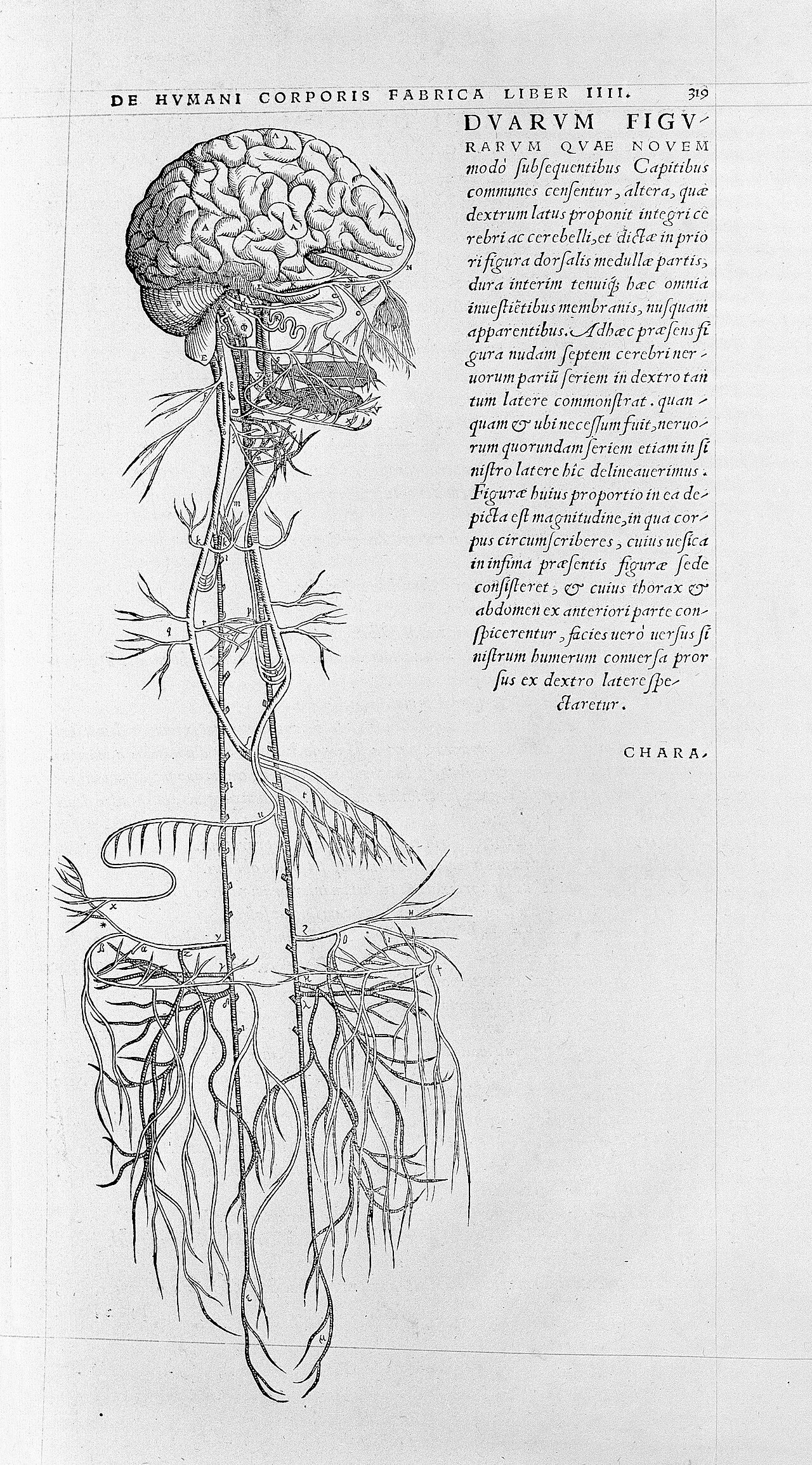
The entire human brain and cerebellum, from Andreas Vesalius’s anatomy book of 1543. People have studied the brain for centuries; recordings of the dying brain are much newer.
WHERE THE EVIDENCE STANDS
WHAT WE DON’T KNOW YET
Nobody knows yet what, if anything, a dying person experiences during the final burst of brain activity. Human studies are tiny, often just a few patients. Scientists also do not know exactly when damage in the dying brain becomes impossible to undo.
WHAT WOULD CHANGE THIS ANSWER
Larger studies that record many dying patients, including some who survive and can describe what they felt, could show whether the gamma surge is common and whether it matches an experience. Better treatments that save brain cells after longer loss of blood flow would change when damage counts as permanent.
People ask this question for many reasons. Some are sitting with someone they love at the end of life. Some have survived a close call. Some simply want to know what the last moments are like. All of these reasons deserve a clear, gentle answer.
Here is the core picture. Your brain is very sensitive to any break in its blood flow. It depends on blood to bring it oxygen all the time. When the heart stops or breathing fails, oxygen in the brain drops fast. As it falls, the brain’s normal electrical activity goes quiet. On a brain recording, the busy lines turn flat.
Next comes a slower event. In a study of nine dying patients whose brains were being monitored, a wave of electrical change began to spread across the brain typically about four minutes after blood flow made its final drop. Scientists call it a terminal spreading depolarization. In lab studies, this kind of wave marks the point where brain cells start to be injured. At first it can still be reversed. Over time, it cannot.
Some studies found something surprising along the way. In rats, and in a few dying patients, the brain showed a short burst of fast, organized activity called gamma waves. Researchers link these waves with conscious processing. Nobody knows yet whether the burst means the person experiences anything.
Two more facts may help families at the bedside. A study of hospice patients found that some brains still reacted to sounds after the person could no longer respond. And in the United States, a person can be declared dead when every function of the whole brain, including the brainstem, has stopped for good.
Whatever you believe about what follows death, the brain science itself is the same for everyone. This page sticks to what the studies show.
The brain is highly sensitive to any drop in blood flow and oxygen. A 2018 study in the Annals of Neurology, by Dreier and colleagues, recorded what happens when that flow ends. The team placed sensors in or on the brains of nine patients with devastating brain injuries. The patients had moved to comfort care only, and their breathing tubes were removed. The researchers then watched the brain’s oxygen fall.
In eight of the nine patients, normal electrical activity went quiet across the recorded area at the same time. This happened while oxygen was dropping steeply. The team called it “nonspreading depression,” because it did not travel from place to place. It simply stopped.
Then came a second event. A wave of electrical change, called a terminal spreading depolarization, began to move between the sensors. It started a median of 3.9 minutes after blood flow made its final drop. You can picture it as a slow tide rolling across the surface of the brain. That picture is an analogy. The real event is brain cells losing the electrical balance they need to work.
Why does this wave matter? In lab studies, the researchers explain, injury to nerve cells begins only when this kind of wave arrives. It typically starts 2 to 5 minutes after severe loss of blood flow. At first the change can be reversed if blood returns. If it does not, the damage becomes permanent. The researchers say knowing this timing could help doctors judge how long they have to restore blood flow.
You may have seen headlines saying the brain surges with activity at death. Here is what the studies found.
In 2013, Borjigin and colleagues at the University of Michigan recorded the brains of rats as their hearts were stopped in the lab. Within the first 30 seconds, they saw a brief surge of fast, tightly coordinated gamma waves. It came before the recording went flat. The fast activity even rose above the levels seen when the rats were awake.
In 2023, the same group looked at four patients who were in a coma and dying after their breathing support was withdrawn. Two of the four showed a sharp surge of gamma activity. It included stronger connections within a region at the back of the brain that some scientists think is critical for conscious processing. The surge was set off by the drop in oxygen and grew as the heart failed.
A 2022 report described one more case: an 87-year-old patient whose brain was being recorded when the heart stopped. After the heart stopped, overall activity fell. But fast gamma waves made up a larger share of what remained, and they stayed linked with slower rhythms even after blood flow to the brain had stopped.
The strongest objection is simple. These are very small studies. The human evidence comes from a handful of people, and only some of them showed a surge. The patients were in a coma or badly injured, so none could tell anyone what they felt. The 2022 authors note that injury and brain swelling may have shaped their recording.
So a burst of activity is not the same as an experience. Researchers call it a possible sign of heightened conscious processing, and they are careful with that wording. Some people link it to near-death experiences. None of these studies could test that link, because none of the patients survived to describe what they felt. And a brain recording cannot say whether anything continues after the brain stops. That question, which people of faith and skeptics answer in different ways, is taken up in Is there life after death?
This may be the most practical question on this page. A 2020 study in Scientific Reports tested hospice patients while they could still respond, and again later, when they had become unresponsive. The team played patterns of tones and recorded brain responses. Most of the unresponsive patients still showed an automatic brain response to a change in tone. Some showed a response usually linked with noticing a change. The authors concluded that hearing may be one of the last senses to stop working.
The U.S. National Cancer Institute gives families similar advice. In the final days, it says, people may sleep more, answer slowly or not at all, and may seem confused. Most people can still hear after they can no longer speak, so it may help to keep talking to them and touching them. The same guide notes that a rattling sound in the breath can come in the last hours or days, and that it does not seem to be painful for the person.
“Brain death is a kind of coma.” It is not. In the United States, a 2023 guideline from several medical societies explains that the Uniform Determination of Death Act of 1981 lets doctors declare death in one of two ways. One is when the heart and lungs stop for good. The other is when all functions of the entire brain, including the brainstem, stop for good. Doctors check for three signs: coma, no brainstem reflexes, and no breathing during a special test. Coma is only one of the three. A person in a coma who still has brainstem reflexes, or who breathes on their own, is not brain dead.
“Every part of the brain dies the instant the heart stops.” Not quite. In a 2019 study in Nature, Yale researchers pumped a special fluid through pig brains that had been dead for up to four hours. Some blood vessel and cell functions came back. But the brains showed no overall electrical activity. So the death of brain cells is a process that unfolds over time, not a single instant, and science is still learning its timing.
“Sudden clear moments before death are well understood.” People sometimes report that someone with severe dementia suddenly seems clear and talks, especially near the end of life. A 2019 review called this “paradoxical lucidity.” It noted that the reports so far are mostly personal accounts and that the effect still needs to be confirmed with careful study.
The answer stays the same after all this detail. As oxygen runs out, the brain goes quiet, a slow wave spreads through it, and damage sets in over minutes. Some brains show a short burst of fast activity along the way. What that moment is like from the inside, nobody knows yet. If you are thinking about your own death or someone else’s, Is it possible to make peace with the idea of dying? and Why does grief hurt so much, even physically? may help.
THREE THINGS TO REMEMBER
What are near-death experiences, and what do they tell us?
Near-death experiences are real experiences, reported by about 10 to 20% of people who survive a stopped heart.
See a mistake? Report a problem. Corrections are made openly.
CONTINUE THE THREAD
Mind & MortalityAnswer
Why death can feel frightening: loss, separation, uncertainty and the dying process, with clear limits on psychological explanations.
Mind & MortalityAnswer
Most grief slowly softens on its own, but some grief stays stuck and heavy, and knowing the signs, and what actually helps, can make a real difference.
Mind & MortalityAnswer
Many grieving people feel, hear or even see someone they have lost, and studies suggest it is common, usually comforting and usually not a sign that something is wrong.
Labels describe the evidence for a claim, not the people who hold it.
Match my phone uses your device’s light or dark setting.