Mind & MortalityAnswer
When does grief need more help?
Most grief slowly softens on its own, but some grief stays stuck and heavy, and knowing the signs, and what actually helps, can make a real difference.
THE QUESTION LIBRARY MIND & MORTALITY
Losing someone you love can bring waves of pain, poor sleep and exhaustion, and research is starting to show why grief reaches the body as well as the heart.
If this is personal right now: call 988 or text 988 in the US · more support
Grief hurts because loss strikes the body’s stress system, not only your thoughts. Common reactions include poor sleep, low appetite, tiredness and sudden waves of pain. Studies also find that heart attack risk rises for a short time in the first days after a death. Brain scans suggest grief uses some of the same systems that handle pain, stress and attachment, though scientists still debate how much it overlaps with physical pain. For most people, the pain eases with time.
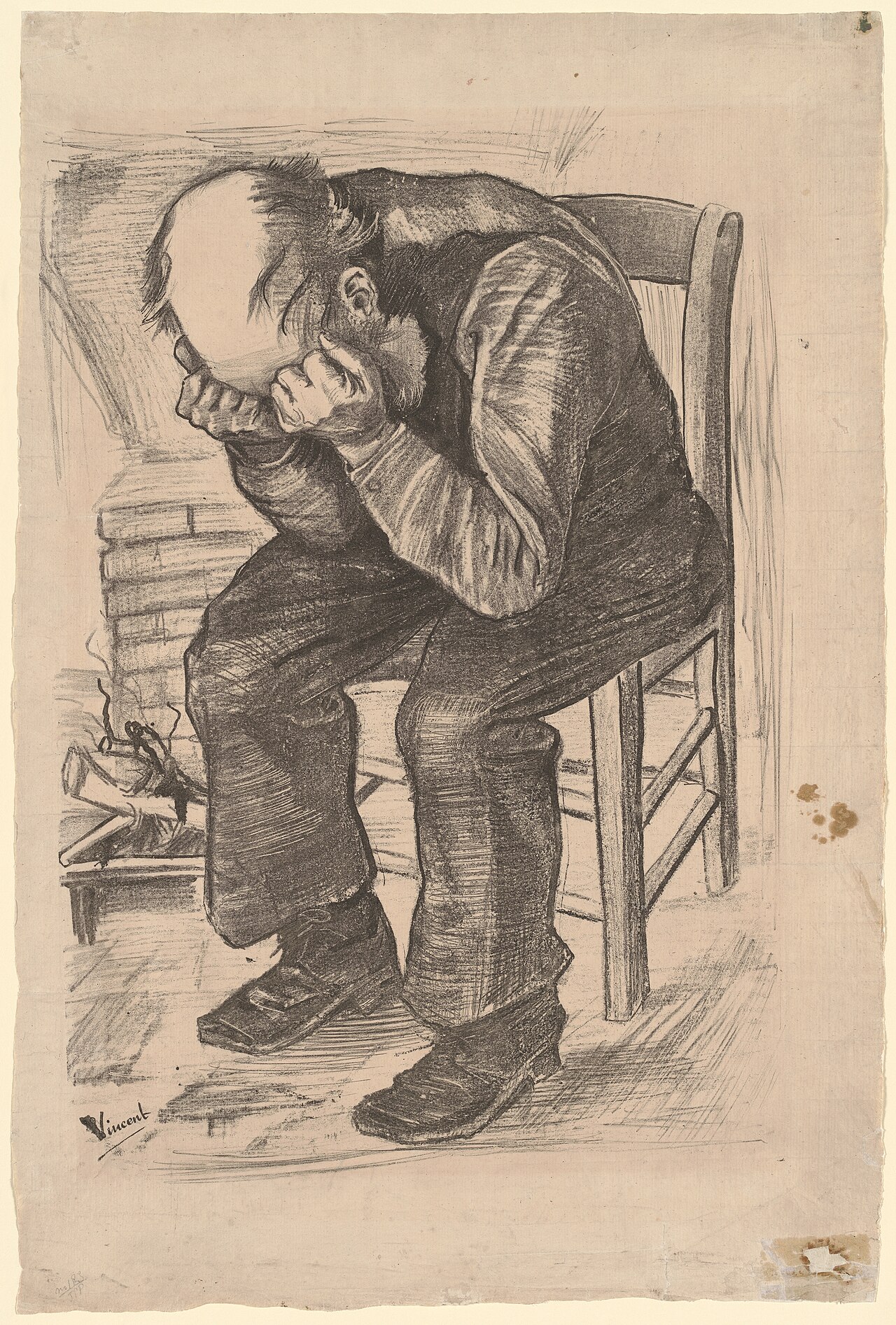
At Eternity’s Gate, a lithograph by Vincent van Gogh from November 1882, now at the Metropolitan Museum of Art. An old man sits by the fire with his face buried in his hands.
WHERE THE EVIDENCE STANDS
WHAT WE DON’T KNOW YET
Scientists do not know yet exactly how much grief shares with physical pain inside the brain. They also cannot yet predict well who will heal on their own and who will get stuck in long, disabling grief.
WHAT WOULD CHANGE THIS ANSWER
Large brain studies of grieving people, rather than small groups or lab tasks, could settle how close grief is to physical pain. Long studies that follow many bereaved people could show which kinds of support actually lower the health risks after a loss.
If you are grieving, you may be surprised by how physical it feels. Your chest aches. You cannot sleep, or you sleep and still feel exhausted. Food loses its taste. A song in a store can knock the air out of you. People often ask whether this is normal. It is.
Grief is the response to losing someone close. Research shows it reaches the body, not only the mind. The U.S. National Cancer Institute lists loss of sleep, loss of appetite, tiredness, numbness, anger and guilt among normal grief reactions. It also describes “grief bursts”: short waves of very intense pain, often 20 to 30 minutes long. Holidays, anniversaries or sorting through the person’s things can set them off. Sometimes they seem to come from nowhere.
Why does a loss hit so hard? Part of the answer is stress. In one study of people whose hearts were stunned by sudden emotional stress, stress hormones such as adrenaline were far higher than in heart attack patients. And in the first day after the death of someone important, another study found, the risk of a heart attack jumped sharply before falling back. The extra risk for any one person was still small. Another part of the answer is attachment. Brain studies suggest that reminders of a lost loved one stir the brain’s pain systems and, in people with long-lasting grief, its reward systems too. When that person is gone, the brain may have to relearn a world without them, and that takes time.
Scientists still debate the details. They do not agree on how closely emotional pain matches physical pain in the brain. But the main point is clear. Grief is not weakness, and it is not all in your head. For most people, the worst of it eases over months to a couple of years.
People of every faith and of none grieve, and each tradition brings its own comfort. This page covers what research can add.
The U.S. National Cancer Institute’s guide to grief and bereavement describes normal grief in plain terms. Right after a death, many people feel numb, shocked or unable to believe it. Later come periods of sadness, lost sleep, lost appetite, fatigue, guilt and loss of interest in life. Some people cry, sigh, dream of the person, or even briefly sense that they are there. The guide says there is no typical grief response, and recovery time varies from person to person.
These effects can reach health too. A 2007 review in The Lancet by Stroebe and colleagues found that bereavement is linked with more physical symptoms and illnesses and more use of medical care. It is also linked with a higher risk of death, especially in the first weeks and months after a loss. The same review makes an important point: grief is not a disease, and most people adjust without professional help.
Studies suggest it can, for a short time. In a 2012 study in the journal Circulation, researchers interviewed 1,985 people in the hospital after a heart attack. They asked about deaths of important people in the months before. The heart attack rate was 21 times higher in the 24 hours after such a death, and it fell steadily day by day. The extra risk for any one person was small. Among people at low risk to begin with, there was about 1 extra heart attack in the first week for every 1,394 people who lost someone. Among people at high risk, it was about 1 for every 320.
A much larger 2014 study in JAMA Internal Medicine followed 30,447 people in the United Kingdom, aged 60 to 89, whose partner died. It compared them with 83,588 similar people whose partner was still alive. In the 30 days after the death, 0.16% of the bereaved group had a heart attack or stroke, compared with 0.08% of the others. That is about twice the rate. After 30 days, the extra risk faded. Both studies show a link in time. They cannot prove that grief alone caused each heart attack or stroke.
Then there is broken-heart syndrome. Doctors also call it takotsubo cardiomyopathy or stress cardiomyopathy. According to Harvard Health Publishing, it can follow severe emotional or physical stress, such as the loss of a loved one. The heart’s main pumping chamber suddenly weakens, and the symptoms feel like a heart attack, even though the heart’s arteries are clear. More than 90% of reported cases are in women aged 58 to 75. Most people recover fully, though in rare cases it can be fatal. In a 2005 study in The New England Journal of Medicine of 19 patients whose heart trouble followed sudden emotional stress, stress hormones such as adrenaline were far higher than in patients with a serious heart attack, and heart function had recovered when checked two to four weeks later.
If you are grieving and feel chest pain or sudden shortness of breath, treat it as a medical emergency and get help. Doctors need tests to tell these conditions apart.
This is where scientists disagree. In a 2003 study in Science, Eisenberger and colleagues scanned people playing a computer ball-tossing game in which the other players stopped passing to them. A brain area also active in physical pain studies, the anterior cingulate cortex, was more active when people were left out. The more active it was, the more upset people said they felt.
An important objection came in 2014. A study in Nature Communications scanned 60 people as they felt painful heat, and as they looked at photos of former partners after a breakup. The same broad brain regions were active in both. But a computer could tell the two brain patterns apart, and the pattern for one did not predict the other. The authors concluded that rejection has its own brain signature and does not simply borrow pain wiring. Neither study looked at grief after a death, so both are only clues. So the words we use, like “heartache,” point to something real, but the brain may handle it in its own way.
In a 2008 study, O’Connor and colleagues scanned 23 bereaved women while they saw reminders of the person who had died. Both groups, with and without long-lasting grief, showed pain-related brain activity. But only the women with long-lasting, complicated grief also showed activity in a reward area called the nucleus accumbens. That activity matched how much they said they yearned for the person.
In a 2022 review, O’Connor and a coauthor proposed that grieving may be a form of learning. The brain holds a deep, lasting belief that a loved one will always be there. At the same time, it holds memories of the death. The two clash, and the brain needs time and new experience to update. This is a proposal, not a settled finding, but it may explain why grief can take so long.
“There are five stages, in order.” In a Yale study of 233 bereaved people, published in JAMA in 2007, acceptance was the item people endorsed most often. Yearning, not disbelief, was the strongest painful feeling from 1 to 24 months after the loss. When the researchers rescaled their data, the average peaks did fall in the order stage theory predicts. So stages may describe an average. The Cancer Institute’s point still holds: there is no typical grief response.
“If it still hurts, something is wrong with me.” Pain that comes and goes for months is normal. The Cancer Institute says most people’s symptoms lessen between 6 months and 2 years. A smaller group has grief that stays intense and disabling. In 2022 the American Psychiatric Association added prolonged grief disorder to its diagnostic manual. For adults, it requires the loss to be at least a year old, with intense symptoms nearly every day. It estimates that 4% to 15% of bereaved adults develop it, and effective treatments exist.
Some grieving people wish they could be with the person who died. If that wish ever turns into thoughts of ending your life, please reach out now. The care note on this page has a number to call.
The answer stays the same after all this detail. Grief hurts physically because loss shakes the body’s stress systems and the brain’s deep bonds, not because you are weak. For most people, the pain eases with time and support. If you are wondering what happens at the end of a life, What happens in the brain as a person dies? and Is it possible to make peace with the idea of dying? may help.
THREE THINGS TO REMEMBER
Next on the path “When someone has died, or you’re afraid”
When does grief need more help?
Right away, if grief brings thoughts of ending your life or harming yourself: in the US, call or text 988.
See a mistake? Report a problem. Corrections are made openly.
CONTINUE THE THREAD
Mind & MortalityAnswer
Most grief slowly softens on its own, but some grief stays stuck and heavy, and knowing the signs, and what actually helps, can make a real difference.
Mind & MortalityAnswer
Many grieving people feel, hear or even see someone they have lost, and studies suggest it is common, usually comforting and usually not a sign that something is wrong.
Mind & MortalityAnswer
Many people who come close to death describe light, peace or leaving their bodies, so here is what research has found, what might explain it, and what science cannot say.
Labels describe the evidence for a claim, not the people who hold it.
Match my phone uses your device’s light or dark setting.