Extraordinary ClaimsExplainer
What Would Count as Evidence?
A practical way to move from an intriguing report to a conclusion that someone else can test.
EXTRAORDINARY CLAIMS ESSAY · PERSONAL VIEW
The Great Pyramid does not become less astonishing when we remove aliens from the story. It becomes more astonishing, because the evidence points to human planning, labor, care, and accumulated skill.
Who built the pyramids of Egypt?
My answer is short:
We did.
Human beings did.
I understand why the question feels open. Stand beneath the Great Pyramid of Giza and the scale can overwhelm ordinary intuition. The blocks are huge. The structure is ancient. Modern visitors arrive surrounded by machines and still struggle to imagine the work.
Curiosity is not the problem.
The problem begins when amazement becomes evidence for the first extraordinary answer that comes to mind.
So before reaching for aliens, let us change perspective.
Imagine a catastrophe wipes out most of modern civilization. A small isolated community survives without access to the knowledge, tools, or institutions that built today’s cities.
Years later, its members reach Dubai and stand beneath the Burj Khalifa.
They may conclude that human beings could not have made it. The tower would lie far outside their experience. They would see the result without seeing the engineering, cranes, factories, mathematics, global supply chains, and generations of accumulated knowledge behind it.
Their conclusion would not mean they were unintelligent.
It would mean the process was invisible to them.
Now imagine they reached Giza. Stoneworking might feel more familiar than a glass skyscraper, even though the pyramid’s construction was an enormous achievement.
What looks impossible depends partly on what knowledge we bring to the site.
Now bring an Egyptian pharaoh into the present.
Show him an airplane, a smartphone, a suspension bridge, a particle accelerator, or a rocket launch.
He might reasonably suspect the work of gods.
Yet the people who built those things are not a different species from the people who built the pyramids.
The difference is accumulated knowledge.
Ancient Egyptians were not primitive versions of us with smaller minds. They were modern humans working with the materials, institutions, mathematics, tools, and experience available to their time.
The Great Pyramid was built for King Khufu roughly 4,500 years ago.
Our species has existed for about 300,000 years. In evolutionary terms, the builders were us.
They had language, families, governments, religion, trade, specialists, planning, and generations of experience with stone construction.
The Great Pyramid was not Egypt’s first attempt. Earlier builders developed mastabas and pyramids, made errors, changed angles, improved techniques, and carried lessons forward. The Step Pyramid of Djoser and other earlier projects show an architectural tradition developing over time.
The Great Pyramid did not appear from nowhere.
It stood at the end of a learning curve.
The alien explanation gives mystery a face.
It also skips several steps.
If extraterrestrials helped, we should ask for evidence that distinguishes their involvement from human construction. Where are the nonhuman tools, materials, records, biological traces, or techniques that cannot be connected to Egyptian society?
A possibility is not evidence merely because it is exciting.
And invoking an advanced civilization does not solve the engineering problem. It moves the problem somewhere else while adding a visitor for whom we have no physical trace.
The disciplined question is not, Can I imagine aliens doing it?
It is, What explanation best fits the evidence we actually have?
The evidence tells a detailed human story.
A settlement for workers. South of the Sphinx, archaeologists uncovered a large settlement associated with the pyramid workforce, including bakeries, storage areas, animal bones, tools, and evidence of organized provisioning. The site shows that feeding and housing workers was part of a state-scale operation. AERA overview.
Burials and medical care. Cemeteries near the pyramids contain people connected with the work. Some skeletons show serious injuries that healed, suggesting treatment and survival. The evidence does not fit the popular image of a disposable workforce worked immediately to death. Scholars still debate the exact labor system, but organized crews, skilled specialists, and rotating labor obligations fit the evidence better than the old movie image of chained slaves. Background.
A logbook from Khufu’s reign. The Diary of Merer, found at Wadi al-Jarf, records the work of an inspector whose crew transported limestone by boat from Tura toward Giza during the construction period of the Great Pyramid. It is not a complete building manual, but it is direct administrative evidence connecting organized Egyptian labor and material transport to Khufu’s project. Smithsonian · Archaeology.
Tools suited to different stone. Copper tools could work softer limestone. Harder stones such as granite required pounding stones, abrasives, drills, saws, patience, and enormous labor. Simple tools are not the same as easy work.
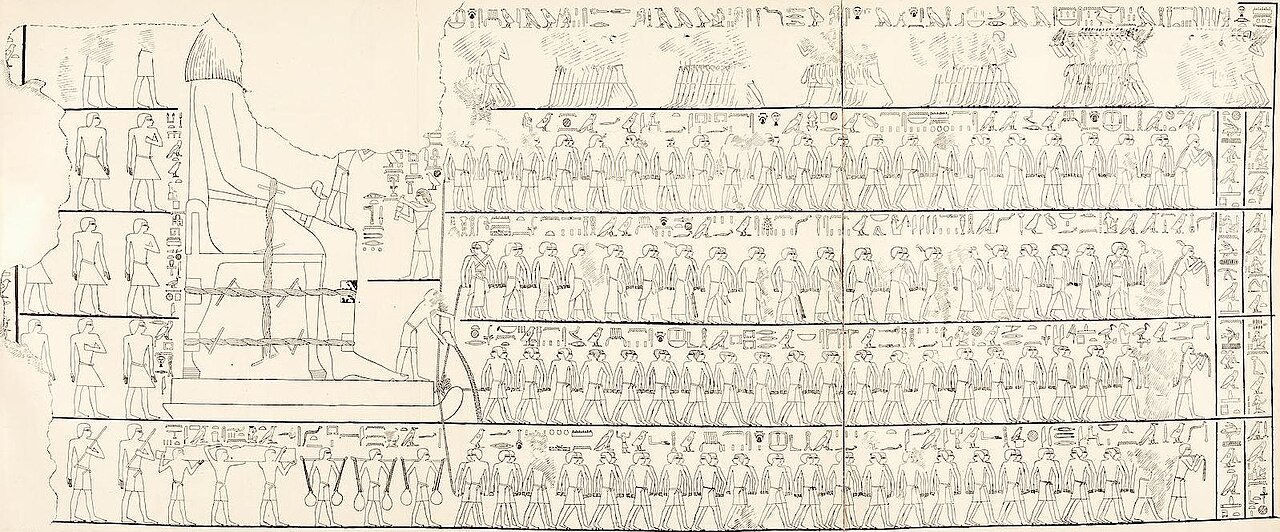
Transport on sledges. Egyptians moved heavy objects on sledges. Experiments show that dampening sand in front of a sledge can reduce the force needed to pull it. An Egyptian image from the tomb of Djehutihotep even depicts a person pouring liquid in front of a sledge carrying a large statue. University of Amsterdam.
Ramps and ropes. Archaeologists have found evidence of ancient ramp systems, including one at Hatnub dating to the period of Khufu. The Hatnub structure does not prove one complete blueprint for the Great Pyramid, but it shows that Egyptians used ramps, posts, and ropes to move heavy stone up steep slopes. University of Liverpool.
We still do not know every detail of every stage.
That uncertainty is not a blank check for any explanation.
It is a research problem.
Images removed from their original setting can look like almost anything.
Egyptian art used symbolic forms repeatedly: sun disks, boats, wings, crowns, gods, stars, and ritual objects. Some shapes presented online as spacecraft make sense within that artistic and religious system when archaeologists examine the full scene.
No credible physical evidence currently shows that extraterrestrials designed or built the pyramids.
That statement does not mean extraterrestrial life is impossible.
It means the pyramid claim has not met its burden of proof.
The pyramids deserve awe.
But the human explanation does not reduce the wonder.
It gives the wonder names and bodies: quarry workers, boat crews, surveyors, stonecutters, rope makers, bakers, administrators, healers, architects, farmers serving in rotating teams, and generations of people improving what earlier builders learned.
They organized food. They cared for injuries. They moved stone. They measured, failed, corrected, and continued.
That story is larger than the alien story because it reveals what our species can accomplish through cooperation and accumulated knowledge.
Who built the pyramids?
We did.
And we should be proud enough of humanity to let the evidence give humanity the credit.
Why do extraordinary claims need extraordinary evidence?Established
Because a claim that clashes with a huge amount of well-tested evidence starts out unlikely, and it takes strong evidence to outweigh all of that. This is…

Ricardo Maldonado, founder and editor of God Plays Dice.
More essays by Ricardo
What does research say about people who report memories of past lives?
People really do report experiences they interpret as memories of past lives, and researchers have investigated such reports.
God Plays Dice answers big questions in plain words, with sources and one of six honest labels.
CONTINUE THE THREAD
Extraordinary ClaimsExplainer
A practical way to move from an intriguing report to a conclusion that someone else can test.
Extraordinary ClaimsClaim examination
A report can be sincere and still leave the cause unknown. Here is how to examine the leap from sighting to explanation.
Extraordinary ClaimsClaim examination
What a famous 2003 argument really claims, how scientists have tried to test the idea, and where science runs out.
The Architect AI companion · All Access
Match my phone uses your device’s light or dark setting.