HD-Blast ResearchEssay · personal view
Does reproducing a calculation prove a scientific idea?
Repeating the steps can check a calculation. Deciding what it tells us about nature takes further work.
HD-BLAST RESEARCH STORY
HD-Blast research update for September 2026: two calculated patterns, a repeatable check, and clear limits on what this mathematical result can claim.
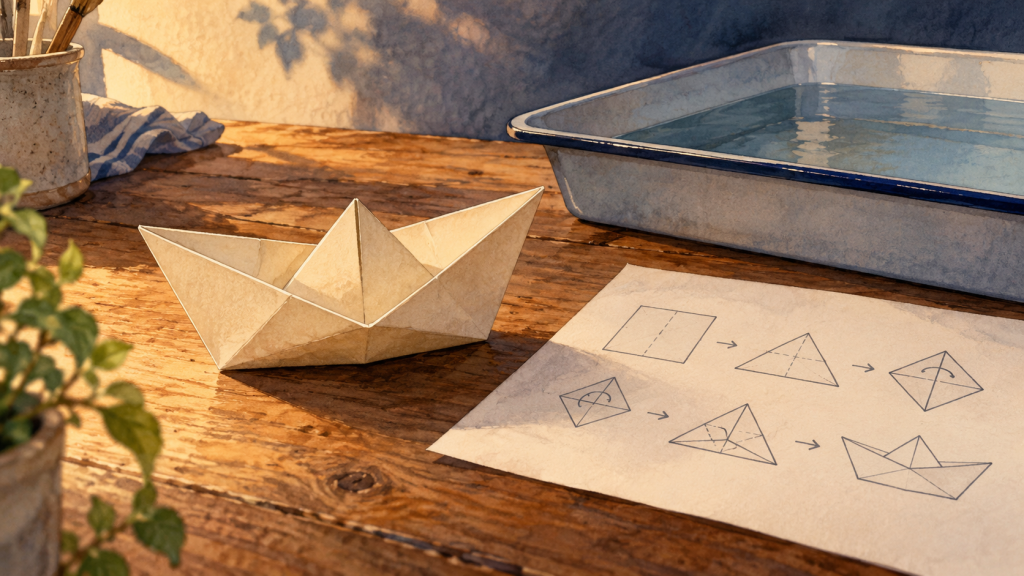
Conceptual AI illustration. The clay arrangements illustrate a comparison of patterns; they are not measured data or a depiction of HD-Blast.
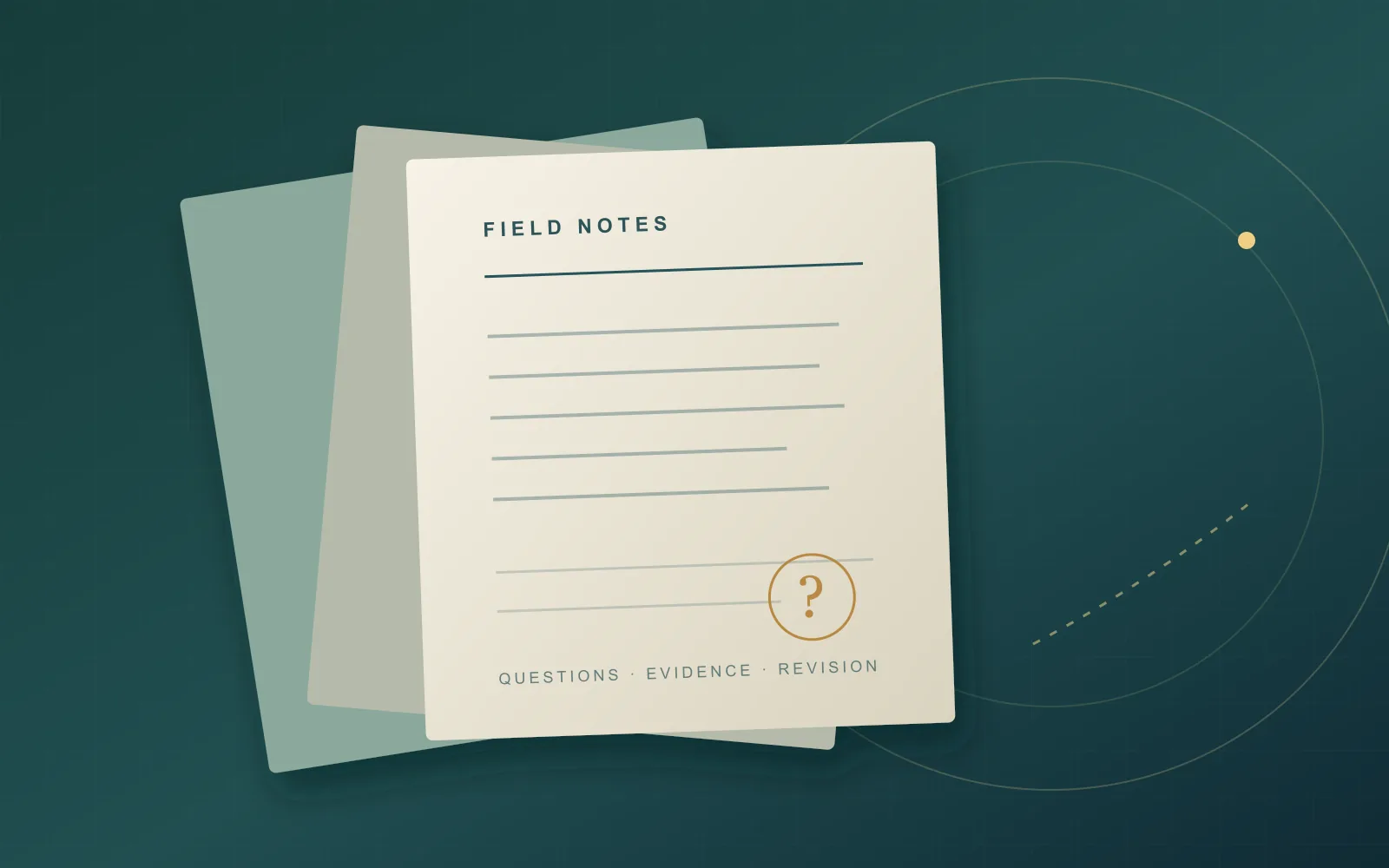
Conceptual illustration of an evolving research record. It is not a reproduction of a paper, dataset, or verified finding.
What counts as progress when the question is as large as the origin of the universe?
For me, it has to begin with something I can explain clearly: what was checked, what came out, and how much that result allows me to say.
On September 5, 2026, the v24 research package was published on Zenodo. On September 9, a fresh local rerun reproduced its archived calculation. The result concerns one specified mathematical model, under its stated assumptions. It does not establish that a higher-dimensional blast happened.
This HD-Blast research update explains that limited step and why I think it is worth sharing.
HD-Blast is short for higher-dimensional blast. It is the hypothesis behind my book, GOD PLAYS DICE: could our hot beginning have been the aftermath of an event in a space with more dimensions than we experience?
If you are new to that picture, the plain-language hypothesis overview is a useful starting point. This update follows one smaller mathematical question within that larger research effort.
The model follows five linked mathematical fields—quantities that can vary from place to place. It uses a specified background and a linear approximation. In plain language, it studies disturbances using rules that let their effects add together. It does not establish what happens when the fuller interactions left out of that approximation are included.
Within those rules, the calculation uses two chosen disturbances and two defined mathematical readouts. It asks whether the disturbances produce distinguishable response patterns after allowing for the calculation’s bounded approximation errors.
These readouts are mathematical definitions. They are not instruments that have recorded something in the sky.
Imagine two recipes. If you double every ingredient in one recipe, you make more of the same mixture. The proportions have not changed. A different balance of ingredients would be a different pattern.
That is a picture for the comparison here. Under the model’s assumptions, the two calculated response patterns are not simply scaled copies of each other. The mathematical checks account for the allowed approximation errors before reaching that conclusion.
The distinction matters because the question is whether information about two different inputs remains distinguishable through the specified readouts. It is a step toward understanding that particular model’s response.
It does not tell us whether an actual telescope or gravitational-wave detector could make the distinction. Physical signal strengths, detector noise, and practical sensitivity have not been established by this calculation.
The public source is the September 5 v24 research record, titled HDBLAST Zenodo v24: Conditional Full-Domain Certification of the Registered Five-Field Linear Response. Its technical title is long because the conditions are part of the result.
A fresh local copy was used to run the archived checking program again. The rerun completed all 13 outer stages and all 176 selected calculation cells, recovering the same conditional result. Those numbers count parts of a mathematical calculation, not observations of the universe.
The resulting files matched the archived outputs exactly. The source archive also remained unchanged. A separate audit checked that the bounds used in the calculation cover the full declared background-parameter range, within the stated model family.
This gives the update something concrete: a documented calculation whose archived checks were repeated successfully.
It is still important to say what kind of repetition occurred. The rerun used the archived program. It was not a newly written, independent second program, outside peer review, or a new astronomical measurement.
An earlier analytic route had already obtained a positive result with a tighter numerical range. V24 provides a separate reconstruction route. Its contribution should be described on those terms, without turning it into a claim that this was the first such result.
The larger physical questions are still open. How would the proposed event occur? How would its effects reach our universe? What signal would survive, and how could it be separated from other explanations?
This calculation does not answer those questions. It does not prove extra dimensions, explain the hot early universe, or show agreement with observational data. Its mathematical conclusion remains conditional on the model and the assumptions carried into it.
My research page collects the technical work. For the result discussed here, use the dated v24 record linked above so that the version and its limits stay clear.
I want readers to be able to follow the work without having to turn every improvement into a discovery. A careful, repeatable step can matter while the larger answer is still out of reach.
GOD PLAYS DICE, Volume One, is in production. Explore the book and find the free preview on my website.
How did the author check whether his matter-antimatter number match was just a coincidence?
In his February 4, 2026 preprint, Ricardo compared his proposed matter–antimatter number match with thousands of other formulas built from quark-coupling…
God Plays Dice answers big questions in plain words, with sources and one of six honest labels.
CONTINUE THE THREAD
HD-Blast ResearchEssay · personal view
Repeating the steps can check a calculation. Deciding what it tells us about nature takes further work.
HD-Blast ResearchExplainer
The seven questions behind Ricardo Maldonado's research, from the Big Bang to evolution: what each idea proposes, what has been corrected, and what could settle it.
HD-Blast ResearchEssay · personal view
A model needs a justified connection between its numbers and a physical measurement. Units are one part of that explanation.
The Architect AI companion · All Access
Labels describe the evidence for a claim, not the people who hold it.
Match my phone uses your device’s light or dark setting.