
GOD PLAYS DICE™
Ricardo Maldonado — Full Biography
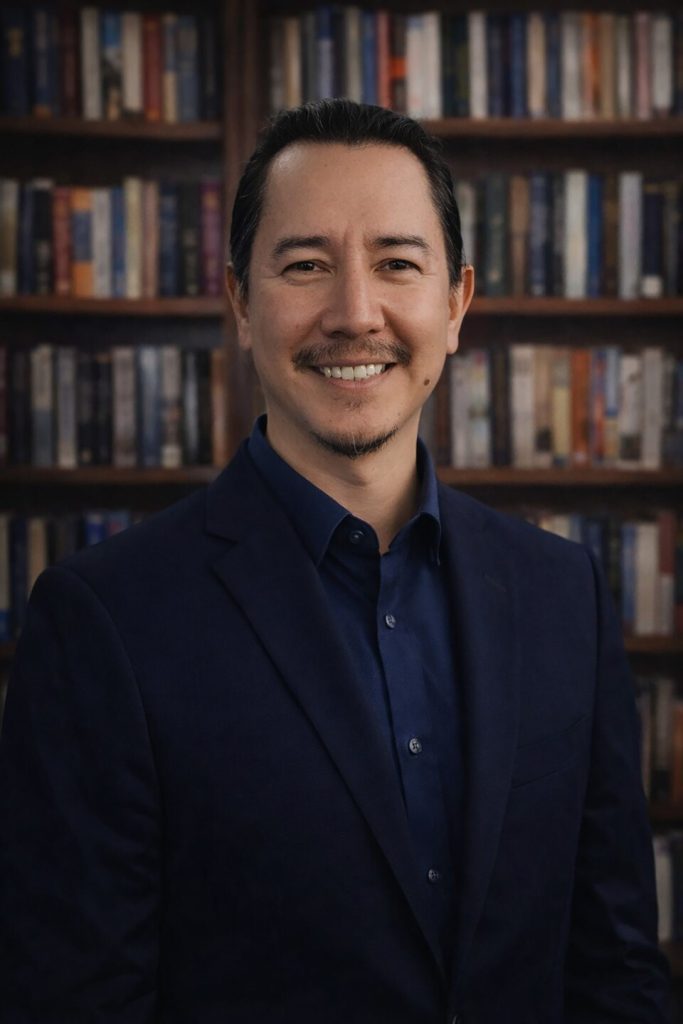
ABOUT THE AUTHOR
Ricardo Maldonado
Ricardo Maldonado is the author of GOD PLAYS DICE™ Volume One: What If Our Big Bang Was the Aftershock of a Higher-Dimensional Blast? Born in Guadalajara, Jalisco, Mexico, and raised in Las Vegas, Nevada, he began publishing at nineteen and has spent much of his life moving between faith and doubt, business and fatherhood, ordinary responsibilities and extraordinary questions.
His interest in cosmology did not begin in a university or a laboratory. It began with childhood insomnia, a lifelong habit of self-education, and one question that refused to leave him alone:
What actually banged at the Big Bang?
What follows is his story in his own words.
The Child Who Couldn’t Sleep
I was born in Guadalajara and moved with my family to Las Vegas when I was five. I am the youngest in a large family, and most of the memories that shaped me belong to this desert city.
To many people, Las Vegas means spectacle—a place where the dice never stop rolling. To my family, it meant work. My father washed dishes at Bally’s. My mother worked in housekeeping there. They had come to the United States hoping to give their children a better future, and ours was a home built on long shifts, tight margins, patience, and sacrifice.
By seven, sleep had stopped being simple.
Other children feared monsters under the bed. I feared not understanding the infinity above me.
I would lie awake until the ceiling seemed to disappear. In my mind, the roof vanished, then the neighborhood, then the planet itself. I would imagine Earth suspended in a darkness too large for a child to hold. I did not yet know words such as cosmology, spacetime, or quantum mechanics. I only knew that the universe was real, that I was inside it, and that its existence demanded an explanation.
Why are we here?
Why is there something instead of nothing?
If God created the universe, who created God?
My father never pretended to possess every answer. He was a lifelong reader, and some nights I sat beside him for hours, asking the hardest questions I could form. What he gave me was more useful than certainty. He gave me the patience to stay with a question even when the answer did not come quickly.
He died in 2012, but that patience remains part of me.
The Church Was My First World
Because I was raised Catholic, the first place I carried my questions was to God.
Catholicism was not only something my family practiced on Sundays. It shaped the rhythm of my childhood. I attended Mass, served as an altar boy, sang in a youth prayer-group choir, helped as an usher, took part in parish ministries, and attended dozens of retreats and spiritual conferences. By fourteen, I was also designing church flyers, postcards, shirts, and other materials.
I once portrayed Saint Francis of Assisi in a parish production. Another year, I portrayed Jesus during an Easter reenactment. I served as Religious Affairs officer in student government. Church became such a second home that one day my parents nearly called the police before realizing I was probably still there carrying out one responsibility or another.
In every practical sense, I belonged there.
Those years gave me real gifts. They taught me reverence, service, community, self-examination, forgiveness, and the belief that a life should be used for something larger than the self. My beliefs later changed, but gratitude does not require me to erase the world that formed me.
I have lived both inside faith and outside it. That is why I try not to reduce believers to ignorance or nonbelievers to emptiness. A person can find compassion within religion, and a person can find conscience without it. The honest question is not which label makes us superior. It is what kind of human being our convictions help us become.
The Weight of a Sentence
There was another story from those years that followed me for much longer than I understood.
According to a memory my mother often repeated, the priest who baptized me paused, looked at me, and told my parents, “This child will be someone important.”
In a deeply religious family, a sentence like that can behave like a prophecy even when it is only a sentence. For years, I thought important meant exceptional. I believed I had to accomplish something extraordinary, discover something, or prove that my life had fulfilled a promise I never asked to receive.
That belief gave me drive. It also placed an invisible weight on almost everything I tried to do.
Writing this book and pursuing its hypothesis became, in part, another attempt to earn that word. Recognizing this does not diminish the work. It helps me separate the value of an idea from my need for that idea to make me valuable.
I understand the sentence differently now.
Importance is not a prize reserved for the famous, wealthy, powerful, or correct. A life matters before it earns a title. My work must still answer to evidence, but my worth—and yours—does not depend on winning an argument with the universe.
Learning to Build With What I Had
My education moved through several worlds. I attended St. Christopher Catholic School on scholarship, entered the Honors Program at Mojave High School, and later studied at Southern Nevada Vocational Technical Center, now known as Southeast Career Technical Academy. I pursued design, accepted leadership responsibilities, and worked on a redesign of my school’s logo.
Soon after high school, while attending the College of Southern Nevada full time, I began the project that would teach me more about publishing than any single class could have.
At nineteen, I launched Una Voz en el Desierto—A Voice in the Desert—a Spanish-language Catholic magazine in Las Vegas. I was undocumented at the time. I had no publishing experience, no financial safety net, and very little money. So I learned by doing.
I wrote. I designed. I found advertisers. I worked with printers. I negotiated prices, watched deadlines approach, corrected mistakes, and handled the small emergencies no textbook warns you about. What I lacked in experience, I tried to make up for with conviction and work.
The magazine gradually moved from Catholic ministry toward personal growth. Later came La Voz de la Mujer, a publication centered on Latina women and inspired in part by an idea and a name my sister Noemi helped shape. The subject changed, but the deeper purpose did not: I wanted words to help people feel seen, encouraged, and less alone.
An early disappointment with the institutional side of the Church taught me that faith and institution are not the same. Once I saw that distinction, other questions followed.
When Certainty Began to Loosen
My movement away from religion was gradual. There was no single dramatic conversion from belief to disbelief. The questions simply outlived many of the answers I had inherited.
Then, on December 11, 2007, my life divided into a before and an after.
I was stopped at a red light when a drunk driver struck the back of my car and sent me across the intersection. I survived, but I have lived with lower-back problems ever since. That same month, I released the final print issue of my magazine.
After the accident, I withdrew. Depression arrived. The version of me that had moved through life on conviction and constant work became harder to find. Pain has a way of stripping decorative language from a worldview. It shows you which beliefs can carry weight and which ones were being carried by momentum.
Grief filled the silence first.
Curiosity came later.
Because I worked for myself, I could choose what filled my ears throughout the day.
Some people fill silence with music.
I filled mine with the universe.
Astronomy. Cosmology. Astrophysics. Philosophy. Evolution. Black holes. The Big Bang. I listened while I drove, worked, exercised, cleaned, and lay awake trying to sleep. My insomnia never truly left. It simply changed subjects.
Science did not give me a replacement religion. It gave me a method. It was willing to say, “We do not know yet,” and continue looking. It allowed evidence to correct even the most comforting story. I learned to trust that humility.
Within the world we can observe and test, I stopped believing that a personal God was directing events. About whatever may lie beyond the reach of our theories, I became more careful than certain. My most honest answer is often the simplest one:
I do not know.
That is not an escape from the question. It is respect for its size.
Reinvention as a Form of Survival
The magazine years taught me that beginnings rarely arrive with permission.
After publishing, I built other projects and businesses, including Las Vegas en Español and Rank.Vegas, teaching myself design, web development, marketing, photography, and video as each new chapter demanded.
I failed at projects. I changed direction. I began again.
For much of that time, success looked more impressive from the outside than it felt from within. I often struggled simply to keep everything moving. Only later did I understand how much those years had taught me.
Reinvention is not a weakness.
Sometimes it is a form of survival.
For years I measured progress by output—another issue, another client, another project, another problem solved. The accident forced me to slow down. Family taught me to reconsider what I was moving toward.
I no longer want my life measured only by money or recognition. I would rather leave a legacy of wisdom than wealth. Wealth can disappear. What we teach, write, and give to another person can continue moving through lives we will never see.
What good is knowledge if it is never shared?
The Person Beside Me
I met my wife, Neleida, in 2004. Within the first few weeks, my first gift to her was not flowers or chocolate. It was a copy of Awaken the Giant Within. On our early dates, she would catch me drifting into thought and ask where I had gone.
“I’m thinking about the universe,” I told her.
She did not believe me.
This book is my very delayed proof.
Her patience, love, and belief in me have carried more of this journey than any public record can show.
The Night the Question Changed Shape
On February 18, 2019, the question that had followed me since childhood took a new form.
I was lying awake beside my wife, thinking about the Big Bang, extra dimensions, and the possibility that our observable universe might not be the whole story. Then a picture formed with unusual clarity:
What if the Big Bang was not the absolute beginning, but the local aftermath of a violent event in a larger, higher-dimensional setting?
I sat up, grabbed an envelope from the nightstand, and wrote the idea down before it could disappear. The next day, I shared a cautious version online. Only two people responded.
Part of me felt ridiculous. Another part knew the question would not leave.
I want to be exact about what that moment means. It is part of my personal history. It is not evidence. It was not proof, prophecy, or a scientific discovery. A meaningful experience can explain why a person cares about an idea; it cannot establish that the idea is true.
If the higher-dimensional blast hypothesis is to matter scientifically, it must risk being wrong. It must become specific enough for observations, mathematics, criticism, and independent work to support it, change it, or rule it out.
My conviction does not get the final word.
The universe does.
Fatherhood Changed the Center
When our daughter, Valentina, was born in 2020, the center of my life changed. I once described that day in Spanish as el día que volví a nacer—the day I was born again. Fatherhood returned me to life with a different sense of purpose.
I began to think less about what I could prove about myself and more about what I could leave for her. Legacy is not what the world remembers about you. It is what the people you love are able to carry forward because you were here.
In 2024, a candid photograph of Valentina and me at a local Father’s Day event appeared in the Las Vegas Review-Journal. The image was not of a publisher, entrepreneur, or researcher, but of a father playing with his child.
That felt appropriate.
What I Am—and What I Am Not
I am an author, a writer, and a self-taught independent researcher—not a physicist. I do not ask readers to accept a claim on my name alone.
Curiosity belongs to everyone. Scientific conclusions, however, must be earned through evidence, reproducibility, criticism, and specialist scrutiny.
GOD PLAYS DICE™ Volume One brings together memoir, plain-language science, philosophical reflection, and a working higher-dimensional-blast hypothesis. The hypothesis remains unconfirmed. Its public technical record shows the questions, tests, revisions, limits, and failures, but a public record is not peer review, independent validation, or institutional endorsement.
My goal is to make the question clear enough to examine and the proposal specific enough to challenge. If it fails, that failure should remain visible. If some part survives, it should be tested again.
That is the standard I am trying to follow.
What I Still Carry
I did not leave the Church empty-handed.
I carried forward reverence, service, self-examination, and a language for forgiveness. Years later, outside the Church, I sometimes found through meditation a release similar to what I had once found in confession: the quiet experience of facing my own imperfections, accepting responsibility, forgiving myself, and beginning again.
I do not treat those experiences as proof of a doctrine. I understand them as human capacities—reflection, reconciliation, humility, and the need to belong.
Science did not remove wonder from my life. It taught wonder to accept discipline.
Family did not remove ambition. It taught ambition where to stop.
Pain did not give me a hidden answer. It taught me that time is not guaranteed.
And fatherhood did not solve the meaning of life. It made meaning immediate.
I no longer think of happiness as a permanent height we reach. I think more about the privilege of being alive at all. Joy, grief, confidence, doubt, success, failure, and ordinary afternoons are not interruptions to life. They are the life that is actually here.
The universe does not need to be personal to be profound. It gave rise to beings who can care. For me, that is enough to make care a responsibility.
Why I Write
I write because questions have followed me for as long as I can remember.
I write because my father taught me to remain patient with them.
I write because the Church taught me that words can serve, even after my beliefs changed.
I write because my mother and my family taught me endurance.
I write because Neleida believed in me when the work existed mostly as sleeplessness, scattered notes, and unfinished thoughts.
I write because Valentina may one day want to know what her father was thinking about while he was also learning how to raise her.
And I write for anyone who has ever felt slightly misaligned with the world—not better, not worse, simply tilted toward questions other people seem able to leave alone.
For years, I believed that becoming important meant doing something spectacular. I understand it differently now. Perhaps the task is not to become more important than anyone else. Perhaps it is to recognize that every conscious life already matters—and then live as though the lives around us matter too.
I do not know where the question at the center of God Plays Dice will ultimately lead. I may be right, partly right, or entirely wrong. What matters is that wonder and evidence remain visibly distinct, and that reality is always allowed to correct me.
I am still the child who looked into the dark and felt that the universe was too loud to ignore.
The difference is that I no longer demand that the night answer me.
I have learned to keep listening.
Learn more about GOD PLAYS DICE™ Volume One and explore the technical record cited in the book.