
GOD PLAYS DICE™
Press Room
MEDIA • PODCASTS • EVENTS
Approved facts, book language, full-resolution images, interview directions, and contact information for GOD PLAYS DICE™ Volume One and Ricardo Maldonado.
Canonical book description
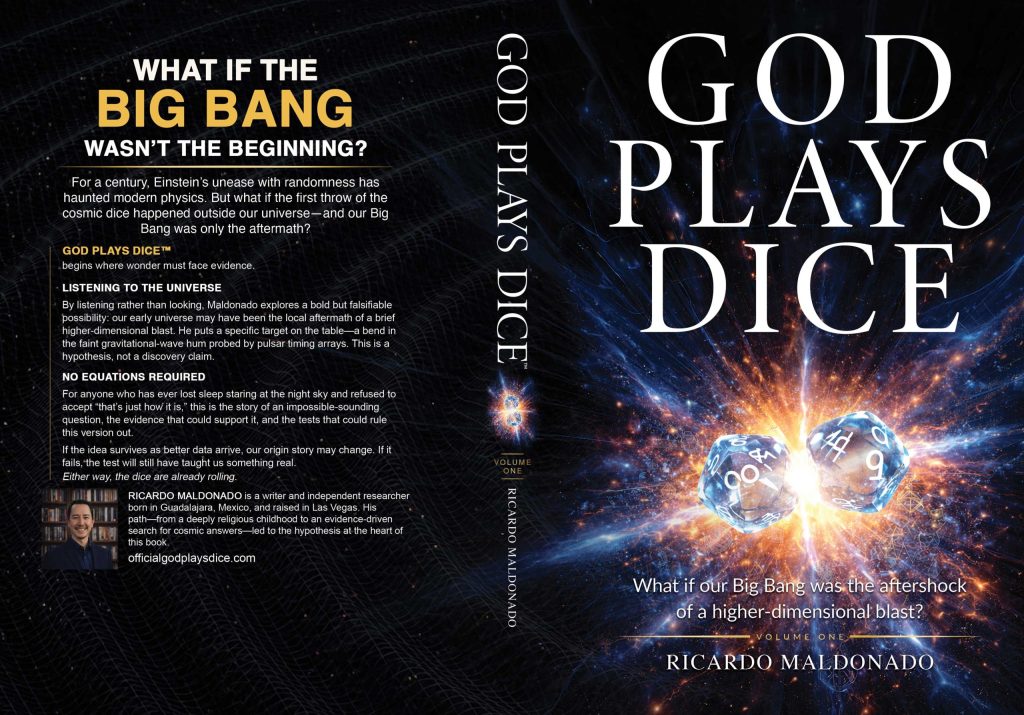
For a century, Einstein’s unease with randomness has haunted modern physics. But what if the first throw of the cosmic dice happened outside our universe—and our Big Bang was only the aftermath?
In God Plays Dice, writer and independent researcher Ricardo Maldonado explores a bold but falsifiable possibility: our hot, dense early universe may have been the local aftermath of a brief higher-dimensional blast. To make the idea testable, he puts a specific target on the table: a bend in the faint gravitational-wave hum probed by pulsar timing arrays.
Maldonado is not a physicist. He follows a question that refused to leave him alone—and refuses to protect the idea from failure. This is a hypothesis, not a discovery claim. The book distinguishes its testable benchmark from a still-unfinished physical mechanism, explains what its exploratory screens can and cannot establish, and identifies the observations that could rule out the version tested here.
For anyone who has ever lost sleep staring at the night sky and refused to accept “that’s just how it is,” God Plays Dice is part personal journey and part evidence scorecard. No equations are required. If the idea survives as better data arrive, our origin story may change. If it fails, the test will still have taught us something real. Either way, the dice are already rolling.
50-word author bio
Ricardo Maldonado is a writer and independent researcher born in Guadalajara, Mexico, and raised in Las Vegas. From a deeply religious childhood to an evidence-driven search for cosmic answers, his path led to the falsifiable higher-dimensional blast hypothesis at the heart of God Plays Dice, his first book-length cosmology project.
Book status: In production. Format, publication date, pricing, ISBN, and retailer details must be confirmed before use.
APPROVED CENTENNIAL MEDIA ANGLE
A century-old metaphor becomes a modern wager.
God Plays Dice arrives in 2026, the centennial year of Albert Einstein’s December 4, 1926 letter to Max Born containing the remark later popularized as “God does not play dice.”
Accuracy note: Einstein was questioning quantum mechanics, not proposing a theory of the Big Bang. Ricardo Maldonado knowingly repurposes the metaphor to frame a separate, falsifiable hypothesis about cosmic origins.
In the centennial year of Einstein’s dice remark, God Plays Dice turns the metaphor into a modern wager about cosmic origins—one the universe can grade.
Historical source: Einstein’s December 4, 1926 letter to Max Born ↗
LATEST PUBLIC RESEARCH RELEASE • AUGUST 18, 2026
A narrow mathematical advance—with the boundary kept visible.
The HDBLAST record—Ricardo Maldonado’s public research archive for the higher-dimensional blast—now strengthens two limited parts of the model’s mathematics.
The release does not show that a higher-dimensional blast happened, provide a complete explanation of the Big Bang, or match the proposal to observations. Its bundled checks are project checks, not outside peer review.

Interview directions
- The 1926–2026 centennial connection.
- What actually banged at the Big Bang?
- How a childhood question became a falsifiable benchmark.
- Why failure conditions belong in popular science.
- How pulsar timing arrays listen to the universe.
- What Zenodo v21 does—and does not—establish.
- Why the book and later exploratory work remain in separate lanes.